Tag Archives: Emmitsburg

Building the Emmitsburg History Exhibit

Near the end of 2024 and the start of 2025, we knew we needed to create a new exhibit for 2026, the year commemorating the United States 250th.  

As we looked for guidance from the America 250 Commission, we also began to look at our own collections.  At the time, the America 250 was encouraging state and local organizations to do the bulk of the work, connecting people with their most directly accessible history.  In this spirit, we thought, what can be more local than curating a history of Emmitsburg?

We began to examine our collections, which were heavy on materials from Mother Seton and her family and from the Daughters various ministries across the United States.  We had materials from their ministries in Emmitsburg, including St. Joseph’s Academy/St. Joseph College, a major institution in the town since the time of Mother Seton.  We had records and artifacts from some of the local schools the Daughters operated.  We had accounts of the Civil War detailing life in Emmitsburg, which by sheer luck did not become Gettysburg in the War and in historical memory, but we did not have many artifacts.  And we had records and a few artifacts from the Emmitsburg railroad, a point of local pride and, at one time, the smallest incorporated railroad in the United States.

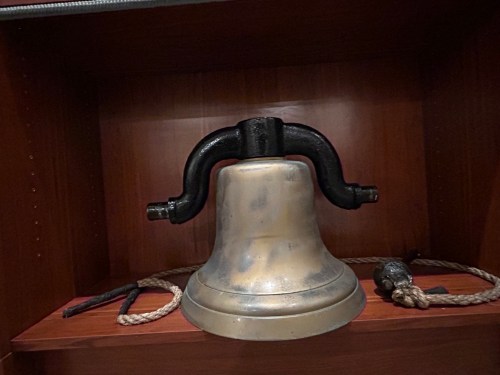
Bell from Train Station

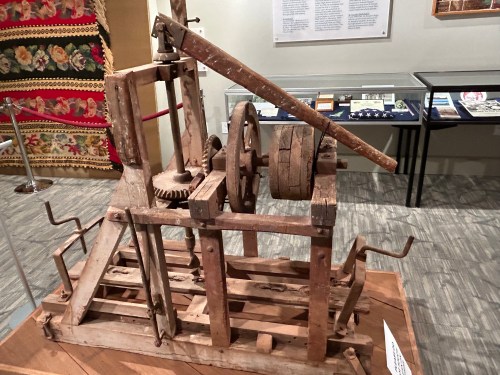
This exhibit quickly became our most research-heavy exhibit, one that extended past the collections that are in our possession.  We began to dive into the history of the town beyond our collection scope, utilizing the resources of the Emmitsburg Historical Society and various school alumni organizations.  We began to identify themes and marquee artifacts for display, settling on a drill press from the late 1800s as a nod to the town’s agricultural history; a crocheted afghan from the 1870s that was created by an Academy student; and a terracotta angel that was in the Academy Chapel, which later became the National Fallen Firefighters Memorial Chapel.  We also worked with our neighbors to secure loans of materials, ensuring that the exhibit tells a story of the town, not just of Mother Seton or the Daughters.

Drill Press on Display

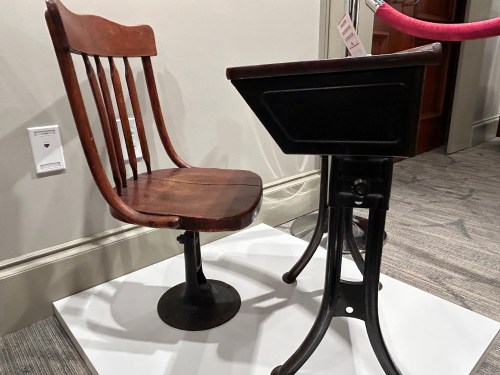
We also used this opportunity to explore the undertold story of Emmitsburg’s longstanding African American community.  Even in the Antebellum era, generations of families, often consisting of free and enslaved individuals, can be found in the historical record.  The town’s history therefore touches on the hardships of slavery and the persistence of a community.  We even get the chance to display an artifact from a point of pride in the town – a school desk from St. Euphemia’s, the first school in Frederick County to desegregate.

St. Euphemia's School Desk

We began to look for other types of materials to show: tangible three-dimensional artifacts alongside posters and “wordier” pieces, photographs where able, and even films!  Amongst them, we have quote-unquote “annotated” a silent video from the 1940s that shows the St. Joseph College campus and surrounding areas and received permission from the National Fallen Firefighters Foundation to utilize a commissioned music video that features the moving lyric “I’m going home to Emmitsburg.”

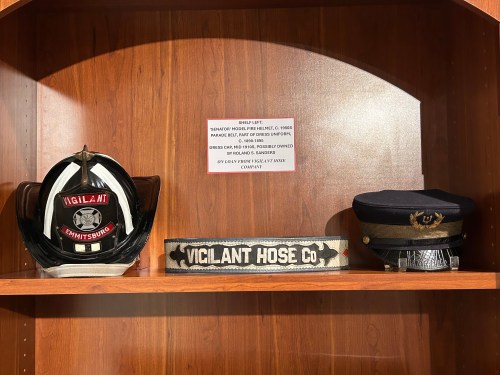
Helmets, hats, and belts on display, loaned from Vigilant Hose Company

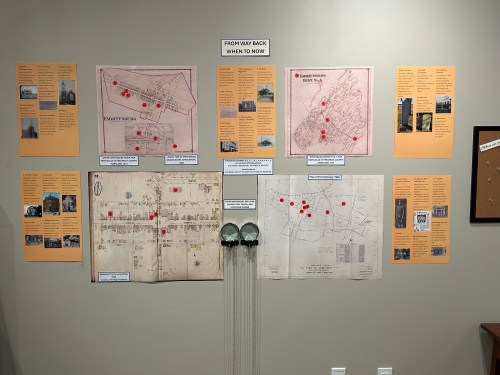
We have also sought ways to incorporate some level of interactivity into our exhibits.  We invite children to map out the pathways of Civil War soldiers in the leadup to the Battle of Gettysburg, and we invite everyone to explore (reproduced) historical maps from the collection of the town, often with details down to individual properties.  This afforded a way to include many of the small stories that are often hard to include in extensive detail in an exhibit like this!

Maps on Display with title "From Way Back When to Now"

“Emmitsburg: From Way Back When to Now” opens to the public on Saturday, April 11, 2026 and will run through the holiday season 2027.  We are located in the Archives gallery of the Seton Shrine.

Welcome to Emmitsburg everybody!

Leave a comment

Filed under African American History, Announcements, Archives, Artifacts, Emmitsburg

Visiting Pope Leo XIII

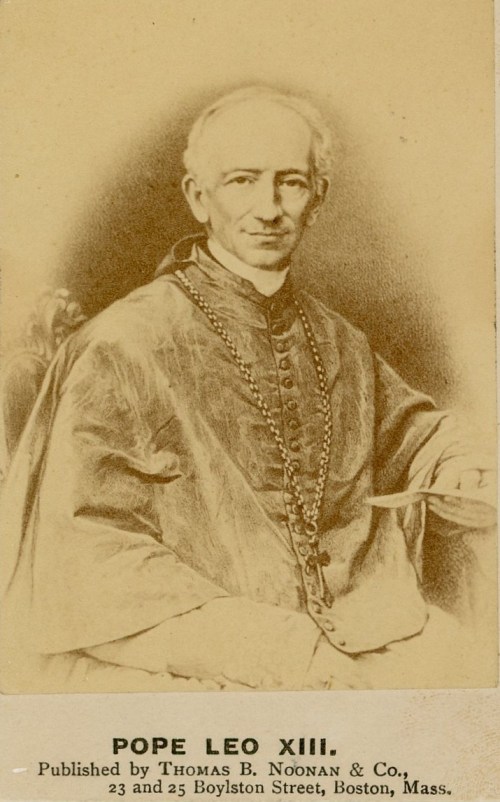
With the election of Pope Leo XIV in 2025, we thought it would be worthwhile to look into the figure from whom the new pontiff took his name, Pope Leo XIII. 

Elected in 1878, he is most well-known for his encyclical Rerum Novarum.  In this document, Leo XIII  formally articulated the principals that today define Catholic social teachings.  In this, he addressed the conditions of the working poor and what is owed to those living in poverty.  His concern for those living in poverty formed an almost natural affinity between His Holiness and the Vincentian double family: the Vincentian priests and the Daughters of Charity.

Prayer Card for Pope Leo XIII

In 1893, the Superiors of the Vincentians and the Daughters of Charity had an audience with Pope Leo XIII.  The account of this meeting is in the Archives dated January 26, 1893, held to celebrate the founding of the Vincentians.  Joining them were students of the Daughters of Charity from Rome.

Father Antoine Fiat, Superior General of both communities, provided his gratitude at the Pope’s guidance in Rerum Novarum:

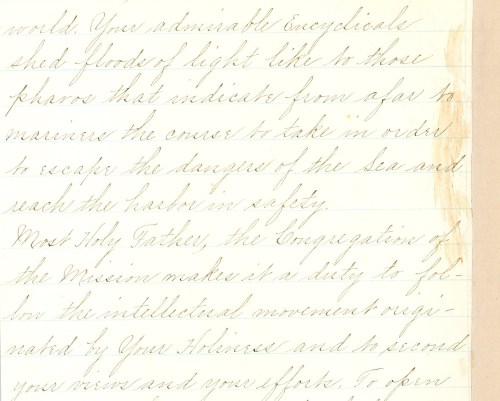
Your admirable encyclicals shed floods of light like to those pharos [lighthouse] that indicate from afar to mariners the course to take in order to escape the dangers of the Sea and reach the harbor in safety. Most Holy Father, the Congregation of the Mission [formal name for the Vincentians] makes it a duty to follow the intellectual movement originated by Your Holiness and to second your views and your efforts.

Portion of account of visit with Pope Leo XIII

In response to Father Fiat’s address, Pope Leo XIII addressed the Vincentians and Daughters in French, the language of their founders and superiors, despite himself being a native Italian.  He shows particular fondness for the schools the communities conduct around Rome, and seems to show favor toward the ongoing (at the time) cause for sainthood for Louise de Marillac.

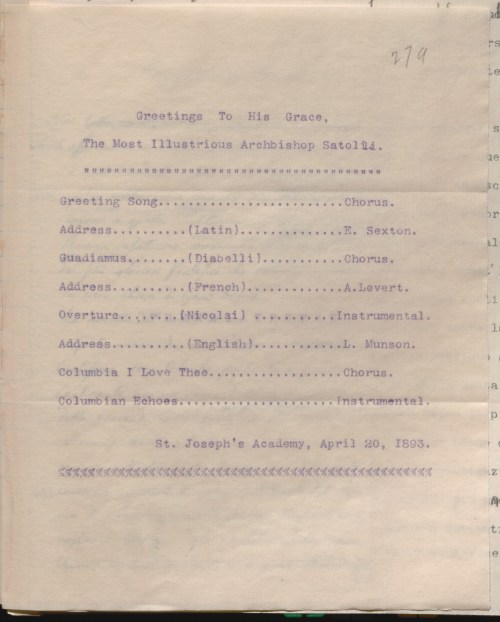
Even though no American Daughters were part of this audience, it was still celebrated in the United States.  The Provincial Annals contain a letter by Sister Caroline Eck, writing from St. Joseph ‘s Academy in Emmitsburg, Maryland.  The Sisters and students at the Academy were met by Cardinal Francesco Satoli, the first official Apostolic Delegate to the United States, who recounted the meetings between the Holy Father and the French Superiors.  The students and staff celebrated this (at the time) highest meeting of a church official with the students, emphasizing the global nature of the Daughters and the internationality represented by the Catholic Church!

Program from days' events at St. Joseph's Academy
Program from days’ events at St. Joseph’s Academy

Leave a comment

Filed under Daughters of Charity, Leo XIII, Social Justice

Dinosaurs in Emmitsburg

Dinosaurs began to be recognized by paleontologists as the creatures that they were in the early 1800s.  In 1895, the Provincial Annals included a note about the local community and the scientific field of paleontology: 

“These few days past the men have been removing two large slabs from Avenue side walk.  One is destined for the Johns Hopkins’s University, the other for our own cabinet.  Prof. Mitchell of the Mountain [Mount St. Mary’s University] is the one who is securing these singular geological specimens.  They have long been objects of the Sisters’ curiosity & comment as they promenade up and down the Avenue in summer evening recreation.  They bear the impression of many feet of different kinds & sizes, pre-historic creatures that lived O many & many age ago!  The Professor’s interest in our quarry from where these slabs were taken led him.  His opinion is that all this land round about ages & ages ago formed an estuary, the mountains were its shores.”

The slabs documented by Dr. James A. Mitchell were the first dinosaur prints from Maryland to be announced in a scientific publication.

In the spirit of this time period, the cabinet referred to was a “cabinet of curiosities,” sort of a predecessor to a modern-day museum exhibit.  It was housed in the Burlando Building of St. Joseph’s Academy, the school thatthe Daughters operated.  Later, it was on display, in a deep historical anachronism, in the Stone House on campus where the community had begun in 1809. 

Dr. Mitchell made sketches of the slabs.  Then the slabs went missing.

In 1990, a group of maintenance workers discovered a slab in a crate with fossilized footprints in an old barn on campus.  The search was sparked by Dr. Peter Kranz, who was tracking Mitchell’s work from 100 years before.  In 1998, the slab was put on permanent display in the Maryland Science Center.  Before it was moved from Emmitsburg to Baltimore, the Sisters and employees in Emmitsburg could see it for themselves, privately and up close. 

The Maryland Science Center performed their own analysis on the footprints, identifying them as coming from:

“several dinosaurs who walked across it during the Triassic period, 210 million years ago.  Scientists are not certain exactly which type of dinosaur made the tracks….They were small, plant-eating dinosaurs, about the size of a turkey.  They were ornithischian dinosaurs, and had hip skeletons somewhat like that of birds [This time period in the 1990s is when the theory of dinosaur to bird evolution started to receive wide acceptance].  They usually walked on two legs (‘bi-pedal’), but occasionally dropped down to walk on four legs part of the time.”

Theorized sketches of the dinosaurs created by the Maryland Science Center

With the level of excitement of such a find, it was natural to assume that the same tracks that Mitchell and the Sisters set eyes on in the 1890s had been rediscovered.  However, based on his sketches, this is not the same slab, but an entirely different set of fossilized dinosaur tracks.  It appears the slab once sent to Johns Hopkins has been lost as well.

The discovery and transfer of the fossils were widely covered in the local media, and they went on display at the Maryland Science Center in the aftermath of the first two Jurassic Park films. They remain on display now in the “Dinosaur Mysteries” exhibit.

Sister Betty Ann McNeil overseeing the shipment of the slab out of Emmitsburg
Fossilized footprints on display at Maryland Science Center (Courtesy MD Science Center)

Leave a comment

Filed under Emmitsburg, Exhibits, James Mitchell, Ph.D., Mount St. Mary's University