October is Archives month! We wanted to take this opportunity to profile a Daughter of Charity from the Community’s history who worked to preserve that history.
Sister Joan Marie Hoyt served as a teacher and a librarian before becoming an Archivist.
Like many Daughters of Charity, Sister Joan Marie began her ministry as a teacher after she completed her Seminary, teaching at St. John’s School in Baltimore beginning in 1945. Fifteen years, four teaching assignments, and a Master of Library Science degree from St. John’s University later, she began a new ministry as librarian at Seton High School in Baltimore. She served in this role at three other schools across New York State before becoming the founding Archivist for St. Vincent’s Medical Center in Bridgeport, CT.
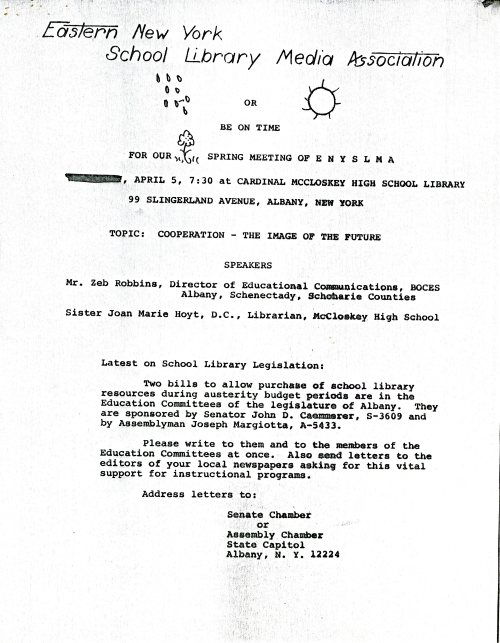
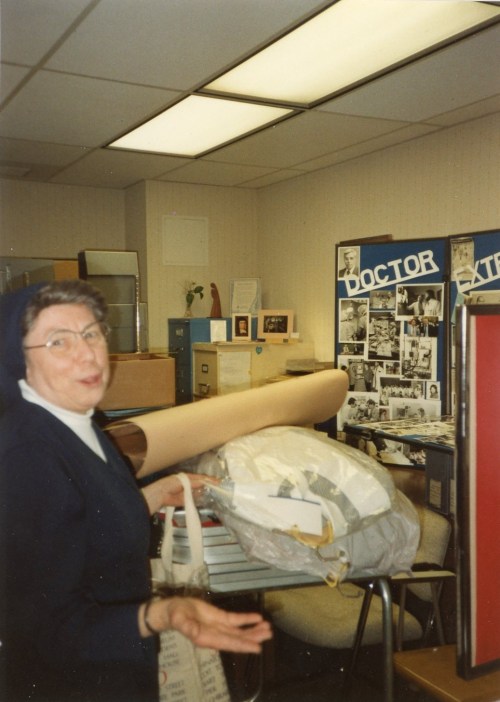
Some of Sister Jane Marie’s advocacy as a school librarian
Sister Joan Marie reached out to St. Vincent’s in 1989 at the urging of her Visitatrix, Sister Louise Gallahue, to serve in the on-site medical library. She served staff admirably and did what librarians do – connect their users with the information they needed (using cutting edge desktop computer technology)!
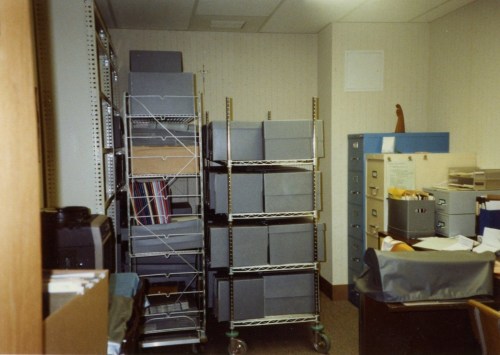
Over 90 years, St. Vincent’s had accumulated quite a bit of organizational and medical history. Unfortunately – and like many Archives in their early stages – it was being stored in a musty basement in an unusable and somewhat unstable state.
Sister Joan Mari began by bringing some order out of the chaos and replacing unstable materials with stable ones. Instead of having materials stacked on the floor, she brought in shelving that kept historic records off of basement floors, which posed a flood hazard. Instead of highly acidic cardboard boxes and rusting metal filing cabinets, she brought in acid-free boxes and folders. And, rather than boxes marked “Miscellaneous,” she brought in a filing system, labels, record groups, and dates.
A vastly improving archive!
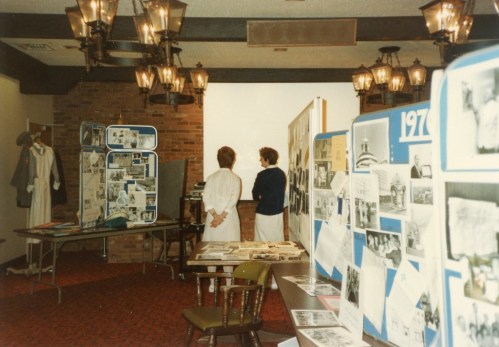
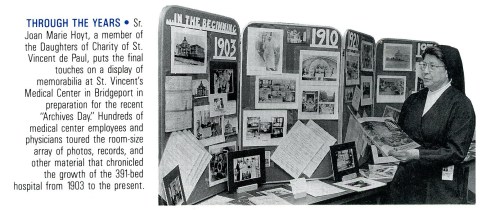
It is not enough to merely keep the materials, however. The materials in an Archive exist to be used. So, Sister Joan Marie began to organize “Archive Days” and build Heritage Wall to better connect staff to the living mission of the Hospital. The first Archive Day featured photos, letters, memorabilia, and publications that filled almost an entire room.
Sister’s ministry in Bridgeport proved to be her longest. Alongside her work at the Hospital, she served on the Board of the Bridgeport Historical Society and played violin with the St. Augustine’s Cathedral Folk Group before she passed away from cancer in 1998.
Sister Mildred Dunker was one of the first Sisters to join the Daughters of Charity after the formal establishment of the St. Louis Province in 1910. She had a rare distinction for a Daughter of Charity, serving for nearly the entirety of her ministry – 82 of her 84 years as a Sister – in one building, the Marillac Provincial House, serving as head cook for Daughters of Charity, Seminary Sisters, retired Sisters, and priests.
Sister Mildred completed her Seminary at St. Vincent’s Hospital in 1916, and was among the first group to move in to the new Provincial House. As she recounted:
We set up living quarters on the second floor, west end, later to be the Infirmary. Some beds had come over from St. Vincent’s. The three of us would get up at four in the morning. We would start prayers, read the first point of meditation, come out and sit on the front steps of Marillac to wait for the horse and buggy to take us to St. Vincent’s for Mass. The road was not as nice as it is now. We just simply drove down the hill to ford the creek; we never knew if we would be dumped or not. We went in the back door at St. Vincent’s; it was always open. After Mass, we had breakfast at St. Vincent’s. Then I would go down to the kitchen. I had a little basket and could pick up what we needed for our dinner and evening meal. The other two Sisters would bring back what they needed for the day. We did that every day for about two months. We did not return to St. Vincent’s during the day except on days when we had special community exercises. Then the driver would come and get us. After about six weeks or so, Sister Visitatrix started to come over to Marillac and we did not have to go to St. Vincent’s except for Mass and breakfast. That is how it happened that I, Sister Mildred Dunker, made the first Repetition of Prayer at Marillac.
One of the earliest photos of the Marillac Provincial House, 1918
In 1998, as the Daughters of Charity in St. Louis prepared to move and sell their beloved Marillac Provincial House to the University of Missouri St. Louis, Sister Mildred played a large role in helping the Sisters say goodbye. She recorded her memories and personal tour of the Marillac at age 100.
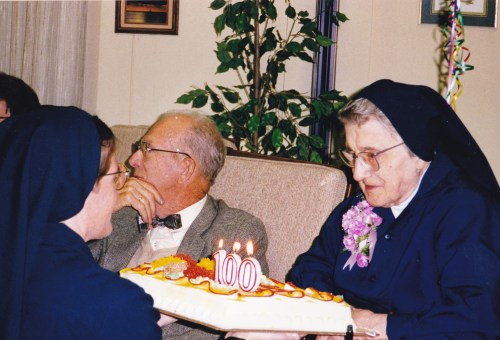
Sister Mildred on the occasion of her 100th birthday
When we initially conceived of this post, we were going to share excerpts from her entire tour of the Marillac Provincial House. However, the transcript of her tour alone runs over 50 typed pages and simply contains too much information to begin to pare down. So instead, we are going to focus on the portion of her tour of the Marillac Chapel. We were moved by her love of the artwork and architecture, and we thought our readers might be as well.
We are in the vestibule of the Chapel. Look at those two large paintings of the apparitions of Our Blessed Mother to St. Catherine Labouré. This one (to the right) shows St. Catherine kneeling at Our Lady’s feet. Let’s read the inscription on the plaque: “From the Central House, Emmitsburg, Maryland to the Marillac Seminary. March 15, 1916.” That was a gift from the Sisters in Emmitsburg. The other painting, on the left side, shows the apparition of November 27, 1830 when Mary told Catherine to have a medal, the Miraculous Medal, made in her honor with the prayer: “O Mary, conceived without sin, pray for us who have recourse to thee.”
Opposite the paintings are two stone trimmed niches. The architect who constructed the vestibule just put them there, but left them vacant. I really don’t remember when St. Louise and St. Catherine were put into the niches but I like them. The prayer book boxes for the Sisters’ prayer books were added later. Neither did we have the stand with the book of the names of our deceased Sisters. On either side of the center vestibule are smaller arches. The arch on the left leads from the Seminary corridor to the Chapel. Look at this door, it is still the original green.
….
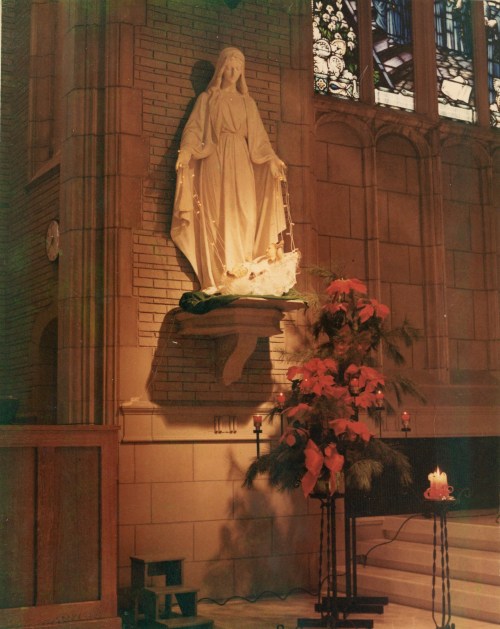
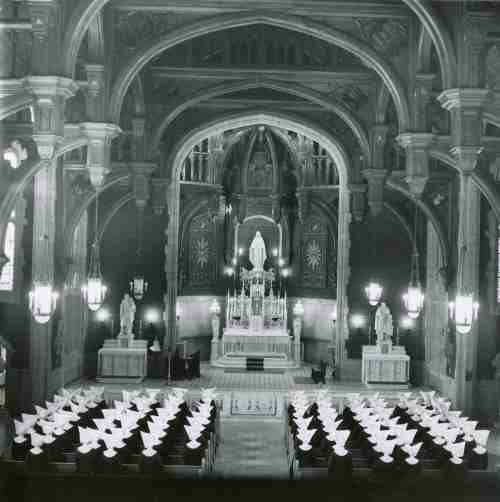
From the vestibule, we enter the Chapel proper. The walls used to be a beautiful red, the color of the bricks. When the Chapel was remodeled [in 1968], the red walls were painted the gray which we see now. I liked the red better. As you entered the Chapel, your eyes were drawn to the three white marble altars in the sanctuary and above the altar to the silver clouds where there was a white marble statue of our Blessed Mother, surrounded by the prayer in golden letters: “O Mary conceived without sin, pray for us who have recourse to thee.” It was so beautiful, you almost thought you were in heaven. That statue of Blessed Mother now stands on the pedestal on the left side of the sanctuary. The worker had to chisel away part of the back of the statue so it would fit. That statue of Mary was a personal gift of Sister Eugenia Fealy to the community.
On the wall in the sanctuary, on both sides of Blessed Mother were the bronze plaques now hidden by the hanging over which the pictures of St. Louise and the Martyrs of Arras were placed. The pictures, now in the front hall, were put over the bronze plaques at the time of the triduum. They looked beautiful with the three electric candles on either side going up to Mary. There were two large-sized angels on either side of the altar holding the lighted candelabra. One of the adoring angels was a gift in memory of our Director, Father Sullivan. The other angel was in memory of the visit of Most Honored Mother Le Brun, Superioress General of the Daughters of Charity.
The main altar was beautiful. We were told that it was made of 10,000 pieces of marble; the openings and arches trimmed with white stone and the red wall background made it look so nice. The marble altar was given by Sister Stephanie Wall. In the center of the main altar is a hollow marble form (called the baldachin) which houses the beautiful gold cross. We always had such beautiful altar cloths and tabernacle veils. Many of them were hand-painted. So many of the sisters could really paint.
….
Look at the beautiful ceiling. I think they call it a hammerbeam ceiling. The color has changed, once green. There are seven arches in the Chapel and six in the sanctuary. You can count five smaller arches against the wall. Many people come to look at the hammerbeam ceiling; it is so unusual. Those boxlike projections at the end of each arch are there for a purpose; they hide the joinings. If you look well at them you will see that some are plain and others are decorated. Do you see the crosses? Some point north, south, east and west. Someone told us that they represent the universal Church. The color has changed on the whole ceiling from the original green to the light brown that you see now.
….
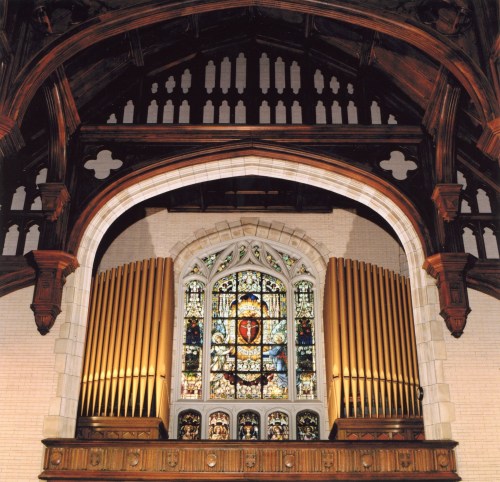
Sister Aloysius Collins was the first organist; I could listen to her playing for a long time. When we first came over to Marillac, Sister Aloysius picked certain Sisters for the choir. For the Mass on Sunday, the Sisters used to stand along the railing in the choir. We had a choir for a number of years, then all the Sisters were asked to sing from the Chapel, not from the choir. Father Claude, a Passionist, taught chant to the Seminary Sisters and some Habit Sisters who lived here. Later Sister Mary Louise Rikhoff taught chant. The Sisters use the choir loft quite a bit to “run in and pray.” The large stained glass window in the choir loft has the seal of the Daughters of Charity, a flaming heart surmounted by a cross with the motto of the Community: “The Charity of Jesus Christ presses us.” I like to look up and see it as I leave the Chapel.
….
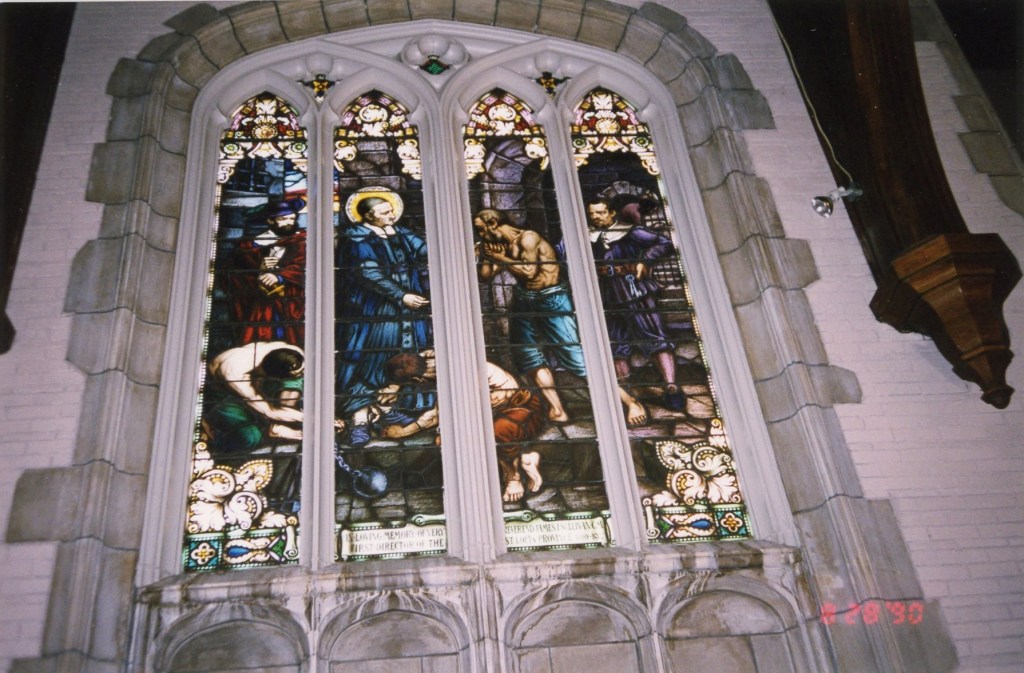
There are two stained glass windows in the sanctuary. The one of St. Vincent, taking the place of a galley slave, was given in loving memory of Very Reverend James J. Sullivan, C.M., First Director of the St. Louis Province 1910-1927. On the opposite wall is pictured the four Daughters of Charity who were martyred during the French Revolution. This was a gift of the Sister Servants of the Province for the celebration of Sister Eugenia’s Golden Jubilee. Beneath the picture we read, “Commemorating the Golden Jubilee Sister Eugenia Fealy First Visitatrix of the St. Louis Province 1879-1921. Both of the windows were installed in 1929.
Sister Mildred explains how the Chapel could be so gorgeous:
Just outside the sanctuary, near the statue of St. Louise is a memorial shield, a plaque of dedication to the donor of the Chapel. James Boro, brother of Sister Marie Boro saved his money. His sister, Sister Marie, inherited the money and gave the gift to the community for the Chapel in his memory.
This is a guest post by Addison Pickett, our intern for the summer and a member of the Mount St. Mary’s University Class of 2028!
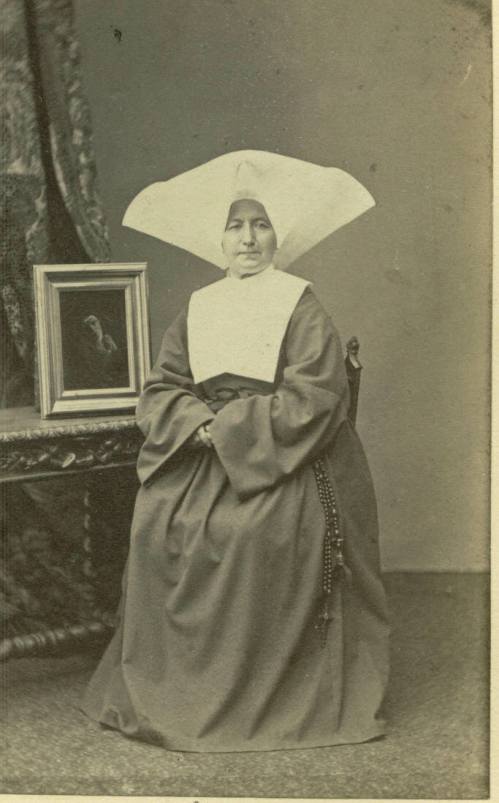
Mother Euphemia Blenkinsop was born Catherine Blenkinsop in Dublin, Ireland, c. 1815-1816. In her youth, she emigrated to the United States, where she joined the postulancy at St. Joseph’s, Emmitsburg, Maryland in 1831. Taking her habit, she took the name Euphemia as well, no doubt inspired by the early Christian martyr St. Euphemia, and it was said that the name fit her so well because of its meaning: harmonious and agreeable. In 1866, she succeeded Mother Ann Simeon as Visitatrix to the Daughters of Charity and served as Visitatrix until her death in 1887. She continues to live on as a model of innocent piety.
Mother Euphemia shows up within the pages of Sr. Mary Raphael Smith’s journal, ‘Souvenir of Old Times,’ through poems, passages, and prose dedicated to her. This journal includes many writings from the Sisters and priests of St. Joseph’s Academy from about 1833 to 1889, as well as graduation ceremony programs, obituaries, and newspaper clippings about St. Joseph’s. On St. Euphemia’s feast day, September 16th, many writings can be found about Mother Euphemia, revealing the deep admiration that the Sisters had for their Visitatrix.
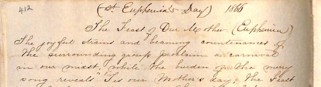
From Souvenir of Old Times, page 412: “The Feast of Our Mother (Euphemia)”
On St. Euphemia’s Feast Day in 1866, Mother Euphemia Blenkinsop’s first year as Visitatrix, the Sisters detail their hopes for a good relationship with their new Mother. This note also details a gift that the Sisters gave to Mother Euphemia, most likely as a welcoming gift: “Accept our simple tribute of affection, a moss basket gemmed with Autumn’s bright flowers, fit emblems of our heart-felt wishes, with the rich fruits of the plentiful Gathering Season, and auspicious presage of the abundant blessings with which we hope Heaven may crown your efforts in your new field of labor.”
This slice of life from September 1868 shows the kindness of the Daughters of Charity towards their new Visitatrix and marks the beginning of her noteworthy time as their leader.
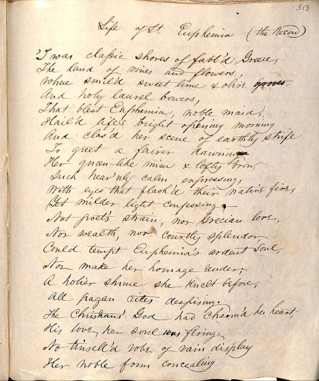
From Souvenir of Old Times, page 313: “Life of St. Euphemia (The Record)”
A reference to St. Euphemia appears on pages 313-315, telling the story of St. Euphemia’s life in the form of a poem. It is not dated, nor is there an author credited. However, in the pages following, a paper pamphlet tucked inside tells the same poem written in print and dates to September 16th, 1868.
Certain details in this poem are undeniably different from the accounts we have of St. Euphemia today, but it captures the essence of the early Christian Martyr nonetheless. It tells that St. Euphemia was born in Greece, “the land of vines and flowers.” She was a holy woman consecrated to Jesus, and when a pagan judge tried to tempt and convert her, she rejected all of his offers. For her faithfulness to God, she was attacked by an angry mob and burned alive, but both attempts on her life left her completely unharmed. Finally, the pagan judge was able to kill her with a sword: “[The judge] Commands the sword her life, to end, / This act his word redeeming.” While these entries don’t mention Mother Euphemia Blenkinsop by name, it can be assumed that they were written with her in mind, recording the story of her namesake.
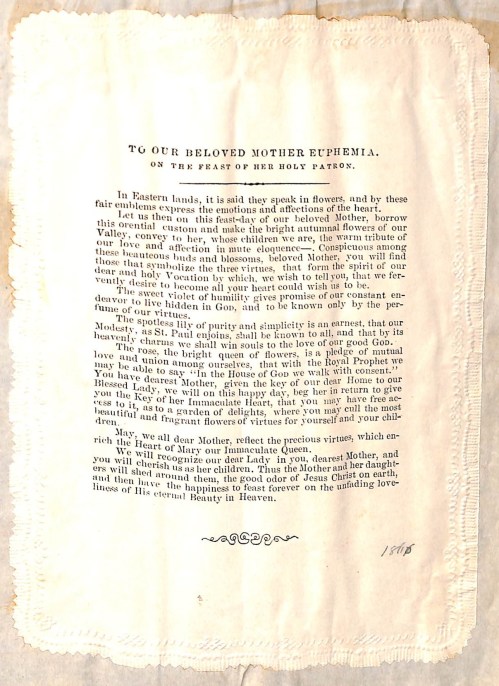
From Souvenir of Old Times, page 425: “To Our Beloved Mother Euphemia. On The Feast of Her Holy Patron.”
Another entry reveals the deep love that the Sisters had for Mother Euphemia even in her first year as Visitatrix. Mixing prose and devotion to the Virgin Mary with love for their Visitatrix, this piece calls upon Our Mother Mary to guide Mother Euphemia in leadership. The Community showed its loyalty and trust from the start saying: “We will recognize our dear Lady in you, dearest Mother, and you will cherish us as your children.” Despite her assumption of the role being very recent, the Sisters had a deep trust she would fulfill her role well.