Category Archives: Artifacts

Building the Emmitsburg History Exhibit

Near the end of 2024 and the start of 2025, we knew we needed to create a new exhibit for 2026, the year commemorating the United States 250th.  

As we looked for guidance from the America 250 Commission, we also began to look at our own collections.  At the time, the America 250 was encouraging state and local organizations to do the bulk of the work, connecting people with their most directly accessible history.  In this spirit, we thought, what can be more local than curating a history of Emmitsburg?

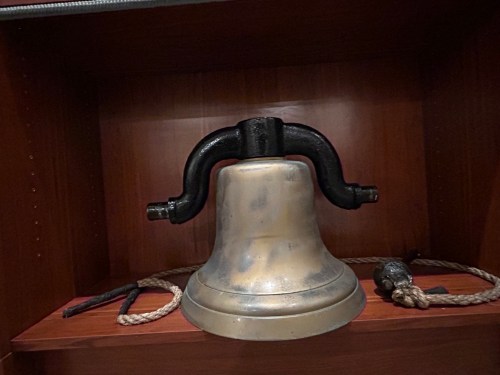
We began to examine our collections, which were heavy on materials from Mother Seton and her family and from the Daughters various ministries across the United States.  We had materials from their ministries in Emmitsburg, including St. Joseph’s Academy/St. Joseph College, a major institution in the town since the time of Mother Seton.  We had records and artifacts from some of the local schools the Daughters operated.  We had accounts of the Civil War detailing life in Emmitsburg, which by sheer luck did not become Gettysburg in the War and in historical memory, but we did not have many artifacts.  And we had records and a few artifacts from the Emmitsburg railroad, a point of local pride and, at one time, the smallest incorporated railroad in the United States.

Bell from Train Station

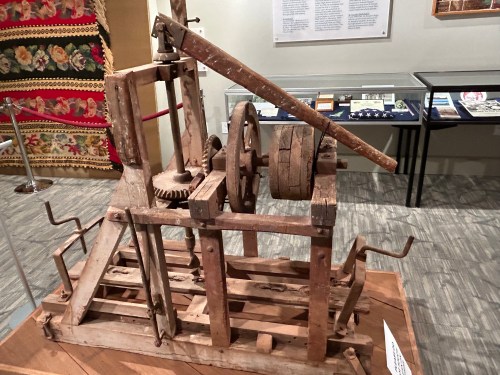
This exhibit quickly became our most research-heavy exhibit, one that extended past the collections that are in our possession.  We began to dive into the history of the town beyond our collection scope, utilizing the resources of the Emmitsburg Historical Society and various school alumni organizations.  We began to identify themes and marquee artifacts for display, settling on a drill press from the late 1800s as a nod to the town’s agricultural history; a crocheted afghan from the 1870s that was created by an Academy student; and a terracotta angel that was in the Academy Chapel, which later became the National Fallen Firefighters Memorial Chapel.  We also worked with our neighbors to secure loans of materials, ensuring that the exhibit tells a story of the town, not just of Mother Seton or the Daughters.

Drill Press on Display

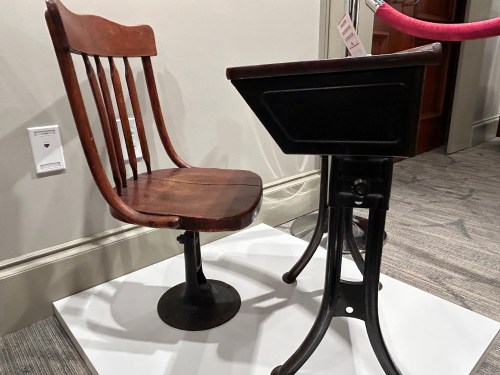
We also used this opportunity to explore the undertold story of Emmitsburg’s longstanding African American community.  Even in the Antebellum era, generations of families, often consisting of free and enslaved individuals, can be found in the historical record.  The town’s history therefore touches on the hardships of slavery and the persistence of a community.  We even get the chance to display an artifact from a point of pride in the town – a school desk from St. Euphemia’s, the first school in Frederick County to desegregate.

St. Euphemia's School Desk

We began to look for other types of materials to show: tangible three-dimensional artifacts alongside posters and “wordier” pieces, photographs where able, and even films!  Amongst them, we have quote-unquote “annotated” a silent video from the 1940s that shows the St. Joseph College campus and surrounding areas and received permission from the National Fallen Firefighters Foundation to utilize a commissioned music video that features the moving lyric “I’m going home to Emmitsburg.”

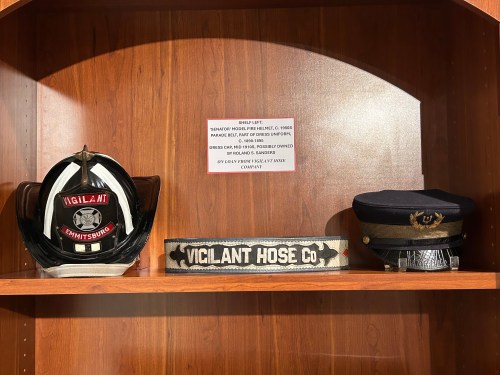
Helmets, hats, and belts on display, loaned from Vigilant Hose Company

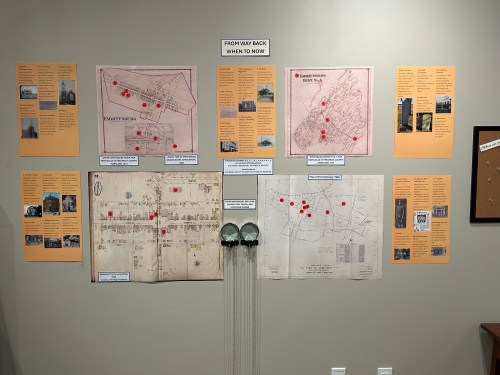
We have also sought ways to incorporate some level of interactivity into our exhibits.  We invite children to map out the pathways of Civil War soldiers in the leadup to the Battle of Gettysburg, and we invite everyone to explore (reproduced) historical maps from the collection of the town, often with details down to individual properties.  This afforded a way to include many of the small stories that are often hard to include in extensive detail in an exhibit like this!

Maps on Display with title "From Way Back When to Now"

“Emmitsburg: From Way Back When to Now” opens to the public on Saturday, April 11, 2026 and will run through the holiday season 2027.  We are located in the Archives gallery of the Seton Shrine.

Welcome to Emmitsburg everybody!

Leave a comment

Filed under African American History, Announcements, Archives, Artifacts, Emmitsburg

The Guestbook at St. Ann’s Home

Guestbooks for major life events are keepsakes of the most important events.  A day to day guestbook might not quite have the same value, but over time it can reveal some important things. 

St. Ann’s Infant Home, founded in Washington, D.C. in 1860 and which later moved out to Hyattsville, Maryland in 1962 was one of the most prominent institutions of the Daughters of Charity in the capital area.  It’s role of caring for orphaned children evolved into a modern day care and family service center (now fittingly called St. Ann’s Center for Children, Youth and Families).

And its guestbook shows just how prominent of an institution it was.

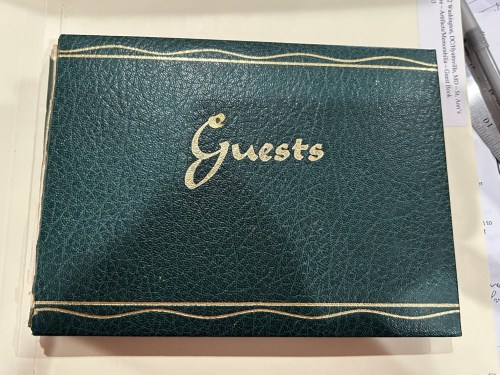
Cover of St. Ann’s Center for Children, Youth and Families guestbook

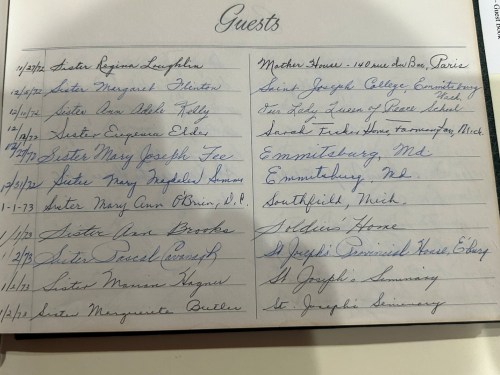
Many of the names are Daughters of Charity from around the U.S., illuminating the full range of ministries that they were engaged from the earliest date in the book, 1972, to its latest, 1983.

Page from St. Ann's guestbook

Amongst those visitors, though, are also Sisters from around the world, reflecting the global missionary spirit of the Daughters of Charity.  There are a number of Daughters from Bolivia, Ecuador, Venezuela, Japan, the Philippines, Vietnam, Madagascar, the U.K., and France.

Page from St. Ann's guestbook

Several members of the local media appear, including journalists from local station WJLA, led by the trailblazer and future Emmy-winning journalist Renee Poussaint. 

Page from St. Ann's guestbook

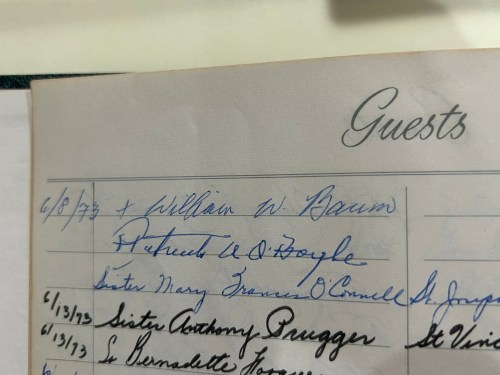
A delegation of the Bishop and Archbishops of Washington visited on June 8, 1973, consisting of Archbishop William Baum and former Archbishop Patrick Cardinal O’Boyle.

Page from guest book at St. Ann's

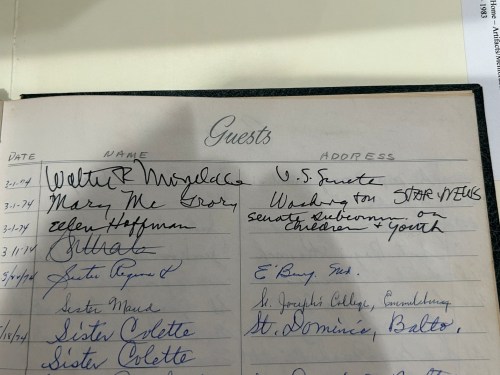
Most eye catching however, are the names of national level politicians.  Just glancing through the entries we see Representative George Miller of California, Senator Pat Leahy of Vermont, and future Vice President Walter Mondale, who arrived with a cadre of reporters.

Page from guest book at St. Ann's

Mary 18, 1981 saw perhaps the Center’s most frequent high-profile visitor, First Lady Nancy Reagan, barely six weeks into her new role.  The St. Ann’s collection highlights many high profiles visits, and this First Lady has the most folders amongst any Washington political figures. 

Page from St. Ann's guestbook

Leave a comment

Filed under Archives, Artifacts, Daughters of Charity, First Ladies, Social Work, Uncategorized

The Austin Cooler

Some artifacts are artifacts because they are unique; others appear amazingly ordinary until their place in history becomes evident.

What appears as a simple Igloo-brand cooler, the kind used for family picnics and fishing trips became a life-saving tool and a step into a new medical world at Seton Medical Center in Austin.  On February 2, 1986, Doctors Jim Calhoon, John Oswalt, and Emery Dilling completed the first open heart transplant at the Hospital, beginning its time as one of the most respected heart health programs in the country.  The cooler was used to transport the heart during the life-saving procedure.

Once the procedure was complete and the patient declared safe, the three doctors fully made their mark on the artifact and signed the cooler.

The cooler was a frequent showpiece of the archives at Seton Medical Center.  When the Hospital was transferred to the auspices of Ascension healthcare in 1999, many of the materials in the Archive were transferred to the Archives of the West Central Province in St. Louis, which then came to Emmitsburg in 2011.  It was discovered a few years later, however, that an entire roomful of materials had never been transferred, including the legendary cooler.  Thankfully, the entire collection was able to be reunited in 2019.

The cooler was on display from 2022-2023, and we will occasionally pull it out for special displays for visiting groups from Austin or from the health care field.  We are looking for ways to display it for the wider public again within the next few years.

Leave a comment

Filed under Artifacts, Austin, Texas