Filling in Family History:  Sister Baptistine Massa

Published with the approval and assistance of Nicky Dilts

Occasionally in these posts, we like to highlight projects our researchers are working on. This post is not about an academic project, but about a family history exploration with some deep personal meaning.

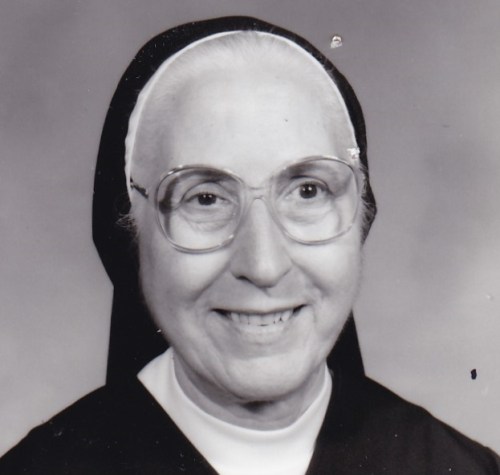
Nicky Dilts is her family’s historian, and there was a branch that she was missing on her family tree.  Her grandmother, Clorinda Pasquinucci, had spoken of an aunt that became a Catholic Sister of some order or another.  In Nicky’s possession were two memorials of her great-great-aunt.  The first was a photograph, and the second was a prayer book gifted to her grandmother from this mysterious Sister-aunt.  The prayer book is signed “To my dear Clorinda[,] Best wishes for a Merry Christmas 1933[,] Pray for Aunt Frances Sr. Baptistine.”
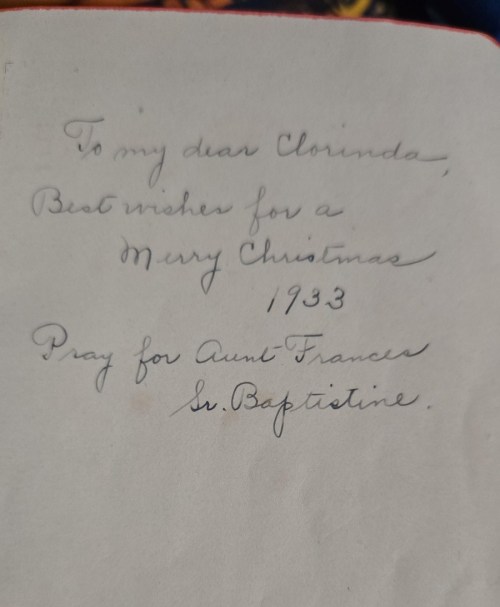
Handwritten message from Sister Baptistine reading: "To my dear Clorinda, Best wishes for a Merry Christmas 1 Pray for Aunt Frances Sr. Baptistine."
Courtesy Nicky Dilts

With this artifact, Nicky had a community name, a baptismal name, and a time period.  From her extended research, she knew her likely last name – Massa – and that she had emigrated from Italy. The one thing she didn’t know for certain was what Community Sister Baptistine was in. Thankfully, the distinctive habit – with the notable cornette head covering, worn before 1964 –meant that Sister Baptistine could only be a Daughter of Charity.
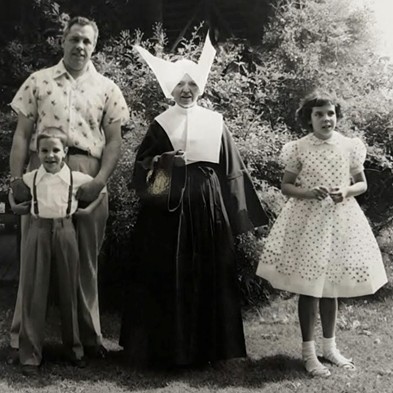
Photo of Sister Baptistine Massa with three family members
Courtesy Nicky Dilts

Nicky called us with her information, and we were able to match it instantly.  We are able to provide the information found in the Community ledgers and confirm what she knew already, including Sister Baptistine’s birthplace in Levanti, Italy and her parents, Emanuel Massa and Christine Luceti. Moreover, we could share Sister’s date of birth, date of death, date she entered the Community, and where she had served on ministry.

For some genealogists, especially looking further back, this is the limit to what we are able to provide to people, before the explosion of recordkeeping.  Sister Baptistine’s file, however, contained a goldmine of information. Some things were vital documents, where, although we disappointed Nicky in not having Sister Baptistine’s birth certificate, we did have her naturalization certificate when she became a U.S. citizen.

Naturalization certificate of Sister Baptistine Massa

And, after Sister’s death, her file had correspondence between the Community and some of those same family members whom Nicky’s genealogical work had documented, showing the family’s support for the Community and the Community’s concern for a grieving family.  It gave an account of her final days and her devotion to the Brady Maternity Home in Albany, where she lived, ministered, and eventually died after 49 years there.

Typewritten text reading: "June 28, 1966[.] Dear Mrs. Stevens and Miss Massa, I am addressing this letter to both of you so that together you will learn all about the last days of your dear Sister and our beloved companion. Sisters is a great loss to all of us as we all loved her and admired her for her kindness and her holiness. Sister was on active duty all day Saturday, June 25. She served our chaplain's breakfast and did all the other little things that she did all day, the last of which was to go around the home and bless the little children with Holy Water. This gave Sister the opportunity to meet all the personnel and to keep in touch with the children she loved so much."

Some of these documents even went into further detail about Sister’s family:

Portion of a letter from Mrs. C. Lagario reading: "These are the names of Sisters relatives. Mr. Frank Montegane[,] Mr. & Mrs. I. Montegane[,] Mr. & Mrs. H. Bawers[,] Mr. & Mrs. M. Schenone[,] Mr. & Mrs. . Lamerdin[,] Mr & Mrs. H. Gaerndt[,] Mr. & Mrs. J. Labario[,] Mrs. Caroline Labario Our prayer are with you. Mrs. C. Lagario"

Although we use this blog to highlight some projects of academic researchers, our most common category of users is genealogists, and our most common question is “My aunt/great-aunt was a Daughter of Charity; do you have any pictures of her?” It is a question we are always happy to provide an answer to.

Leave a comment

Filed under Archives, Deceased Sisters, Sister Baptistine Massa

Sister-Veterans of World War II

Come, let us go up to the mountain of the Lord, to the temple of the God of Jacob. He will teach us his ways, so that we may walk in his paths. The law will go out from Zion, the word of the Lord from Jerusalem. He will judge between the nations and will settle disputes for many peoples. They will beat their swords into plowshares and their spears into pruning hooks. Nation will not take up sword against nation, nor will they train for war anymore.

-Isaiah 2:3-4

We would like to take this opportunity to highlight a few Daughters of Charity of this Province who served their country prior to joining the Community.

To clarify, this post will NOT be about the Sister-Veterans of the Civil War, who served during their Community lives.  Nor will it be about the Sister-Veterans of the Spanish-American War, World War I, or World War II who did the same.  This post is merely about four Daughters of Charity who, during their lives before joining the Community, served something greater than themselves in a slightly different way during the Second World War. 

This post is also not meant to disparage or ignore the service of any Daughters of Charity whom we failed to include here.  “Veteran status” is not a search terms that we filter for among the Daughters whose files are in the Archives.  It is more something that we stumbled upon over time.  It also may open the possibility of a part 2 in the future…

So, without further ado:

Sister Karen Baustian

Sister Karen started as an unenlisted electronics tech for the Army Air Corps, the future U.S. Air Force, following her brother into the service.  She then enlisted in the U.S. Women’s Marine Corps in 1943, serving for 27 months as a Radio Tech.  She began her service directing communications on the Paris Island Marine Corp base in South Carolina before volunteering for active service.  This took her to Hawaii, where she repaired equipment for use in the Pacific Theater of the War.

After her honorable discharge in 1945, Sister Karen remained in the Marine Corp. Reserves until 1949.  Looking to continue in her line of work after the War in Minneapolis, she was rejected from numerous jobs for being a woman.  She instead utilized the GI Bill to go to school for broadcast journalism and for the next eight years worked in radio broadcasting in the rural parts of the state.  As she traveled around the state in the 1950s, she began attending Bible study and growing in her own faith, when a priest directed her to the Daughters of Charity.

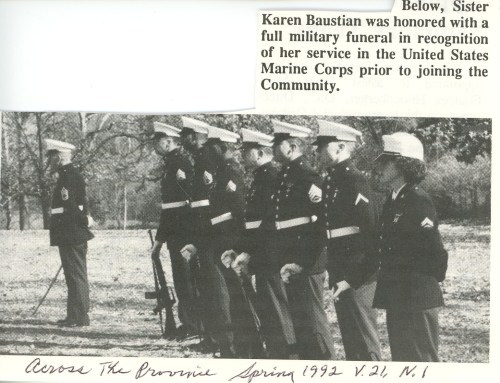
Photo of Sister Karen Baustian's funeral clipped from provincial newsletter, 1992 with full military honors
Picture and notice from Sister Karen’s funeral in the Provincial newsletter, 1992

Sister Marguerite Eavey

Seeing that she had no brothers to represent her family in the War effort, Sister Marguerite volunteered at age 20 for the Women Accepted for Volunteer Emergency Service (or the WAVES Program).  Her service as a Pharmacist’s Mate, 1st Class, lasted from 1943 to 1945 and occurred at the Naval hospitals in Philadelphia and Norfolk, Virginia.  She translated this service into attending the Worcester School of Business and becoming a secretary for the Department of the Interior after the War ended. 

At age 30, she returned to her hometown of Martinsburg, West Virginia, where she went to school under the Daughters and applied to enter the Community.

Headshot of Sister Marguerite Eavey in coiffe habit

Sister Regina Lindner

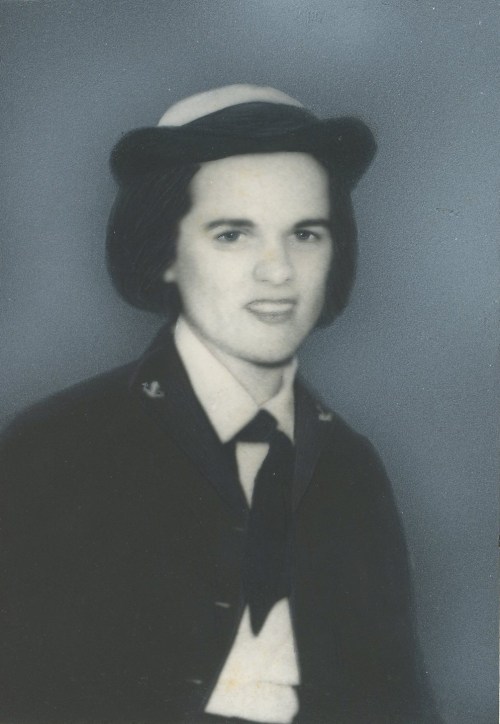
Another WAVES veteran, Sr. Regina Lindner actually began her Seminary as a Daughter of Charity, stopped to serve in 1941, and returned to the Community later.  She also achieved the rank of Pharmacist’s Mate, 1st class, serving in Naval hospitals in California.  Four more of her siblings remained with the Daughters of Charity, while Sister Regina returned home after the War to care for their ailing mother.  In 1947, she returned to the Community to complete Seminary.   

Sister Regina Lindner in WAVES uniform, circa 1943

Sister Margaret Albert Scholl

Sr. Margaret Albert began her career in the U.S. Public Health Service, but very quickly enlisted in the U.S. Coast Guard Medics in 1944.  The Coast Guard at this time was patrolling the Atlantic and guarding the homefront in the event of a possible invasion of the East Coast.  At the same time, based at the U.S. Coast Guard Academy in New London, Connecticut, she trained other paramedics for service in distant theaters of the War.  Her service lasted from 1944 to 1951, and she joined the Daughters of Charity immediately thereafter.

Sister Margaret Albert Schroll receiving award from U.S. Coast Guard Officer on deck of the 'USCGC Eagle' in 1976
Receiving a gift from USCGC Eagle in 1976

3 Comments

Filed under Daughters of Charity, World War 2

Sketches of a Soul: Father Bruté’s Spirituality in Art

This is a guest blog post by Leah Kanik, a Junior at Mount St. Mary’s University, class of 2027. She has been an intern with the Daughters of Charity Provincial Archives for Fall 2025 semester.

Sacred art has been a staple in the spirituality of the Catholic Church for centuries for its ability to raise the mind to contemplate the things of God. Humanity needs corporeal reminders of the supernatural to direct the mind and soul to higher truths, and art is a way in which this interiority can be reflected by the exterior. For those who use art to manifest the interior life, it is as if the longings of their soul were so strong that they must spill onto paper. Such could be said of Father Simon Gabriel Bruté, that “Angel of the Mountain” and first bishop of Vincennes whose influence transformed the places he ministered to. His drawings reveal the childlike simplicity of a priest who balanced peace of soul amidst the immense responsibilities of shepherding his people.

All of his extant drawings in the Daughters of Charity Archives predate his appointment as bishop of Vincennes in 1835 and instead cover his time at Saint Mary’s College in Baltimore and Mount Saint Mary’s University in Emmitsburg. After arriving in Baltimore from France in 1810, Father Bruté taught at St. Mary’s Seminary for two years before being assigned to teach at the Mount. In 1815, he was made president of Saint Mary’s College, but returned to the Mount in 1818 to toil in keeping the school out of debt and administering to the spiritual needs of Emmitsburg and the Sisters of Charity, of which he was chaplain.

His priestly assignment at the Mount provided him with numerous opportunities to engage in his hobby of drawing. For example, his proximity to the Sisters of Charity during his time in Maryland enabled Bruté to become friend and spiritual director to Mother Seton, and thus many of the drawings are addressed to or depict Seton or her children. Other drawings outline the world of Emmitsburg as he knew it, relate his travels to France, or are simply a recreational sketch.

Whatever its context is, Father Bruté’s drawings predominantly include a reference to the divine which is reflective of his deep spirituality even in the most mundane things. This is seen in his more lighthearted sketches that show a kind of playfulness in using pen and paper to uplift the soul. He drew animals, landscapes, buildings, and religious symbols to supplement his letters and add beauty to the quotidian task of writing. Drawings about the reality of death or which are more historically significant also include an element of joy because of his faith in God and eternal life. No situation or created thing was exempt from participating in Father Bruté’s life of faith.

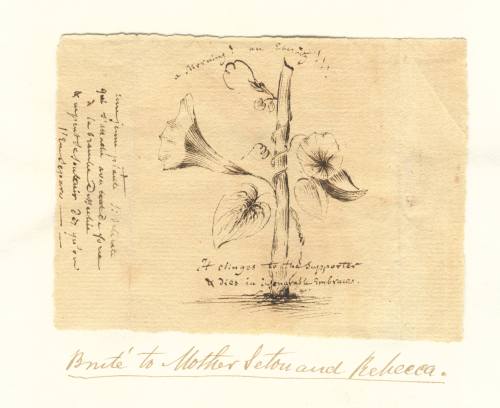
Sketch by Father Bruté called 'Morning Glories'
A leisurely sketch of a morning glory with Bruté’s call for Eternity

It is not the picture alone that manifests his interior life. Bruté uses Scripture or his own poems and prayers to pour out the aspirations of his soul. Even his historical drawings depicting the landscape of Emmitsburg or the sketch of his ship which took him to France have Scripture and prayers dispersed throughout them. They serve as reminders of his love and goal for Heaven. Indeed, a quarter of his drawings include the word “Eternity” as either central to the image or as a minor addition to a leisurely sketch. Even drawings in which the word is not explicitly written, the message of eternal life is implied by the belief in a home that transcends this world. Such was the nature of the drawings Father Bruté sent to Rebecca Seton for consolation in her illness, and this message of eternal life seemed to comfort even himself as he witnessed death within the Seton family.

Sketch of Father Bruté's: Rebecca Seton's Flight to Heaven
The flight of Rebecca Seton to Heaven amidst her mother’s sorrow

Drawing was thus an outlet for Father Bruté during his labors in Maryland, but it was the responsibility of running Saint Mary’s and the Mount, helping the Sisters, and carrying out other priestly duties that were catalysts for his sketches. Perhaps the lack of drawings during his bishopric in Vincennes is due to his advanced age and increasing responsibilities, as well as having to care for a newly established frontier diocese that spanned the entire state of Indiana. Nonetheless, he utilized his ability to draw to link the temporal and spiritual worlds on paper, and so he encapsulates the purpose of sacred art in using the material to point to the divine. Whether one possesses the ability to draw like him or not, Father Bruté’s love of sacred art reminds us of the joy of the spiritual life and the necessity of preserving artistic beauty in the service of God.

Sketch of Father Bruté's: Landscape of St. Joseph's Valley
A sketch of the Emmitsburg landscape with verses of Scripture dispersed throughout

Leave a comment

Filed under Archives, Simon Brute