Tag Archives: St. Joseph’s Academy

Building the Emmitsburg History Exhibit

Near the end of 2024 and the start of 2025, we knew we needed to create a new exhibit for 2026, the year commemorating the United States 250th.  

As we looked for guidance from the America 250 Commission, we also began to look at our own collections.  At the time, the America 250 was encouraging state and local organizations to do the bulk of the work, connecting people with their most directly accessible history.  In this spirit, we thought, what can be more local than curating a history of Emmitsburg?

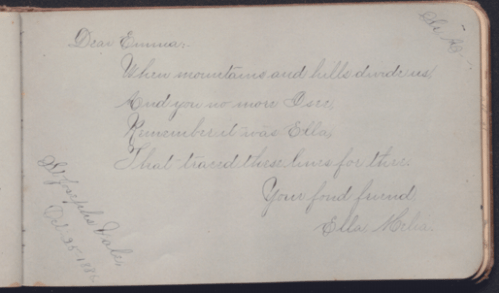
We began to examine our collections, which were heavy on materials from Mother Seton and her family and from the Daughters various ministries across the United States.  We had materials from their ministries in Emmitsburg, including St. Joseph’s Academy/St. Joseph College, a major institution in the town since the time of Mother Seton.  We had records and artifacts from some of the local schools the Daughters operated.  We had accounts of the Civil War detailing life in Emmitsburg, which by sheer luck did not become Gettysburg in the War and in historical memory, but we did not have many artifacts.  And we had records and a few artifacts from the Emmitsburg railroad, a point of local pride and, at one time, the smallest incorporated railroad in the United States.

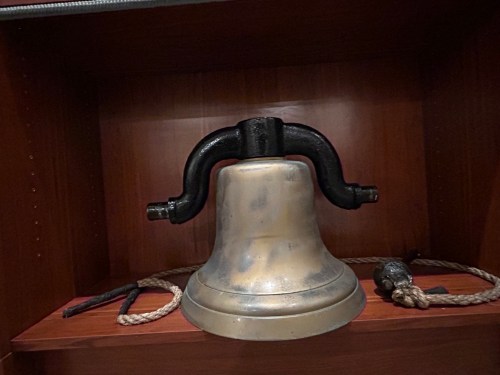
Bell from Train Station

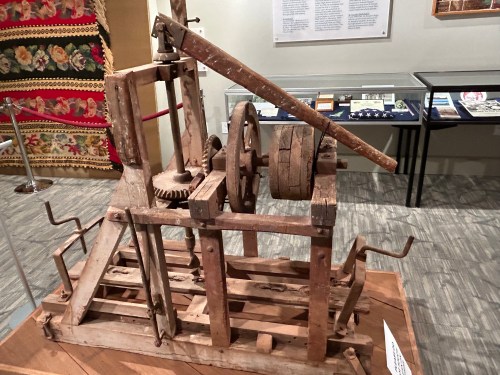
This exhibit quickly became our most research-heavy exhibit, one that extended past the collections that are in our possession.  We began to dive into the history of the town beyond our collection scope, utilizing the resources of the Emmitsburg Historical Society and various school alumni organizations.  We began to identify themes and marquee artifacts for display, settling on a drill press from the late 1800s as a nod to the town’s agricultural history; a crocheted afghan from the 1870s that was created by an Academy student; and a terracotta angel that was in the Academy Chapel, which later became the National Fallen Firefighters Memorial Chapel.  We also worked with our neighbors to secure loans of materials, ensuring that the exhibit tells a story of the town, not just of Mother Seton or the Daughters.

Drill Press on Display

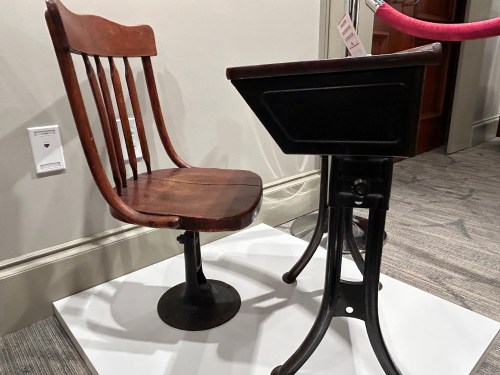
We also used this opportunity to explore the undertold story of Emmitsburg’s longstanding African American community.  Even in the Antebellum era, generations of families, often consisting of free and enslaved individuals, can be found in the historical record.  The town’s history therefore touches on the hardships of slavery and the persistence of a community.  We even get the chance to display an artifact from a point of pride in the town – a school desk from St. Euphemia’s, the first school in Frederick County to desegregate.

St. Euphemia's School Desk

We began to look for other types of materials to show: tangible three-dimensional artifacts alongside posters and “wordier” pieces, photographs where able, and even films!  Amongst them, we have quote-unquote “annotated” a silent video from the 1940s that shows the St. Joseph College campus and surrounding areas and received permission from the National Fallen Firefighters Foundation to utilize a commissioned music video that features the moving lyric “I’m going home to Emmitsburg.”

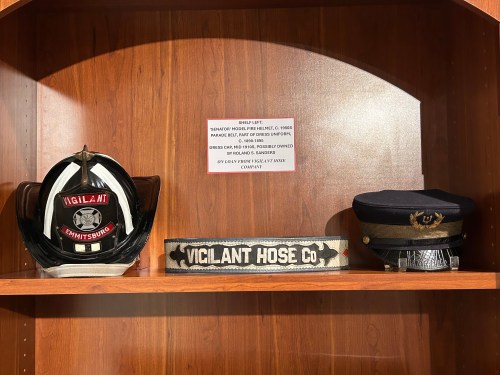
Helmets, hats, and belts on display, loaned from Vigilant Hose Company

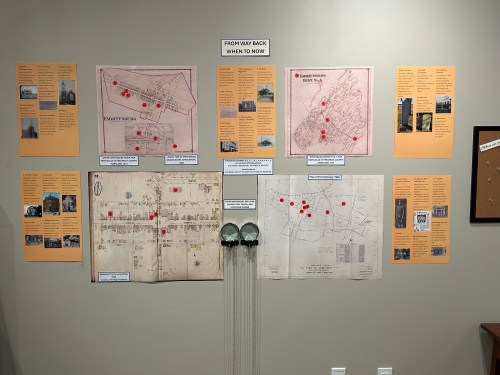
We have also sought ways to incorporate some level of interactivity into our exhibits.  We invite children to map out the pathways of Civil War soldiers in the leadup to the Battle of Gettysburg, and we invite everyone to explore (reproduced) historical maps from the collection of the town, often with details down to individual properties.  This afforded a way to include many of the small stories that are often hard to include in extensive detail in an exhibit like this!

Maps on Display with title "From Way Back When to Now"

“Emmitsburg: From Way Back When to Now” opens to the public on Saturday, April 11, 2026 and will run through the holiday season 2027.  We are located in the Archives gallery of the Seton Shrine.

Welcome to Emmitsburg everybody!

Leave a comment

Filed under African American History, Announcements, Archives, Artifacts, Emmitsburg

Visiting Pope Leo XIII

With the election of Pope Leo XIV in 2025, we thought it would be worthwhile to look into the figure from whom the new pontiff took his name, Pope Leo XIII. 

Elected in 1878, he is most well-known for his encyclical Rerum Novarum.  In this document, Leo XIII  formally articulated the principals that today define Catholic social teachings.  In this, he addressed the conditions of the working poor and what is owed to those living in poverty.  His concern for those living in poverty formed an almost natural affinity between His Holiness and the Vincentian double family: the Vincentian priests and the Daughters of Charity.

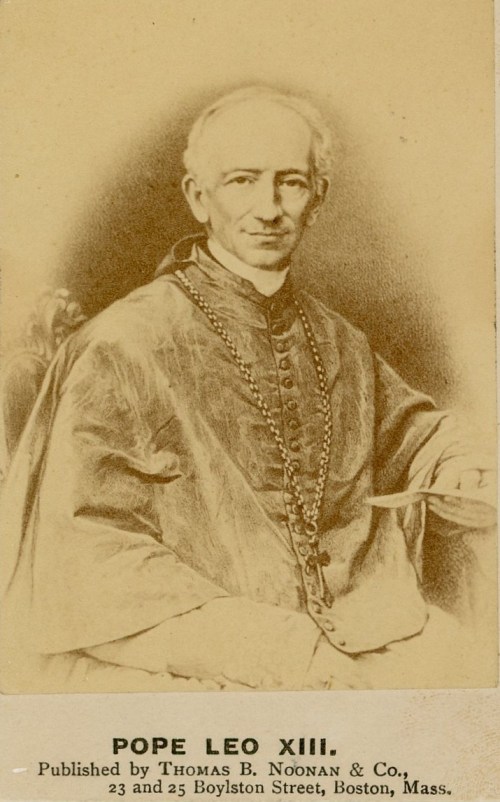
Prayer Card for Pope Leo XIII

In 1893, the Superiors of the Vincentians and the Daughters of Charity had an audience with Pope Leo XIII.  The account of this meeting is in the Archives dated January 26, 1893, held to celebrate the founding of the Vincentians.  Joining them were students of the Daughters of Charity from Rome.

Father Antoine Fiat, Superior General of both communities, provided his gratitude at the Pope’s guidance in Rerum Novarum:

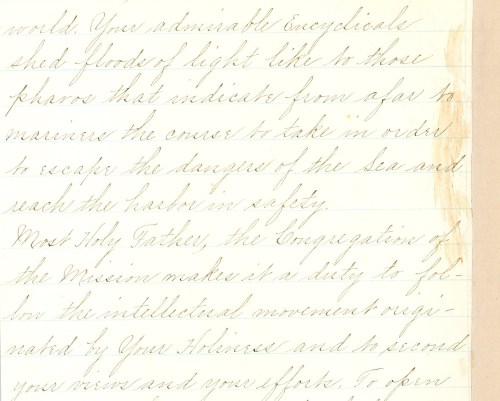
Your admirable encyclicals shed floods of light like to those pharos [lighthouse] that indicate from afar to mariners the course to take in order to escape the dangers of the Sea and reach the harbor in safety. Most Holy Father, the Congregation of the Mission [formal name for the Vincentians] makes it a duty to follow the intellectual movement originated by Your Holiness and to second your views and your efforts.

Portion of account of visit with Pope Leo XIII

In response to Father Fiat’s address, Pope Leo XIII addressed the Vincentians and Daughters in French, the language of their founders and superiors, despite himself being a native Italian.  He shows particular fondness for the schools the communities conduct around Rome, and seems to show favor toward the ongoing (at the time) cause for sainthood for Louise de Marillac.

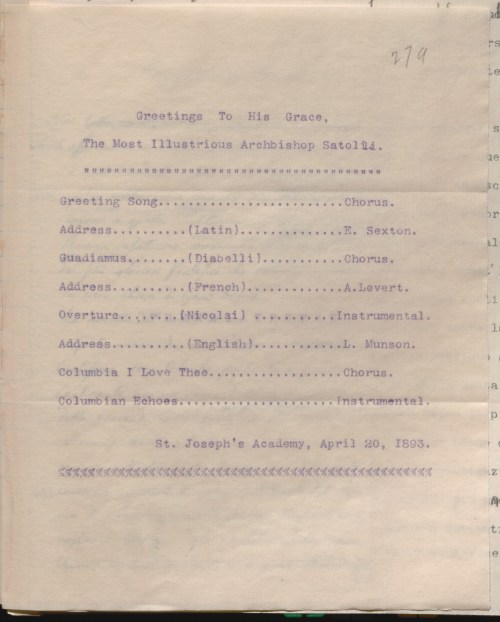
Even though no American Daughters were part of this audience, it was still celebrated in the United States.  The Provincial Annals contain a letter by Sister Caroline Eck, writing from St. Joseph ‘s Academy in Emmitsburg, Maryland.  The Sisters and students at the Academy were met by Cardinal Francesco Satoli, the first official Apostolic Delegate to the United States, who recounted the meetings between the Holy Father and the French Superiors.  The students and staff celebrated this (at the time) highest meeting of a church official with the students, emphasizing the global nature of the Daughters and the internationality represented by the Catholic Church!

Program from days' events at St. Joseph's Academy
Program from days’ events at St. Joseph’s Academy

Leave a comment

Filed under Daughters of Charity, Leo XIII, Social Justice

Father Burlando

In the United States, there was never a more influential Provincial Director than Father Francis Burlando.

The position of the Provincial Director is always held by a Vincentian priest.  He is meant to invoke the spirit of the community’s founders in the Daughters within a province, play a role in the formation of the Sisters, have a vote in Council decisions, and ensure that the Daughters of Charity live the spirit of their vows of poverty.  Father Burlando was born in Genoa, Italy in 1814.  He volunteered to go to America shortly before his ordination as a priest in 1837.  He taught in Perryville, Missouri, and was pastor at St. Vincent’s Parish in St. Louis, where important gatherings and Masses are still celebrated for the Daughters today.

Father Burlando, circa 1870
American Vincentians, 1870, Father Burlando at right

In 1849, he accompanied Father Mariano Maller to Emmitsburg.  Father Maller was set to take his position in 1850 as the first Provincial Director for the Daughters of Charity in the United States, after Mother Seton’s community formally merged with Daughters in 1850.  Father Burlando was to be the Sisters’ confessor but returned to St. Louis for health reasons.  In 1853, Father Maller was appointed as Director for the Daughters’ Province in Brazil, and Father Burlando was appointed as the Provincial Director in the United States.

Father Burlando had the responsibility of completing the transition of the Sisters of Charity into Daughters of Charity.  Although the blue and white habit of the Daughters had begun to trickle into the United States, Father Burlando oversaw the completion of the change across the entire country through 1854. When the Civil War passed through Emmitsburg and the Sisters’ grounds became host to marching armies, Father Burlando worked to keep both Sisters and students safe, using their status as religious to make sure no accidental firing occurred.  When the Battle of Gettysburg subsided on July 3, 1863, Burlando personally led the Sisters to Gettysburg to begin their nursing duties there.  After the War, he helped shape the historical record by encouraging the Sisters to write their accounts of what they experienced.  Today, these accounts are some of the greatest treasures in the Archives.

With regard to St. Joseph’s Academy, Burlando oversaw an expansion of the school and the construction of his namesake building.  Having learned of architecture and building from his father in Italy, a plumber, he co-designed what would become his namesake building, which still stands as part of the FEMA Fire Academy.

Someone only identified as “An Old Pupil” described his relationship with the students at the Academy: 

Father Burlando took the most active interest in the studies of the pupils of St. Joseph’s and in everything pertaining to their comfort and welfare, always planning how to give them increased pleasure in their recreation, and in return the pupils loved him with a sincere affection, regarding him as a most tender Father. His practical mind was always suggesting something new for their future benefit, and as he fully realized the influence of [a] woman in her home, he labored to direct the education of those under his care to that end, introducing the study of domestic economy at St. Joseph’s, that the young ladies might be trained to fulfil properly the important duties of life. For this alone he is entitled to everlasting gratitude.

Burlando Building at St. Joseph’s Academy, Emmitsburg, circa 1871

Burlando also provided guidance on business matters, with his template for establishing ministries as incorporated institutions, which helped guide the community as it established some of its most long-lasting works.  Drafted in 1870, his guidelines provided uniform structure and procedure for the next 80-plus years, ensuring the longevity and independence of the Daughters’ ministries. 

Father Burlando died suddenly in 1873 of a stroke.  Along with his importance, the suddenness of his death probably contributes to the voluminous accounts of his funeral.  Father Burlando is one of the priests, or even non-Sisters, to be buried in the Old Cemetery in Emmitsburg, in a place of honor directly around the mortuary chapel.

The Provincial Archives contains much of his personal and business correspondence, the notes that he used to compile the history of the community mergers in 1850; and his notes that were used to re-construct the Provincial Annals for the 1850s, 1860s, and early 1870s; and many of his retreats, which began in 1856.  Among the accounts of his death and funeral are poems written by Sisters and students alike:

1 Comment

Filed under Civil War, Gettysburg, Rev. Francis Burlando