Category Archives: Archives

Films from Milwaukee

When it comes to outdated media, the Archives tries to take slow and steady steps to make the materials playable and available again.  We have the capacity to digitize VHS tapes, cassette tapes, and even reel-to-reel audio in-house.  We must however, still turn to outside vendors to make film usable again.  We have to set priorities for conservation and digitization due to our own budgetary constraints, but we try and send out a few films a year.

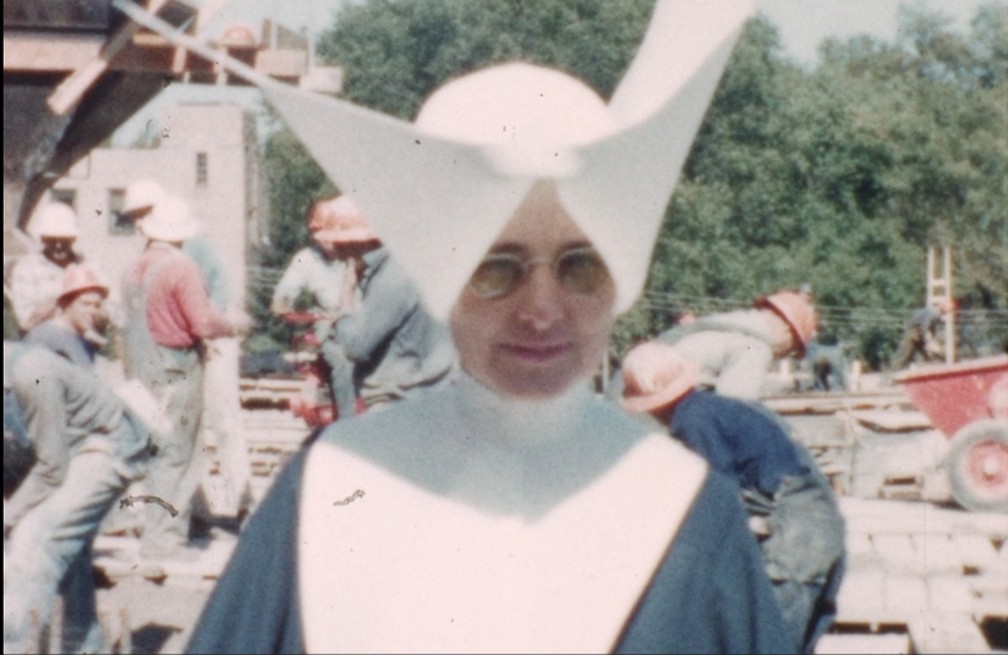
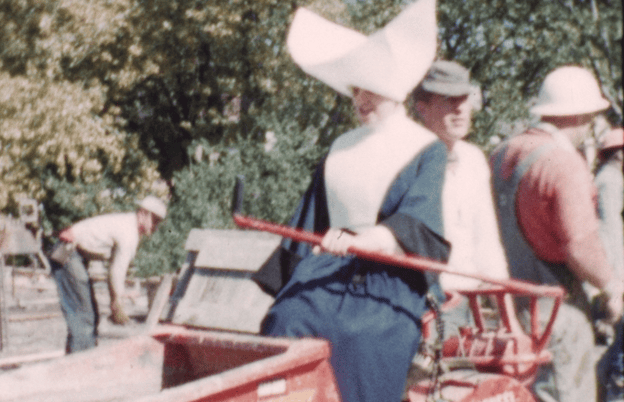
Recently, we have completed conservation on several 8-and-16-mm short films from St. Mary’s Hospital in Milwaukee, which show various pieces of the Hospital’s history.  Some of these were labeled, others had just been labeled with the name of the Hospital, so we only learned what was contained on the films once we received them back.  It turns out all of the films were silent home movies that nonetheless provide valuable glimpses into the work at the Hospital.

The pre-1964 films in bright color show the vibrancy of the old Daughters of Charity habit.  The film, titled “Construction of the North Wing,” shows exactly that in 1959.  The film alternatively shows Sister Hermine Regan, Head Administrator, overseeing the work and having a little fun on the site.

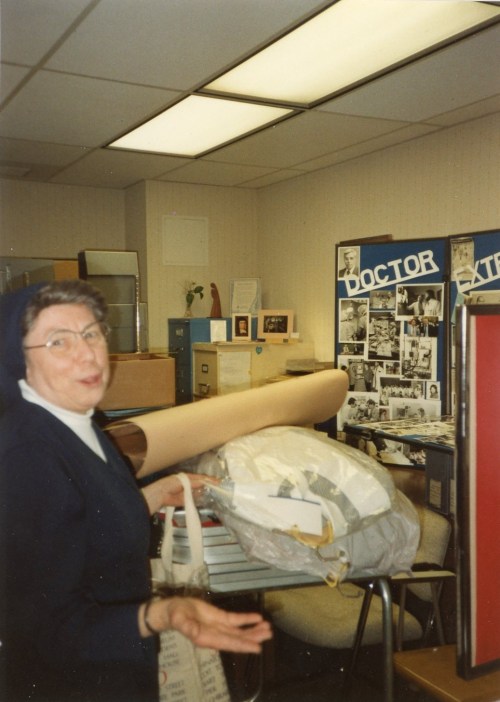
Other films show the slice of life day-to-day work of the “Medical Records Office,” complete with helpful intertitles to supplement the silent footage.

Many of the films, however, appear to be instructional, preserved and disconnected from the sound, training, or lecture.  These could have been training films for staff or could have been used as part of lectures at St. Mary’s School of Nursing.  These include a 1-minute-long film showing the setup of a camera….

…and a far more in-depth, 25-minutes depiction of a surgery in progress (images from which we are not going to share in this post due to its contents). 

The eight total films are now available to researchers, either on-site or remotely.  Although those wishing to view the films must contact us first, we no longer have to contend with old equipment or fear of damaging these artifacts to view them or make them usable!

Leave a comment

Filed under Archives, Digitized Collections, St. Mary's Hospital, Milwaukee

Mother Euphemia Blenkinsop, The Daughters of Charity’s Beloved Mother

This is a guest post by Addison Pickett, our intern for the summer and a member of the Mount St. Mary’s University Class of 2028!

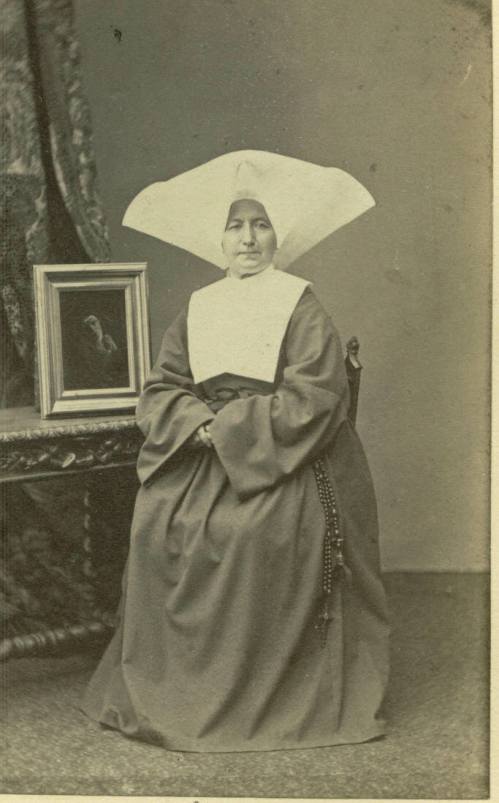
Mother Euphemia Blenkinsop

Mother Euphemia Blenkinsop was born Catherine Blenkinsop in Dublin, Ireland, c. 1815-1816. In her youth, she emigrated to the United States, where she joined the postulancy at St. Joseph’s, Emmitsburg, Maryland in 1831. Taking her habit, she took the name Euphemia as well, no doubt inspired by the early Christian martyr St. Euphemia, and it was said that the name fit her so well because of its meaning: harmonious and agreeable. In 1866, she succeeded Mother Ann Simeon as Visitatrix to the Daughters of Charity and served as Visitatrix until her death in 1887. She continues to live on as a model of innocent piety.

Mother Euphemia shows up within the pages of Sr. Mary Raphael Smith’s journal, ‘Souvenir of Old Times,’ through poems, passages, and prose dedicated to her. This journal includes many writings from the Sisters and priests of St. Joseph’s Academy from about 1833 to 1889, as well as graduation ceremony programs, obituaries, and newspaper clippings about St. Joseph’s. On St. Euphemia’s feast day, September 16th, many writings can be found about Mother Euphemia, revealing the deep admiration that the Sisters had for their Visitatrix.

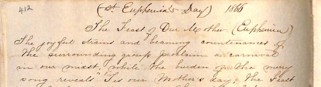
From Souvenir of Old Times, page 412: “The Feast of Our Mother (Euphemia)”

On St. Euphemia’s Feast Day in 1866, Mother Euphemia Blenkinsop’s first year as Visitatrix, the Sisters detail their hopes for a good relationship with their new Mother. This note also details a gift that the Sisters gave to Mother Euphemia, most likely as a welcoming gift: “Accept our simple tribute of affection, a moss basket gemmed with Autumn’s bright flowers, fit emblems of our heart-felt wishes, with the rich fruits of the plentiful Gathering Season, and auspicious presage of the abundant blessings with which we hope Heaven may crown your efforts in your new field of labor.”

This slice of life from September 1868 shows the kindness of the Daughters of Charity towards their new Visitatrix and marks the beginning of her noteworthy time as their leader.

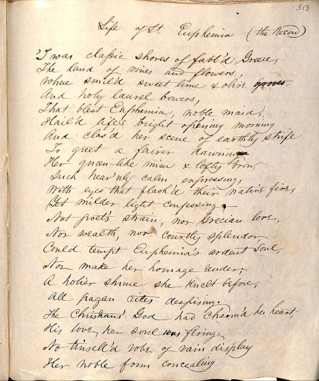
From Souvenir of Old Times, page 313: “Life of St. Euphemia (The Record)”

A reference to St. Euphemia appears on pages 313-315, telling the story of St. Euphemia’s life in the form of a poem. It is not dated, nor is there an author credited. However, in the pages following, a paper pamphlet tucked inside tells the same poem written in print and dates to September 16th, 1868.

Certain details in this poem are undeniably different from the accounts we have of St. Euphemia today, but it captures the essence of the early Christian Martyr nonetheless. It tells that St. Euphemia was born in Greece, “the land of vines and flowers.” She was a holy woman consecrated to Jesus, and when a pagan judge tried to tempt and convert her, she rejected all of his offers. For her faithfulness to God, she was attacked by an angry mob and burned alive, but both attempts on her life left her completely unharmed. Finally, the pagan judge was able to kill her with a sword: “[The judge] Commands the sword her life, to end, / This act his word redeeming.” While these entries don’t mention Mother Euphemia Blenkinsop by name, it can be assumed that they were written with her in mind, recording the story of her namesake.

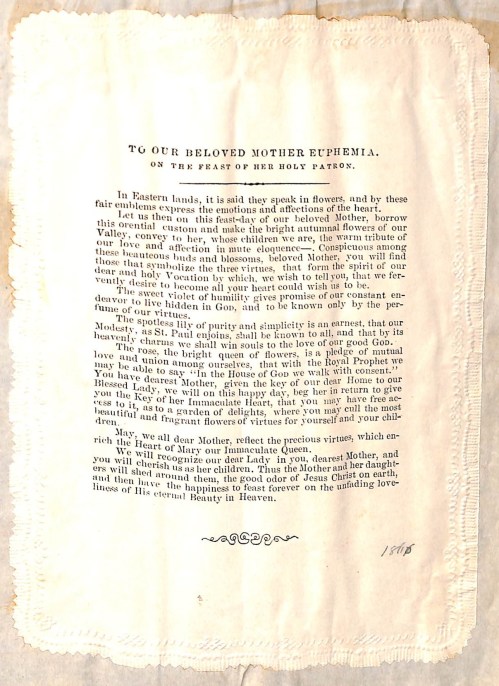
From Souvenir of Old Times, page 425: “To Our Beloved Mother Euphemia. On The Feast of Her Holy Patron.”

Another entry reveals the deep love that the Sisters had for Mother Euphemia even in her first year as Visitatrix. Mixing prose and devotion to the Virgin Mary with love for their Visitatrix, this piece calls upon Our Mother Mary to guide Mother Euphemia in leadership. The Community showed its loyalty and trust from the start saying: “We will recognize our dear Lady in you, dearest Mother, and you will cherish us as your children.” Despite her assumption of the role being very recent, the Sisters had a deep trust she would fulfill her role well.

Leave a comment

Filed under Archives, Mother Euphemia Blenkinsop, Sr. Mary Raphael Smith

The Common Autograph Poems of St. Joseph’s Academy Students

This is a guest post by Addison Pickett, our intern for the summer and a member of the Mount St. Mary’s University Class of 2028!

Keeping autograph books was a common practice for students in the 19th century to remember their classmates and friends from their school years. Autograph books were eventually replaced by the autograph pages in yearbooks and are now a relic of their time.

While the go-to for 21st century students are writing things like ‘HAGS,’ ‘Stay Cool!,’ or their phone numbers, students of the 19th century often recited small poems with themes of friendship and remembrance alongside their signatures. The autograph books of Emma Moore and Mame from St. Joseph’s Academy in Emmitsburg, Maryland are no exception. These autograph books date from 1885 and 1886, respectively, and hold signatures from as late as 1892. These books shed light on the thoughts and feelings of high school girls in the 1880s.

Portion of Emma Moore's scrapbook, page 25
From Emma Moore Scrapbook, page 25: “When rocks and hills divide us, / And you no more I see, / Remember it was Tiphine, / Who wrote these lines to thee. Yours Sincerely, Tiphine Burnbach”
Portion of Emma Moore's Scrapbook, page 55
From Emma Moore Scrapbook, page 55: “When mountains and hills divide us, / And you no more I see, / Remember it was Ella, / That traced these lines for thee. Your fond friend, Ellen [Ella] Melia”

This poem was a very common recitation in autograph books of the 19th century, and even provides a space to write one’s name within the poem. There are many different variations of the poem, and these two entries showcase that. While Tiphine writes “rocks and hills,” Ella writes “mountains and hills,” perhaps feeling it was more apt for their home on St. Joseph’s Vale. At the end of the poem, as well, Tiphine writes “who wrote these lines to thee,” whereas Ella says “who traced these lines for thee.”

From the Autograph Book of Mame, page 15: “Drop one pearl in memory’s casket for your loving friend M. A. May”

From the Emma Moore Scrapbook, page 42: “In memory’s casket drop one pearl for your schoolmate and friend Annie Farrell”

Another common “Forget-Me-Not” poem from the 19th century, this poem uses the imagery of dropping pearls into a casket as symbolism for remembering old friends. A variation of these lines are even featured in the 1881 book “New Choice Selections for Autograph Books: Comprising Original and Selected Friendly, Affectionate, Humorous and Dedicatory Verses, Suitable for inscription in Autograph Albums, on all occasions.”

From the Autograph Book of Mame, page 51: “Memory consecrates these lines, / Friendship holds them dear, / May they often call to mind / The friend that placed them here. Sincerely your friend Louisa McSherry”

Portion of Emma Moore's scrapbook, page 61
From the Emma Moore Scrapbook, page 61: “Memory consecrates these lines, / Friendship holds them dear, / May they often call to mind / The friend that placed them here. Marie Duperier”

While this poem holds no variation between Louisa and Marie’s entries, there is no record of the verse online. Perhaps lack of variation and availability online shows that this was a more unique or contained “Forget-Me-Not” poem. It is a simple poem that simply calls for remembrance of friendship.

From the Autograph Book of Mame, page 17: “Gather ye rosebuds while ye may, / Old time is still a-flying, / And that same flower that blooms today, / Tomorrow may be dying.”

From the Emma Moore Scrapbook, page 6: “Gather your rosebuds while you may, / Old time is still a-flying, / And the same flower that smiles today, / Tomorrow may be dying.”

This poem is titled ‘To The Virgins, Make Much of Time,’ and was written by Robert Herrick in 1648. Departing from themes of remembrance and friendship, Herrick’s poem is often described as a “Carpe Diem” poem about making the most of your life. Besides “Forget-Me-Not” poems, themes of living well were also very common in these two autograph books. Interestingly, Julia O’Keefe errs from the original poem when she writes “that same flower that blooms,” instead of “that same flower that smiles.” Julia likely misremembered the line or learned the poem from someone who misremembered.

These poems display the traditions and culture of 19th century schoolgirls, revealing their interests and desires as well as love for their friends. The 19th century can seem so foreign to the modern age, but small traditions like these autograph books show that humans are always united by their love and care for one another.

References:

https://queensu.scholaris.ca/server/api/core/bitstreams/c710c6f7-b9d6-4d6d-9fd2-751b5f8a645a/content

https://ameshistory.org/content/autograph-book-verses

Leave a comment

Filed under Archives, St. Joseph's Academy