The St. Joseph’s Needlework Collection

When Mother Seton started St. Joseph’s School (later Academy) in 1810, she made it a point to include the very practical skill of needlework into her curriculum for the young girls who attended the School.  Many of these needleworks survive in the archival collections of the Daughters from across the span of the 19th century.

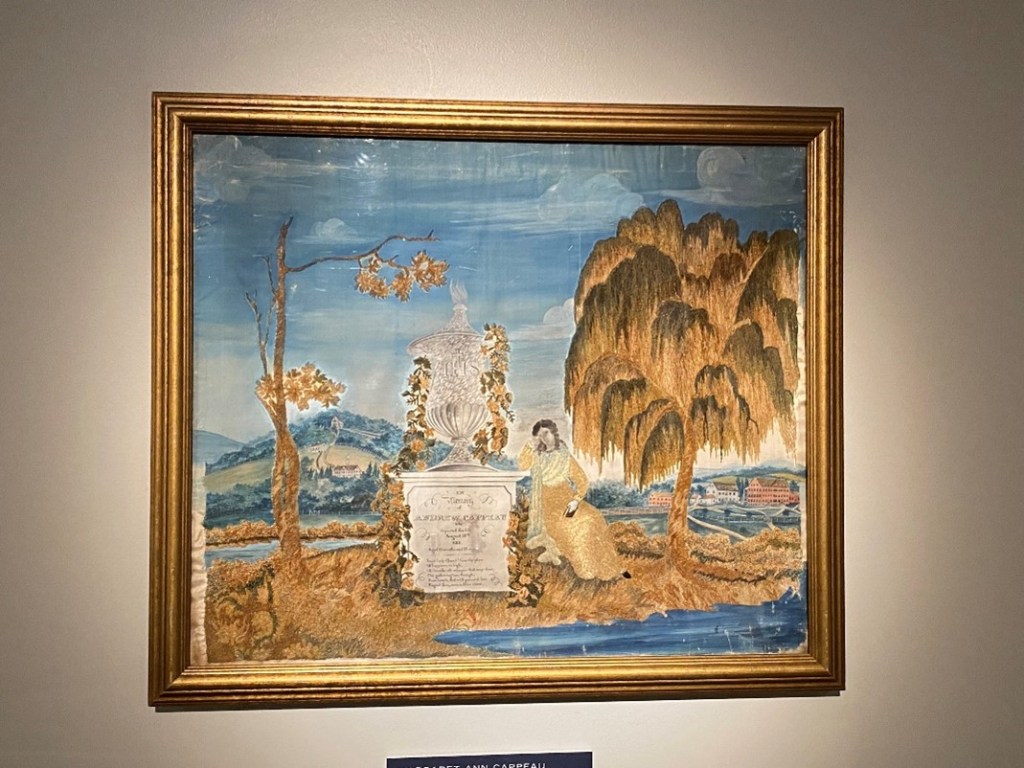
The incorporation of needlework into the curriculum served to teach skills in the arts, religious instruction, the beginnings of basic literacy, and practical skills for 19th century feminine life that prepared the girls to be proper 19th century women.  Many of the needleworks in the collection combine multiple mediums, with a background painted in watercolor and the silk embroidered on top of it, as with this piece shown below by Margaret Ann Cappeau (began her studies in 1826).

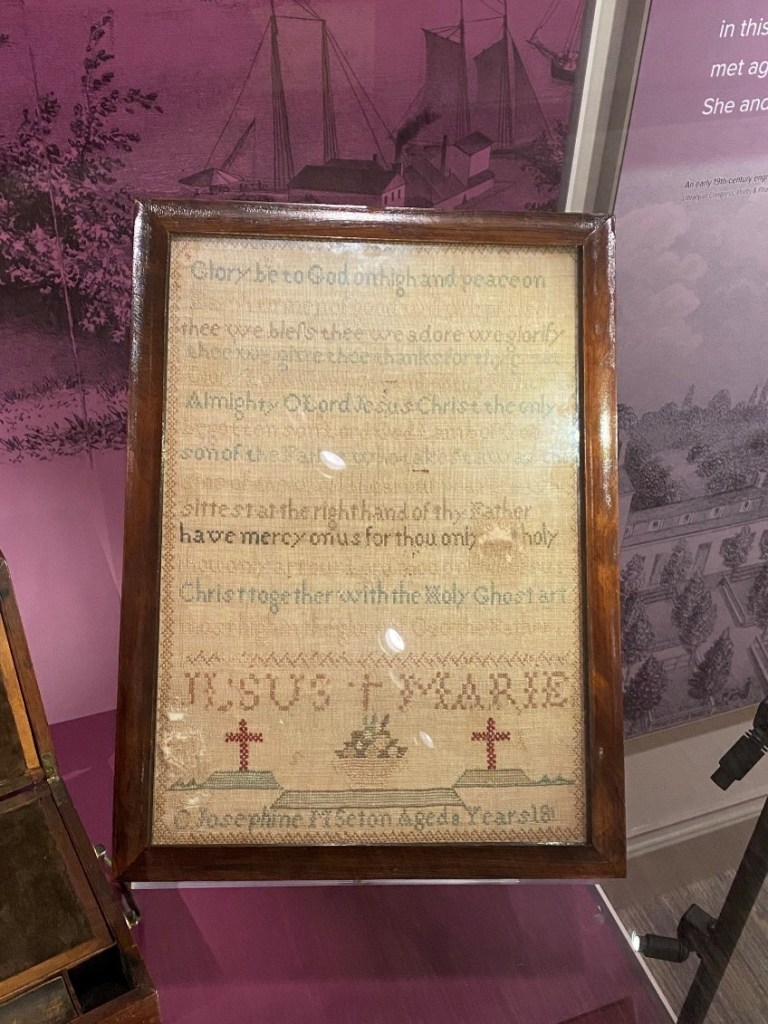
For literacy and instruction in religion, many students started with basic letters and numbers.  When they had mastered these tasks, they advanced on to stitching out verses of scripture.  Mother Seton even helped her daughter Catherine with her needlework and early learning on this front.

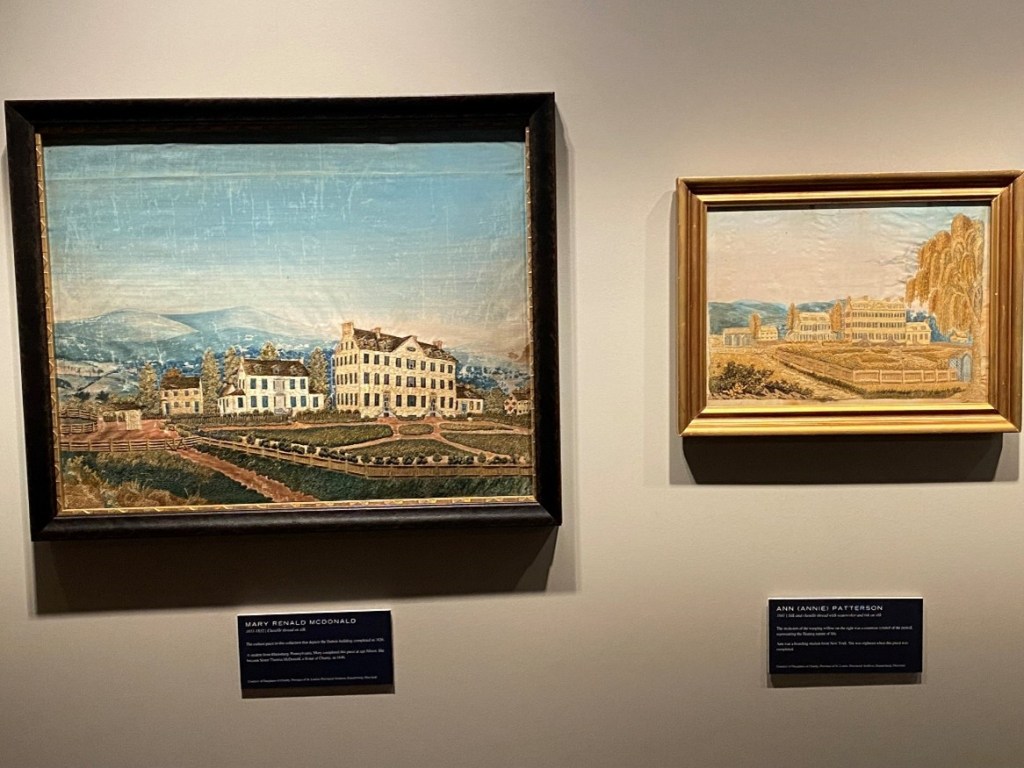
In addition to being records of the curriculum of the Academy, the needlepoints also serve as some of the earliest records of the evolution of the School’s campus.  A common subject of the needleworks is a depiction of the school itself, and, in the era before photography was invented or common, the images created by the students provide the earliest visual records of how the campus grew and evolved.

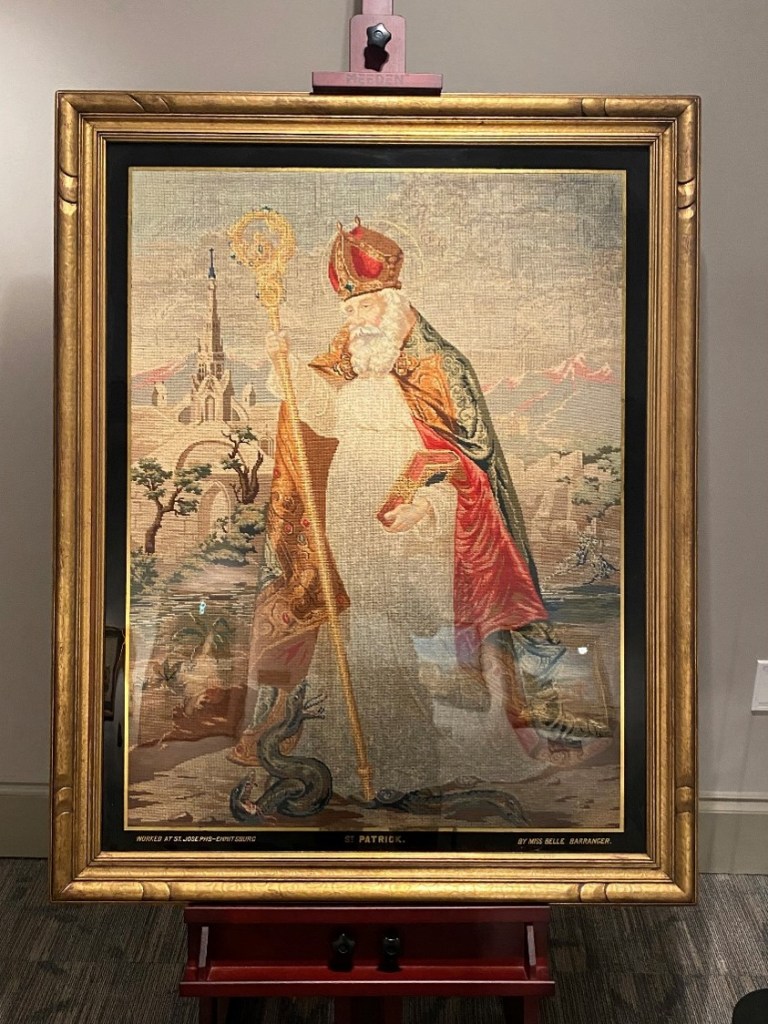
Other needleworks contain stories of their own.  Belle Barranger began creating the largest needlepoint in the collection on the eve of the Battle of Gettysburg, when the School was evacuated and temporarily closed as both the Union and Confederate armies marched through town.  As she tried to finish St. Patrick and his destruction of the serpents, she did not have time to finish the serpent itself!  As the piece passed from one generation of her family to the next, so too did the story and what it represented, until her descendants, still knowledgeable of the Daughters, donated it back to them for posterity after their mother’s death.

These samplers were common in Maryland and have a distinctive style.  Today, they are exceedingly rare and valuable, with the Daughters of Charity collection being one of the largest, with nearly 40 samplers dating from 1812 to 1940.  Many of the samplers from the collection are currently on display in the Seton Shrine Museum through the end of 2024.  They can be viewed both as beautiful pieces of artwork or as pieces of documenting the history of education in Emmitsburg.

1 Comment

Filed under Artifacts, Education, Emmitsburg, Exhibits, St. Joseph's Academy

Teddy Roosevelt’s Christmas Cards

The Daughters of Charity have had histories with many United States Presidents, but perhaps no stranger one is reflected in the Archives than the one with President Teddy Roosevelt.

Theodore Roosevelt first became acquainted with the Daughters at Montauk Point Camp on Long Island.  Colonel Roosevelt, a New Yorker from the New York City-Long Island area, passed through on his way to the Spanish-American War, with the Daughters nursing at stateside camps in 1898. 

In 1902, President Roosevelt was visiting Indianapolis, when he suffered from an abscess in his leg.  Sister Regina Purtell, then director of St. Vincent’s Hospital, met the President and would serve as his private nurse.

In the several years afterward that he occupied the White House, President Roosevelt seems to have recognized Sister Regina’s fellow Daughters of Charity at Providence Hospital.  During his second term, from 1905-1908, the Daughters and the President exchanged Christmas cards every year, with the President sending a nice thank you for their prayers and their work.  Although they are not handwritten, they are all unique, which indicates that they were not a form letter but dictated by the President to a secretary.  He did then personally sign the letters on official White House stationery. 

His primary point-of-contact seems to have been Sister Regis Biller, another veteran of Montauk Point. 

Some of the letters do have the unfortunate mar of some out-of-date archival practice, when a stamp by the holding institution was used to show ownership of an item and prove authenticity.  While none of the stamps obscure the text, they tend to take the reader out of the moment with an intrusion of later 20th century practices.

2 Comments

Filed under Theodore Roosevelt, U.S. Presidents

Remembering JFK and November 22, 1963

The year 2023 marks 60 years since the assassination of the nation’s first Catholic President, John F. Kennedy.  The Daughters of Charity Provincial Archive contains several references to this day and to the late President.

Most directly, the Daughters of Charity taught at Holy Trinity School in Dallas during that time period, a longtime parish of the Vincentian Fathers, the brother community to the Daughters.  Inside the boundaries of that parish was Parkland Hospital, where the President was rushed after the shots rang out.  Father Oscar Huber, C.M., the pastor at Holy Trinity, provided the Last Rites for President Kennedy.

Image Courtesy the Vincentian Provincial Archive at DePaul University – ritual book used by Father Oscar Huber for President Kennedy’s Last Rites

A tradition of the Daughters Schools at the time was the Children of Mary groups, several of which sent condolence cards to Jacqueline.  Two of Mrs. Kennedy’s polite responses survive, once from Holy Trinity School in Dallas and the other from Utica Catholic Academy in Upstate New York.

Thank you card from Jacquie Kennnedy reading:  "Mrs. Kennedy is most grateful to you for remembering her and her family and deeply regrets not being able to personally respond to all those who have been so thoughtful."

In the immediate aftermath of the assassination, the President’s gravesite in Arlington Cemetery became a pilgrimage site.  When the Superioress General, Mother Suzanne Guillemin, visited the United States from France, the Daughters arranged a trip to the gravesite in the midst of her full travel schedule.

Photo of Mother Suzanne Guillemin, Superioress General, along with a priest and three other Daughters of Charity visiting President Kennedy's grave

The Daughters maintained relationships with members of the Kennedy family in the subsequent years.  Perhaps most notably, Jacqueline hand-wrote a personal thank-you letter to Sister Helen Kelly at Carney Hospital, Boston, in 1969 thanking Sister for favoring her preferred site of the future Kennedy Presidential Library, a controversial site choice at the time.  The Daughters also worked with Jean Kennedy Smith, the President’s sister and their brother-in-law, Sargent Shriver, in the governance of the Kennedy Child Study Center in New York City.

Director of the Kennedy Child Study Center: Sister Mary Patricia Finneran; Archbishop Cardinal Francis Spellman of New York; Rabbi Samuel Belkin, President of Yeshiva University; Sargent Shriver; and Jean Kennedy Smith
Director of the Center Sister Mary Patricia Finneran; Archbishop Cardinal Francis Spellman of New York; Rabbi Samuel Belkin, President of Yeshiva University; Sargent Shriver; and Jean Kennedy Smith

Although not strictly part of the collection scope, several Sisters over the years have donated their JFK memorabilia to the Archives, reflecting the deep scar that the assassination left across the Daughters, the American Catholic community, and the nation.  Even 60 years on, this remains a deep emotional wound in the American psyche.

Photo of the motorcade with the President, First Lady, and Governor Connally, taken by Sister Angela Fitzgibbon, D.C., November 22, 1963

1 Comment

Filed under John F. Kennedy