Category Archives: St. Joseph’s Academy

The Common Autograph Poems of St. Joseph’s Academy Students

This is a guest post by Addison Pickett, our intern for the summer and a member of the Mount St. Mary’s University Class of 2028!

Keeping autograph books was a common practice for students in the 19th century to remember their classmates and friends from their school years. Autograph books were eventually replaced by the autograph pages in yearbooks and are now a relic of their time.

While the go-to for 21st century students are writing things like ‘HAGS,’ ‘Stay Cool!,’ or their phone numbers, students of the 19th century often recited small poems with themes of friendship and remembrance alongside their signatures. The autograph books of Emma Moore and Mame from St. Joseph’s Academy in Emmitsburg, Maryland are no exception. These autograph books date from 1885 and 1886, respectively, and hold signatures from as late as 1892. These books shed light on the thoughts and feelings of high school girls in the 1880s.

Portion of Emma Moore's scrapbook, page 25
From Emma Moore Scrapbook, page 25: “When rocks and hills divide us, / And you no more I see, / Remember it was Tiphine, / Who wrote these lines to thee. Yours Sincerely, Tiphine Burnbach”
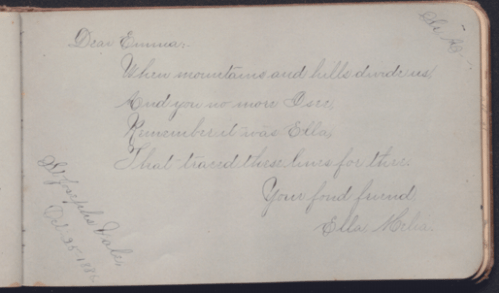
Portion of Emma Moore's Scrapbook, page 55
From Emma Moore Scrapbook, page 55: “When mountains and hills divide us, / And you no more I see, / Remember it was Ella, / That traced these lines for thee. Your fond friend, Ellen [Ella] Melia”

This poem was a very common recitation in autograph books of the 19th century, and even provides a space to write one’s name within the poem. There are many different variations of the poem, and these two entries showcase that. While Tiphine writes “rocks and hills,” Ella writes “mountains and hills,” perhaps feeling it was more apt for their home on St. Joseph’s Vale. At the end of the poem, as well, Tiphine writes “who wrote these lines to thee,” whereas Ella says “who traced these lines for thee.”

From the Autograph Book of Mame, page 15: “Drop one pearl in memory’s casket for your loving friend M. A. May”

From the Emma Moore Scrapbook, page 42: “In memory’s casket drop one pearl for your schoolmate and friend Annie Farrell”

Another common “Forget-Me-Not” poem from the 19th century, this poem uses the imagery of dropping pearls into a casket as symbolism for remembering old friends. A variation of these lines are even featured in the 1881 book “New Choice Selections for Autograph Books: Comprising Original and Selected Friendly, Affectionate, Humorous and Dedicatory Verses, Suitable for inscription in Autograph Albums, on all occasions.”

From the Autograph Book of Mame, page 51: “Memory consecrates these lines, / Friendship holds them dear, / May they often call to mind / The friend that placed them here. Sincerely your friend Louisa McSherry”

Portion of Emma Moore's scrapbook, page 61
From the Emma Moore Scrapbook, page 61: “Memory consecrates these lines, / Friendship holds them dear, / May they often call to mind / The friend that placed them here. Marie Duperier”

While this poem holds no variation between Louisa and Marie’s entries, there is no record of the verse online. Perhaps lack of variation and availability online shows that this was a more unique or contained “Forget-Me-Not” poem. It is a simple poem that simply calls for remembrance of friendship.

From the Autograph Book of Mame, page 17: “Gather ye rosebuds while ye may, / Old time is still a-flying, / And that same flower that blooms today, / Tomorrow may be dying.”

From the Emma Moore Scrapbook, page 6: “Gather your rosebuds while you may, / Old time is still a-flying, / And the same flower that smiles today, / Tomorrow may be dying.”

This poem is titled ‘To The Virgins, Make Much of Time,’ and was written by Robert Herrick in 1648. Departing from themes of remembrance and friendship, Herrick’s poem is often described as a “Carpe Diem” poem about making the most of your life. Besides “Forget-Me-Not” poems, themes of living well were also very common in these two autograph books. Interestingly, Julia O’Keefe errs from the original poem when she writes “that same flower that blooms,” instead of “that same flower that smiles.” Julia likely misremembered the line or learned the poem from someone who misremembered.

These poems display the traditions and culture of 19th century schoolgirls, revealing their interests and desires as well as love for their friends. The 19th century can seem so foreign to the modern age, but small traditions like these autograph books show that humans are always united by their love and care for one another.

References:

https://queensu.scholaris.ca/server/api/core/bitstreams/c710c6f7-b9d6-4d6d-9fd2-751b5f8a645a/content

https://ameshistory.org/content/autograph-book-verses

Leave a comment

Filed under Archives, St. Joseph's Academy

The St. Joseph’s Needlework Collection

When Mother Seton started St. Joseph’s School (later Academy) in 1810, she made it a point to include the very practical skill of needlework into her curriculum for the young girls who attended the School.  Many of these needleworks survive in the archival collections of the Daughters from across the span of the 19th century.

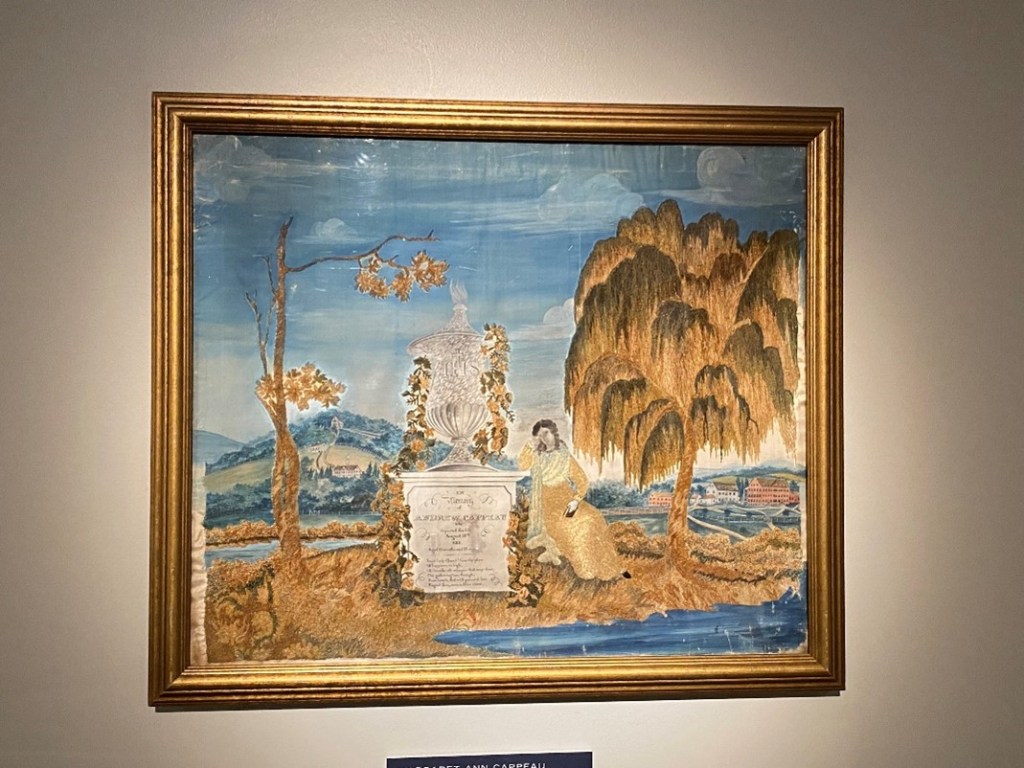
The incorporation of needlework into the curriculum served to teach skills in the arts, religious instruction, the beginnings of basic literacy, and practical skills for 19th century feminine life that prepared the girls to be proper 19th century women.  Many of the needleworks in the collection combine multiple mediums, with a background painted in watercolor and the silk embroidered on top of it, as with this piece shown below by Margaret Ann Cappeau (began her studies in 1826).

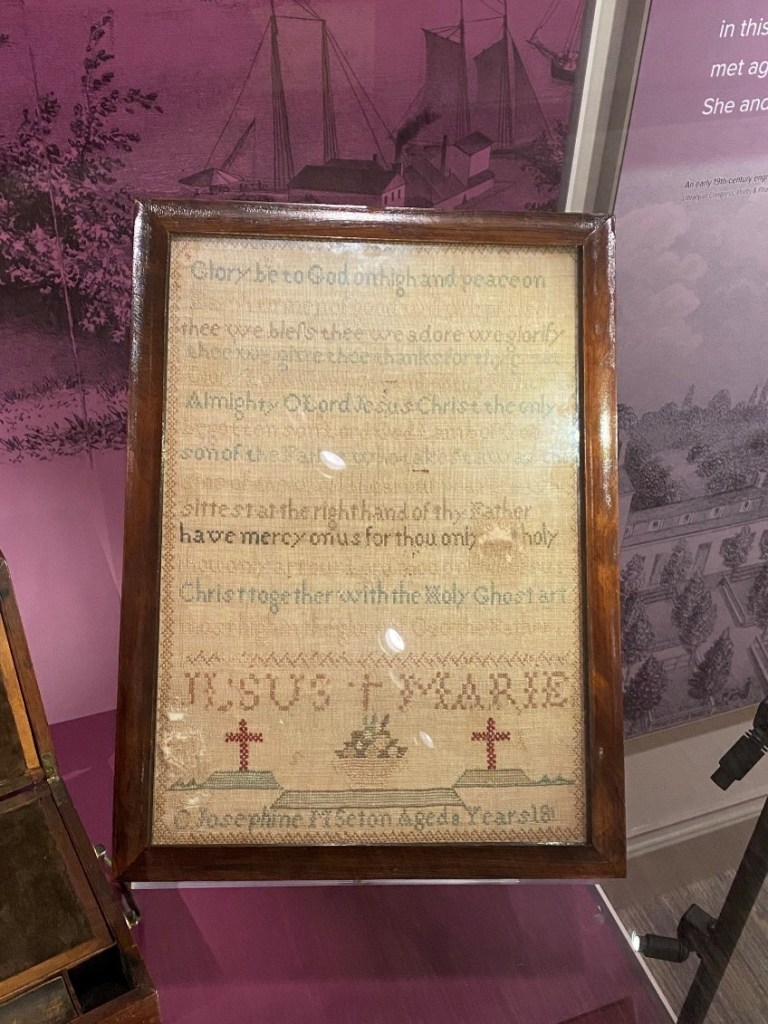
For literacy and instruction in religion, many students started with basic letters and numbers.  When they had mastered these tasks, they advanced on to stitching out verses of scripture.  Mother Seton even helped her daughter Catherine with her needlework and early learning on this front.

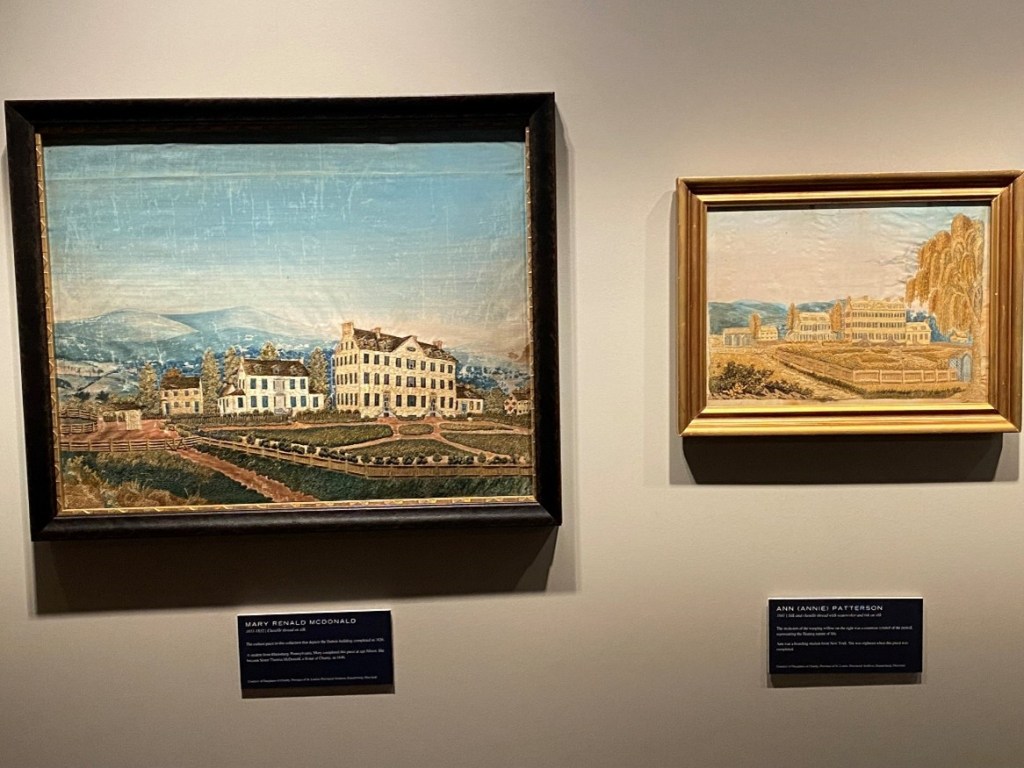
In addition to being records of the curriculum of the Academy, the needlepoints also serve as some of the earliest records of the evolution of the School’s campus.  A common subject of the needleworks is a depiction of the school itself, and, in the era before photography was invented or common, the images created by the students provide the earliest visual records of how the campus grew and evolved.

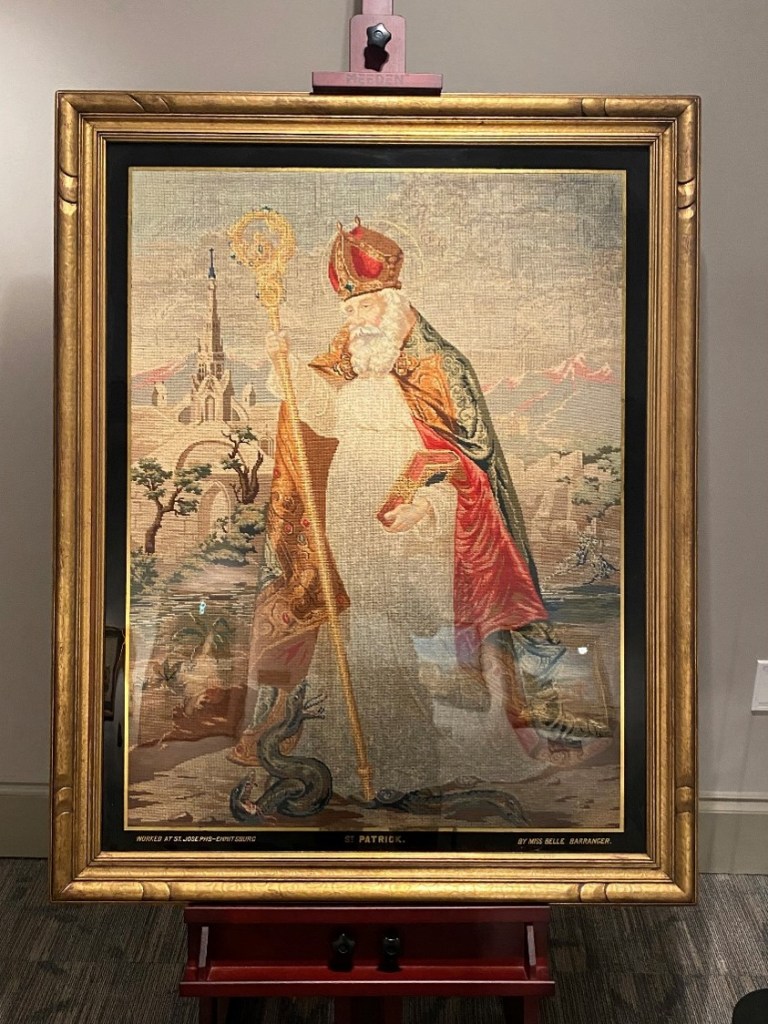
Other needleworks contain stories of their own.  Belle Barranger began creating the largest needlepoint in the collection on the eve of the Battle of Gettysburg, when the School was evacuated and temporarily closed as both the Union and Confederate armies marched through town.  As she tried to finish St. Patrick and his destruction of the serpents, she did not have time to finish the serpent itself!  As the piece passed from one generation of her family to the next, so too did the story and what it represented, until her descendants, still knowledgeable of the Daughters, donated it back to them for posterity after their mother’s death.

These samplers were common in Maryland and have a distinctive style.  Today, they are exceedingly rare and valuable, with the Daughters of Charity collection being one of the largest, with nearly 40 samplers dating from 1812 to 1940.  Many of the samplers from the collection are currently on display in the Seton Shrine Museum through the end of 2024.  They can be viewed both as beautiful pieces of artwork or as pieces of documenting the history of education in Emmitsburg.

1 Comment

Filed under Artifacts, Education, Emmitsburg, Exhibits, St. Joseph's Academy

Special Exhibit: The Academy at Christmastime

Along with our partners at The National Shrine of Saint Elizabeth Ann Seton, the Archives has curated a set of student notebooks from students of St. Joseph’s Academy. We even made some copies so you can see more than the page that is on display! Stop by the entry hallway to the Basilica to see them!

This is available all week through Sunday, December 11 and leads through the Museums by Candlelight (Saturday, December 10) event put on by the Frederick Historic Sites Consortium!

Leave a comment

Filed under Announcements, Exhibits, St. Joseph's Academy