Category Archives: Exhibits

Dinosaurs in Emmitsburg

Dinosaurs began to be recognized by paleontologists as the creatures that they were in the early 1800s.  In 1895, the Provincial Annals included a note about the local community and the scientific field of paleontology: 

“These few days past the men have been removing two large slabs from Avenue side walk.  One is destined for the Johns Hopkins’s University, the other for our own cabinet.  Prof. Mitchell of the Mountain [Mount St. Mary’s University] is the one who is securing these singular geological specimens.  They have long been objects of the Sisters’ curiosity & comment as they promenade up and down the Avenue in summer evening recreation.  They bear the impression of many feet of different kinds & sizes, pre-historic creatures that lived O many & many age ago!  The Professor’s interest in our quarry from where these slabs were taken led him.  His opinion is that all this land round about ages & ages ago formed an estuary, the mountains were its shores.”

The slabs documented by Dr. James A. Mitchell were the first dinosaur prints from Maryland to be announced in a scientific publication.

In the spirit of this time period, the cabinet referred to was a “cabinet of curiosities,” sort of a predecessor to a modern-day museum exhibit.  It was housed in the Burlando Building of St. Joseph’s Academy, the school thatthe Daughters operated.  Later, it was on display, in a deep historical anachronism, in the Stone House on campus where the community had begun in 1809. 

Dr. Mitchell made sketches of the slabs.  Then the slabs went missing.

In 1990, a group of maintenance workers discovered a slab in a crate with fossilized footprints in an old barn on campus.  The search was sparked by Dr. Peter Kranz, who was tracking Mitchell’s work from 100 years before.  In 1998, the slab was put on permanent display in the Maryland Science Center.  Before it was moved from Emmitsburg to Baltimore, the Sisters and employees in Emmitsburg could see it for themselves, privately and up close. 

The Maryland Science Center performed their own analysis on the footprints, identifying them as coming from:

“several dinosaurs who walked across it during the Triassic period, 210 million years ago.  Scientists are not certain exactly which type of dinosaur made the tracks….They were small, plant-eating dinosaurs, about the size of a turkey.  They were ornithischian dinosaurs, and had hip skeletons somewhat like that of birds [This time period in the 1990s is when the theory of dinosaur to bird evolution started to receive wide acceptance].  They usually walked on two legs (‘bi-pedal’), but occasionally dropped down to walk on four legs part of the time.”

Theorized sketches of the dinosaurs created by the Maryland Science Center

With the level of excitement of such a find, it was natural to assume that the same tracks that Mitchell and the Sisters set eyes on in the 1890s had been rediscovered.  However, based on his sketches, this is not the same slab, but an entirely different set of fossilized dinosaur tracks.  It appears the slab once sent to Johns Hopkins has been lost as well.

The discovery and transfer of the fossils were widely covered in the local media, and they went on display at the Maryland Science Center in the aftermath of the first two Jurassic Park films. They remain on display now in the “Dinosaur Mysteries” exhibit.

Sister Betty Ann McNeil overseeing the shipment of the slab out of Emmitsburg
Fossilized footprints on display at Maryland Science Center (Courtesy MD Science Center)

Leave a comment

Filed under Emmitsburg, Exhibits, James Mitchell, Ph.D., Mount St. Mary's University

The St. Joseph’s Needlework Collection

When Mother Seton started St. Joseph’s School (later Academy) in 1810, she made it a point to include the very practical skill of needlework into her curriculum for the young girls who attended the School.  Many of these needleworks survive in the archival collections of the Daughters from across the span of the 19th century.

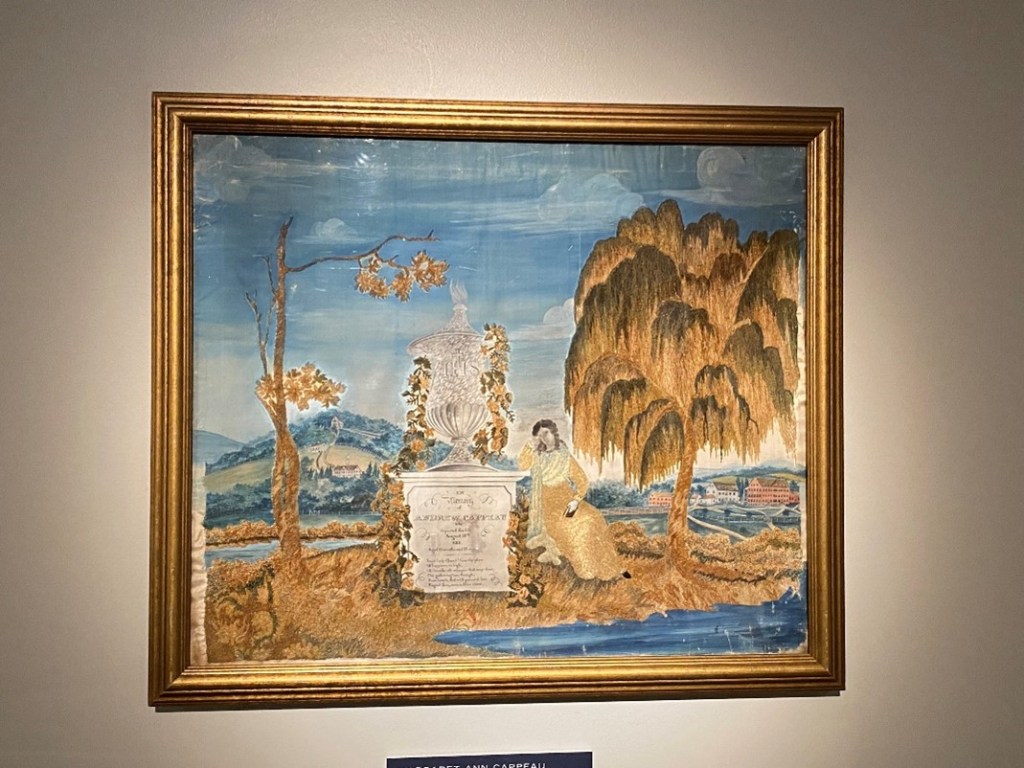
The incorporation of needlework into the curriculum served to teach skills in the arts, religious instruction, the beginnings of basic literacy, and practical skills for 19th century feminine life that prepared the girls to be proper 19th century women.  Many of the needleworks in the collection combine multiple mediums, with a background painted in watercolor and the silk embroidered on top of it, as with this piece shown below by Margaret Ann Cappeau (began her studies in 1826).

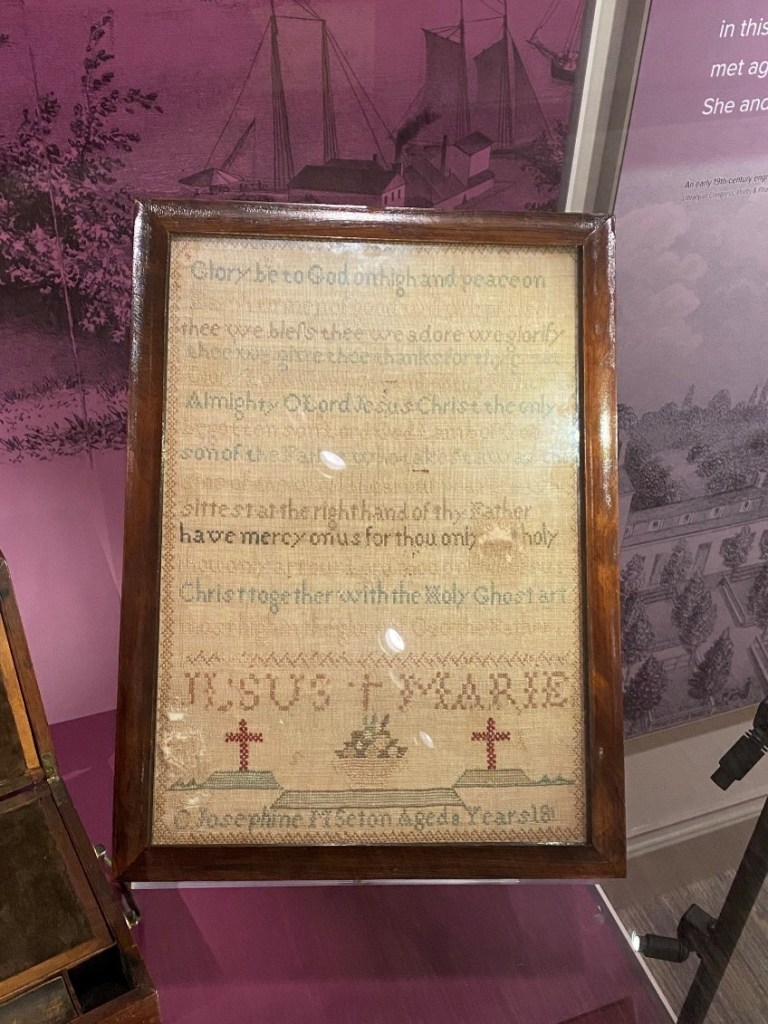
For literacy and instruction in religion, many students started with basic letters and numbers.  When they had mastered these tasks, they advanced on to stitching out verses of scripture.  Mother Seton even helped her daughter Catherine with her needlework and early learning on this front.

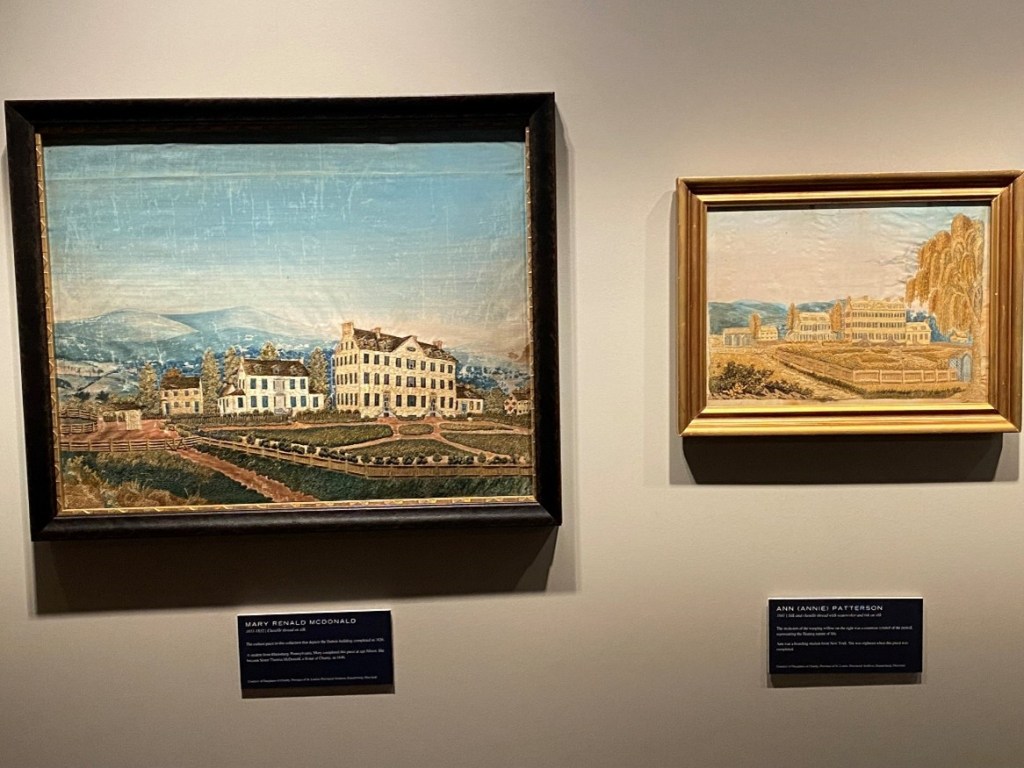
In addition to being records of the curriculum of the Academy, the needlepoints also serve as some of the earliest records of the evolution of the School’s campus.  A common subject of the needleworks is a depiction of the school itself, and, in the era before photography was invented or common, the images created by the students provide the earliest visual records of how the campus grew and evolved.

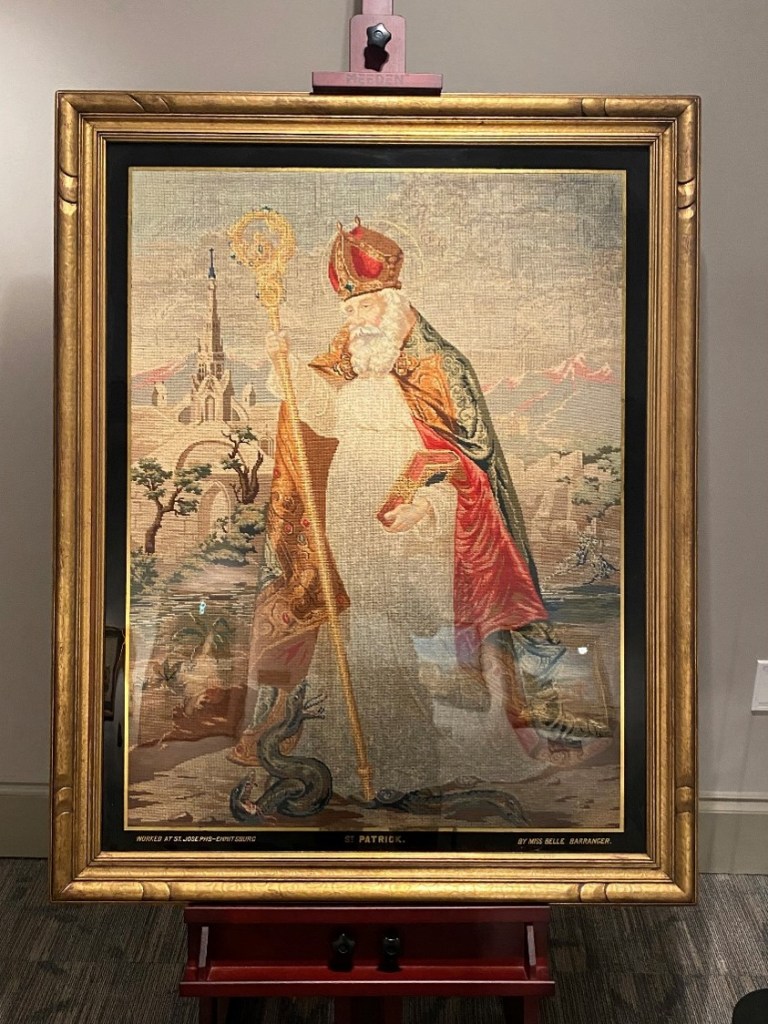
Other needleworks contain stories of their own.  Belle Barranger began creating the largest needlepoint in the collection on the eve of the Battle of Gettysburg, when the School was evacuated and temporarily closed as both the Union and Confederate armies marched through town.  As she tried to finish St. Patrick and his destruction of the serpents, she did not have time to finish the serpent itself!  As the piece passed from one generation of her family to the next, so too did the story and what it represented, until her descendants, still knowledgeable of the Daughters, donated it back to them for posterity after their mother’s death.

These samplers were common in Maryland and have a distinctive style.  Today, they are exceedingly rare and valuable, with the Daughters of Charity collection being one of the largest, with nearly 40 samplers dating from 1812 to 1940.  Many of the samplers from the collection are currently on display in the Seton Shrine Museum through the end of 2024.  They can be viewed both as beautiful pieces of artwork or as pieces of documenting the history of education in Emmitsburg.

1 Comment

Filed under Artifacts, Education, Emmitsburg, Exhibits, St. Joseph's Academy

Creating the Habit Exhibit

For about a month now, the Daughters of Charity Provincial Archives’ exhibit on the history, symbolism, and eventual change of the Daughters habit has been open. We wanted to use this opportunity to discuss some of the background that led us to the finished product of the exhibit.

The origin of the exhibit came, of course, with the planning of the renovation of the Seton Shrine Museum, when the Daughters Archive secured their own exhibit gallery, open to the public alongside the Shrine. As we thought about what would be our first opening to a large crowd, we turned to our own statistics and the number of questions we receive about the Daughters traditional habit. With the number of requests we receive on this subject, we saw an opening to appeal and educate on a popular subject. With the number of habits, rosaries, and chaplets in the artefactual collections, we saw a chance for a very material heavy exhibit.

From here, we saw five key things to focus on: the origins in the times of St. Louise, the habits and chaplets and their symbolism, making a cornette, and the change of the habit.

When it came to creating the mannequins, the showpiece and centerpieces of the exhibit, we did have to acquire a few more mannequins, but also now faced the challenge of how to prepare them for a museum-going audience. Thankfully, we were able to draw upon our colleagues at Heritage Frederick, the Historical Society of Frederick County, to teach us how to dress them properly. Their curator, Amy Hunt, had just finished leading the creation of their “Women’s Work from Farm to Fashion” exhibit, and taught us what she knew about displaying textiles and clothing.

We realized early on that we wanted something of a ‘workshop closet’ feel, both as an aesthetic and as a way to establish some separation between the visitor and the habits – hence the platform and barrier. We realized the chaplets and rosaries could easily be displayed in exhibit cases that we already had, and we already had a pulled cornette on display in our old exhibit space in a perfectly sized case. The cornette-making equipment also provided a nice show piece, and we had already digitized an instructional video of a Daughter explaining how to make a cornette into its iconic shape and image.

We also realized that something in the artifact collections, which we had in abundance but which got very little actual use could give the exhibit a much-needed feeling of fun and spontaneity – the dolls. These not only illustrated the different habits over time, even when we did not have room for more mannequins, but also provided a resonance point for guests and particularly something relatable for children.

With the big showpieces and themes covered, we could then take steps to fill the rest of the space. One staff member realized that artwork depicting the habits could entice visitors. Another realized that guests could have a personal connection with a Daughter if they were allowed to touch and handle her chaplet. All of these things helped create our first exhibit truly open to the public without restriction. We invite you in to explore the truly iconic apparel of the Daughters of Charity!

Getting in the Habit: Iconic Apparel of the Daughters of Charity is open at the Seton Shrine in Emmitsburg, Maryland. Monday through Saturday 10AM-5PM, except Wednesday when it is open until 7:30PM. Private tours can be arranged by contacting archives@doc.org or calling 301-447-6067. The exhibit will be open through the end of 2024.

Leave a comment

Filed under Archives, Exhibits, Habit