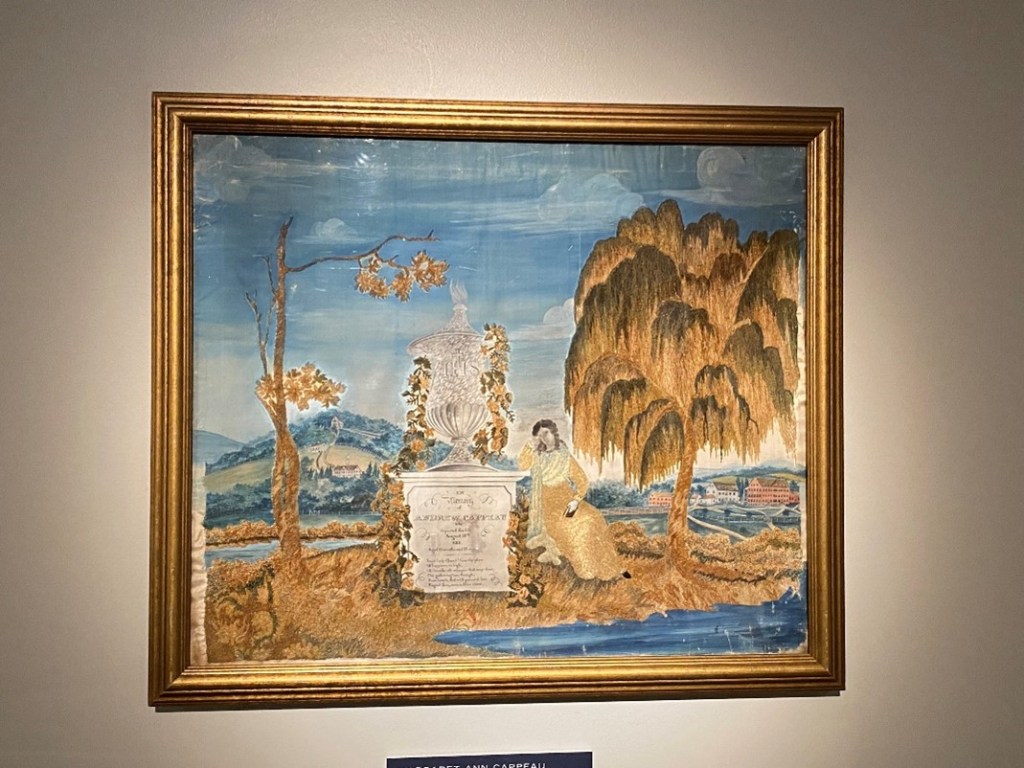
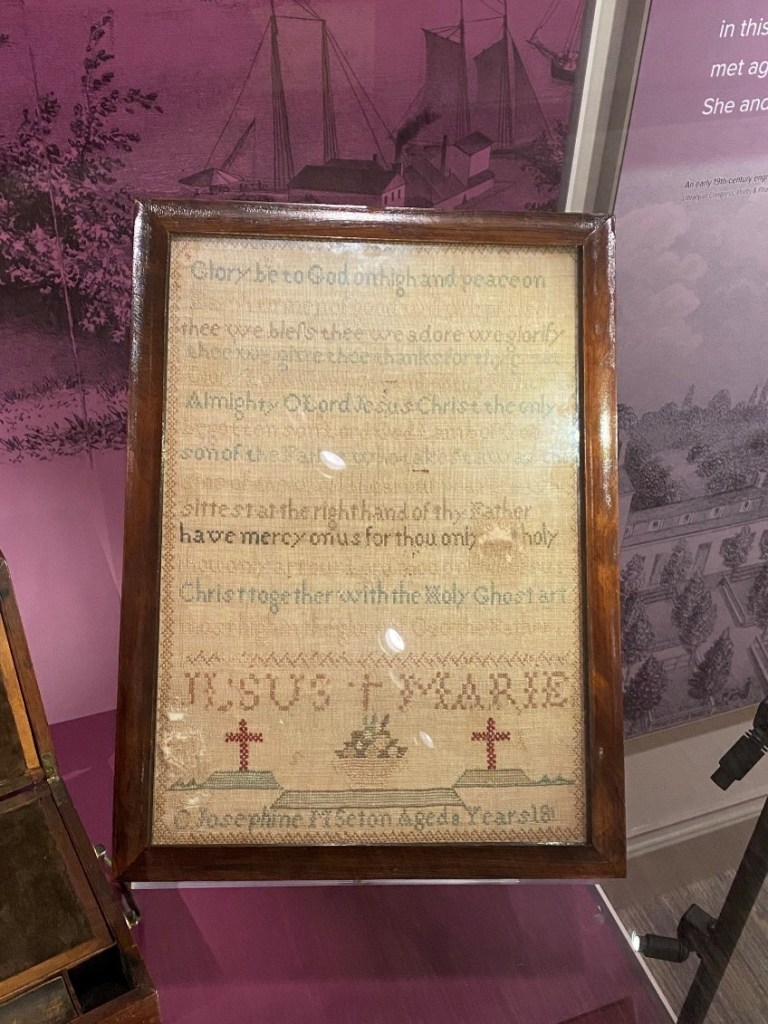
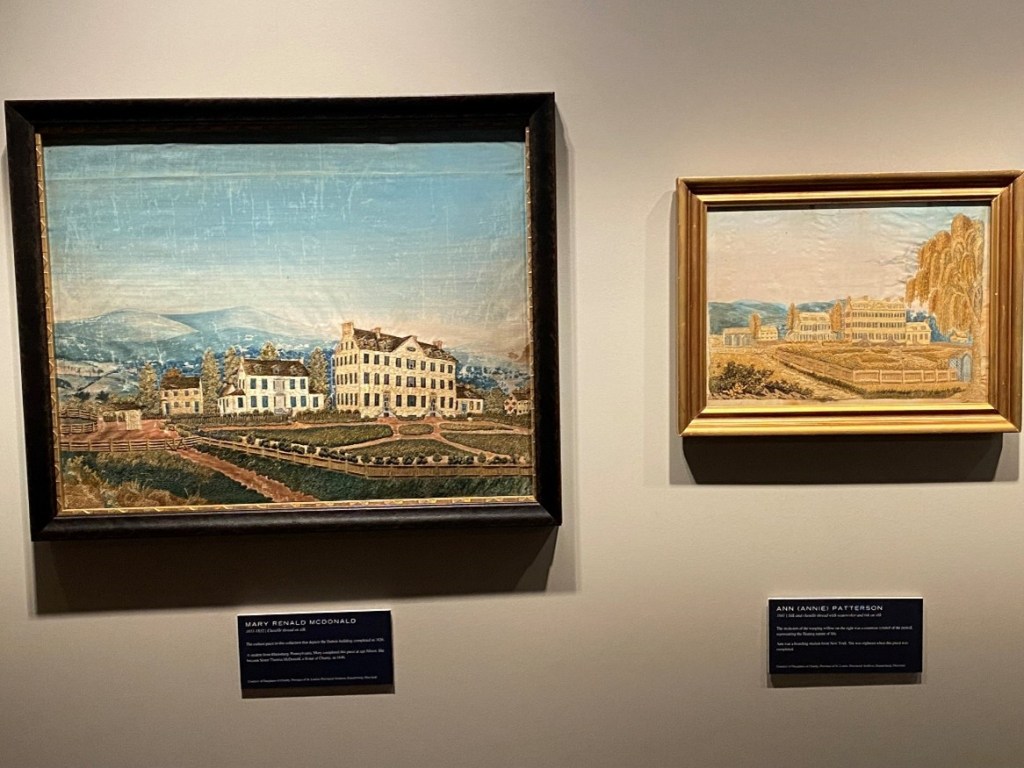
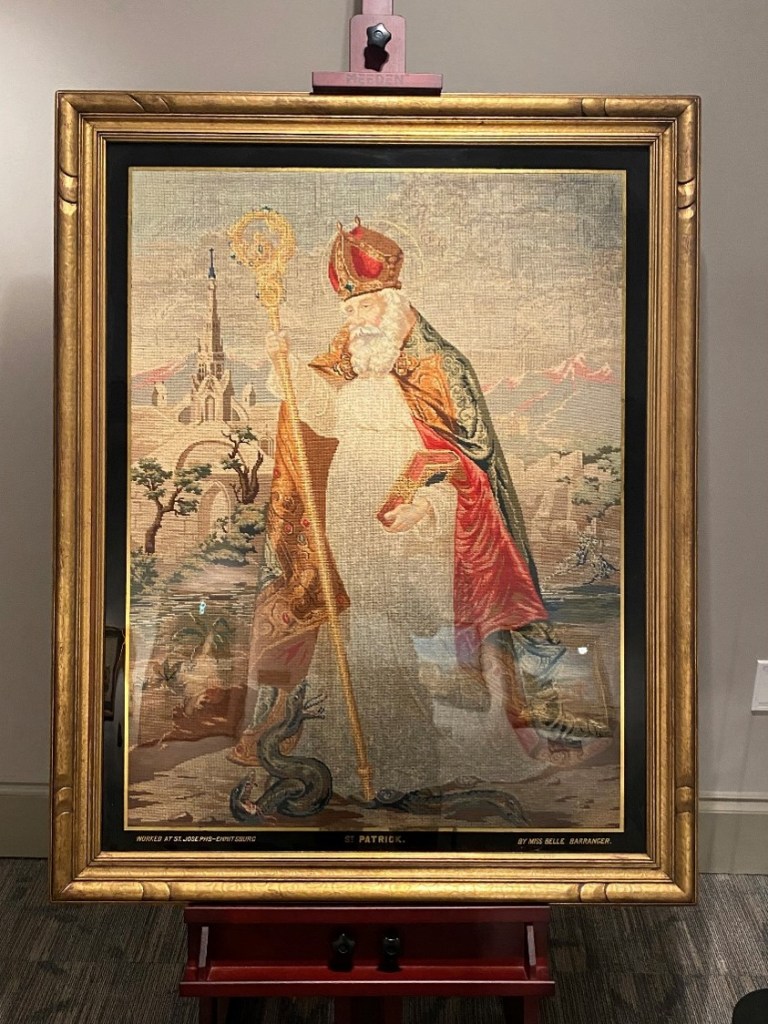
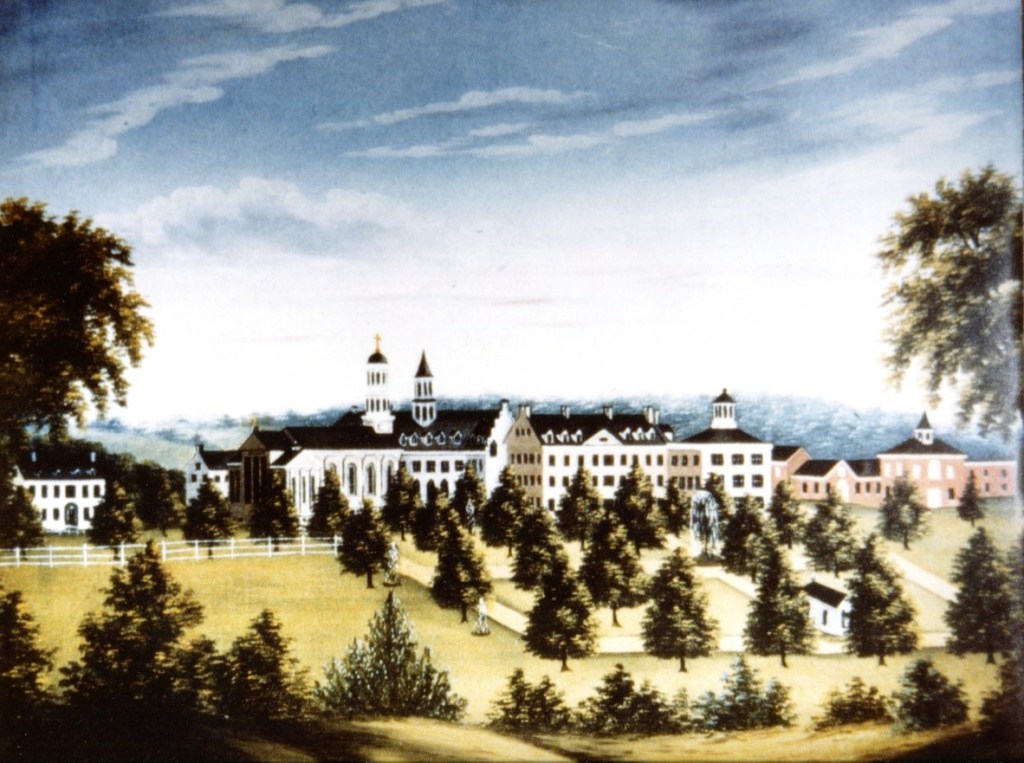
When Mother Seton started St. Joseph’s School (later Academy) in 1810, she made it a point to include the very practical skill of needlework into her curriculum for the young girls who attended the School. Many of these needleworks survive in the archival collections of the Daughters from across the span of the 19th century.
The incorporation of needlework into the curriculum served to teach skills in the arts, religious instruction, the beginnings of basic literacy, and practical skills for 19th century feminine life that prepared the girls to be proper 19th century women. Many of the needleworks in the collection combine multiple mediums, with a background painted in watercolor and the silk embroidered on top of it, as with this piece shown below by Margaret Ann Cappeau (began her studies in 1826).
For literacy and instruction in religion, many students started with basic letters and numbers. When they had mastered these tasks, they advanced on to stitching out verses of scripture. Mother Seton even helped her daughter Catherine with her needlework and early learning on this front.
In addition to being records of the curriculum of the Academy, the needlepoints also serve as some of the earliest records of the evolution of the School’s campus. A common subject of the needleworks is a depiction of the school itself, and, in the era before photography was invented or common, the images created by the students provide the earliest visual records of how the campus grew and evolved.
Other needleworks contain stories of their own. Belle Barranger began creating the largest needlepoint in the collection on the eve of the Battle of Gettysburg, when the School was evacuated and temporarily closed as both the Union and Confederate armies marched through town. As she tried to finish St. Patrick and his destruction of the serpents, she did not have time to finish the serpent itself! As the piece passed from one generation of her family to the next, so too did the story and what it represented, until her descendants, still knowledgeable of the Daughters, donated it back to them for posterity after their mother’s death.
These samplers were common in Maryland and have a distinctive style. Today, they are exceedingly rare and valuable, with the Daughters of Charity collection being one of the largest, with nearly 40 samplers dating from 1812 to 1940. Many of the samplers from the collection are currently on display in the Seton Shrine Museum through the end of 2024. They can be viewed both as beautiful pieces of artwork or as pieces of documenting the history of education in Emmitsburg.
This is part one of a four-part series on the history of the four primary campuses in the Province, which correspond to the locations where the four provinces that formed the Province of St. Louise had their provincial houses: Emmitsburg, MD; Albany, NY; Evansville, IN; and St. Louis, MO.
The foundation of the Emmitsburg campus, the oldest of the four campuses in the current Province of St. Louise, came from Mother Seton herself when she founded St. Joseph’s Free School. Although this is applying the term anachronistically, the “campus” at the time would have consisted of the Stone House, where the Sisters lived when they first arrived, and the historic St. Joseph’s House, also called the White House.
Mary Jamison’s needlework of St. Joseph’s Academy in 1812, the oldest “photo” of the campus in the collection
As St. Joseph’s Free School developed into St. Joseph’s Academy, more buildings were added to the campus. By 1902, when the Academy was re-incorporated as St. Joseph College, the campus featured classroom space, student dorm rooms, a library, art studios, living quarters and chapel for the Daughters, and an area for the Provincial Council, as well as a Seminary for the formation of the Sisters.
St. Joseph’s Academy, 1850
Between 1964 and 1965, the current St. Joseph’s House was built, allowing the Sisters, Seminary, and Council to move away from the College. The move took place on September 12, 1964, with employees on hand to assist the Sisters in the move.
The building’s original layout featured a central courtyard with four spokes: “A Wing” was Seminary, “C Wing” the postulatum, “E Wing” the Council offices and Administration, and “K Wing” the Chapel and Shrine of the recently beatified Mother Seton.
The new Provincial House under construction, 1963, with the old campus in the background
In 1972, the Villa St. Michael, the Sisters retirement facility in Baltimore, permanently moved to the Provincial House in Emmitsburg, filling the top floors of rooms. In 1975, with the canonization of Mother Seton, the process began to convert the Daughters’ chapel into a place of public veneration at the tomb of the Saint. In 1979, the Seton Shrine Museum opened in its current location beneath the Basilica.
The large amount of downsizing that the Province and the campus had experienced after the 1960s allowed for the Daughters to begin to partner with good works in the area. From 1992 to 1994, construction for St. Catherine’s Nursing Home took place, offering a home and care for the elderly that continues to this day.
In 2008, the Marian Center closed. Having been created in 1953 to spread devotion to Mary, this ministry created Miraculous Medals and red and green Scapulars, along with the distribution of educational materials.
In 1998, the Seminary, now Interprovincial and covering all provinces of the United States, moved to Los Altos California (it has since moved to St. Louis).
In 2011, the four provinces merged, and the modern iteration of the Provincial Archives was created. Moving from their spot at the end of E-wing, the new repository made it one of the largest archives for a community of women religious in the country. It opened to researchers in 2013
Touring the archival repository under construction, October 2012
In 2013, the Daughters sold A-Wing of the campus to Homes for America to create Seton Village, a series of low-income apartments for senior citizens, fulfilling a valuable need in Northern and Western Maryland. With E-wing now empty, in the early 2020s, the Daughters began talks to partner with Mount St. Mary’s University for a new home for their Physician’s Assistant program. Sister Teresa George, the current Provincial Treasurer, discusses the collaboration on the Live Significantly podcast in the episode “Sister Teresa George: Synergy.”
Other changes are coming to the Seton Shrine, as they expand their space on the campus to present high-quality historical and spiritual exhibitions on the life of the community’s American Foundress and the Sisters of Charity Federation communities.
This is the second of our three-part celebration for Black History Month 2022, focusing on elements of African American history within the Daughters of Charity archives collection. The first part, on the Briscoe family of Emmitsburg, can be found here.
Origins
[Quote from Provincial Annals, 1878]: September 19. A new school, under the name of St. Euphemia’s School, was opened in Emmitsburg for girls, and small boys. Father White, the pastor, was determined to have the Sisters.
With this note from the Provincial Annals, 1878, a new ministry of the Daughters of Charity began in Emmitsburg, MD. While this would seem to place the Sisters in competition with themselves and their own long-running St. Joseph’s Academy, St. Euphemia’s served those from the town of Emmitsburg who had different educational needs and financial situation from those who attended the boarding school.
Eight years later, in 1886, St. Euphemia’s began a parallel education program, under one roof but in two separate rooms:
[Sunday April 4, from the 1886 Annals] Sunday too in town Father White announced the opening of his colored school for Tuesday. But who is to teach it? The Sisters are next door, but they can hardly assume a new work, and of course, all contingent expenses in the absence of both superiors. So then is a good deal of little sly laugh and talk as to how Fr. White’s zeal is going to make out.
From 1886, Black and white children were both taught by the same community of Sisters, under the same roof, but in separate spaces. In 1944, the walls at last came down, integrating education in Frederick County for the first time. The St. Euphemia’s collection in Emmitsburg is a notable record of both the administration of the school and a record of those students’ lives, both before and after the end of desegregation.
The School and Its Children
The school was located on Green Street, which was later called Depaul Street, in a two-story, brick building. While St. Joseph’s Academy was a strictly girls’ school, St. Euphemia’s taught both boys and girls.
The 1887 school year is the first instance in which we have an exact number of students attending the school: 137 white students and 40 African American students. In 1898, it was 183 white and 24 African American. In 1900, we know it was 110 girls to 73 boys, with no information about the race of any student.
The school had an agreement with Frederick County to receive local support as a school for African American students, since they were barred from attending public schools. However, according to the Board minutes of 1918, St. Euphemia’s had not received this support for the year, and the financial records indicate this support had been paid sporadically since 1890. Apparently, it was a task to pester the County on this matter, although it appears to have been distributed more consistently after 1927. It should be noted that this support per African American student was a fraction of the County’s expenditures for white students.
St. Euphemia’s School Board Minutes, 1918
In the annual meeting of 1943, the Board minutes indicate that enrollment was down to four African American students. Faced with a teacher shortage for a segregated African American classroom, the School instead made the decision to integrate and ensure that every student could get their elementary education. Notably, it was the first school in Frederick County to integrate, 10 years before Brown v. Board.
The Collection
The collection contains financial and Board documents of the school, the enrollment cards for the white students (valuable for genealogy), and several books of students’ schoolworks from the 1890s, completed as part of the Sisters exposition at the Chicago World’s Fair of 1893. But the collection also contains the recorded memories of two African American alumni of the school who attended during the days of segregation, as well as some of the sisters. In 2004, Sister Eleanor Casey made it a point to gather their memories, and they point to both the hope, drive, and self-empowerment that their teachers tried to instill, alongside the indignity and absurdity of segregation.
Kathleen Williams attended St. Euphemia’s in the 1920s and only passed away in 2016 at age 102. She recalled the hard work that Sister Beata Bartling expected of her students:
Oh, if you didn’t know your spelling. That was your homework at night. You had to write each word 25 times. And I never forgot my spelling. I can still spell. Marie [her daughter] has to ask me sometimes how to spell. Oh, Lord, Sister Beata. Oh, she was something else.
Mrs. Kathleen Richardson Williams, 2004
Despite this, it is worth noting that, while the archives currently holds nearly 250 report cards for white students at St. Euphemia’s, Sister Eleanor reported that, despite searching, neither she nor others were able to locate the report cards of the African American students.
Barbara Van Brakle Weedon remembers her family’s generational experience at St. Euphemia’s:
And, of course, my father was the youngest son and he had Sister Beata [Bartling] as one of the teachers. And he always praised Sister Beata. He was always so grateful because Sister Beata was determined. She had such respect for the children that she was determined that they were worth something. That they were going to learn. That’s all, I remember him talking about Sister Beata, how grateful that he was.
At the same time, the policies of segregation still often applied to the school:
We were all in the one room no matter what grade we were. And we were not allowed to drink from the water fountain. We had our own little like an urn in the classroom. And then we weren’t allowed to use the restrooms. There was an outhouse outside that we used. And I think some of the transients used to use the rest [sic] so my cousin and I, Kenny, we painted it. Cleaned it up and painted it and put a lock on the door. And that was our, that was our outside little restroom because we couldn’t use the inside. Then for any of the school plays or anything we couldn’t be in any of [the] school plays. And when we made our First Communion and Confirmation we always walked together at the end of the line. So we were, we were separated. But as kids you never thought it. We were fortunate because we had good happy homes and I often wondered, you know, what it would be like for children who didn’t have a happy home to go to and to have to go through that all day…
Each interview also provides valuable family and regional history of the Emmitsburg, Gettysburg, and Mount St. Mary’s, particularly of their African American family members.
The End of St. Euphemia’s
In 1956, facing low enrollment, the Daughters closed St. Euphemia’s School and its sister institution, St. Anthony’s. They were consolidated into Mother Seton School, which remains strong today as the flagship educational institution of the Daughters in Emmitsburg.
The building itself on Depaul Street was converted to apartments in 1985.
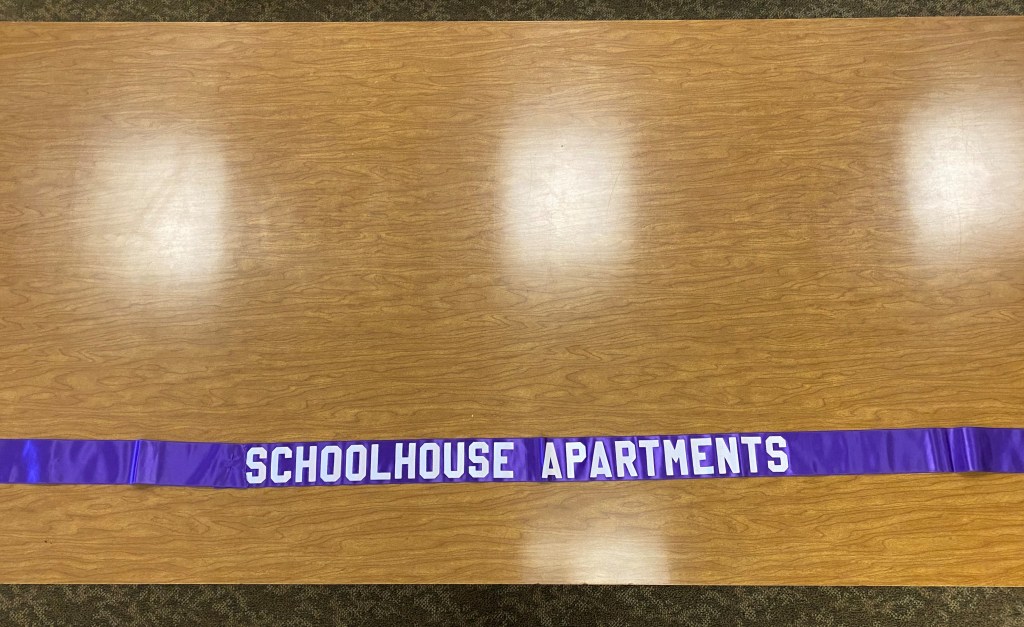
Ribbon from the opening of the Schoolhouse Apartments
The St. Euphemia’s collection contains valuable information for genealogists, but more importantly, for an era of education that, thankfully, we are moving past. Racial segregation, particularly in the education that is meant to provide for the next generation, was, is, and always will be wrong. What is valuable about this collection is that it provides voice to an institution and to the users of that institution, of Sisters both of their time and of those trying to provide a quality and fair education to a student population who could and would reach far beyond an unfair situation. One final quote comes from Sister Angela Cool, 2005, and perfectly captures that dichotomy:
One day many years later when talking to my father about how terrible it was that we were separated. He said, ‘If the Sisters had not taken them they would have had no education, those were the days of segregation, they could not go to the public school.’