Category Archives: Emmitsburg

The Emmitsburg Plant Books

In the age of Laudato Si, we are reminded of the value of knowing what our common home looks like, and part of this is knowing the level of biodiversity in our environment.  The Sisters and Daughters of Charity who ministered at St. Joseph’s Academy and at their Provincial house throughout the 19th century did not go into extensive detail on trees, plants, and ecology around them.  Thankfully, some of their students did.

The Archives has five books, each containing a collection of pressed leaves and flowers of various plant species found in the area, along with the scientific name of each plant.  The books range in date from 1806 to 1874.

The typical page from one of these books consists of one or several samples cut and pasted into the books and its scientific name.

This page consists of Salvia Splendens and Salvia patens, or red and blue sage.

The scrapbooks provide evidence of the education Academy students were receiving, both in Latin and in plants and botany.  While many of the plants are native, several of them are not, indicating some type of cultivation.  One of the books even contains a chart of the plants, including its count, scientific, and common name, as well as more information on its taxonomical classification.

From 1807

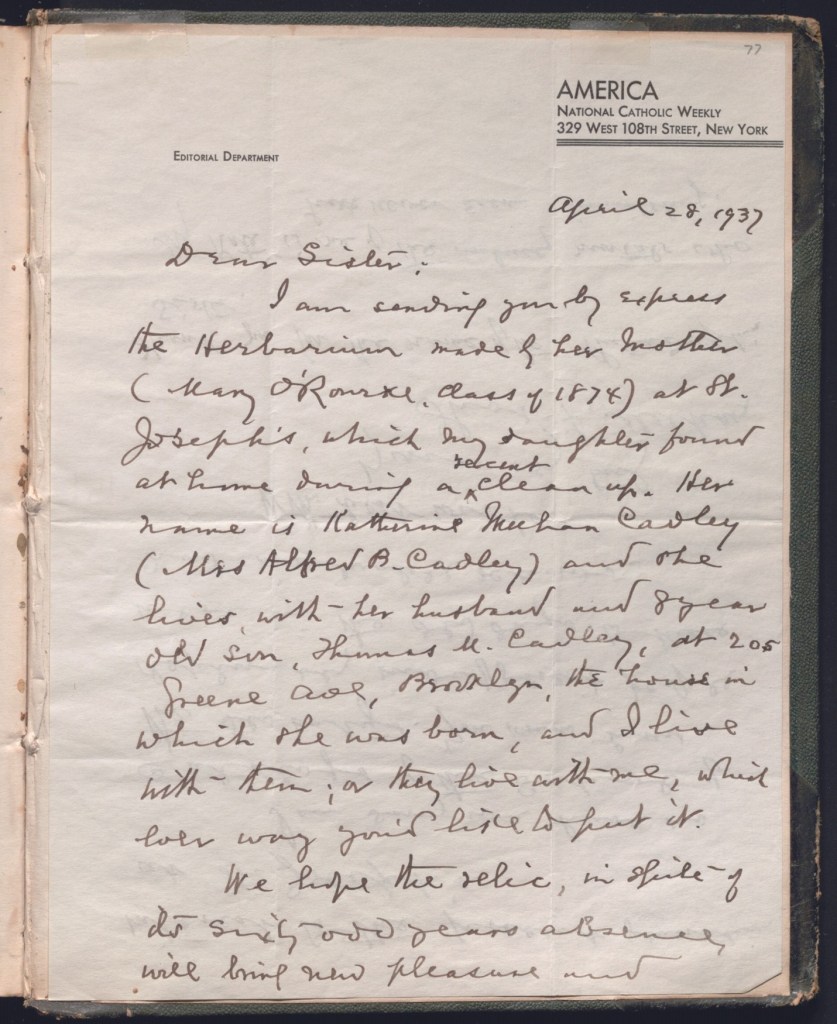
Seeing as some of the books predate Mother Seton’s founding of her school in Emmitsburg in 1809, it is unclear exactly how some of the earliest books came to the collections.  Others, however, have clear provenance and direct connection to Emmitsburg, as the one created by Mary O’Rourke, class of 1874, sent by her husband and daughter after her passing.

We are in the process of scanning these books, first and foremost as a conservation measure.  Decaying plant matter does not typically do well for conservation and holding up well, as anyone familiar with trees, soil, gardening, or nutrients will tell you.  The plant samples are also incredibly fragile, made dry and brittle by over a century (sometimes two) of survival.  Scanning will preserve the books in the state they are in now, at least in image form, in case more and more pieces get whittled away.  Currently, three of the five books have been scanned, and we are planning to make them available publicly through our colleagues at Digital Maryland.  Eventually, we will make the others available as well, but due to their size, we will need to work with third-party vendors with capabilities that we do not have on-site.

1 Comment

Filed under Emmitsburg, Environment

The St. Joseph’s Needlework Collection

When Mother Seton started St. Joseph’s School (later Academy) in 1810, she made it a point to include the very practical skill of needlework into her curriculum for the young girls who attended the School.  Many of these needleworks survive in the archival collections of the Daughters from across the span of the 19th century.

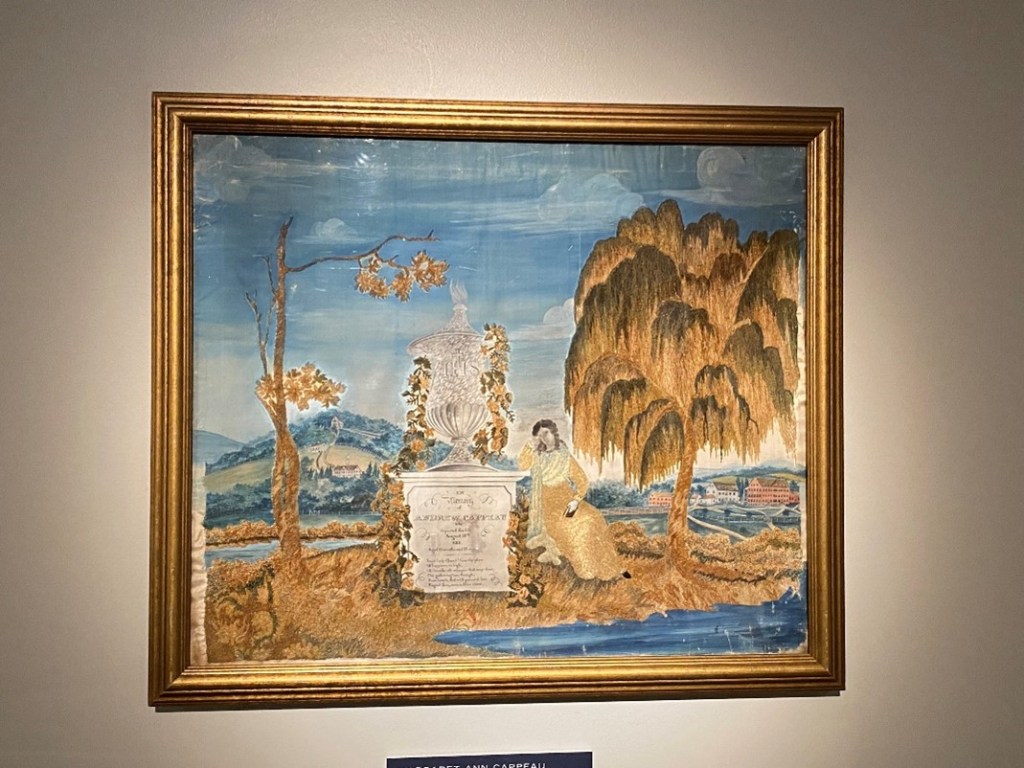
The incorporation of needlework into the curriculum served to teach skills in the arts, religious instruction, the beginnings of basic literacy, and practical skills for 19th century feminine life that prepared the girls to be proper 19th century women.  Many of the needleworks in the collection combine multiple mediums, with a background painted in watercolor and the silk embroidered on top of it, as with this piece shown below by Margaret Ann Cappeau (began her studies in 1826).

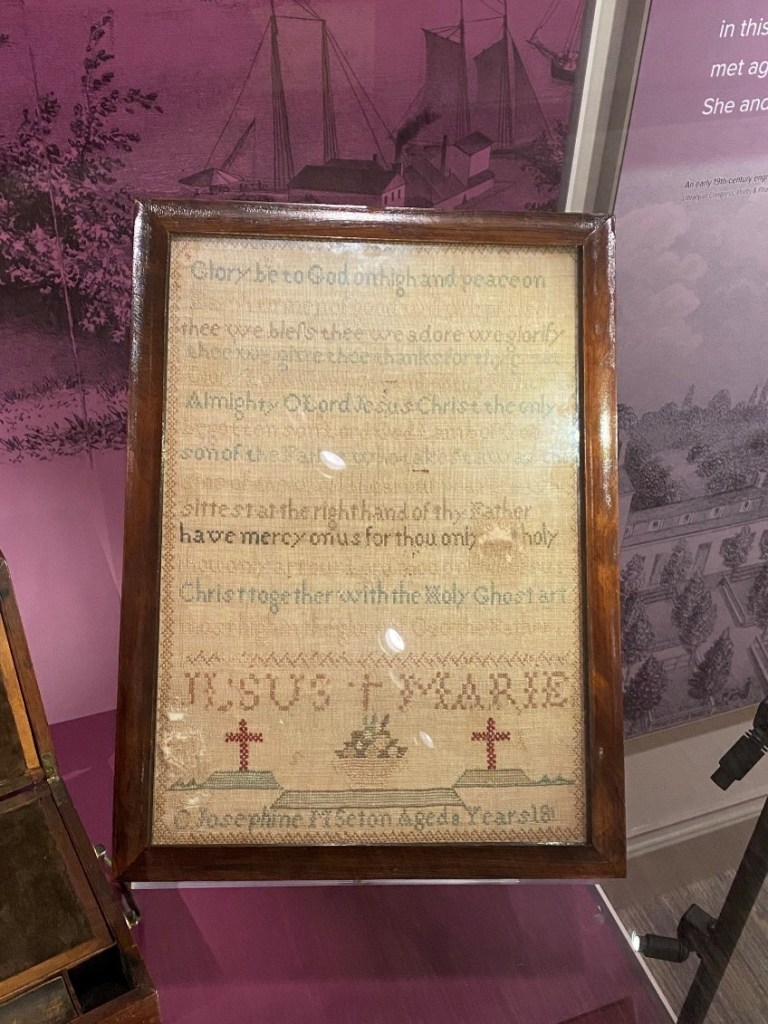
For literacy and instruction in religion, many students started with basic letters and numbers.  When they had mastered these tasks, they advanced on to stitching out verses of scripture.  Mother Seton even helped her daughter Catherine with her needlework and early learning on this front.

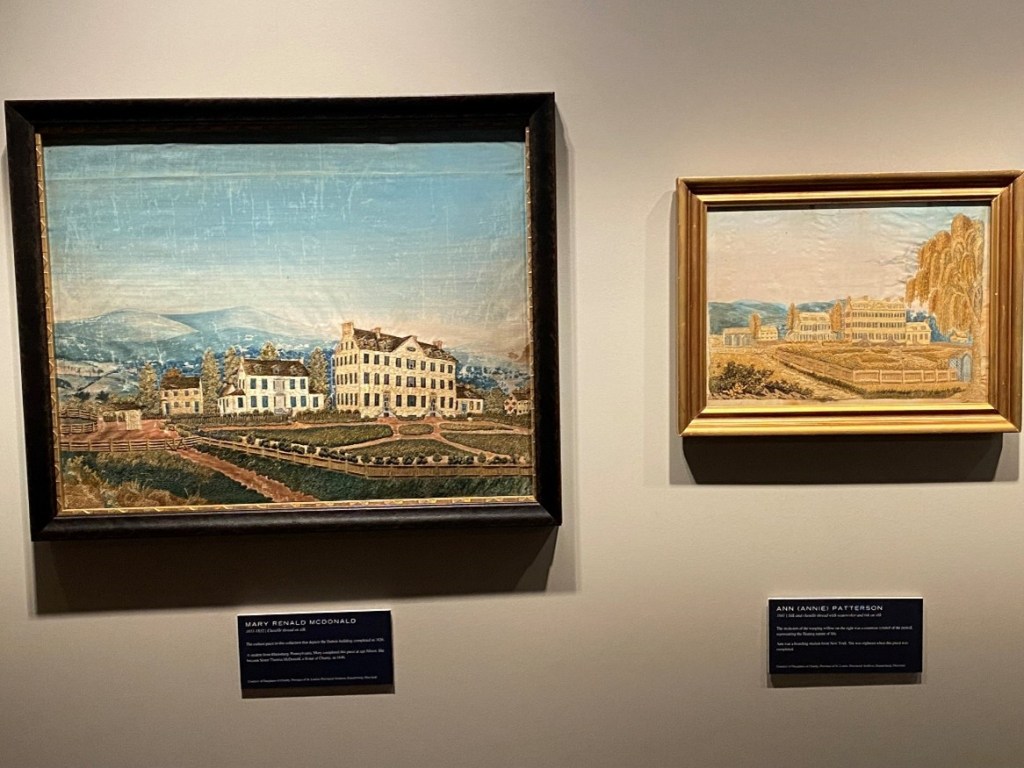
In addition to being records of the curriculum of the Academy, the needlepoints also serve as some of the earliest records of the evolution of the School’s campus.  A common subject of the needleworks is a depiction of the school itself, and, in the era before photography was invented or common, the images created by the students provide the earliest visual records of how the campus grew and evolved.

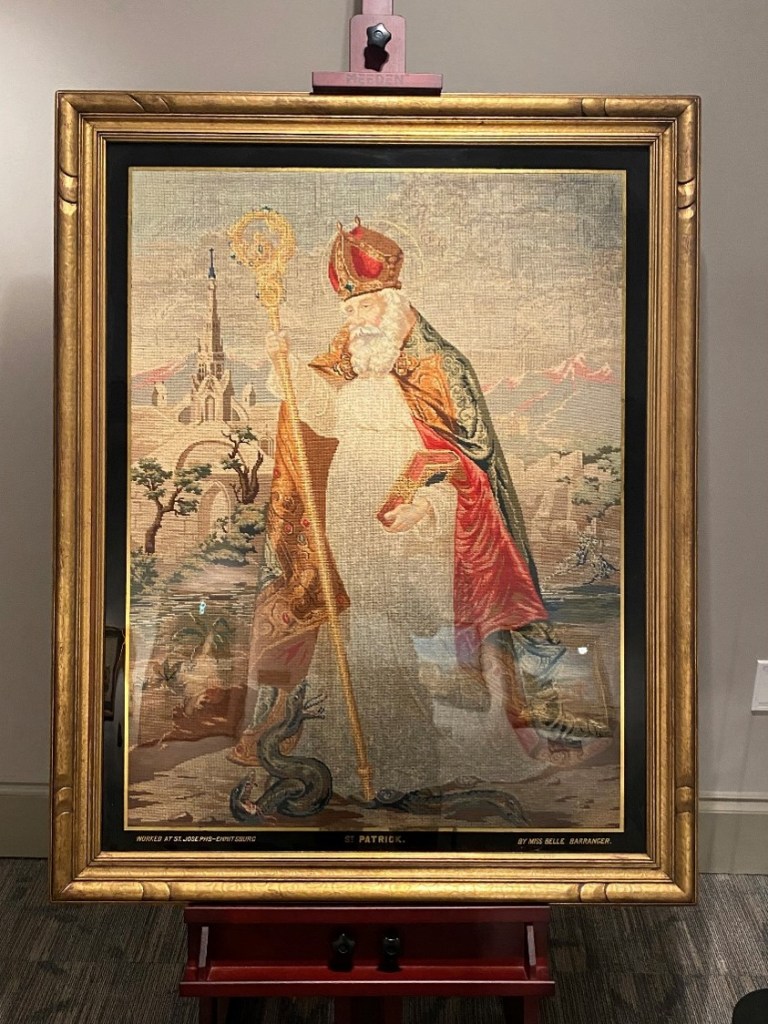
Other needleworks contain stories of their own.  Belle Barranger began creating the largest needlepoint in the collection on the eve of the Battle of Gettysburg, when the School was evacuated and temporarily closed as both the Union and Confederate armies marched through town.  As she tried to finish St. Patrick and his destruction of the serpents, she did not have time to finish the serpent itself!  As the piece passed from one generation of her family to the next, so too did the story and what it represented, until her descendants, still knowledgeable of the Daughters, donated it back to them for posterity after their mother’s death.

These samplers were common in Maryland and have a distinctive style.  Today, they are exceedingly rare and valuable, with the Daughters of Charity collection being one of the largest, with nearly 40 samplers dating from 1812 to 1940.  Many of the samplers from the collection are currently on display in the Seton Shrine Museum through the end of 2024.  They can be viewed both as beautiful pieces of artwork or as pieces of documenting the history of education in Emmitsburg.

1 Comment

Filed under Artifacts, Education, Emmitsburg, Exhibits, St. Joseph's Academy

Our Four Campuses: Emmitsburg, Maryland

This is part one of a four-part series on the history of the four primary campuses in the Province, which correspond to the locations where the four provinces that formed the Province of St. Louise had their provincial houses:  Emmitsburg, MD; Albany, NY; Evansville, IN; and St. Louis, MO.

The foundation of the Emmitsburg campus, the oldest of the four campuses in the current Province of St. Louise, came from Mother Seton herself when she founded St. Joseph’s Free School.  Although this is applying the term anachronistically, the “campus” at the time would have consisted of the Stone House, where the Sisters lived when they first arrived, and the historic St. Joseph’s House, also called the White House.

Mary Jamison’s needlework of St. Joseph’s Academy in 1812, the oldest “photo” of the campus in the collection

As St. Joseph’s Free School developed into St. Joseph’s Academy, more buildings were added to the campus.  By 1902, when the Academy was re-incorporated as St. Joseph College, the campus featured classroom space, student dorm rooms, a library, art studios, living quarters and chapel for the Daughters, and an area for the Provincial Council, as well as a Seminary for the formation of the Sisters.

St. Joseph’s Academy, 1850

Between 1964 and 1965, the current St. Joseph’s House was built, allowing the Sisters, Seminary, and Council to move away from the College.  The move took place on September 12, 1964, with employees on hand to assist the Sisters in the move. 

The building’s original layout featured a central courtyard with four spokes:  “A Wing” was Seminary, “C Wing” the postulatum, “E Wing” the Council offices and Administration, and “K Wing” the Chapel and Shrine of the recently beatified Mother Seton.

The new Provincial House under construction, 1963, with the old campus in the background

In 1972, the Villa St. Michael, the Sisters retirement facility in Baltimore, permanently moved to the Provincial House in Emmitsburg, filling the top floors of rooms.  In 1975, with the canonization of Mother Seton, the process began to convert the Daughters’ chapel into a place of public veneration at the tomb of the Saint.  In 1979, the Seton Shrine Museum opened in its current location beneath the Basilica.

The large amount of downsizing that the Province and the campus had experienced after the 1960s allowed for the Daughters to begin to partner with good works in the area.  From 1992 to 1994, construction for St. Catherine’s Nursing Home took place, offering a home and care for the elderly that continues to this day.

In 2008, the Marian Center closed.  Having been created in 1953 to spread devotion to Mary, this ministry created Miraculous Medals and red and green Scapulars, along with the distribution of educational materials.

In 1998, the Seminary, now Interprovincial and covering all provinces of the United States, moved to Los Altos California (it has since moved to St. Louis). 

In 2011, the four provinces merged, and the modern iteration of the Provincial Archives was created.  Moving from their spot at the end of E-wing, the new repository made it one of the largest archives for a community of women religious in the country.  It opened to researchers in 2013

Touring the archival repository under construction, October 2012

In 2013, the Daughters sold A-Wing of the campus to Homes for America to create Seton Village, a series of low-income apartments for senior citizens, fulfilling a valuable need in Northern and Western Maryland. With E-wing now empty, in the early 2020s, the Daughters began talks to partner with Mount St. Mary’s University for a new home for their Physician’s Assistant program.  Sister Teresa George, the current Provincial Treasurer, discusses the collaboration on the Live Significantly podcast in the episode “Sister Teresa George:  Synergy.”

Other changes are coming to the Seton Shrine, as they expand their space on the campus to present high-quality historical and spiritual exhibitions on the life of the community’s American Foundress and the Sisters of Charity Federation communities.

The campus on a summer day, 2014

3 Comments

Filed under Emmitsburg, St. Joseph's Academy