Category Archives: Artifacts

The St. Joseph’s Needlework Collection

When Mother Seton started St. Joseph’s School (later Academy) in 1810, she made it a point to include the very practical skill of needlework into her curriculum for the young girls who attended the School.  Many of these needleworks survive in the archival collections of the Daughters from across the span of the 19th century.

The incorporation of needlework into the curriculum served to teach skills in the arts, religious instruction, the beginnings of basic literacy, and practical skills for 19th century feminine life that prepared the girls to be proper 19th century women.  Many of the needleworks in the collection combine multiple mediums, with a background painted in watercolor and the silk embroidered on top of it, as with this piece shown below by Margaret Ann Cappeau (began her studies in 1826).
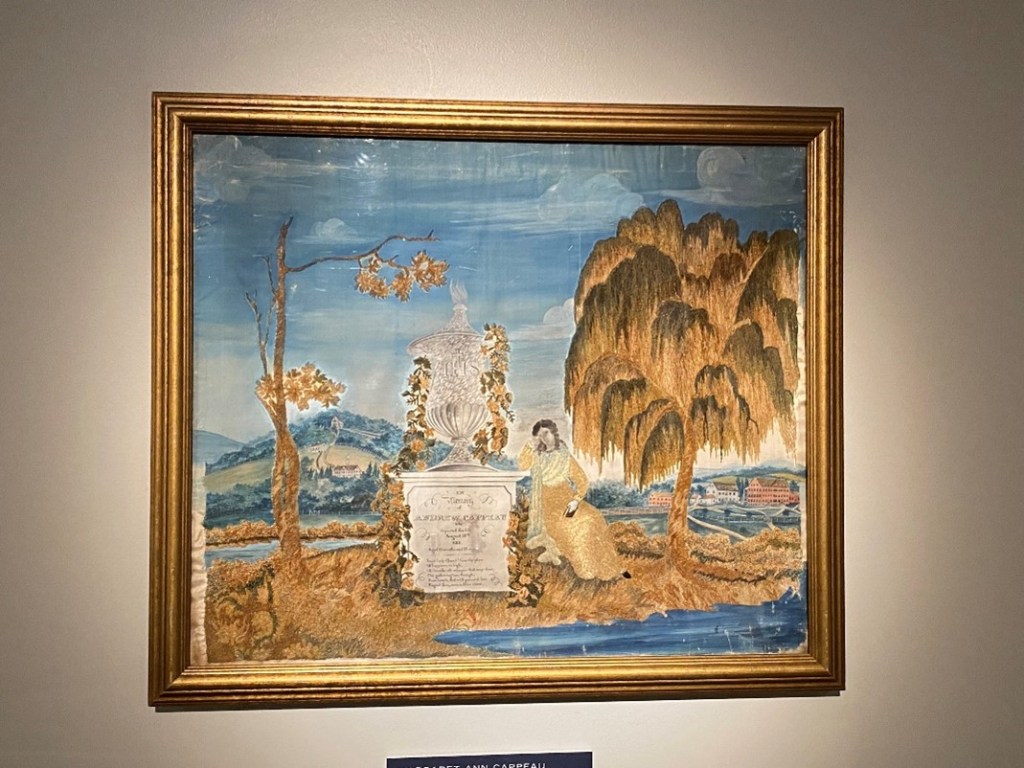
For literacy and instruction in religion, many students started with basic letters and numbers.  When they had mastered these tasks, they advanced on to stitching out verses of scripture.  Mother Seton even helped her daughter Catherine with her needlework and early learning on this front.
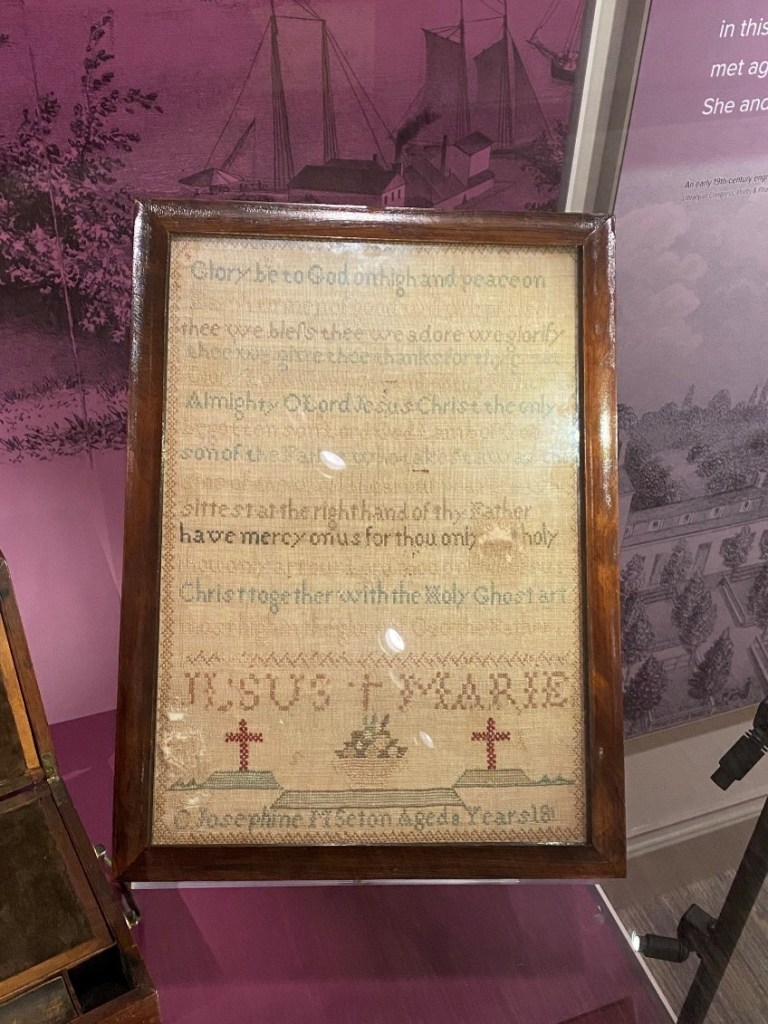
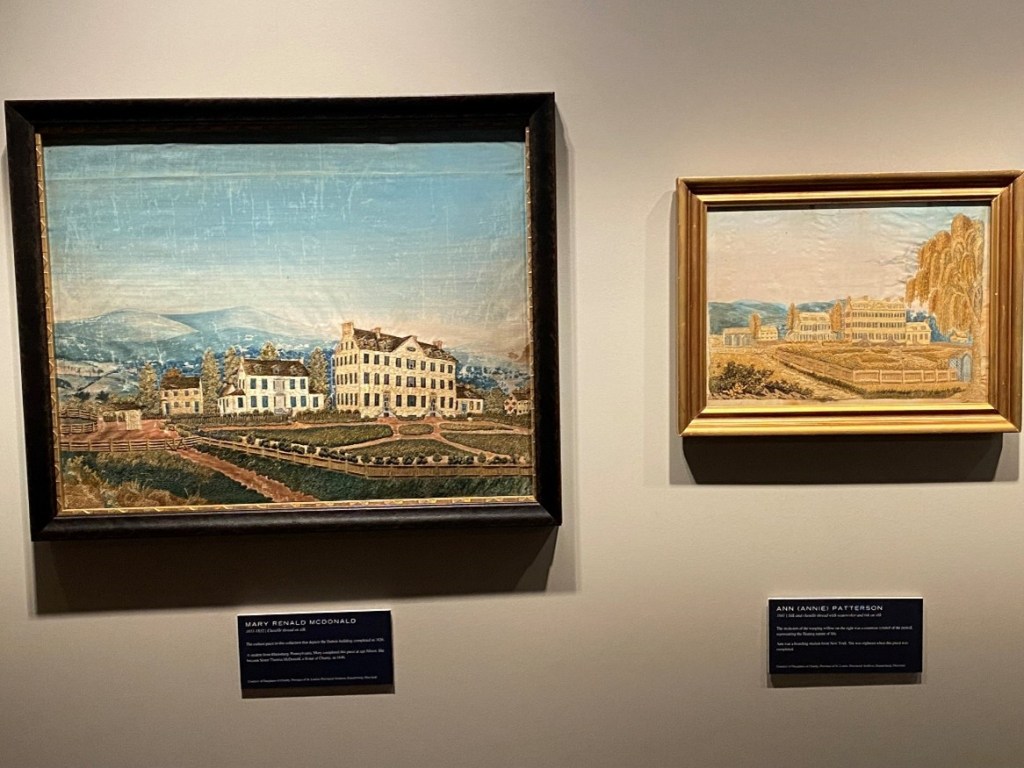
In addition to being records of the curriculum of the Academy, the needlepoints also serve as some of the earliest records of the evolution of the School’s campus.  A common subject of the needleworks is a depiction of the school itself, and, in the era before photography was invented or common, the images created by the students provide the earliest visual records of how the campus grew and evolved.
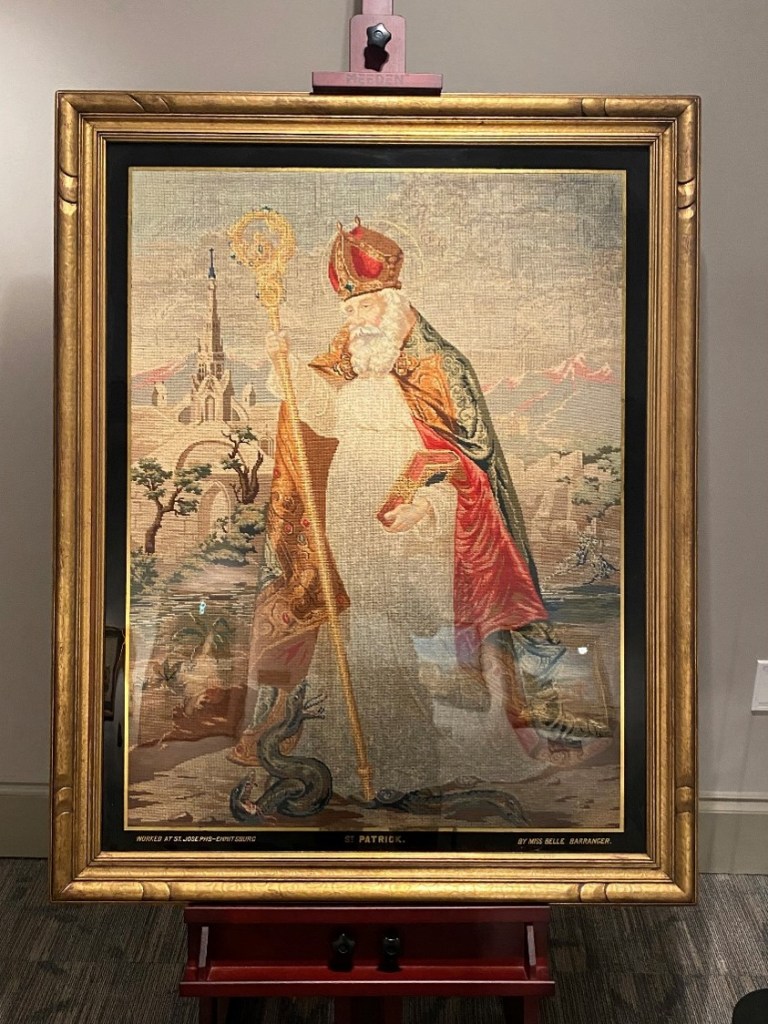
Other needleworks contain stories of their own.  Belle Barranger began creating the largest needlepoint in the collection on the eve of the Battle of Gettysburg, when the School was evacuated and temporarily closed as both the Union and Confederate armies marched through town.  As she tried to finish St. Patrick and his destruction of the serpents, she did not have time to finish the serpent itself!  As the piece passed from one generation of her family to the next, so too did the story and what it represented, until her descendants, still knowledgeable of the Daughters, donated it back to them for posterity after their mother’s death.
These samplers were common in Maryland and have a distinctive style.  Today, they are exceedingly rare and valuable, with the Daughters of Charity collection being one of the largest, with nearly 40 samplers dating from 1812 to 1940.  Many of the samplers from the collection are currently on display in the Seton Shrine Museum through the end of 2024.  They can be viewed both as beautiful pieces of artwork or as pieces of documenting the history of education in Emmitsburg.

1 Comment

Filed under Artifacts, Education, Emmitsburg, Exhibits, St. Joseph's Academy

The Lumière of St. Louise

Typically, in these posts, we try to focus on materials held here at the local Provincial Archives.  For this post, however, we would like to focus on a piece of global news of the Daughters and the archival world.

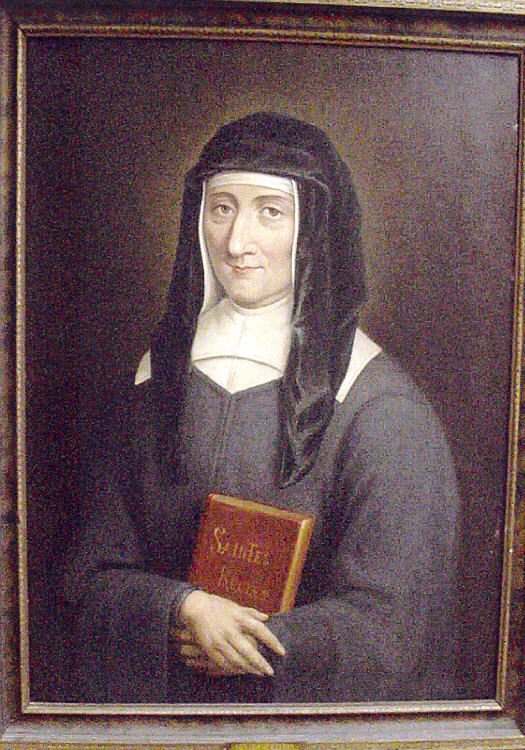
Saint Louise de Marillac portrait, held in the Provincial Archives in Emmitsburg

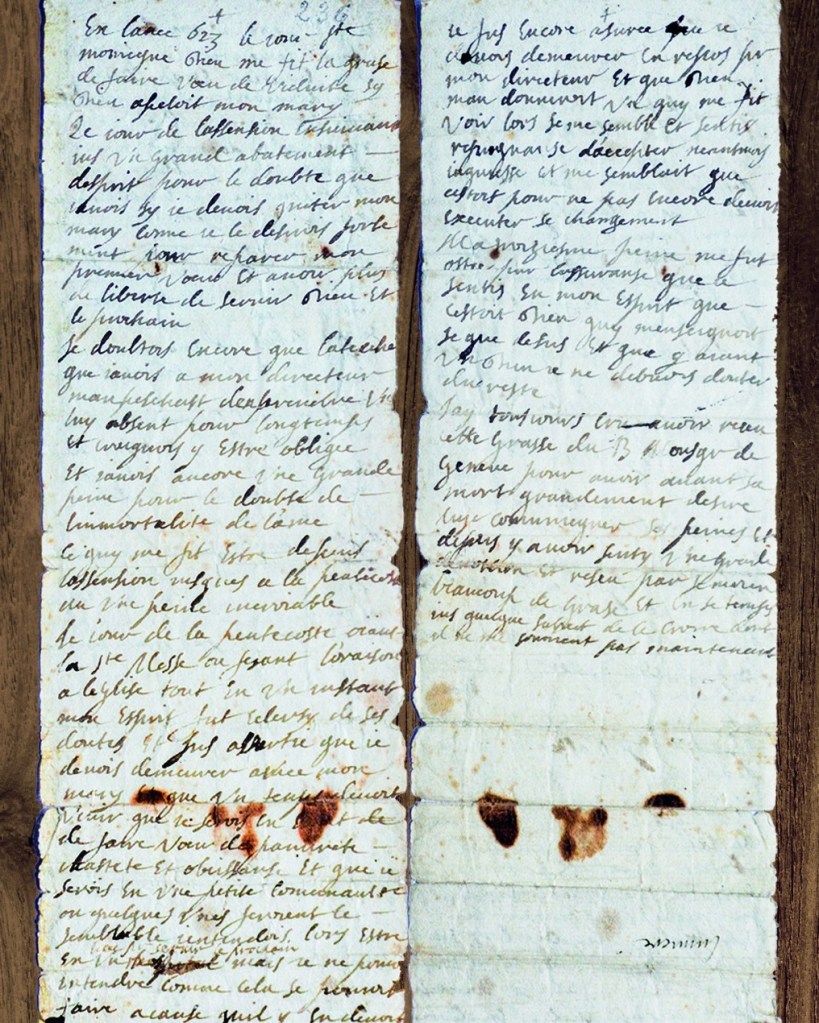
One of the foundational documents of the history and spirituality of the Daughters of Charity is the Lumière of Saint Louise de Marillac, the co-founder of the community alongside Saint Vincent de Paul.  In 1623, on the Feast of Pentecost, Louise found herself in a deep melancholy, with her husband seriously ill, an uncertain future for herself, and a crisis of faith at hand.  In a moment of prayer, she had a vision of the pathway of her life.  She saw herself when she “would be in a position to make vows of poverty, chastity and obedience and that I would be in a small community where others would do the same.”  She added, “I was also assured that I should remain at peace concerning my director; that God would give me one whom He seemed to show me.”  She felt assurance that “it was God who was teaching me these things…I should not doubt the rest.”

It took a decade for the work of her vision to come to pass.  She did find a spiritual director in Saint Vincent, and, in 1633, they together founded the “Little Company” of the Daughters of Charity.  Saint Louise carried the folded message that she wrote to herself on Pentecost until her death.

St. Louise’s Lumière

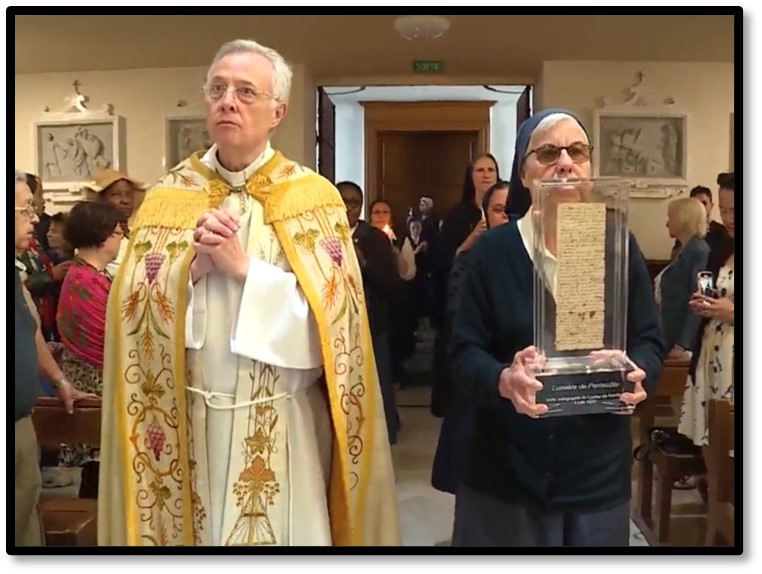
The 400th Anniversary of this Pentecost has just passed.  The folded note of Saint Louise had survived for centuries in the Archive of the Vincentian Fathers, Saint Vincent’s priestly community.  As a magnanimous gesture and a symbol of the fraternal ties between the Vincentians and the Daughters of Charity, the Vincentians repatriated the Lumière back to the Daughters of Charity.  It will live and be preserved in their Mother House at the Rue du Bac in Paris as one of the great historical and spiritual treasures of the Community’s charism!

Father Tomaz Mavric and Sister Francois Petit, Superior and Superioress of the Daughters of Charity, with Sister Francois holding the Lumiere

Although the Provincial Archives does not hold any primary sources of Saint Louise, we can provide a wide array of resources on Louise’s spirituality and the way it is interpreted and lived today through the Community that she founded.  These include scholarship related to Louise and many works named after her, including St. Louise de Marillac School in Arabi, Louisiana; St. Louise de Marillac School in St. Louis; St. Louise de Marillac Hospital in Buffalo, New York; and the Association Louise de Marillac lay organization.

Leave a comment

Filed under Archives, Artifacts, Father Tomaz Mavric, Louise de Marillac, Sister Francois Petit

A Mount Alumni’s Blessed Donation

by Nathaniel Lee Rush Bentz

I have been an intern here for the Fall 2019 semester and I have discovered one of—if not the—most fascinating artifacts I have processed so far. This artifact is a large, metal crucifix with its very own metal plaque stating, “This crucifix was blessed by Pope Paul VI and donated to Providence Hospital [located in Washington, D.C.] by Monsignor Hugh Phillips September 14, 1975.” Having the responsibility to handle and process such an artifact is unbelievable. The weight of the situation is both physical and figurative because this piece is entirely made from brass and copper, making it very heavy, and the fact that a Pope blessed it—let alone interacted with it—makes this processing a rare opportunity for myself.

The donor, Monsignor High Phillips, is an important figure to this artifact in a different respect; he has a strong affiliation to Mount St. Mary’s University, at which I am a Senior student. Monsignor Phillips was a student at the grade school located on the Mount’s campus.  He spent his high school, college, and seminary years on campus and eventually becoming the school’s President—back when Mount St. Mary’s University was titled Mount St. Mary’s College—from 1967 to 1971. Before his presidency, he was a leading figure in maintaining Mount Saint Mary’s famous Grotto of Lourdes as its Director between the years 1958 and 2001. This honor of processing an artifact from a fellow member of the Mount community is astounding, especially given his accomplishments. What was fascinating with regards to Monsignor Phillips’ life is that he was born in the very same Washington, D.C. Providence Hospital that was gifted his donation of this blessed crucifix.

Having a fellow member of the Mount involved with the history of this artifact is one honor, but knowing that this very artifact is affiliated with a Pope as well is another amazing honor. I am not a very religious person, but I can recognize the authority, responsibilities, and image the Pope has to Catholics around the world, especially at Mount Saint Mary’s University. Moreover, getting the opportunity to interact with a blessed artifact is, what I would consider, a unique opportunity of the Daughters’ archive.

Besides the history behind the crucifix, physically speaking, this crucifix breaks norms compared to the other artifacts I have processed in the previous months of this fall semester. The dimensions of this piece deny it to be placed in its own box (for the time being), and it is incredibly heavy. To be extra careful, I find it safer and easier to transport the crucifix and the plaque by cart than carrying it by hand. The length of this crucifix is also large in comparison to other processed artifacts, standing at a height of two-and-a-half feet! The sheer size of this artifact makes a grand statement on its own, which makes this piece even more fascinating. My captivation goes for the crucifix’s aesthetic as well. It is beautifully crafted, likely out of brass and copper, on both the cross and the representation of Christ.

To read further about Monsignor Hugh Phillips, click the link below…

http://www.emmitsburg.net/grotto/father_jack/2004/phillips.htm

2 Comments

Filed under Artifacts, Monsignor Hugh Phillips, Mount St. Mary's University, Providence Hospital