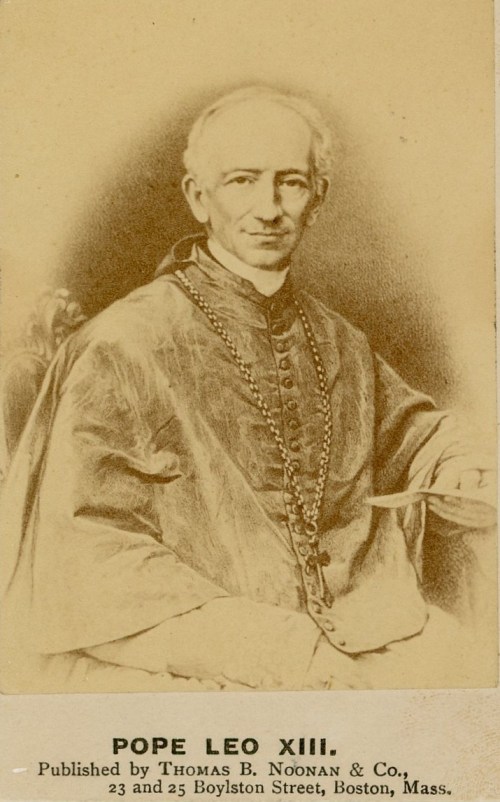
With the election of Pope Leo XIV in 2025, we thought it would be worthwhile to look into the figure from whom the new pontiff took his name, Pope Leo XIII.
Elected in 1878, he is most well-known for his encyclical Rerum Novarum. In this document, Leo XIII formally articulated the principals that today define Catholic social teachings. In this, he addressed the conditions of the working poor and what is owed to those living in poverty. His concern for those living in poverty formed an almost natural affinity between His Holiness and the Vincentian double family: the Vincentian priests and the Daughters of Charity.
In 1893, the Superiors of the Vincentians and the Daughters of Charity had an audience with Pope Leo XIII. The account of this meeting is in the Archives dated January 26, 1893, held to celebrate the founding of the Vincentians. Joining them were students of the Daughters of Charity from Rome.
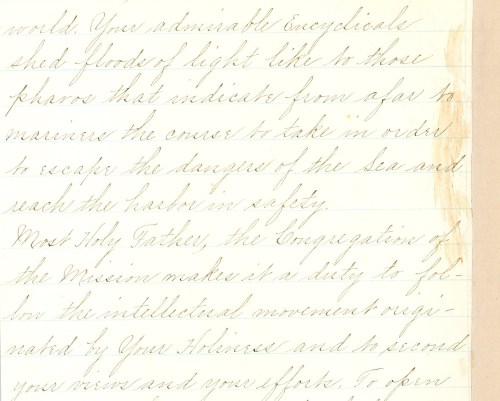
Father Antoine Fiat, Superior General of both communities, provided his gratitude at the Pope’s guidance in Rerum Novarum:
Your admirable encyclicals shed floods of light like to those pharos [lighthouse] that indicate from afar to mariners the course to take in order to escape the dangers of the Sea and reach the harbor in safety. Most Holy Father, the Congregation of the Mission [formal name for the Vincentians] makes it a duty to follow the intellectual movement originated by Your Holiness and to second your views and your efforts.
In response to Father Fiat’s address, Pope Leo XIII addressed the Vincentians and Daughters in French, the language of their founders and superiors, despite himself being a native Italian. He shows particular fondness for the schools the communities conduct around Rome, and seems to show favor toward the ongoing (at the time) cause for sainthood for Louise de Marillac.
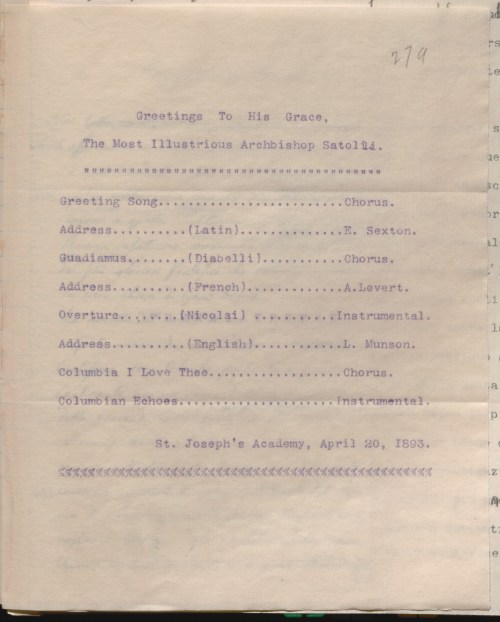
Even though no American Daughters were part of this audience, it was still celebrated in the United States. The Provincial Annals contain a letter by Sister Caroline Eck, writing from St. Joseph ‘s Academy in Emmitsburg, Maryland. The Sisters and students at the Academy were met by Cardinal Francesco Satoli, the first official Apostolic Delegate to the United States, who recounted the meetings between the Holy Father and the French Superiors. The students and staff celebrated this (at the time) highest meeting of a church official with the students, emphasizing the global nature of the Daughters and the internationality represented by the Catholic Church!
Dinosaurs began to be recognized by paleontologists as the creatures that they were in the early 1800s. In 1895, the Provincial Annals included a note about the local community and the scientific field of paleontology:
“These few days past the men have been removing two large slabs from Avenue side walk. One is destined for the Johns Hopkins’s University, the other for our own cabinet. Prof. Mitchell of the Mountain [Mount St. Mary’s University] is the one who is securing these singular geological specimens. They have long been objects of the Sisters’ curiosity & comment as they promenade up and down the Avenue in summer evening recreation. They bear the impression of many feet of different kinds & sizes, pre-historic creatures that lived O many & many age ago! The Professor’s interest in our quarry from where these slabs were taken led him. His opinion is that all this land round about ages & ages ago formed an estuary, the mountains were its shores.”
The slabs documented by Dr. James A. Mitchell were the first dinosaur prints from Maryland to be announced in a scientific publication.
In the spirit of this time period, the cabinet referred to was a “cabinet of curiosities,” sort of a predecessor to a modern-day museum exhibit. It was housed in the Burlando Building of St. Joseph’s Academy, the school thatthe Daughters operated. Later, it was on display, in a deep historical anachronism, in the Stone House on campus where the community had begun in 1809.
Dr. Mitchell made sketches of the slabs. Then the slabs went missing.
In 1990, a group of maintenance workers discovered a slab in a crate with fossilized footprints in an old barn on campus. The search was sparked by Dr. Peter Kranz, who was tracking Mitchell’s work from 100 years before. In 1998, the slab was put on permanent display in the Maryland Science Center. Before it was moved from Emmitsburg to Baltimore, the Sisters and employees in Emmitsburg could see it for themselves, privately and up close.
The Maryland Science Center performed their own analysis on the footprints, identifying them as coming from:
“several dinosaurs who walked across it during the Triassic period, 210 million years ago. Scientists are not certain exactly which type of dinosaur made the tracks….They were small, plant-eating dinosaurs, about the size of a turkey. They were ornithischian dinosaurs, and had hip skeletons somewhat like that of birds [This time period in the 1990s is when the theory of dinosaur to bird evolution started to receive wide acceptance]. They usually walked on two legs (‘bi-pedal’), but occasionally dropped down to walk on four legs part of the time.”
Theorized sketches of the dinosaurs created by the Maryland Science Center
With the level of excitement of such a find, it was natural to assume that the same tracks that Mitchell and the Sisters set eyes on in the 1890s had been rediscovered. However, based on his sketches, this is not the same slab, but an entirely different set of fossilized dinosaur tracks. It appears the slab once sent to Johns Hopkins has been lost as well.
The discovery and transfer of the fossils were widely covered in the local media, and they went on display at the Maryland Science Center in the aftermath of the first two Jurassic Park films. They remain on display now in the “Dinosaur Mysteries” exhibit.
Sister Betty Ann McNeil overseeing the shipment of the slab out of Emmitsburg
Fossilized footprints on display at Maryland Science Center (Courtesy MD Science Center)
Research on the Lee family has been greatly assisted by the work of the “Recovering Identity” project of the Catoctin Furnace Historical Society. The Daughters of Charity Provincial Archives has assisted the project with resources where we were able, and we are grateful to them for the next steps they have taken and their extensive consultation of other sources. Their full reports and summaries and be found here.
Beginning in the late 1870s and going through the 1890s, the “Talks with Ancient Sisters” sought to gather the stories of some of the oldest Sisters and community members, particularly those who had been around in the time of Mother Seton. Speaking in 1884, Sister Helena Elder, a member of the Elder family, a longstanding, extensive landholding family of Emmitsburg, briefly mentioned a family named Lee: “I don’t know whether his name was Charles or not. A colored man and his wife. They lived up there in Brawner’s place,” Sister Helena said. Her interviewer added “I expect that’s the Lee [who] Bishop Bruté speaks of in one of his notes after Mother’s death when he says, ‘here looking across the fields from Charles Lee’s about one mile to the little wood.’”
Like several of the African American families of early Emmitsburg, a brief mention like this can begin to scratch the surface of life amongst the free and enslaved communities of Emmitsburg in a history that has only begun to receive attention within the last few years from local historians.
Father Bruté does in fact first mention Charles shortly after Mother Seton’s death in 1821:
I again shed tears near Charles Lee’s looking from the hill across the meadows one mile towards that little wood to day [sic], 19th May, 1821
The property of the Lees, overlooking the Valley where the Sisters established themselves, had been owned by Charles since 1813 on a property appropriately called “Pleasant View.” Charles is called in the Bill of Sale document “Charles Lee Blackman (formerly the property of John M. Bayard).” Indeed, Charles had purchased his own freedom in 1804 for £100.
Deed identifying Charles Lee as “formerly the property of John M. Bayard” as he purchases his own land for the first time (courtesy Maryland State Archives)
Charles is remembered in the late 1880s by another local African American man, Augustine Briscoe. The Lee property had apparently remained somewhat famous, as he said “There, Sister, there is where Charles used to live. They were old settlers about here. Charles Lee was grandfather to Martin Lee; he was free but his wife wasn’t.” By 1810, Charles and his family were all living together, despite their mixed-freedom status, and, from 1807 to 1814, Charles purchased the freedom of his wife Hannah and children Isaac, Peggy, and Adeline from Elizabeth Brawner, another member of the Elder family. Their later children would be born free and never bear the struggle or indignity of slavery.
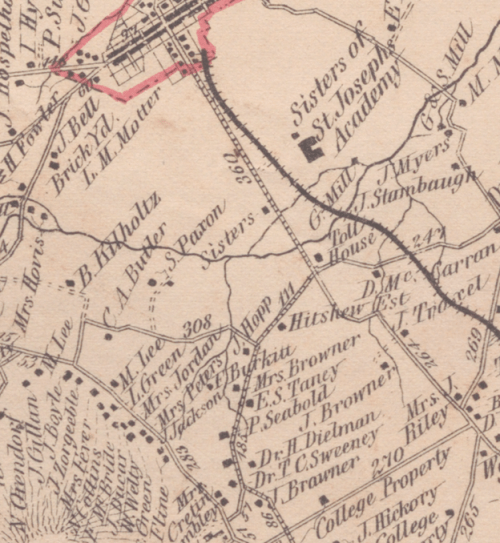
It points to the complicated interwoven strands of freedom and slavery that the Lee and Brawner properties are described as being so close to each other. Maps from the collection show their properties less than a block away from each other, and finance books show payments for activities to both families intermixed together.
1873 Atlas Map, Emmitsburg Dist. (portion)
References to the family in the Daughters’ archive pick up with Isaac, the first family member whose freedom Charles Lee purchased. Isaac Lee receives his own page in one of the surviving financial ledgers, indicating a long-standing set of payments and transactions between the two. From 1838-1839, the ledgers indicate that he was “employed by the month at $10 per month.” Notes that indicate the nature of the work include that portions of his payment come from “the Quarry Acct.” Further details emerge when one delves deeper into the transaction books to find that in addition to farm work, it includes “quarrying stones for a church.” Indeed, this lines up with the construction of the chapel of the new Central House of the Province, which today is the chapel of the FEMA National Fire Academy!
Chapel as it appears today as the National Fallen Firefighters Memorial Chapel
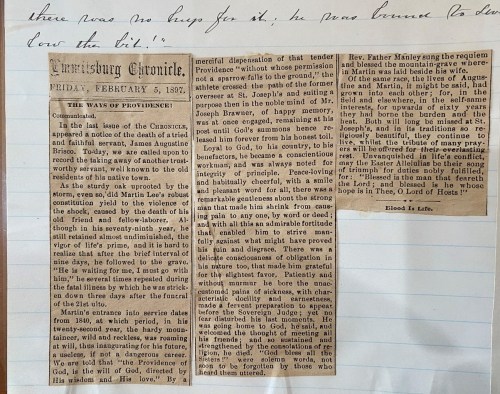
Martin Lee was not a direct descendent of Charles Lee, but married into the Lee family and chose to take his wife’s last name. The Provincial Annals contain a lengthy obituary of him after his death on January 24, 1897. He was described as a “faithful attache” of St. Joseph’s farm who had been devastated by the death of his wife Emily in later years. It is also stated that the death of his friend Augustine Briscoe, another member of another old African American family of Emmitsburg, had been a particular shock to him.
Martin had also put his earnings into purchasing real estate. He owned several small properties on the Mountain. After his death, he offered the Daughters the first chance to buy the property from his family, although the community declined to do so.
Martin Lee Obituary from the Emmitsburg Chronicle, preserved alongside the community accounts
The research process is ongoing for details about the Lee family. In the near future, it is our goal to better understand and describe the many financial ledgers and cash books to make them easier to use, and hopefully to shed more light on the historic African American families of the Emmitsburg area!





 docarchivesblog.org