Tag Archives: Emmitsburg

Historic Bible Collections

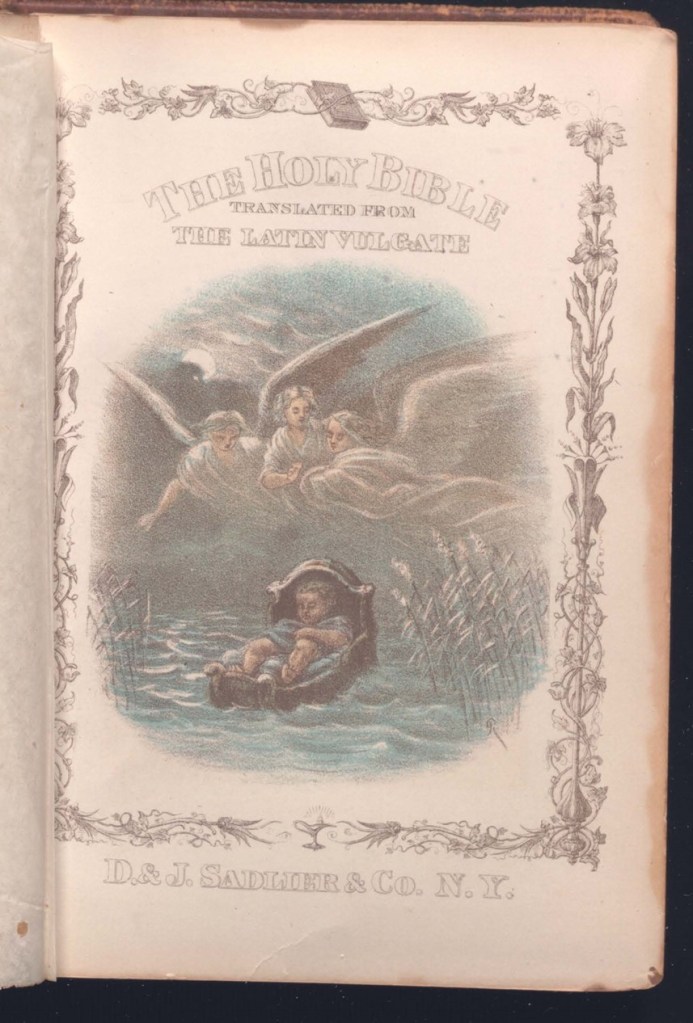
The Daughters of Charity Provincial Archives contains 12 historic Bibles published before 1900, each of them a Catholic Latin Vulgate or an approved translation of a Catholic Bible.  These Bibles offer a picture of the evolving theology of the Catholic Church throughout the 19th century based upon the unchanging foundation of the Word, a depiction of the physical ways in which the Word was made manifest, and, often, a window into the owners of these Bibles and the ways Biblical marginalia can assist with research.

In this post, we would like to highlight some particularly impressive pieces from historic Bible collections!

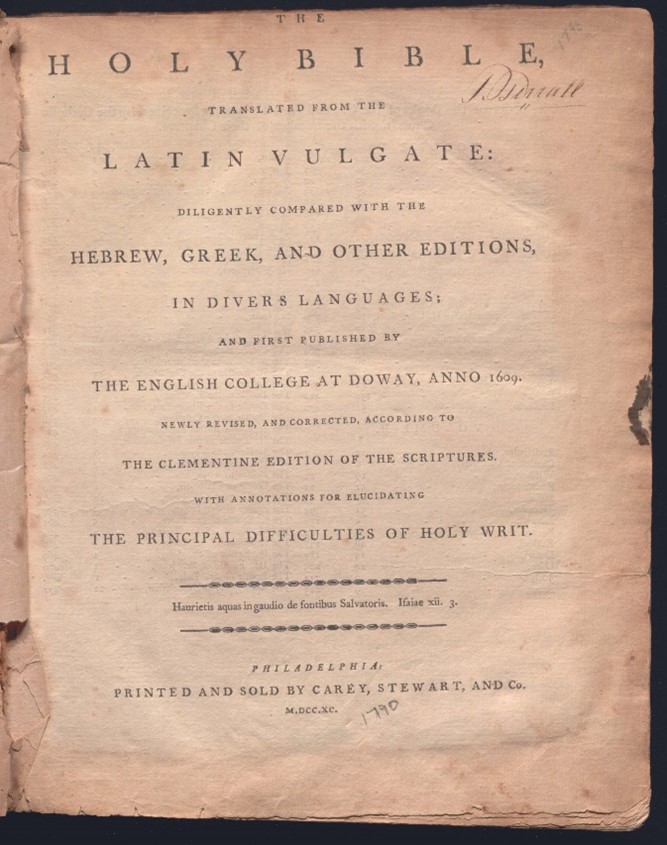
1790 Carey Bible

A Carey Bible is one of the rarest printed Bibles.  Published by the Catholic Matthew Carey out of Philadelphia, it was an English version based off of the Douay-Rheims Bible.  Most notably, it was the first English Catholic Bible printed in the United States.  Although this was not a Catholic Bible owned by Mother Seton – her personal Carey Bibles are located at Notre Dame and Vincennes, Indiana – this was the edition of the Bible that Mother Seton used.  Matthew Carey published other Bibles under the Carey name in subsequent years, but, due to its historical nature and limited initial publication, plus the fact that many surviving versions have association with prominent and historically important people, they often sell for high values at auction.  Although copies in private hands are difficult to calculate, it is almost certain that fewer than 50 remain extant today.

This Bible came to the archives via Sister Joan Marie Hoyt, who discovered it during her years as a librarian and archivist at various institutions operated by the Daughters.  It is far from pristine condition but does contain a few interesting notes.  The first is a signature on the cover page, whose name we have not been able to conclusively identify (any help anybody?).  The second is a copying of a few select verses onto the flyleaf, or the last, blank, loose page of the book.  It is interesting to note that these verses all relate to the subject of temperance from alcohol.

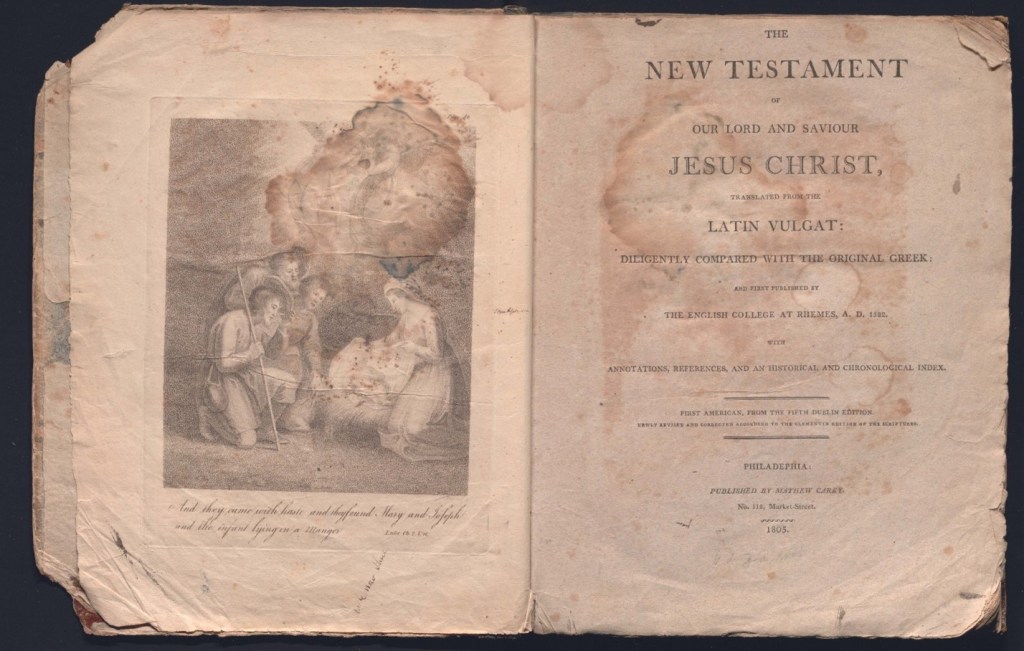
1805 New Testament – The Washhouse Bible

Monetarily, this is worth much less than the Carey Bible, although also a Matthew Carey publication.  This is an English New Testament from 1805, with plain board covers.  The entire piece shows evidence of water damage and warping.  Faded on the cover is the word “Seminary.”  On the front endpapers are the words “for the use of the Wash house.”  Between these two clues, we can place the use of the book at Mount St. Mary’s College in Emmitsburg, just down the road from the nascent community of Mother Seton, where the early Sisters had responsibilities for the Sulpician priests of the school.  The Sisters themselves did not do the washing but oversaw the enslaved women there who did.  This book was likely read by a lector to the enslaved women there, providing a rare surviving physical artifactual document to the labor of the enslaved.  It also served, however, as a record of the deaths of early Sisters and laypeople, including Alice Brennan, “children, boarders, widows, and other unknown persons who lived in Saint Joseph’s Valley in the early years of the Sisters of Charity.”

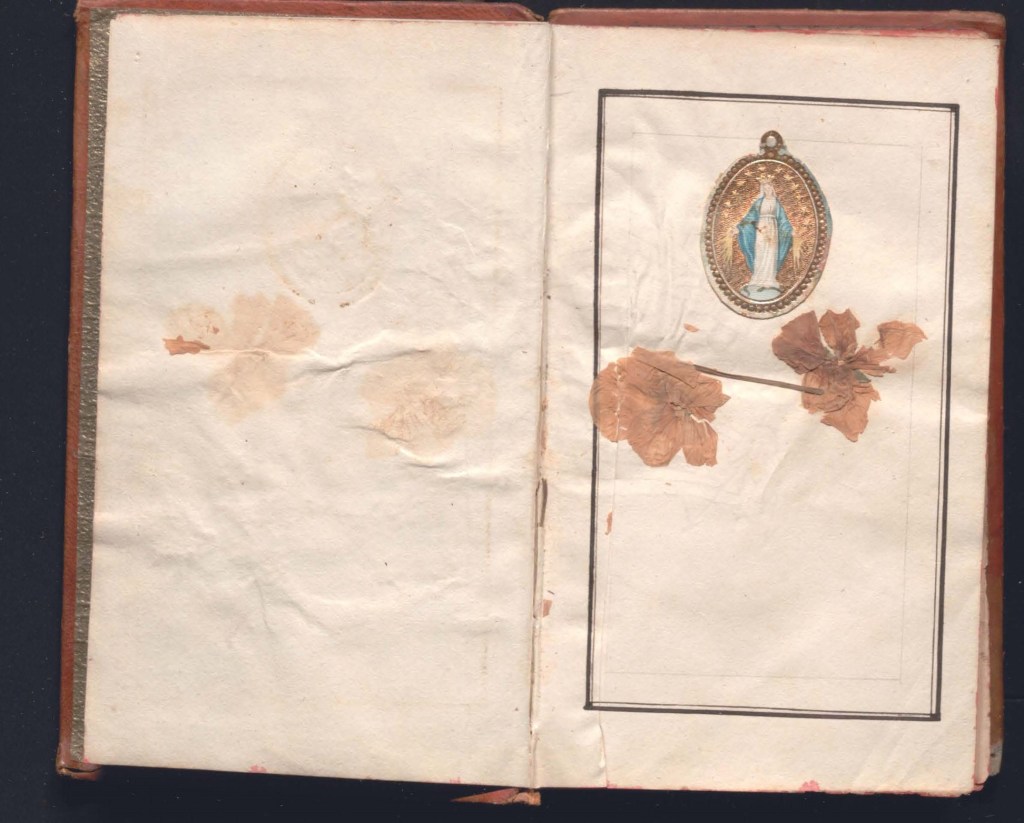
1851

This Latin Vulgate Bible is notable for what it contains in addition to the text – various bits of plant matter throughout (which have now been sleeved to prevent damage to the pages) and a hand-drawn image of the Miraculous Medal, a sacred community symbol of the Daughters of Charity’s devotion to Saint Catherine Labouré and the Blessed Mother.

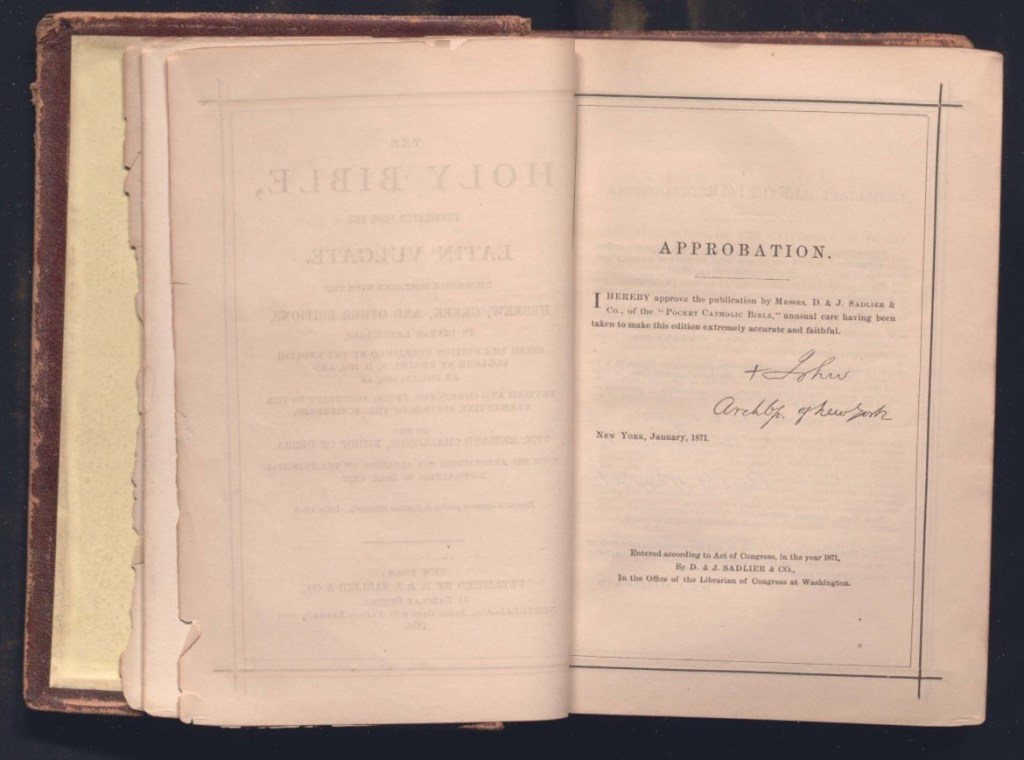
1870 Providence Hospital Bible

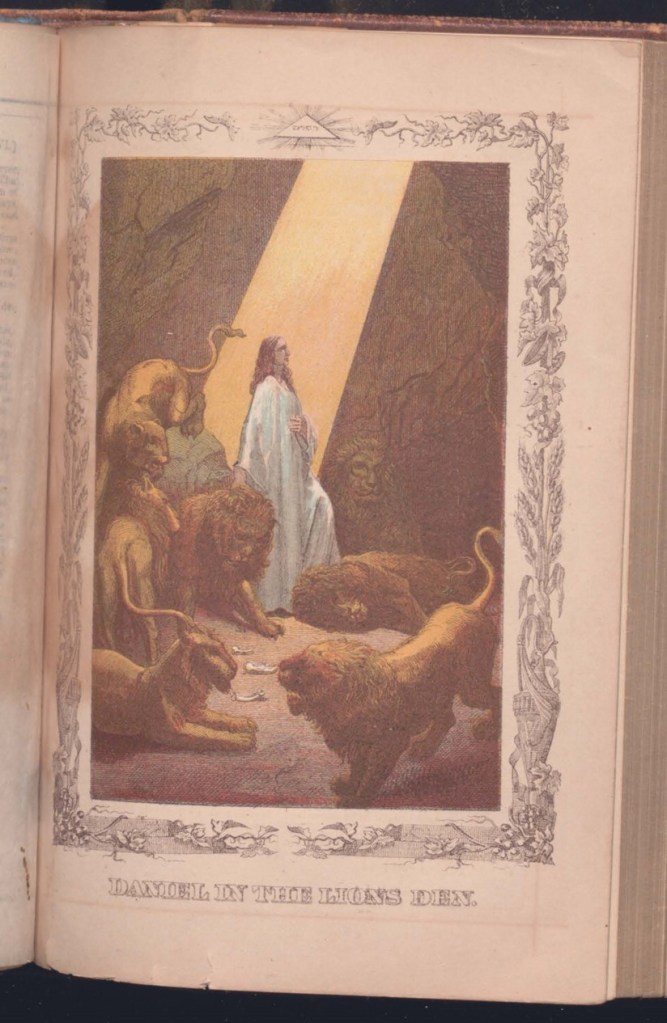
This is another Bible that contains inserted plant matter, but also begins to see the use of included illustrations.  This was not something new in religious life or even in Bibles, but that does not take away from their beauty and impressive nature.  This Bible came from the library of Providence Hospital in Washington, D.C., where it records a number of births, deaths, and signatures, including Miss Annie Farrell; William Tierney; and Archbishop John McCloskey of New York.

1880 Bible Gallery

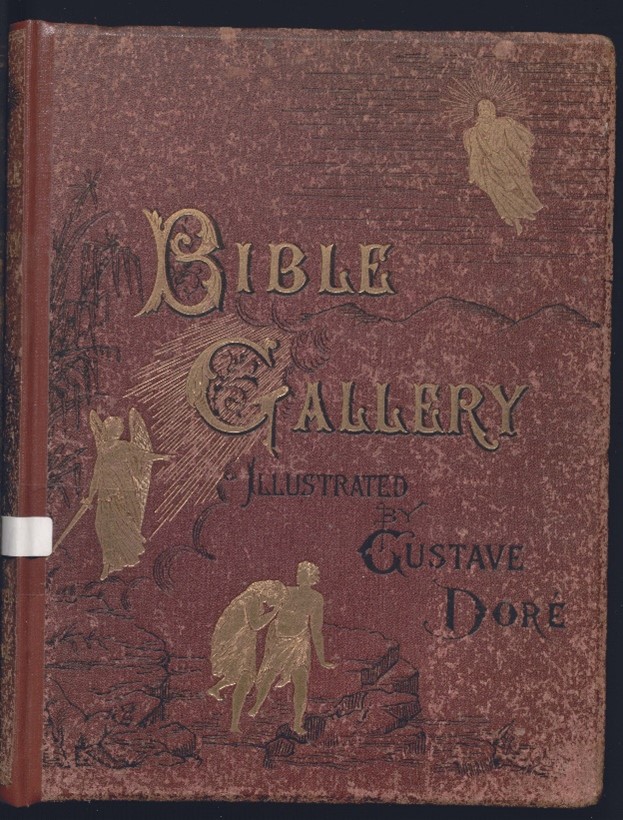
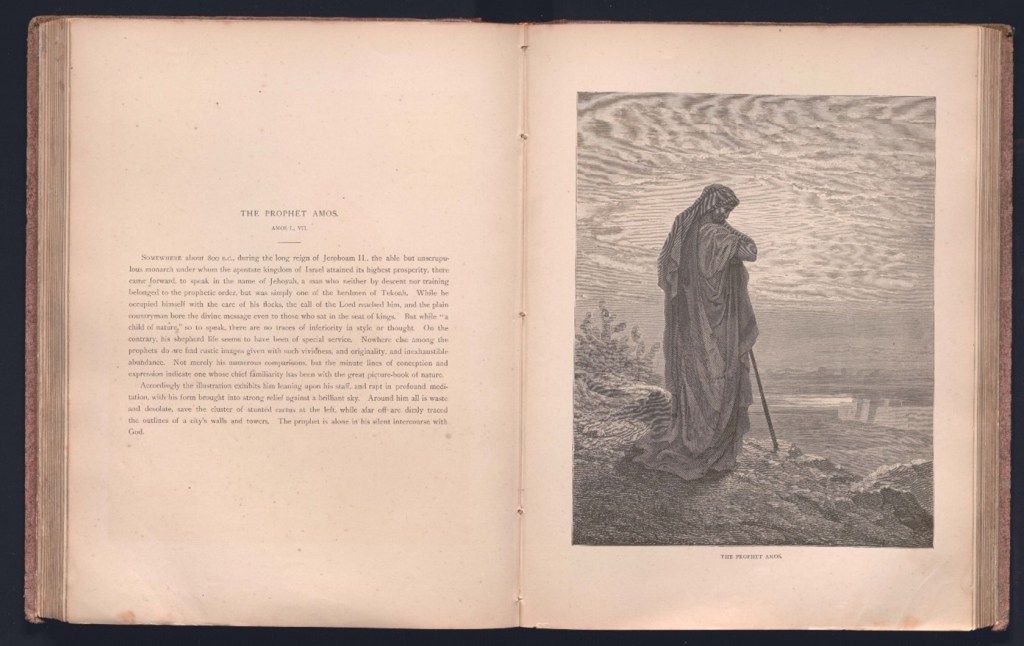
The use of images to tell Bible stories is an old one, evident in the stained glass of Medieval European Gothic churches.  This provided a way to communicate stories, theology, and values at a time when society did not have a high rate of literacy.  Although this is not technically a Bible, we included it here for the sheer magnitude of the images, all created by French artist, Gustave Doré.

All Bibles in the collection that are structurally sound enough are free to be used on-site by researchers and guests by appointment.

Leave a comment

Filed under Bibles

New Digitized Materials Available: St. Joseph College postcards

Explore the campus of the St. Joseph’s Academy and St. Joseph College in Emmitsburg through the digitized postcard collections! Now available through our partners at Digital Maryland https://collections.digitalmaryland.org/digital/collection/sjap.

Leave a comment

Filed under Announcements, Uncategorized

Our Four Campuses: Emmitsburg, Maryland

This is part one of a four-part series on the history of the four primary campuses in the Province, which correspond to the locations where the four provinces that formed the Province of St. Louise had their provincial houses:  Emmitsburg, MD; Albany, NY; Evansville, IN; and St. Louis, MO.

The foundation of the Emmitsburg campus, the oldest of the four campuses in the current Province of St. Louise, came from Mother Seton herself when she founded St. Joseph’s Free School.  Although this is applying the term anachronistically, the “campus” at the time would have consisted of the Stone House, where the Sisters lived when they first arrived, and the historic St. Joseph’s House, also called the White House.

Mary Jamison’s needlework of St. Joseph’s Academy in 1812, the oldest “photo” of the campus in the collection

As St. Joseph’s Free School developed into St. Joseph’s Academy, more buildings were added to the campus.  By 1902, when the Academy was re-incorporated as St. Joseph College, the campus featured classroom space, student dorm rooms, a library, art studios, living quarters and chapel for the Daughters, and an area for the Provincial Council, as well as a Seminary for the formation of the Sisters.

St. Joseph’s Academy, 1850

Between 1964 and 1965, the current St. Joseph’s House was built, allowing the Sisters, Seminary, and Council to move away from the College.  The move took place on September 12, 1964, with employees on hand to assist the Sisters in the move. 

The building’s original layout featured a central courtyard with four spokes:  “A Wing” was Seminary, “C Wing” the postulatum, “E Wing” the Council offices and Administration, and “K Wing” the Chapel and Shrine of the recently beatified Mother Seton.

The new Provincial House under construction, 1963, with the old campus in the background

In 1972, the Villa St. Michael, the Sisters retirement facility in Baltimore, permanently moved to the Provincial House in Emmitsburg, filling the top floors of rooms.  In 1975, with the canonization of Mother Seton, the process began to convert the Daughters’ chapel into a place of public veneration at the tomb of the Saint.  In 1979, the Seton Shrine Museum opened in its current location beneath the Basilica.

The large amount of downsizing that the Province and the campus had experienced after the 1960s allowed for the Daughters to begin to partner with good works in the area.  From 1992 to 1994, construction for St. Catherine’s Nursing Home took place, offering a home and care for the elderly that continues to this day.

In 2008, the Marian Center closed.  Having been created in 1953 to spread devotion to Mary, this ministry created Miraculous Medals and red and green Scapulars, along with the distribution of educational materials.

In 1998, the Seminary, now Interprovincial and covering all provinces of the United States, moved to Los Altos California (it has since moved to St. Louis). 

In 2011, the four provinces merged, and the modern iteration of the Provincial Archives was created.  Moving from their spot at the end of E-wing, the new repository made it one of the largest archives for a community of women religious in the country.  It opened to researchers in 2013

Touring the archival repository under construction, October 2012

In 2013, the Daughters sold A-Wing of the campus to Homes for America to create Seton Village, a series of low-income apartments for senior citizens, fulfilling a valuable need in Northern and Western Maryland. With E-wing now empty, in the early 2020s, the Daughters began talks to partner with Mount St. Mary’s University for a new home for their Physician’s Assistant program.  Sister Teresa George, the current Provincial Treasurer, discusses the collaboration on the Live Significantly podcast in the episode “Sister Teresa George:  Synergy.”

Other changes are coming to the Seton Shrine, as they expand their space on the campus to present high-quality historical and spiritual exhibitions on the life of the community’s American Foundress and the Sisters of Charity Federation communities.

The campus on a summer day, 2014

3 Comments

Filed under Emmitsburg, St. Joseph's Academy