Tag Archives: St. Joseph's Academy

The Emmitsburg Plant Books

In the age of Laudato Si, we are reminded of the value of knowing what our common home looks like, and part of this is knowing the level of biodiversity in our environment.  The Sisters and Daughters of Charity who ministered at St. Joseph’s Academy and at their Provincial house throughout the 19th century did not go into extensive detail on trees, plants, and ecology around them.  Thankfully, some of their students did.

The Archives has five books, each containing a collection of pressed leaves and flowers of various plant species found in the area, along with the scientific name of each plant.  The books range in date from 1806 to 1874.

The typical page from one of these books consists of one or several samples cut and pasted into the books and its scientific name.

This page consists of Salvia Splendens and Salvia patens, or red and blue sage.

The scrapbooks provide evidence of the education Academy students were receiving, both in Latin and in plants and botany.  While many of the plants are native, several of them are not, indicating some type of cultivation.  One of the books even contains a chart of the plants, including its count, scientific, and common name, as well as more information on its taxonomical classification.

From 1807

Seeing as some of the books predate Mother Seton’s founding of her school in Emmitsburg in 1809, it is unclear exactly how some of the earliest books came to the collections.  Others, however, have clear provenance and direct connection to Emmitsburg, as the one created by Mary O’Rourke, class of 1874, sent by her husband and daughter after her passing.
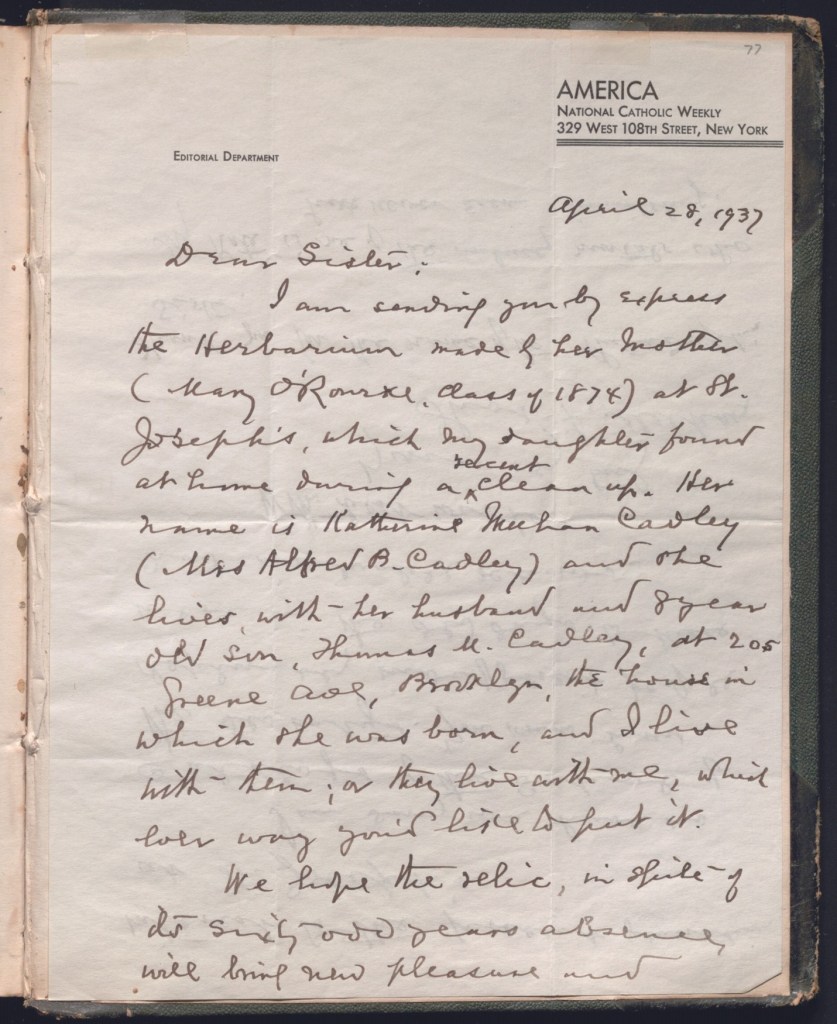
We are in the process of scanning these books, first and foremost as a conservation measure.  Decaying plant matter does not typically do well for conservation and holding up well, as anyone familiar with trees, soil, gardening, or nutrients will tell you.  The plant samples are also incredibly fragile, made dry and brittle by over a century (sometimes two) of survival.  Scanning will preserve the books in the state they are in now, at least in image form, in case more and more pieces get whittled away.  Currently, three of the five books have been scanned, and we are planning to make them available publicly through our colleagues at Digital Maryland.  Eventually, we will make the others available as well, but due to their size, we will need to work with third-party vendors with capabilities that we do not have on-site.

1 Comment

Filed under Emmitsburg, Environment

Special Exhibit: The Academy at Christmastime

Along with our partners at The National Shrine of Saint Elizabeth Ann Seton, the Archives has curated a set of student notebooks from students of St. Joseph’s Academy. We even made some copies so you can see more than the page that is on display! Stop by the entry hallway to the Basilica to see them!

This is available all week through Sunday, December 11 and leads through the Museums by Candlelight (Saturday, December 10) event put on by the Frederick Historic Sites Consortium!

Leave a comment

Filed under Announcements, Exhibits, St. Joseph's Academy

St. Joseph’s School before St. Joseph’s Academy

The commitment to education of the American Daughters of Charity and Sisters of Charity dates to Saint Elizabeth Ann Seton’s initiative for female education, begun in Baltimore in July 1808.  It took two years, however, for female education to become a primary mission of the Sisters of Charity in the form of St. Joseph’s School in Emmitsburg, MD.   

Invited by Rev. Louis William DuBourg, P.S.S., President of St. Mary’s College, the Widow Seton began a small boarding school for Catholic girls on Paca Street with the support of the Sulpician priests at St. Mary’s Seminary.  There she met Samuel Sutherland Cooper, a seminarian who was divesting himself of accumulated wealth in order to pursue his vocation to the priesthood.  He encouraged the widow to agree to direct an educational program on a property that he would purchase.

Pace Street House, Baltimore, c. 1890s

Located beyond the town limits of Emmitsburg, Cooper and the Sulpicians believed the setting to be ideal for an institution to educate girls, with nearby Mount St. Mary’s College providing education for boys. 

On June 22, 1809, Mother Seton arrived at Mount St. Mary’s in Emmitsburg with one of her daughters and a few of her companions; the rest of her children, early community members, and two pupils arrived a little more than a month later when the Stone House was ready for occupancy.  On July 31, 1809, the Sisters of Charity of St. Joseph’s officially began, and St. Joseph’s School became one of the first free Catholic schools for girls staffed by sisters in the United States.

As it became increasingly clear that funding was required, the school began admitting boarding students who paid tuition in May 1810.  These students came from the surrounding Frederick County and became the first boarding students. 

The school curriculum included grammar, spelling, reading, writing, geography, parsing, arithmetic, French, music, and fine sewing, etc.   All pupils received religious education and faith formation, according to their grade level.  Mother Seton wrote to her friend, Julia Scott, how her daughter Annina “studies French, Spanish and Italian with [the day students] under a mistress who is sweetness and modesty itself”

After St. Joseph’s School became St. Joseph’s Academy in 1828, the school continued to teach “day scholars” from the surrounding area for free up until 1870.  When operating costs began to hinder this practice, the Sisters still offered discounts and worked to find ways for students to afford tuition when they needed it. 

St. Joseph’s School and, later, St. Joseph’s Academy, were not parochial schools but Catholic schools sponsored and funded by the Sisters of Charity.  Saint John Neumann, CSsR, 4th bishop of Philadelphia, initiated Catholic parochial education when he established the first diocesan parochial school system in the United States in 1852.

3 Comments

Filed under Baltimore, Elizabeth Ann Seton, Emmitsburg, Paca Street, St. Joseph's Academy