Tag Archives: history

The Lee Family of Emmitsburg

Research on the Lee family has been greatly assisted by the work of the “Recovering Identity” project of the Catoctin Furnace Historical Society.  The Daughters of Charity Provincial Archives has assisted the project with resources where we were able, and we are grateful to them for the next steps they have taken and their extensive consultation of other sources.  Their full reports and summaries and be found here.

Beginning in the late 1870s and going through the 1890s, the “Talks with Ancient Sisters” sought to gather the stories of some of the oldest Sisters and community members, particularly those who had been around in the time of Mother Seton.  Speaking in 1884, Sister Helena Elder, a member of the Elder family, a longstanding, extensive landholding family of Emmitsburg, briefly mentioned a family named Lee:  “I don’t know whether his name was Charles or not.  A colored man and his wife.  They lived up there in Brawner’s place,” Sister Helena said.  Her interviewer added “I expect that’s the Lee [who] Bishop Bruté speaks of in one of his notes after Mother’s death when he says, ‘here looking across the fields from Charles Lee’s about one mile to the little wood.’”

Like several of the African American families of early Emmitsburg, a brief mention like this can begin to scratch the surface of life amongst the free and enslaved communities of Emmitsburg in a history that has only begun to receive attention within the last few years from local historians.   

Father Bruté does in fact first mention Charles shortly after Mother Seton’s death in 1821:

I again shed tears near Charles Lee’s looking from the hill across the meadows one mile towards that little wood to day [sic], 19th May, 1821

The property of the Lees, overlooking the Valley where the Sisters established themselves, had been owned by Charles since 1813 on a property appropriately called “Pleasant View.”  Charles is called in the Bill of Sale document “Charles Lee Blackman (formerly the property of John M. Bayard).”  Indeed, Charles had purchased his own freedom in 1804 for £100.

Deed identifying Charles Lee as “formerly the property of John M. Bayard” as he purchases his own land for the first time (courtesy Maryland State Archives)

Charles is remembered in the late 1880s by another local African American man, Augustine Briscoe.  The Lee property had apparently remained somewhat famous, as he said “There, Sister, there is where Charles used to live. They were old settlers about here. Charles Lee was grandfather to Martin Lee; he was free but his wife wasn’t.”  By 1810, Charles and his family were all living together, despite their mixed-freedom status, and, from 1807 to 1814, Charles purchased the freedom of his wife Hannah and children Isaac, Peggy, and Adeline from Elizabeth Brawner, another member of the Elder family.  Their later children would be born free and never bear the struggle or indignity of slavery.

It points to the complicated interwoven strands of freedom and slavery that the Lee and Brawner properties are described as being so close to each other.  Maps from the collection show their properties less than a block away from each other, and finance books show payments for activities to both families intermixed together.
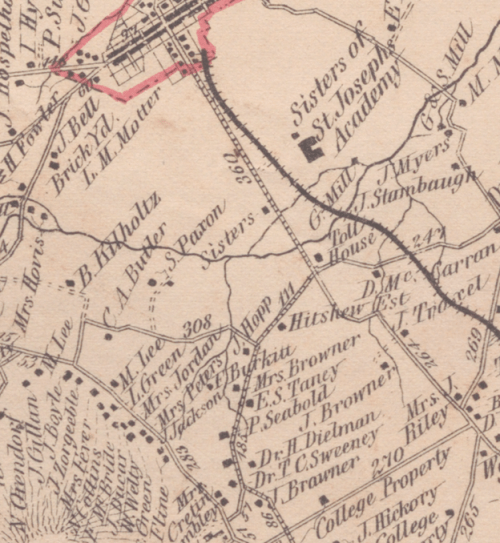
1873 Atlas Map, Emmitsburg Dist. (portion)

References to the family in the Daughters’ archive pick up with Isaac, the first family member whose freedom Charles Lee purchased.  Isaac Lee receives his own page in one of the surviving financial ledgers, indicating a long-standing set of payments and transactions between the two.  From 1838-1839, the ledgers indicate that he was “employed by the month at $10 per month.”  Notes that indicate the nature of the work include that portions of his payment come from “the Quarry Acct.”  Further details emerge when one delves deeper into the transaction books to find that in addition to farm work, it includes “quarrying stones for a church.”  Indeed, this lines up with the construction of the chapel of the new Central House of the Province, which today is the chapel of the FEMA National Fire Academy!  

Chapel as it appears today as the National Fallen Firefighters Memorial Chapel

Martin Lee was not a direct descendent of Charles Lee, but married into the Lee family and chose to take his wife’s last name.  The Provincial Annals contain a lengthy obituary of him after his death on January 24, 1897.  He was described as a “faithful attache” of St. Joseph’s farm who had been devastated by the death of his wife Emily in later years.  It is also stated that the death of his friend Augustine Briscoe, another member of another old African American family of Emmitsburg, had been a particular shock to him.

Martin had also put his earnings into purchasing real estate.  He owned several small properties on the Mountain.  After his death, he offered the Daughters the first chance to buy the property from his family, although the community declined to do so.
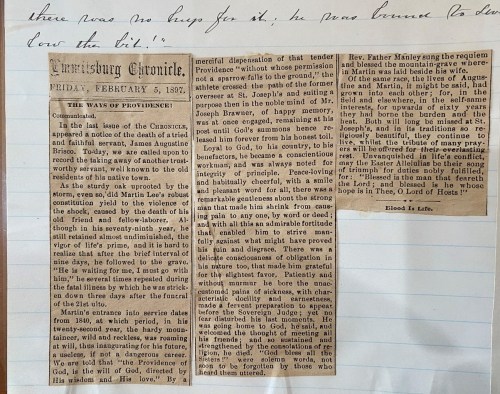
Martin Lee Obituary from the Emmitsburg Chronicle, preserved alongside the community accounts

The research process is ongoing for details about the Lee family.  In the near future, it is our goal to better understand and describe the many financial ledgers and cash books to make them easier to use, and hopefully to shed more light on the historic African American families of the Emmitsburg area!

Leave a comment

Filed under African American History, Emmitsburg

The Setons at the National Archives

The National Archives and Records Administration is the repository of all official documents of the United States government.  With Mother Seton and her family’s long history in the United States, particularly in the United States Navy, the Seton family appears in many different places in our nation’s official government repository.

First, it is also worth noting that the ancestral Seton family have their own collection in the National Records of Scotland from Glorious Revolution through 1785.

The most obvious place that the family is represented is in the census records, with Elizabeth Ann and William Magee Seton appearing in the earliest censuses in New York City, and then Mother Seton appearing in Emmitsburg in 1810 and 1820.  The census records provide massive volumes of information related to demographics and are used most immediately for congressional apportionment and for funding for public services.

Listing for Mother Seton and the community in the 1810 census under “E. Seton”

William Seton III, one of Mother Seton’s surviving sons, is among the most represented due to his career in the Navy.  Military records, for both genealogists and veterans, are among the most used and requested materials in the National Archives.  Within the collection “Naval Records Collection of the Office of Naval Records and Library,” there is a series called “Letters Received from Commissioned Officers Below the Rank of Commander and from Warrant.”  This series contains various letters documenting official correspondence of enlisted sailors and their interaction with superior officers.  Among these are 19 letters including requests for leave, administrative documents, and reports from William Seton reporting to his commanding officers.  They span from his time on the Macedonian during its tour of the Pacific (and whose log is in the possession of the Daughters’ Archive).  Many others request shore leave or ask for extensions of leave.

William’s sister Catherine makes an appearance in one of his requests.  On October 9, 1828, William requested leave to travel in Europe due do “the continued ill health of my sister, to whom the Phisicians [sic] have recommended that course, as the only hope of renovating her constitution.”  This occurred during Catherine’s “World Traveler” era, when she was making extended stays in Europe, before eventually becoming a religious Sister of Mercy.  His letters stretch through his return to Norfolk in 1833 and return to civilian life.

William Seton to the Secretary of the Navy, October 9, 1828:  “Sir[,] I had the honor a few days past, to apply to you for permission to travel in Europe.  I beg leave to state that my reason for doing so was the continued ill health of my sister, to whom the Phisicians [sic] have recommended that course, as the only hope of renovating her constitution”

William Seton Maitland, nephew of Elizabeth and William Magee, also appears in the military records during the Seminole Wars in Florida. 

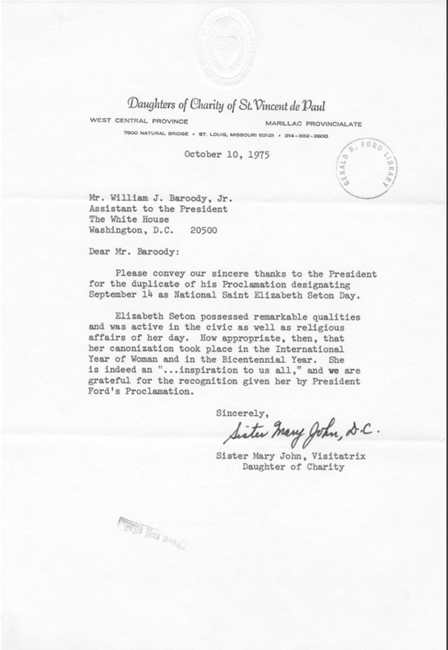
In the more modern day, and as a preview of things to come, the National Archives is also in possession of the official proclamations from the U.S. government about Mother Seton’s canonization.  Under Press Secretary William Baroody’s files, held at the Gerald Ford Presidential Library, is the official proclamation of Elizabeth Ann Seton Day, alongside a signed thank you letter from Sister Mary John Lindner for the community’s replica copy, signed by President Ford.  This replica will be on display next year (2025) for our exhibit “One of Us” at the Seton Shrine, celebrating the 50th anniversary of this event!

As a reminder of the vast scale of the National Archives, and the complexity of archival research, these records are among those that are digitized and available remotely to researchers.  This totals a mere 2% of the National Archives’ holdings, and there may well be other materials that one day are accessible without a trip to your nearest NARA branch.  William Seton IV, Mother Seton’s grandson, appears in Civil War veterans records, but his company, the New York 16th Artillery, have not been digitized yet. 

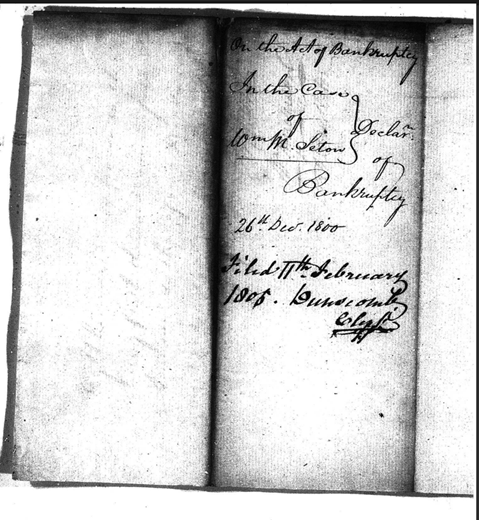
As an example of records which need to be visited in-person, these scans were lent to us by our friend and colleague Dr. Catherine O’Donnell and come from the National Archives branch in Kansas City, where Record Group 21 “Records of District Courts of the United States” reside.  Less than 0.5% of these records are scanned and online as of this time, but among them are early records of the United States bankruptcy court.  It is in these documents that the Setons’ life in New York City began to unravel, as the Seton-Maitland shipping company ran out of money, and the Setons were forced to sell their assets.

Front cover of 1800 bankruptcy filing
First page of Seton Family’s assets during bankruptcy case

Archivists at NARA are working hard to make more materials available, both in-person and remotely.  A way that you can help is to make more materials more searchable.  Their Citizen Archivist program allows anyone with an Internet connection to apply metadata and transcription to documents that have been scanned and made available.  These tags help make more materials searchable, so that that needle in haystack – that one stray name in a vast file – can turn up with a few strokes of a keyboard.

The records in the National Archives are the property of the American people.  Make use of your records, and help others make use of them too!

Leave a comment

Filed under Archives, Elizabeth Ann Seton

Teddy Roosevelt’s Christmas Cards

The Daughters of Charity have had histories with many United States Presidents, but perhaps no stranger one is reflected in the Archives than the one with President Teddy Roosevelt.

Theodore Roosevelt first became acquainted with the Daughters at Montauk Point Camp on Long Island.  Colonel Roosevelt, a New Yorker from the New York City-Long Island area, passed through on his way to the Spanish-American War, with the Daughters nursing at stateside camps in 1898. 

In 1902, President Roosevelt was visiting Indianapolis, when he suffered from an abscess in his leg.  Sister Regina Purtell, then director of St. Vincent’s Hospital, met the President and would serve as his private nurse.

In the several years afterward that he occupied the White House, President Roosevelt seems to have recognized Sister Regina’s fellow Daughters of Charity at Providence Hospital.  During his second term, from 1905-1908, the Daughters and the President exchanged Christmas cards every year, with the President sending a nice thank you for their prayers and their work.  Although they are not handwritten, they are all unique, which indicates that they were not a form letter but dictated by the President to a secretary.  He did then personally sign the letters on official White House stationery. 

His primary point-of-contact seems to have been Sister Regis Biller, another veteran of Montauk Point. 

Some of the letters do have the unfortunate mar of some out-of-date archival practice, when a stamp by the holding institution was used to show ownership of an item and prove authenticity.  While none of the stamps obscure the text, they tend to take the reader out of the moment with an intrusion of later 20th century practices.

2 Comments

Filed under Theodore Roosevelt, U.S. Presidents