Category Archives: Social Justice

The Emmitsburg Plant Books

In the age of Laudato Si, we are reminded of the value of knowing what our common home looks like, and part of this is knowing the level of biodiversity in our environment.  The Sisters and Daughters of Charity who ministered at St. Joseph’s Academy and at their Provincial house throughout the 19th century did not go into extensive detail on trees, plants, and ecology around them.  Thankfully, some of their students did.

The Archives has five books, each containing a collection of pressed leaves and flowers of various plant species found in the area, along with the scientific name of each plant.  The books range in date from 1806 to 1874.

The typical page from one of these books consists of one or several samples cut and pasted into the books and its scientific name.

This page consists of Salvia Splendens and Salvia patens, or red and blue sage.

The scrapbooks provide evidence of the education Academy students were receiving, both in Latin and in plants and botany.  While many of the plants are native, several of them are not, indicating some type of cultivation.  One of the books even contains a chart of the plants, including its count, scientific, and common name, as well as more information on its taxonomical classification.

From 1807

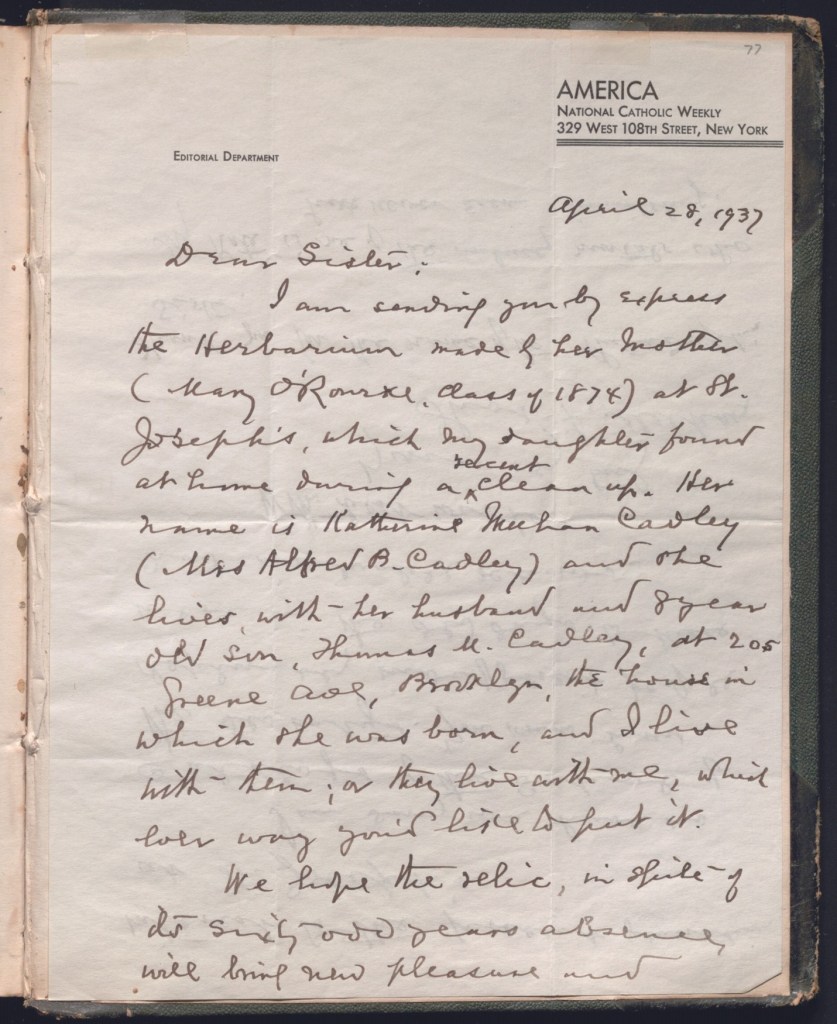
Seeing as some of the books predate Mother Seton’s founding of her school in Emmitsburg in 1809, it is unclear exactly how some of the earliest books came to the collections.  Others, however, have clear provenance and direct connection to Emmitsburg, as the one created by Mary O’Rourke, class of 1874, sent by her husband and daughter after her passing.

We are in the process of scanning these books, first and foremost as a conservation measure.  Decaying plant matter does not typically do well for conservation and holding up well, as anyone familiar with trees, soil, gardening, or nutrients will tell you.  The plant samples are also incredibly fragile, made dry and brittle by over a century (sometimes two) of survival.  Scanning will preserve the books in the state they are in now, at least in image form, in case more and more pieces get whittled away.  Currently, three of the five books have been scanned, and we are planning to make them available publicly through our colleagues at Digital Maryland.  Eventually, we will make the others available as well, but due to their size, we will need to work with third-party vendors with capabilities that we do not have on-site.

1 Comment

Filed under Emmitsburg, Environment

Integrating Parishes: Greensboro

“To work at ending racism, we need to engage the world and encounter others—to see, maybe for the first time, those who are on the peripheries of our own limited view. Knowing that the Lord has taken the divine initiative by loving us first, we can boldly go forward, reaching out to others. We must invite into dialogue those we ordinarily would not seek out. We must work to form relationships with those we might regularly try to avoid.” (23)

“So many of our parishes are richly diverse, composed of people from various cultures and ethnic groups, such that they can be a model for the whole Church and for the country.” (27)

Open Wide Our Hearts:  The Enduring Call to Love a Pastoral Letter against Racism by United States Conference of Catholic Bishops

In 1953, Bishop Vincent Waters of the Diocese of Raleigh, North Carolina ordered all Catholic churches desegregated in the Diocese, followed shortly afterward, in 1955, by the desegregation of Catholic schools.  Over the course of the next twenty years, the impact of desegregation on the Church and the schools was felt across North Carolina.

Since 1928, the Daughters of Charity taught at St. Mary’s School in Greensboro, North Carolina.  In 1949, the school changed its name to Our Lady of the Miraculous Medal, a parish school designated to serve African-American children.  When desegregation began, students started to attend St. Pius X School, leading to a drop in numbers at Our Lady of the Miraculous Medal School.

In 1972, the difficult decision was made to close the school due to declining enrollment, and the Daughters began to re-examine how best to serve the parish community of Our Lady of the Miraculous Medal.  That same year, four Daughters arrived at the parish to tackle this challenge.

Letter from Father Robert Clifford, C.M. of Our Lady of Miraculous Medal Parish

The first step taken was to reconnect the parish to its roots and change the name back to St. Mary’s.  The next step, in the spirit of Vatican II and the recommendations for lay involvement in the life of a parish, was to create a Parish Council.  This would prove to be even more important in the coming years as the process of desegregation continued within the church and throughout the city.

In 1974, the Diocese of Charlotte, of which the parish was now a part, ended the designation as the African-American parish.  Instead, the parish was to have a defined territory just like all the others in the parish.  The surrounding territory brought together people of different social classes and incomes, as well as brought white and black neighborhoods together for the first time in the parish.

The Daughters of Charity now served at St. Mary’s Center, the social outreach arm of the parish.  Sisters served on the Council, as social workers, directing programs of the Parish, visiting the aged and sick, and working with returning citizens.

First Parish Council meeting, October 3, 1972

According to Sister Agnes Silvestro’s report in 1975, the purpose of the Daughters’ ministries at the parish was defined as follows: 

“St. Mary’s is an integrated parish where staff and parishioners [sic] are working together to become a people pleasing to the Father, a ‘single people,’ a FAITH COMMUNITY.”

She also wrote about the need to balance competing claims to the ownership of the Parish from white and Black members.  African-American members outnumbered white members, yet, according to Sister Agnes, ”whites for the most part [were] more vocal.”

Nonetheless, the Sisters, assisted by the Vincentian priests who ministered to the parish, persisted in their work.  Although the Daughters departed in 1980, they laid out plans for a long-lasting and successful parish.  The interior of the church today has been modernized, but essentially looks much as it did almost 90 years.  From the 1970s to the 1990s, the Parish incorporated even more changes into its community life as immigrant communities from Africa, Asia, and Latin America arrived in the community.

Interior of St. Mary’s Parish today (Source: https://stmarysgreensboro.org/)
Our Lady of the Miraculous Medal Parish, 1938

Leave a comment

Filed under Civil Rights, Desegregation, Greensboro, North Carolina

Recollections of the Greensboro Sit-ins

Sister Edwina Whittington was on mission to Our Lady of Miraculous Medal School in Greensboro, North Carolina as teacher and principal from 1961 to 1965. Later in life, she recalled the Daughters’ solidarity with protesters participating in the Greensboro sit-ins to desegregate the city:

“One evening the parents of our school children had planned a meeting to prepare for the celebration of our graduates of Our Lady of the Miraculous Medal School. At that time the school children were all black.

I went over at the appointed time, but no one showed up. I waited awhile because this was so unusual. There were always quite a number of them present for any activity of the Church or School. They were always so cooperative!

After half an hour, I decided to go back to the convent to listen to the radio. As soon as I entered the convent, I saw the other three Sisters avidly listening to the news. The news station stated that now Greensboro was on the map because the first sit-down strike was in progress at the downtown square.

Now I knew why the parents had not attended the meeting. All of the black fathers and their oldest sons (our graduating class of boys were sitting in the square. Eventually, they were all arrested and marched off to an old empty warehouse because there were too many to put in jail.

The next day, Saturday, Father McCormick, C.M., came to see me and told me that he had seen them and they had been packed into the room and they had nothing that they needed.

I said, ‘Please go back and tell the guards that these men always went to Mass on Saturday at 9:00 A.M.’ That gave us, the Sisters, time to tell the wives of these men to pack the things that they would need and to bring them to Church for the 9:00 Mass on Sunday morning.

True to their word, the guards came with the men in two large busses, in time for the 9:00 Mass. We all celebrated Mass together and after it, one woman started the Rosary out loud. Then, the guard in charge came to me to say, ‘That’s enough; no more prayers can be said. I have to get these men back to the warehouse.’ When the Rosary was finished, the women went out of the Church and formed two lines with their bags of supplies. They left a large space in the center of the two lines for the men and their guards to march through. When the mean and their guards came out in formation, the women rushed up to their husbands and sons, gave them the prepared bags, and then went back to form their lines. The civil authorities kept the men for four days and then let them go to their homes.”

Citation: Daughters of Charity Archives, Province of St. Louise, “Recollections by Sr. Edwina Whittington,” RG 11-1-2, Greensboro, NC – Our Lady of Miraculous Medal School Collection, Box 1, Folder 7

Leave a comment

Filed under Civil Rights, Desegregation, Greensboro, North Carolina