There are currently six African Americans on the pathway to sainthood. One of them, Ven. Pierre Toussaint (1766-1853), shares a connection with the early Sisters of Charity of St. Joseph’s.
Toussaint arrived in New York City from Haiti with his enslavers in 1787. He was permitted to work and earn money for himself as a hairdresser, becoming renowned for his skill and able to command high prices from the upper classes for his work. When his Mistress died in 1807, he was freed through her last will and testament. His renown grew through his connections with different members of society – the upper native classes through his work, the immigrants from the Francophone world through his mother tongue, and the Black community – both free and enslaved – through his race and life experience. Upon his freedom, he took the last name Toussaint in honor of Toussaint L’Ouverture, hero of the Haitian Revolution.
Toussaint’s financial success and Catholic faith inspired him to give back. Among other charities, he was a major visitor and contributor to the Roman Catholic Orphan Asylum on Prince Street, an orphan asylum that had been run by the Sisters of Charity of St. Joseph’s since 1817. His special concern for this cause likely came from the death of his sister, after which he took in his niece to raise her. At one time, his donations totaled one-third of all the yearly donations of the Asylum. This is in spite of the Orphan Asylum being, at the time, for white children only.
Among the other causes that he championed, Toussaint showed particular concern for refugees, particularly those who spoke French. He also founded the first Catholic school for Black children in New York City, located at the Parish of St. Vincent de Paul, the city’s Francophone parish at the time.
Toussaint was known for attending daily Mass at St. Peter’s, which was Mother Seton’s parish during her New York years!
In 1846, the Sisters in New York City and Brooklyn withdrew from Mother Seton’s community to form the Sisters of Charity of New York, who inherited the community’s history in the Metro area up until that time. In 1850, members of the Sisters of Charity of St. Joseph’s joined with the French Daughters of Charity, and a separate group of Sisters formed the Sisters of Charity of Cincinnati. The New York Orphan’s Asylum forms part of the core history of the Sisters of Charity of New York and therefore, of the shared history of Mother Seton’s Daughters.
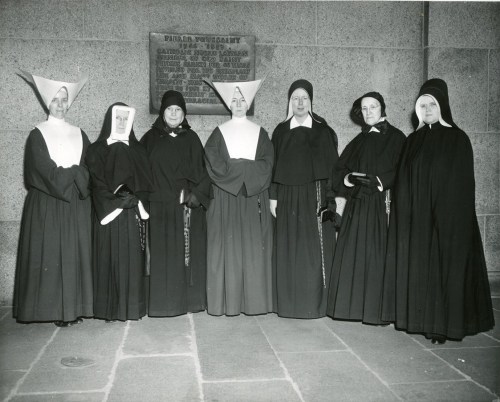
A meeting of the Sisters of Charity Federation, sometime after 1953, in front of the plaque to Pierre at Old St. Patrick’s Cathedral.
In 1990, for his role in helping the Catholic Charities of the city survive in their early days, Toussaint was re-interred to the crypt of St. Patrick’s Cathedral. He is the only layperson so honored. He was declared venerable in 1996. The Pierre Toussaint Guild and Office of Black Ministry of the New York Archdiocese actively engages in charity and sponsorship projects that they believe Toussaint would support today.
“Soon scenes may change, soon friends prove untrue
When for I rove, from dear Saint Josephs view
Yet naught can chase, thy image from my mind”
-From “Farewell to St. Joseph’s,” 1830, by “Remember Maria”
This is part of a yearlong series about the early days of the Sisters of Charity of St. Joseph’s commemorating the 200th anniversary of the death of Saint Elizabeth Ann Seton, foundress of the community. In 1850, the Emmitsburg-based Sisters united with the international community of the French Daughters of Charity.
In many archives that gather administrative or corporate records, the voices of the people who used those services can be frustratingly absent. Luckily, the collection of St. Joseph’s Academy, the school founded by Mother Seton and the Sisters of Charity of St. Joseph’s, features many of the voices of students, including their creations and their writings.
Some of the earliest examples of students’ surviving works include their needlework samplers, several of which come from the era when Mother Seton directly ran the Academy before her death in January 1821.
Needlework by Mary Jamison, July 1812, St. Joseph’s Academy Student, 1810-1813
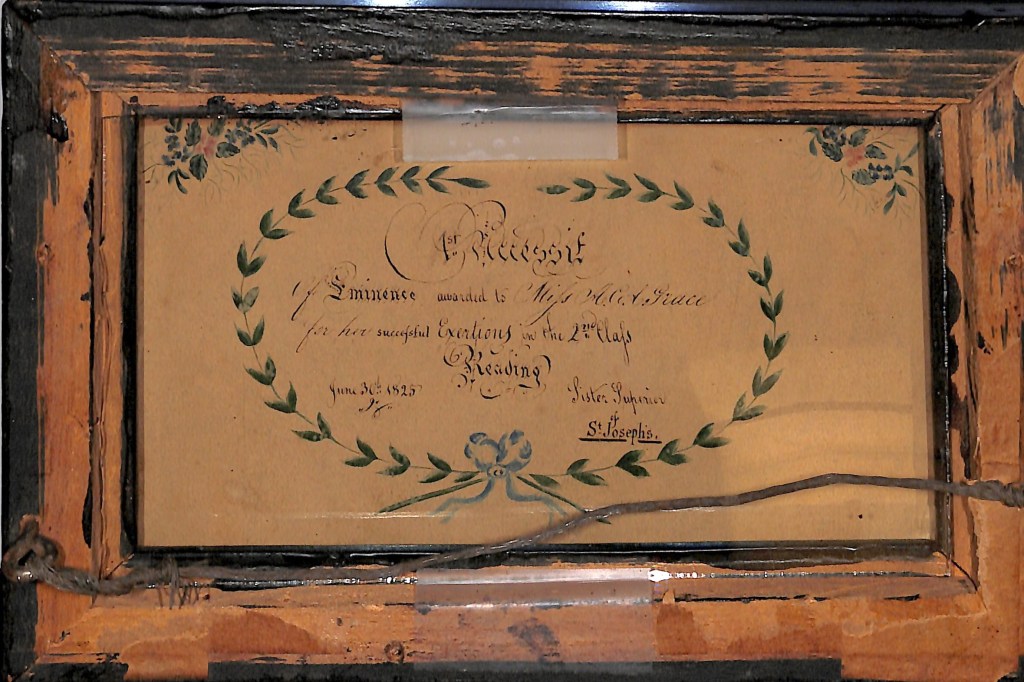
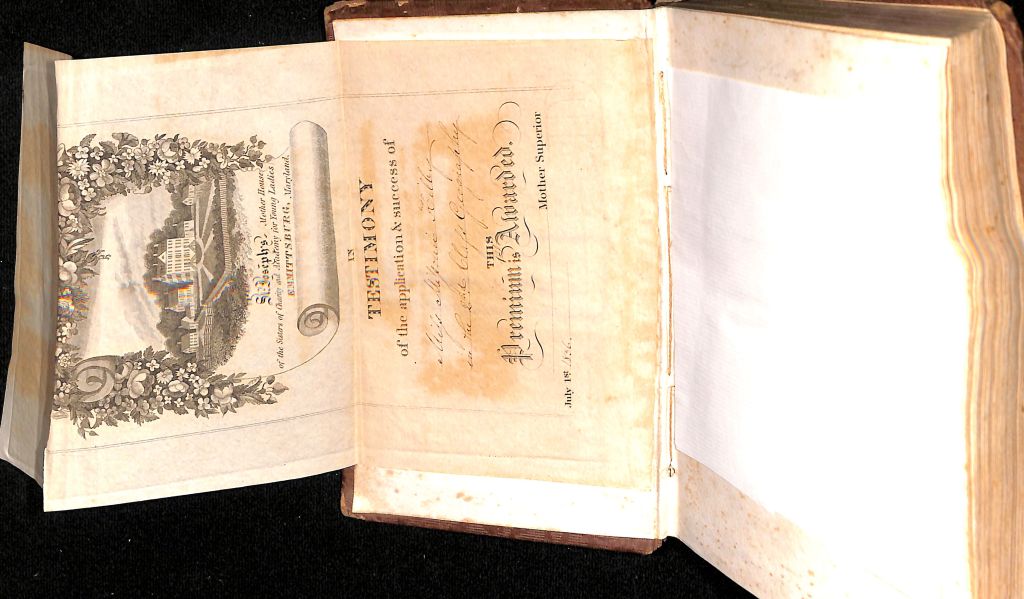
While the number of surviving student mementos from Mother Seton’s era are limited, they become more voluminous as time goes on until St. Joseph’s Academy received a charter as St. Joseph College in 1902. Other markers of the students’ work include “premiums,” which are what would be called in the modern day certificates of achievement or small awards for top performers in the class in different subjects.
Premium earned by A.C.A. Grace, June 30th, 1825
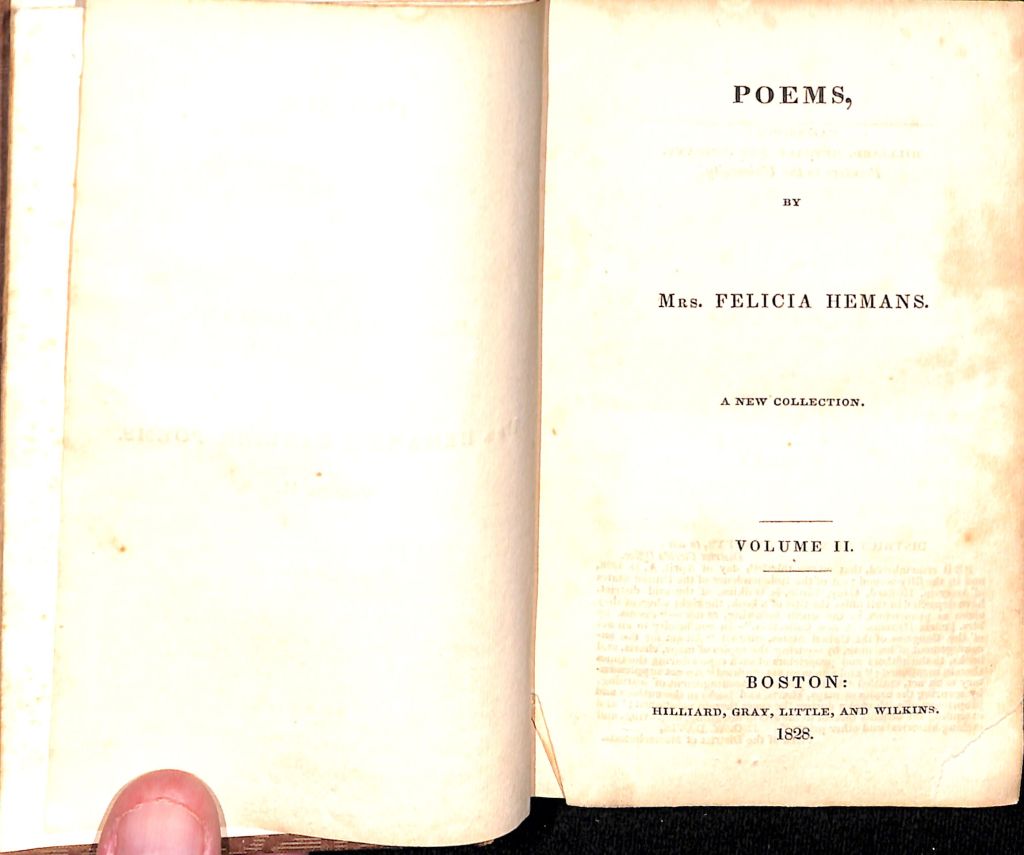
Book premium with certificate on inner cover, earned by Missouri Kilby, 1836
Later programs listed out all premiums. This one is from 1854
Other materials in the archives contain some more direct creations from students of the Academy. Although we refer to it as “Sr. Joannah Hickey’s Journal,” this small volume dated 1830 contains writings from a variety of individuals. It includes the complete version of the poem at the start of this post.
“Farewell to St. Joseph’s,” by “Remember Maria,” 1830
The Sister Mary Raphael Smith Scrapbook contains similar pieces, written by Smith herself, other sisters, and students of the Academy. Sister Mary Raphael had been a student at the Academy before becoming a Sister; she later became Directress of the school. In addition to poetry, the scrapbook contains accounts of events that occurred in the Academy between the 1830s and the 1890s.
Accounts of the death of Father Burlando, by Sister Madeleine O’Brien, Mary Huneker, and others
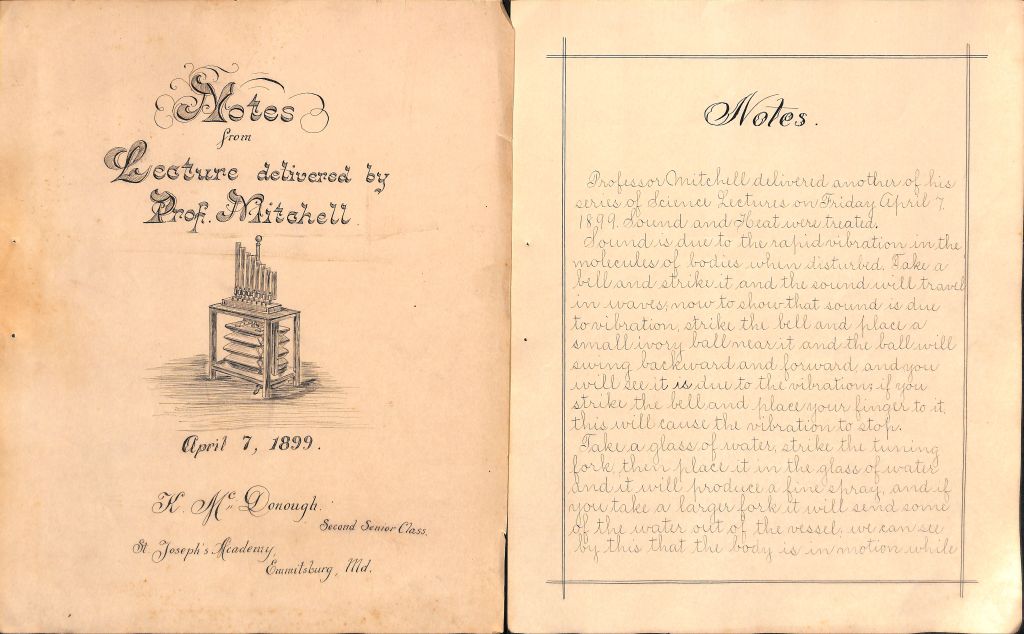
A handful of these additional “Scrapbooks” from the Academy exist across the middle of the 19th century. Other materials address the education provided by the Academy more directly. Katherine McDonough’s lecture notes from 1899 show an average day of education in science, geology, and grammar.
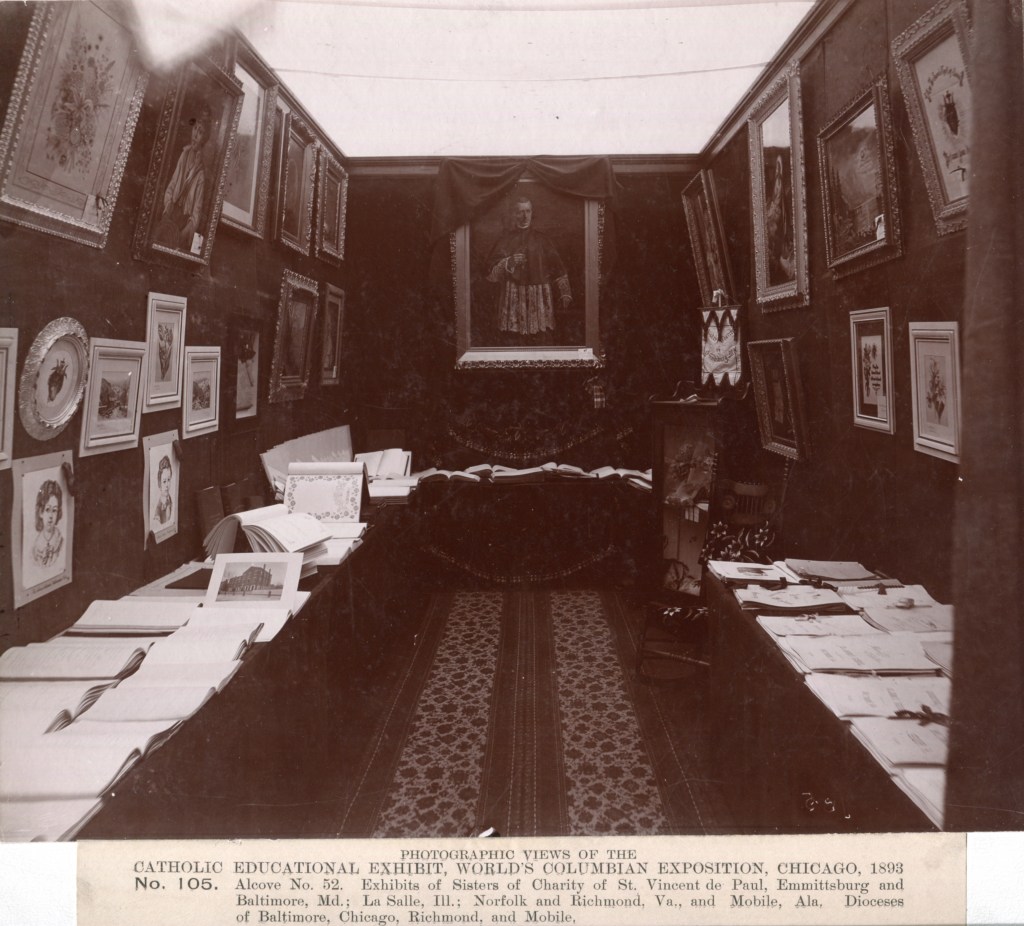
The students of the Academy also contributed to a display of their schoolwork for the 1893 World’s Fair in Chicago.
Art and Schoolwork displayed at Chicago World’s Fair
In addition to a lucky genealogist looking for an Academy student-ancestor who may stumble upon their ancestor’s writing or work, the collection provides a valuable tool of the community and its earliest mission in the United States, along with a picture of education during this time period.
St. Joseph’s Academy on the true lawn tennis court
This is part of a yearlong series about the early days of the Sisters of Charity of St. Joseph’s commemorating the 200th anniversary of the death of Saint Elizabeth Ann Seton, foundress of the community. In 1850, the Emmitsburg-based Sisters united with the international community of the French Daughters of Charity.
The Council knew the end was near for their Foundress and Superioress, Mother Seton, when they met on January 2, 1821. The conclusion of the meeting contained the simple declaration: “Sister Rose was elected.”
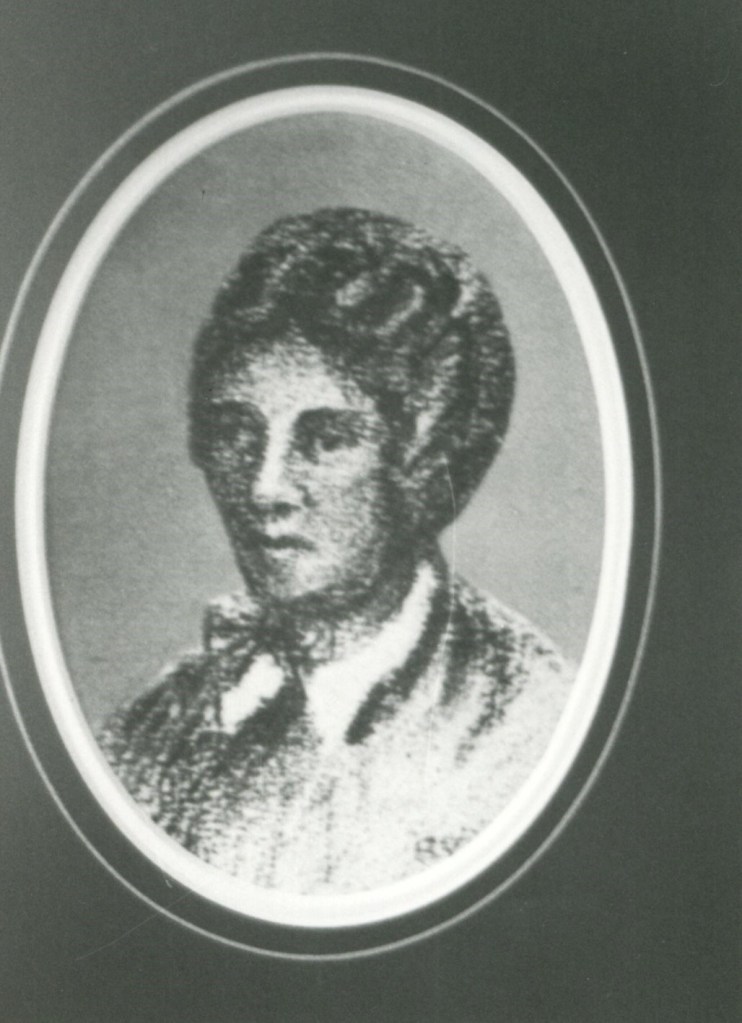
A sketch of Mother Rose White – no other known images of her have been found
Rose White (1784-1841), like Mother Seton, was a widow with a son. Born Rosetta Landry, her husband, Captain Joseph White, disappeared at sea in 1804, and her young daughter passed away not long after. Under the guidance of Father John B. David, P.S.S. – who later briefly became the Superior of the Sisters of Charity of St. Joseph’s – Rose turned more and more toward the Church and charity. Her name appears as a member of the board of the Female Human Association, Charity School in Baltimore as early as 1807.
Charitable organization where Mother Rose White served on the board, front cover and page 4. Images courtesy The Catholic University of America Archives and Special Collections
In 1809, Rose was one of the seven women to join Mother Seton at the her school on Paca Street in Baltimore. She was part of the second wagon of women to travel northwest to Central Maryland the next month, along with the boarding pupils and Mother Seton’s two boys. Appointed Assistant by Mother Seton, she was a member of the first band of sisters which formed the Sisters of Charity of St. Joseph’s.
Front and side view of the first home of the Sisters and orphans on 6th Street in Philadelphia. Date of photos unknown.
Despite Rose having a similar background to her Superioress, Mother Seton’s correspondence John Carroll, first Archbishop of Baltimore, shows a sense that Rose was better suited to the religious life than she was. While Mother Seton wished for Father Pierre Babade, P.S.S. to be appointed as the community Superior, Rose and Sister Kitty Mullen preferred Father David or the more practically-minded Father John DuBois. While clearly showing respect for her ability as an organizer, Mother Seton was prepared in the early days of the community for Sister Rose to be appointed Superioress in her place: “Rose’s virtues are truly valued by me and by us all, but from the time she knew she was proposed as Mother of this house in my place and that every one in it should prepare themselves for the change (which I was directed myself to inform them by a special letter immediately after my return from Baltimore) her conduct has undergone an intire [sic] change and has been very unfavourable to her happiness and ours.” (March 16, 1811).
In 1814, the community began its first ministry outside of Emmitsburg. Father Michael Hurley, pastor at St. Augustine’s Church in Philadelphia and member of the board of trustees at Holy Trinity, which administered St. Joseph’s Orphan Asylum, invited the Sisters of Charity to care for the orphans there. Sister Rose was appointed local Superior of the three sisters. They took possession of the Asylum on October 6, 1814 with a meager budget of $600 per year. Through Sister Rose’s organizing ability and economic management, they were able to gather a cadre of donors and benefactors to extend that money as far as possible. Her abilities at organizing child care and education for orphans led to an invitation to remedy a similar situation at the New York Orphan Asylum in 1817.
Mother Seton left this world on January 4, 1821. In the first Council meeting after her death, it notes that “Sister Cecilia to replace Sr. Rose in N. York.” Almost as if realizing that she had mistitled her new Superioress, the final note from that meeting reads, “the candidate Sally Powers petitions for admission to the Novitiate postponed till the arrival of Mother Rose‑‑‑‑‑,” referring to her as “Mother” for the first time.
In her six years as Superioress, the community expanded to missions in Baltimore; Frederick MD; and Washington, DC. After she had served the maximum two consecutive three-year terms, Mother Rose went on to lead another orphanage in Brooklyn to prosperity, before being re-elected to Superioress in 1833 for six more years. In this term, the community founded 12 more missions in New York; Baltimore; New Orleans; Conewago, PA; Utica, NY; Richmond (2 missions); Pittsburgh; Philadelphia; Pottsville, PA; Norfolk, VA; Martinsburg, VA; and Vincennes, IN. She also saw the cornerstone laid for the new Deluol Building at the prestigious St. Joseph’s Academy in Emmitsburg, which provided space for the students as its enrollment and curriculum expanded.
First page of Mother Rose White’s journal
One of the most vital records of the Sisters of Charity of St. Joseph’s is Mother Rose White’s journal, considered one of the most informative documents about life in the early community. Among the many vivid depictions of the community’s hardship, perhaps the event below illustrates their experiences best:
“We became so crowded that it was thought necessary that some of us should come up to the new house, [St. Joseph’s House, today the Emmitsburg White House], to sleep. Accordingly, Sister Sally [Thompson], Sister Kitty [Mullen] and Sister Rose [White] were named and for several weeks we slept in one of the unfurnished rooms, and would rise often at two, three and four o’clock and go down to the farm [to the Stone House] thinking it was time for morning prayers, and the ground was rough plowed and often very muddy. Sometimes we would be forced to stay all day at the new house, the rain would be so heavy; one [sister] would go down and bring up something to eat. We had spinning wheels and would keep ourselves employed. While sleeping at the stone house, the snow would drift in; one morning Sister Sally [Thompson] and Sister Rose [White] shoveled out nearly two cart loads of snow in the garret where two of the Sisters were sleeping, and did not discover that their beds were partly covered also with snow until day began to dawn through the cracks of the boards, which were the only fastening for the windows, but happily the Sisters took no cold.”
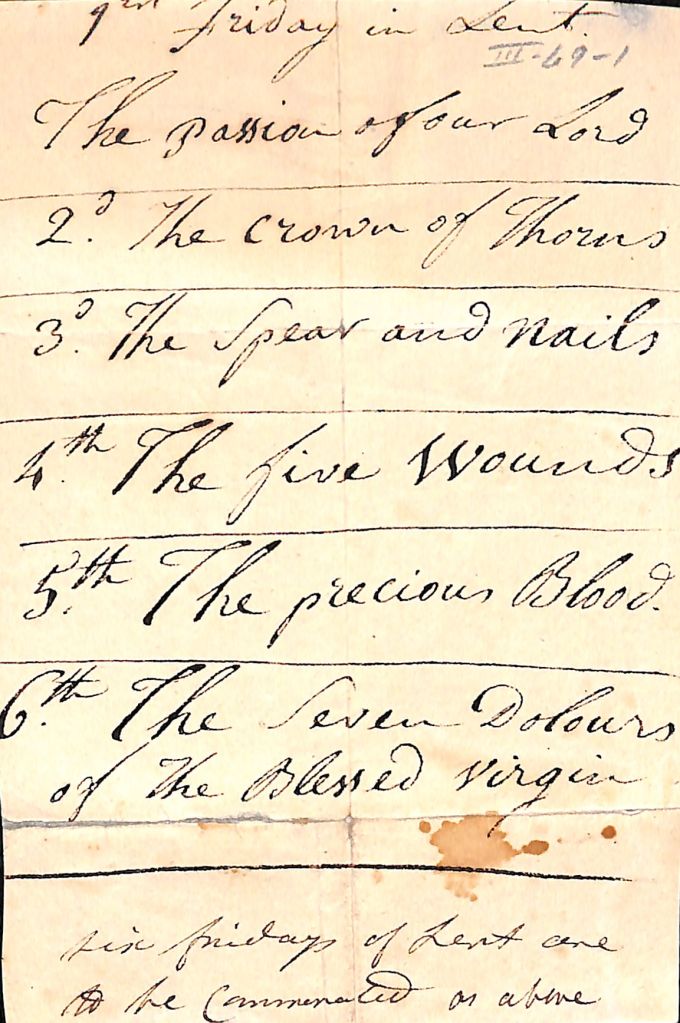
The journal goes on to describe her time in Philadelphia organizing the community for care of some of the neediest. In addition to the journal, surviving documents of Mother Rose in the archives in Emmitsburg include 104 letters addressed to her, 11 from her, 1 copied transcription in her handwriting, and four additional notes, including a simple prayer for Lent.
Mother Rose passed away at St. John’s Asylum in Frederick MD, only two years after her final term as Superioress ended.












 docarchivesblog.org