Category Archives: Emmitsburg

Voices of Students

 “Soon scenes may change, soon friends prove untrue

When for I rove, from dear Saint Josephs view

Yet naught can chase, thy image from my mind”

-From “Farewell to St. Joseph’s,” 1830, by “Remember Maria”

This is part of a yearlong series about the early days of the Sisters of Charity of St. Joseph’s commemorating the 200th anniversary of the death of Saint Elizabeth Ann Seton, foundress of the community.  In 1850, the Emmitsburg-based Sisters united with the international community of the French Daughters of Charity.

In many archives that gather administrative or corporate records, the voices of the people who used those services can be frustratingly absent. Luckily, the collection of St. Joseph’s Academy, the school founded by Mother Seton and the Sisters of Charity of St. Joseph’s, features many of the voices of students, including their creations and their writings. 

Some of the earliest examples of students’ surviving works include their needlework samplers, several of which come from the era when Mother Seton directly ran the Academy before her death in January 1821. 

Needlework by Mary Jamison, July 1812, St. Joseph’s Academy Student, 1810-1813

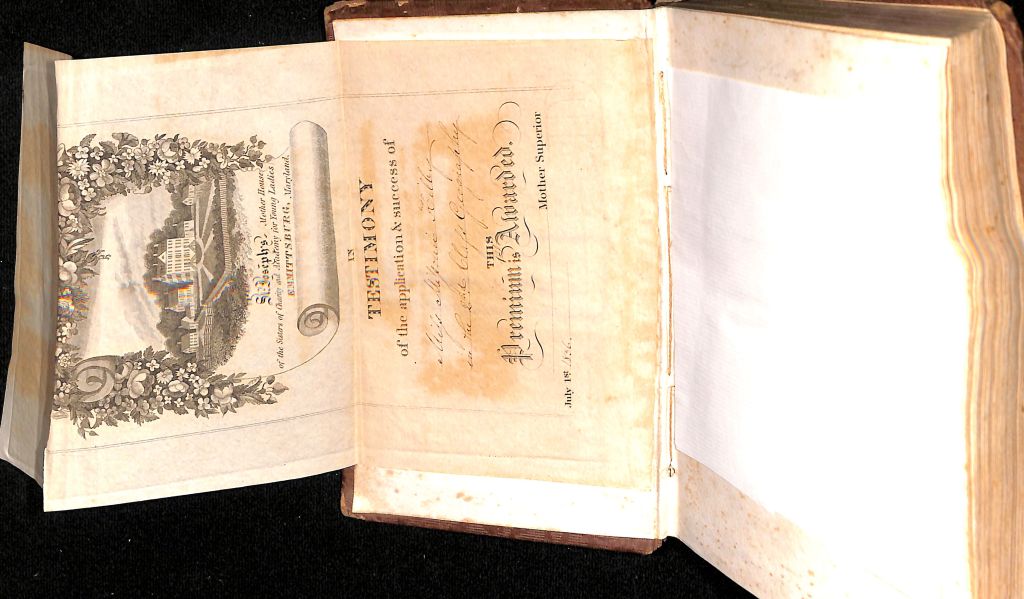
While the number of surviving student mementos from Mother Seton’s era are limited, they become more voluminous as time goes on until St. Joseph’s Academy received a charter as St. Joseph College in 1902.  Other markers of the students’ work include “premiums,” which are what would be called in the modern day certificates of achievement or small awards for top performers in the class in different subjects.
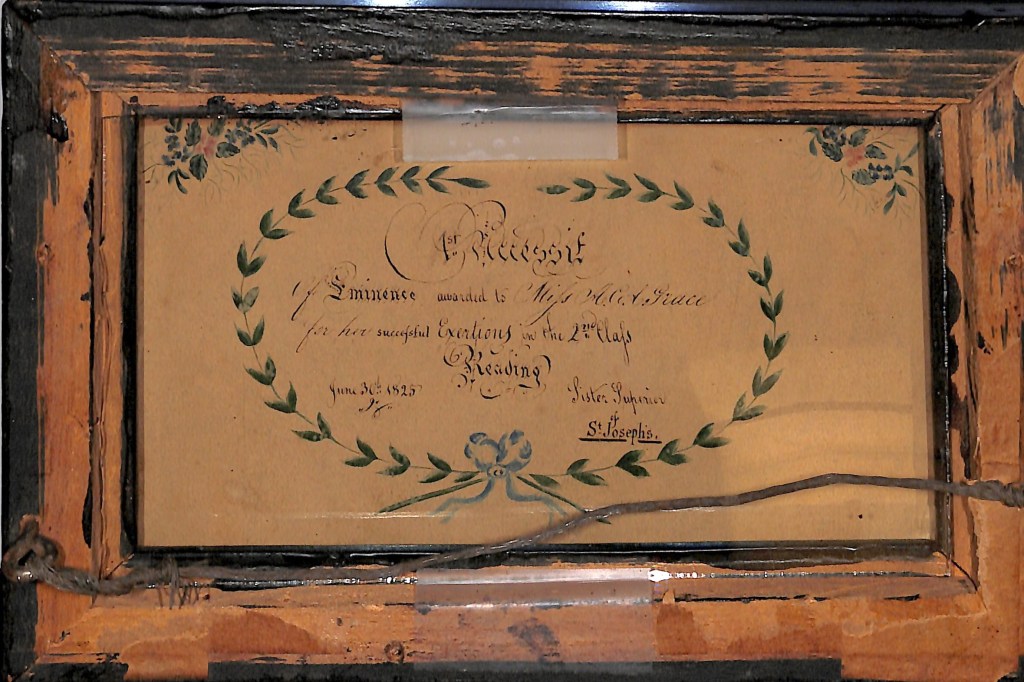
Premium earned by A.C.A. Grace, June 30th, 1825
Later programs listed out all premiums. This one is from 1854

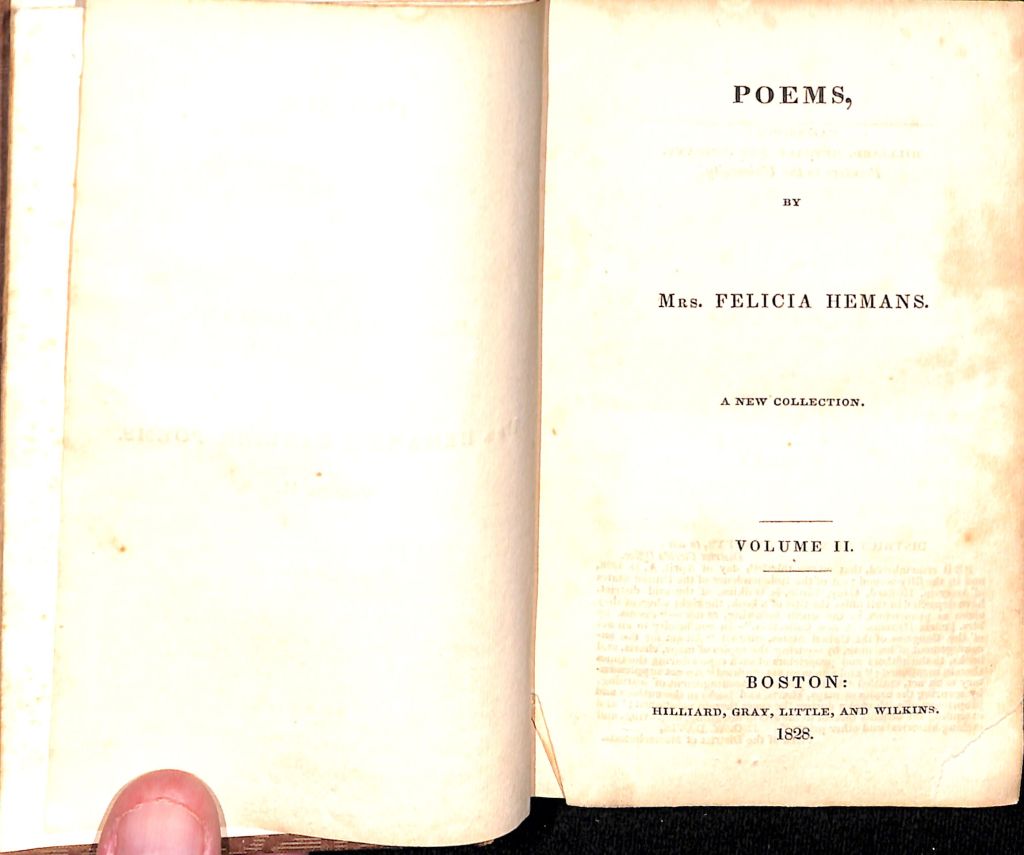
Other materials in the archives contain some more direct creations from students of the Academy.  Although we refer to it as “Sr. Joannah Hickey’s Journal,” this small volume dated 1830 contains writings from a variety of individuals.  It includes the complete version of the poem at the start of this post.

“Farewell to St. Joseph’s,” by “Remember Maria,” 1830

The Sister Mary Raphael Smith Scrapbook contains similar pieces, written by Smith herself, other sisters, and students of the Academy.  Sister Mary Raphael had been a student at the Academy before becoming a Sister; she later became Directress of the school.  In addition to poetry, the scrapbook contains accounts of events that occurred in the Academy between the 1830s and the 1890s.

Accounts of the death of Father Burlando, by Sister Madeleine O’Brien, Mary Huneker, and others

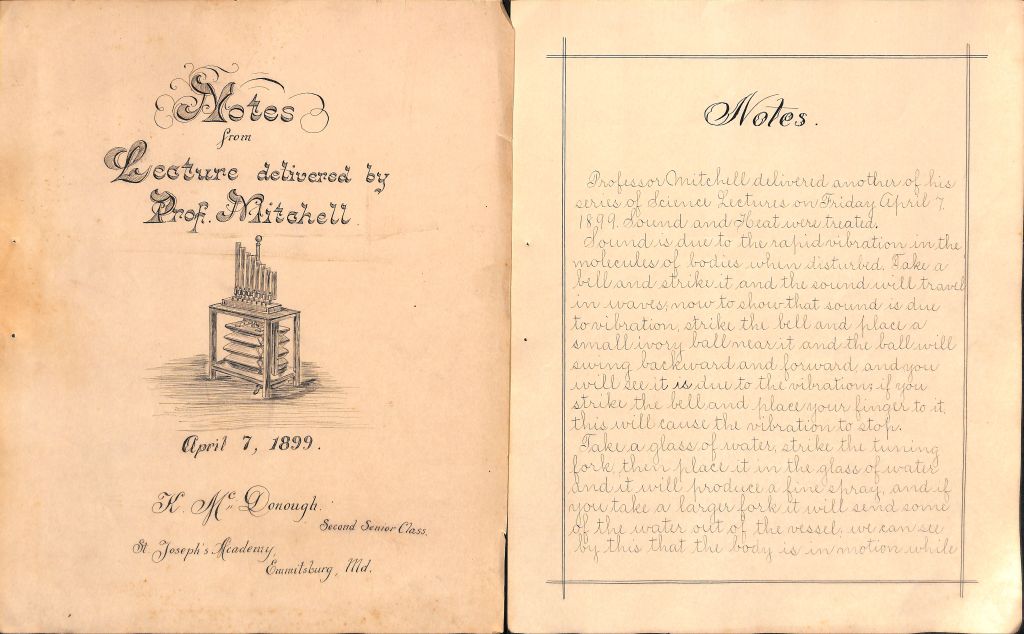
A handful of these additional “Scrapbooks” from the Academy exist across the middle of the 19th century.  Other materials address the education provided by the Academy more directly.  Katherine McDonough’s lecture notes from 1899 show an average day of education in science, geology, and grammar.
The students of the Academy also contributed to a display of their schoolwork for the 1893 World’s Fair in Chicago.

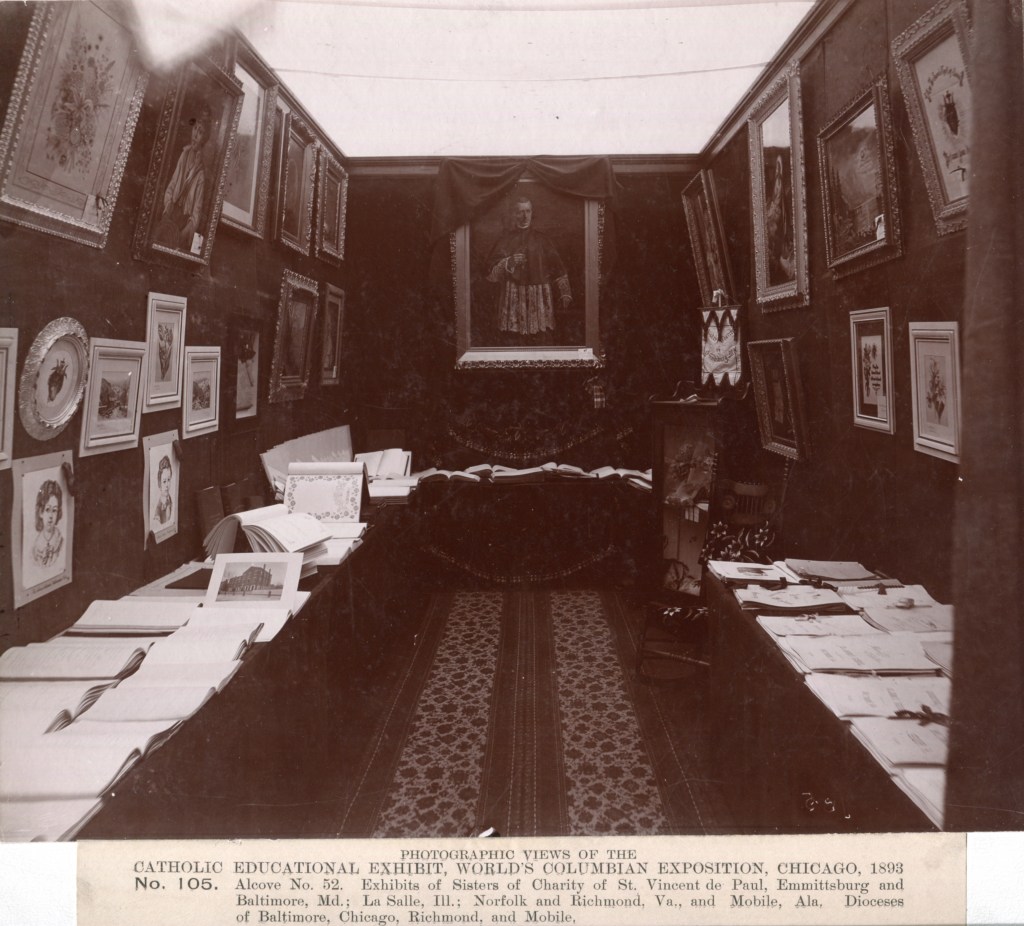
Art and Schoolwork displayed at Chicago World’s Fair

In addition to a lucky genealogist looking for an Academy student-ancestor who may stumble upon their ancestor’s writing or work, the collection provides a valuable tool of the community and its earliest mission in the United States, along with a picture of education during this time period.

St. Joseph’s Academy on the true lawn tennis court

Leave a comment

Filed under Emmitsburg, Sisters of Charity of St. Joseph's, St. Joseph's Academy

The Emmitsburg Community Chorus and Sister Jane Marie Perrot

When Sister Jane Marie Perrot was a child, she asked her parents if she could take piano lessons.  The ongoing Depression meant that her parents had to say, “no;’ they couldn’t afford them. When Sister mentioned this to Sister Loretta Larking, one of the Daughters of Charity who taught her at St. Joseph’s Academy in Portsmouth, Virginia, Sister Loretta made sure that the young child would have music in her life.  Thus began a career and a vocation for Sister Jane Marie.

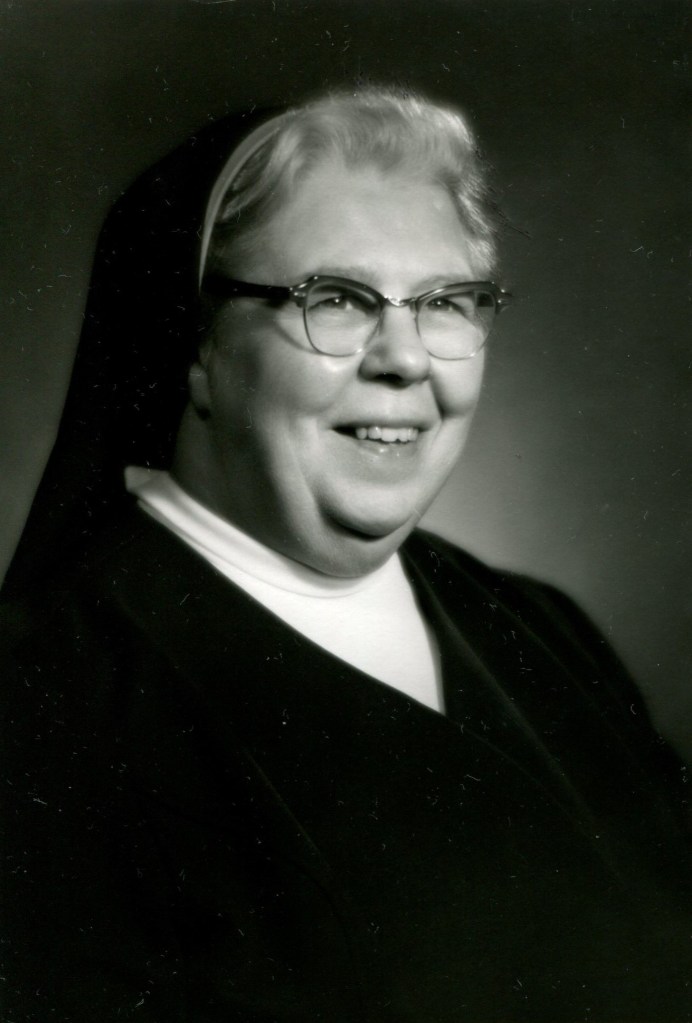
Sister Jane Marie Perrot

Sister began teaching music at her first mission at St. Ann’s School in Bridgeport, Connecticut.  At nearly every school where she taught, Sister Jane Marie would, at least part of the time, be involved with children and their appreciation of the arts.  In addition to her teaching duties, she studied organ at the Peabody Conservatory and received a Master of Arts from The Catholic University in 1952.  She eventually became the music director at St. Joseph’s Central House and St. Joseph College in Emmitsburg in the mid-1960s.

When the reforms of Vatican II were introduced, Sister Jane Marie was not one to shy away from a new era of Church history.  She used music and song to “open up” worship, and, in postulant formation, emotional and experiential forms of evangelization.

Among her evangelization projects was the Emmitsburg Community Chorus, which continues today more than 20 years after Sister Jane Marie’s death.  The chorus began with amateur singers from parishes in Frederick and Carroll Counties in Maryland and Adams County in Pennsylvania.  Known for its yearly Christmas concerts that take place in the Basilica of Saint Elizabeth Seton, it also performed around the Frederick, Western Maryland, and Gettysburg areas.  Sister Jane Marie served as the director from 1968-1973.

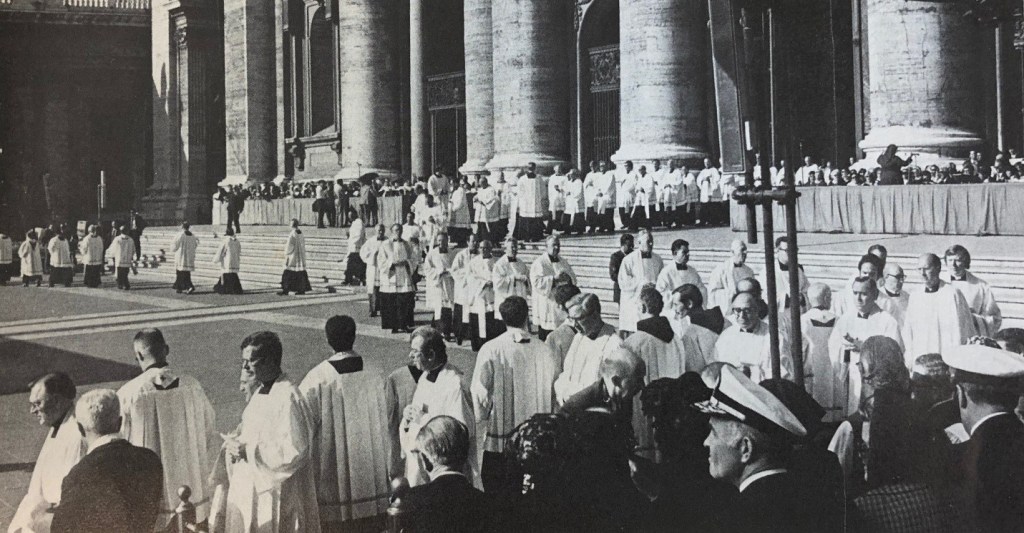
In 1975, the world received news of the canonization of Elizabeth Seton, the founder of the Community in Emmitsburg and the first native-born North American saint.  At the invitation of the Vatican, the Emmitsburg Community Chorus, 45 strong, traveled to Rome to sing alongside musicians from the U.S. Army bands stationed in Germany and the Sistine Chapel Choir in St. Peter’s Square for the assembled crowds and St. Pope Paul VI as part of the canonization ceremony.  Sister Jane Marie took up the baton for the Chorus once again.  She became the first woman to conduct a choir in St. Peter’s Square.

Sister Jane Marie before performance in Rome
Sister Jane Marie “in action” in upper right-hand corner conducting the Emmitsburg Community Chorus
Arrangements and logistics for the performance in Rome

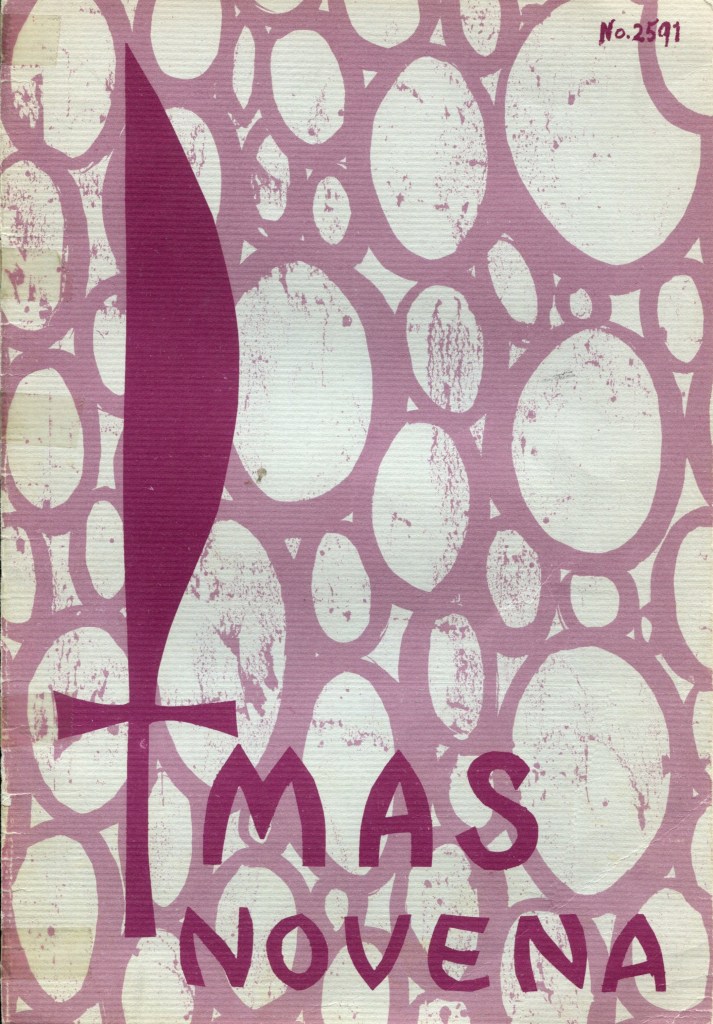
Sister Jane Marie was highly respected in the world of music education.  In 1978, she co-founded with Father Virgil Funk the National Association of Pastoral Musicians, receiving the Association’s award for Educator of the Year in 1996.  She was responsible for an arrangement of the Christmas Novena, performed by the American Daughters of Charity each year before Christmas, and she composed several other hymns.

In 1982, Sister Jane Marie was involved in an automobile accident, severely restricted use of her left arm after a car accident.  Afterward, she was unable to conduct in her preferred vigorous, expressive style.  This did not mean, however, that she could not compose or arrange music, and she continued to direct celebrations, liturgies, and arrange music at the Seton Shrine before her entry into the Ministry of Prayer in 1988. Sister died in December 1998.

1 Comment

Filed under Canonization, Emmitsburg Community Chorus, Sister Jane Marie Perrot

Rev. Bruté’s Image of Emmitsburg

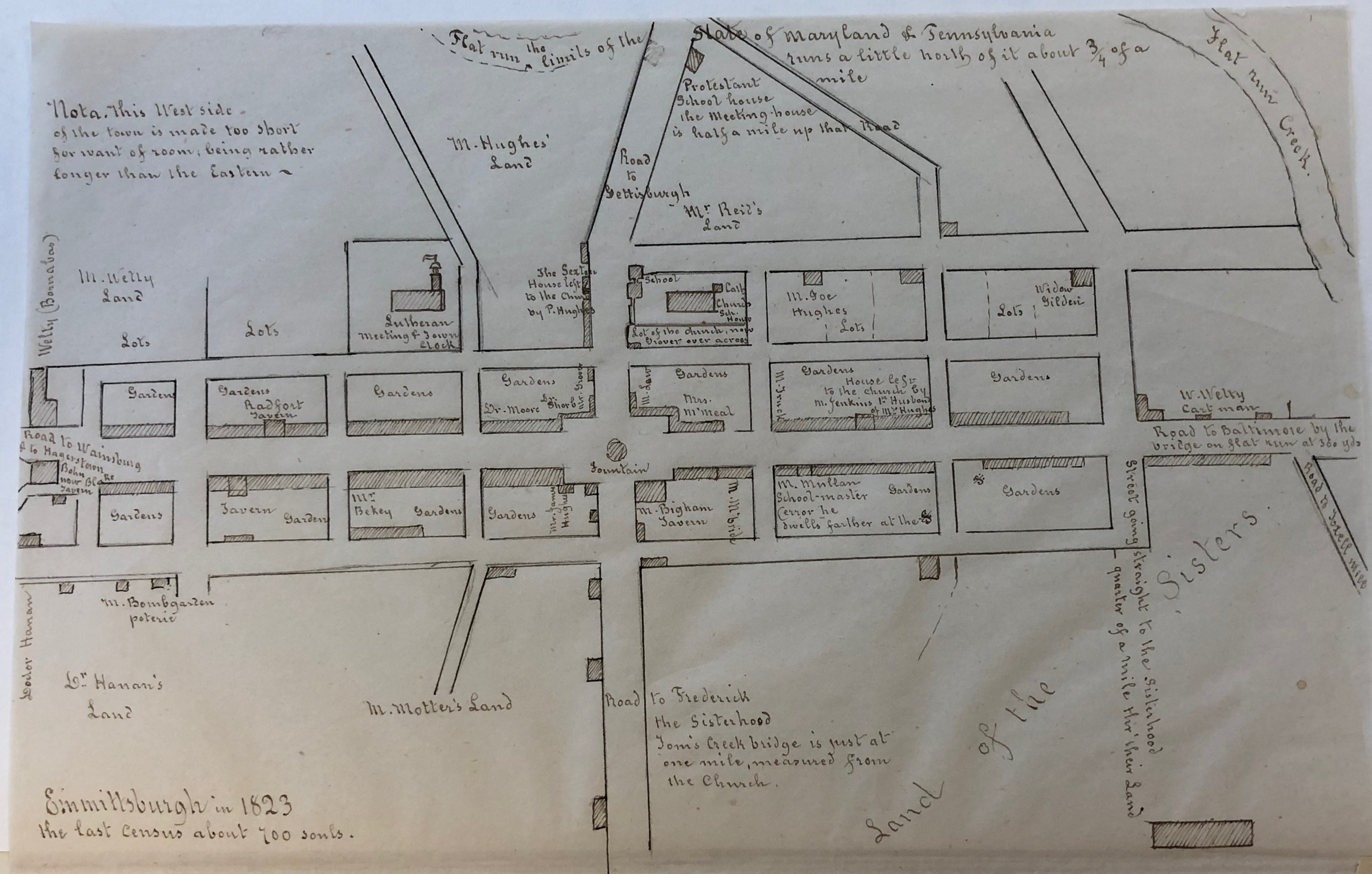
file1-24

Rev. Simon Bruté served as Mother Seton’s Spiritual Director from 1812 until her death in 1821.  Many of his sketches show Mother Seton, the landscapes, Mt. St. Mary’s University, and the town of Emmitsburg.  As a document of local history, his map of the town square, written in tight, neat handwriting, show accurate distances to other towns and, perhaps most importantly, an accurate picture of families and landowners in 1823.  Bruté also left a 14 page manuscript describing the town and landscape, mostly in his native French (although the archives has translations).  Rev. Bruté became Bishop Bruté, the first Bishop of Vincennes, now Indianapolis.  The Archive of the Daughters of Charity, Province of St. Louise archive has a 6 box collection on Bishop Bruté.  Despite his importance, most of his manuscripts have been scattered or lost in a fire at the Benedictine Monastery of St. Meinard, IN.¹  Rev. Edmund J. Schmitt was working on a biography of Bruté before his own death, and his unfinished research notes are located at the University of Notre Dame.²

  1. Catholic Historical Review, Vol. 3, No. 4 (Jan., 1918) pp. 492-494.
  2. “Edmund J. Schmitt Papers,” University of Notre Dame Archives (UNDA),  http://archives.nd.edu/findaids/ead/html/SCT.htm

Leave a comment

Filed under Emmitsburg, Simon Brute