
This is a guest post by Addison Pickett, our intern for the summer and a member of the Mount St. Mary’s University Class of 2028!
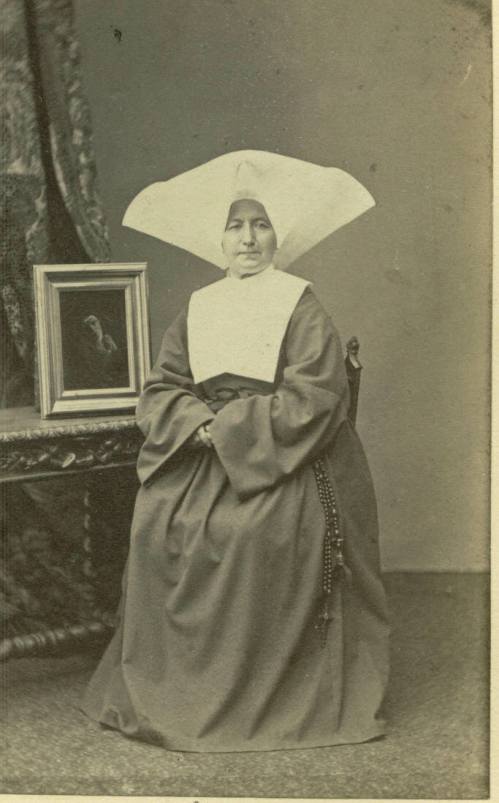
Mother Euphemia Blenkinsop was born Catherine Blenkinsop in Dublin, Ireland, c. 1815-1816. In her youth, she emigrated to the United States, where she joined the postulancy at St. Joseph’s, Emmitsburg, Maryland in 1831. Taking her habit, she took the name Euphemia as well, no doubt inspired by the early Christian martyr St. Euphemia, and it was said that the name fit her so well because of its meaning: harmonious and agreeable. In 1866, she succeeded Mother Ann Simeon as Visitatrix to the Daughters of Charity and served as Visitatrix until her death in 1887. She continues to live on as a model of innocent piety.
Mother Euphemia shows up within the pages of Sr. Mary Raphael Smith’s journal, ‘Souvenir of Old Times,’ through poems, passages, and prose dedicated to her. This journal includes many writings from the Sisters and priests of St. Joseph’s Academy from about 1833 to 1889, as well as graduation ceremony programs, obituaries, and newspaper clippings about St. Joseph’s. On St. Euphemia’s feast day, September 16th, many writings can be found about Mother Euphemia, revealing the deep admiration that the Sisters had for their Visitatrix.
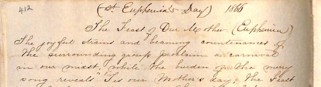
On St. Euphemia’s Feast Day in 1866, Mother Euphemia Blenkinsop’s first year as Visitatrix, the Sisters detail their hopes for a good relationship with their new Mother. This note also details a gift that the Sisters gave to Mother Euphemia, most likely as a welcoming gift: “Accept our simple tribute of affection, a moss basket gemmed with Autumn’s bright flowers, fit emblems of our heart-felt wishes, with the rich fruits of the plentiful Gathering Season, and auspicious presage of the abundant blessings with which we hope Heaven may crown your efforts in your new field of labor.”
This slice of life from September 1868 shows the kindness of the Daughters of Charity towards their new Visitatrix and marks the beginning of her noteworthy time as their leader.
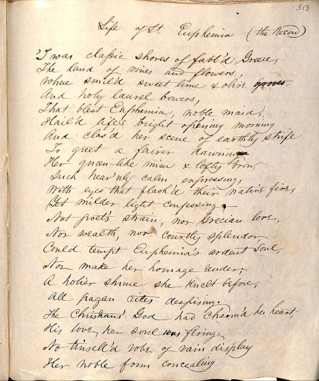
A reference to St. Euphemia appears on pages 313-315, telling the story of St. Euphemia’s life in the form of a poem. It is not dated, nor is there an author credited. However, in the pages following, a paper pamphlet tucked inside tells the same poem written in print and dates to September 16th, 1868.
Certain details in this poem are undeniably different from the accounts we have of St. Euphemia today, but it captures the essence of the early Christian Martyr nonetheless. It tells that St. Euphemia was born in Greece, “the land of vines and flowers.” She was a holy woman consecrated to Jesus, and when a pagan judge tried to tempt and convert her, she rejected all of his offers. For her faithfulness to God, she was attacked by an angry mob and burned alive, but both attempts on her life left her completely unharmed. Finally, the pagan judge was able to kill her with a sword: “[The judge] Commands the sword her life, to end, / This act his word redeeming.” While these entries don’t mention Mother Euphemia Blenkinsop by name, it can be assumed that they were written with her in mind, recording the story of her namesake.
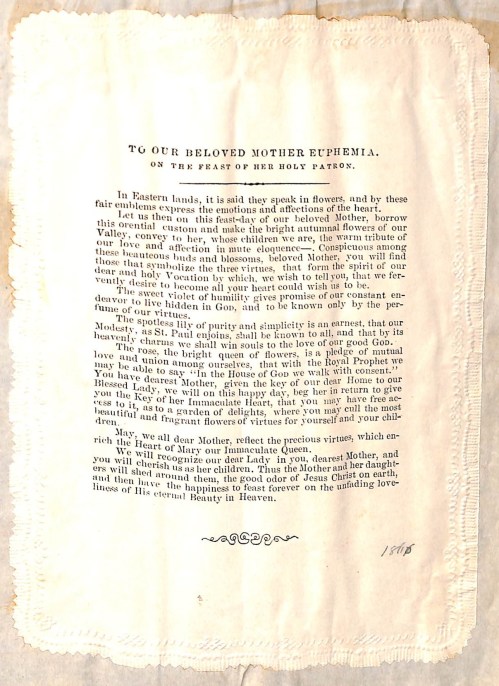
Another entry reveals the deep love that the Sisters had for Mother Euphemia even in her first year as Visitatrix. Mixing prose and devotion to the Virgin Mary with love for their Visitatrix, this piece calls upon Our Mother Mary to guide Mother Euphemia in leadership. The Community showed its loyalty and trust from the start saying: “We will recognize our dear Lady in you, dearest Mother, and you will cherish us as your children.” Despite her assumption of the role being very recent, the Sisters had a deep trust she would fulfill her role well.


