Category Archives: Gettysburg

Father Burlando

In the United States, there was never a more influential Provincial Director than Father Francis Burlando.

The position of the Provincial Director is always held by a Vincentian priest.  He is meant to invoke the spirit of the community’s founders in the Daughters within a province, play a role in the formation of the Sisters, have a vote in Council decisions, and ensure that the Daughters of Charity live the spirit of their vows of poverty.  Father Burlando was born in Genoa, Italy in 1814.  He volunteered to go to America shortly before his ordination as a priest in 1837.  He taught in Perryville, Missouri, and was pastor at St. Vincent’s Parish in St. Louis, where important gatherings and Masses are still celebrated for the Daughters today.
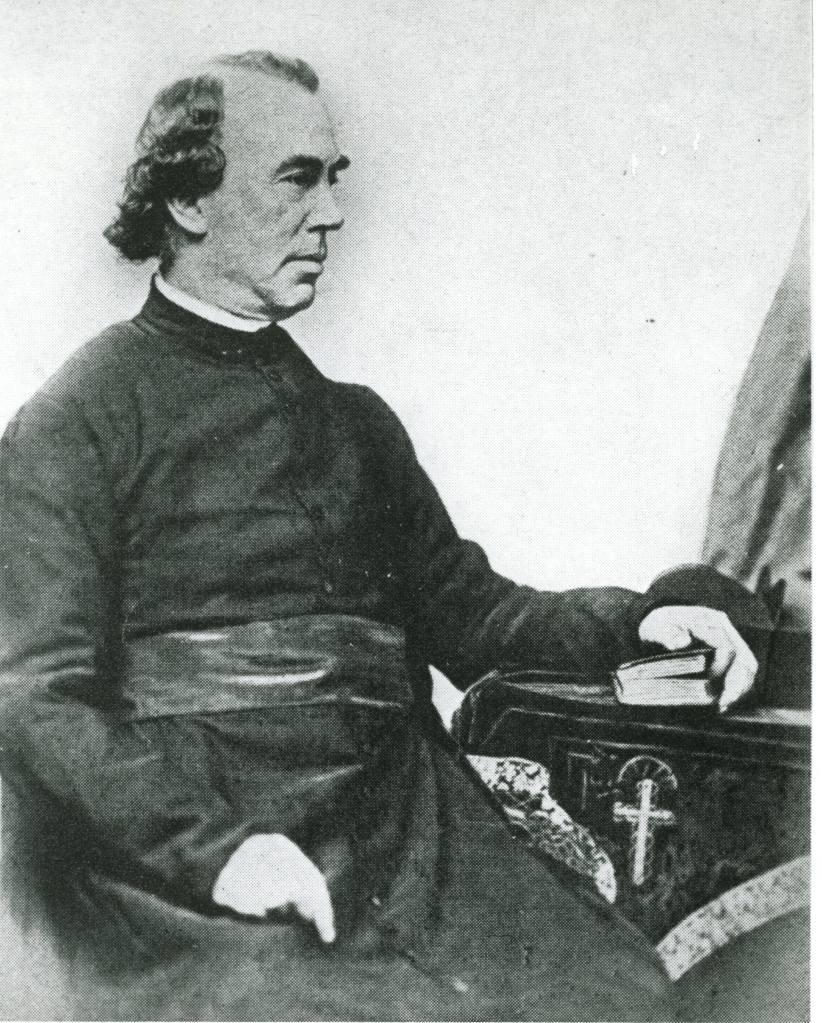
Father Burlando, circa 1870
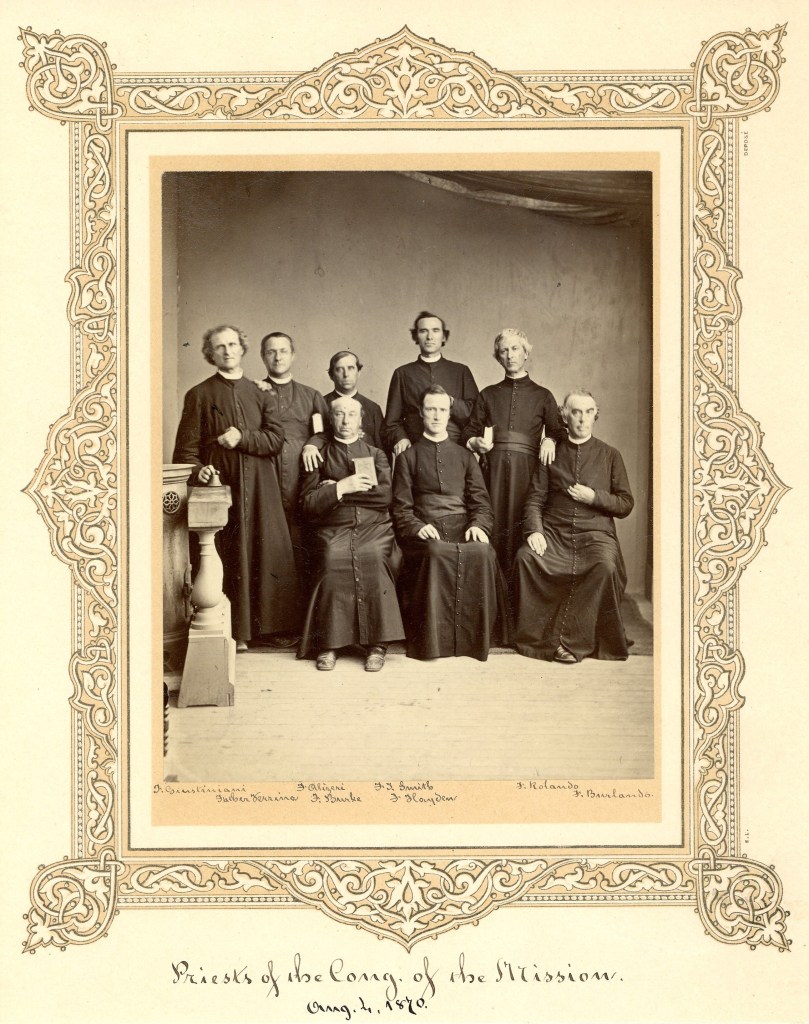
American Vincentians, 1870, Father Burlando at right

In 1849, he accompanied Father Mariano Maller to Emmitsburg.  Father Maller was set to take his position in 1850 as the first Provincial Director for the Daughters of Charity in the United States, after Mother Seton’s community formally merged with Daughters in 1850.  Father Burlando was to be the Sisters’ confessor but returned to St. Louis for health reasons.  In 1853, Father Maller was appointed as Director for the Daughters’ Province in Brazil, and Father Burlando was appointed as the Provincial Director in the United States.

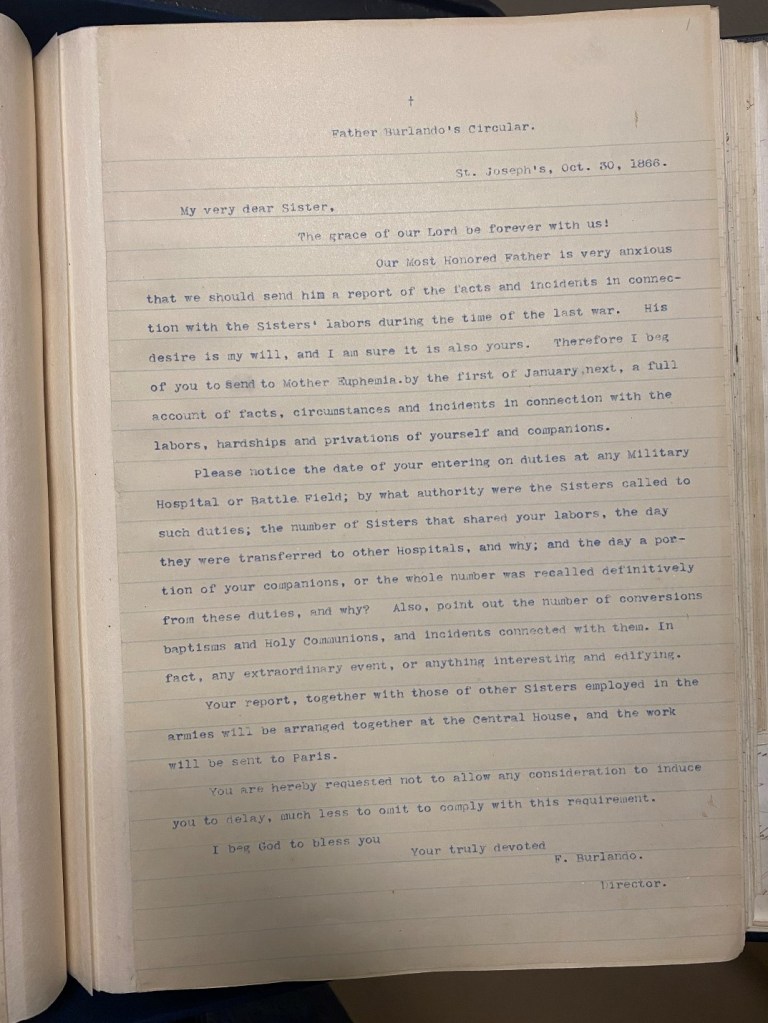
Father Burlando had the responsibility of completing the transition of the Sisters of Charity into Daughters of Charity.  Although the blue and white habit of the Daughters had begun to trickle into the United States, Father Burlando oversaw the completion of the change across the entire country through 1854. When the Civil War passed through Emmitsburg and the Sisters’ grounds became host to marching armies, Father Burlando worked to keep both Sisters and students safe, using their status as religious to make sure no accidental firing occurred.  When the Battle of Gettysburg subsided on July 3, 1863, Burlando personally led the Sisters to Gettysburg to begin their nursing duties there.  After the War, he helped shape the historical record by encouraging the Sisters to write their accounts of what they experienced.  Today, these accounts are some of the greatest treasures in the Archives.
With regard to St. Joseph’s Academy, Burlando oversaw an expansion of the school and the construction of his namesake building.  Having learned of architecture and building from his father in Italy, a plumber, he co-designed what would become his namesake building, which still stands as part of the FEMA Fire Academy.

Someone only identified as “An Old Pupil” described his relationship with the students at the Academy: 

Father Burlando took the most active interest in the studies of the pupils of St. Joseph’s and in everything pertaining to their comfort and welfare, always planning how to give them increased pleasure in their recreation, and in return the pupils loved him with a sincere affection, regarding him as a most tender Father. His practical mind was always suggesting something new for their future benefit, and as he fully realized the influence of [a] woman in her home, he labored to direct the education of those under his care to that end, introducing the study of domestic economy at St. Joseph’s, that the young ladies might be trained to fulfil properly the important duties of life. For this alone he is entitled to everlasting gratitude.

Burlando Building at St. Joseph’s Academy, Emmitsburg, circa 1871

Burlando also provided guidance on business matters, with his template for establishing ministries as incorporated institutions, which helped guide the community as it established some of its most long-lasting works.  Drafted in 1870, his guidelines provided uniform structure and procedure for the next 80-plus years, ensuring the longevity and independence of the Daughters’ ministries. 

Father Burlando died suddenly in 1873 of a stroke.  Along with his importance, the suddenness of his death probably contributes to the voluminous accounts of his funeral.  Father Burlando is one of the priests, or even non-Sisters, to be buried in the Old Cemetery in Emmitsburg, in a place of honor directly around the mortuary chapel.
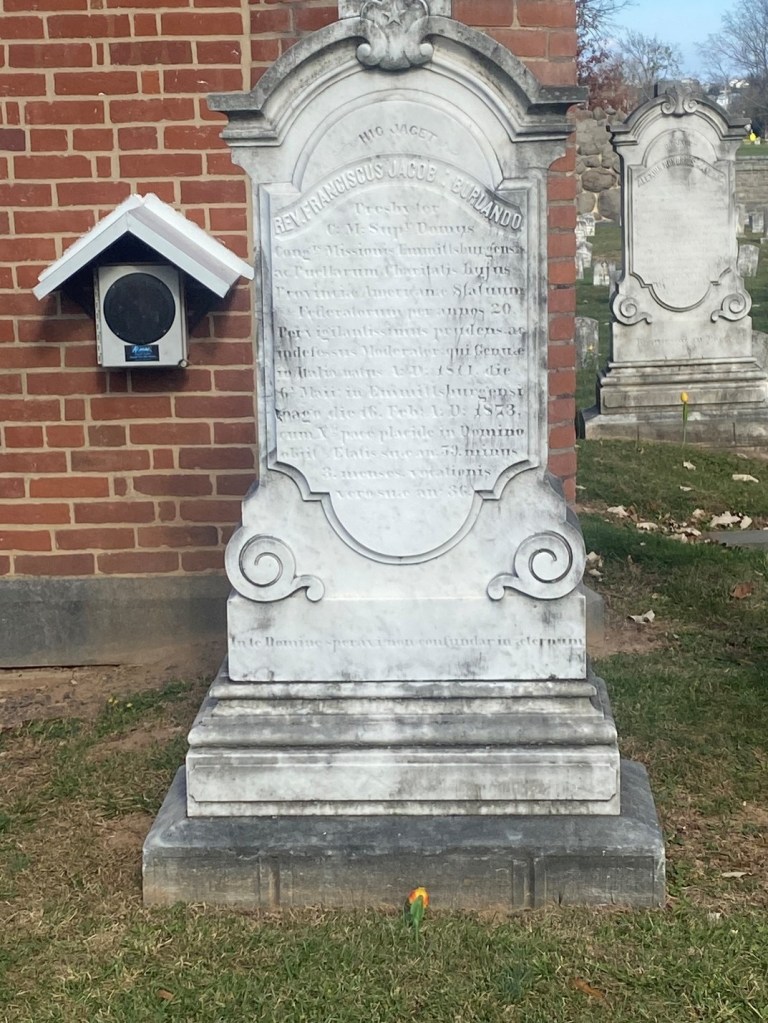
The Provincial Archives contains much of his personal and business correspondence, the notes that he used to compile the history of the community mergers in 1850; and his notes that were used to re-construct the Provincial Annals for the 1850s, 1860s, and early 1870s; and many of his retreats, which began in 1856.  Among the accounts of his death and funeral are poems written by Sisters and students alike:

1 Comment

Filed under Civil War, Gettysburg, Rev. Francis Burlando

Digital Exhibit: Photographs of William H. Tipton

Last week, for #Throwback Thursday, we shared two images of William H. Tipton, a prominent Gettysburg photographer whose images show up in our records of St. Joseph Academy. The Academy records contain a total of five Tipton photographs, showing both campus and students. We present them here. All images are used with the permission of the Provincial Archives. The images in this online exhibit are 150 dpi; high-resolution images are available for study in the Provincial Archives.

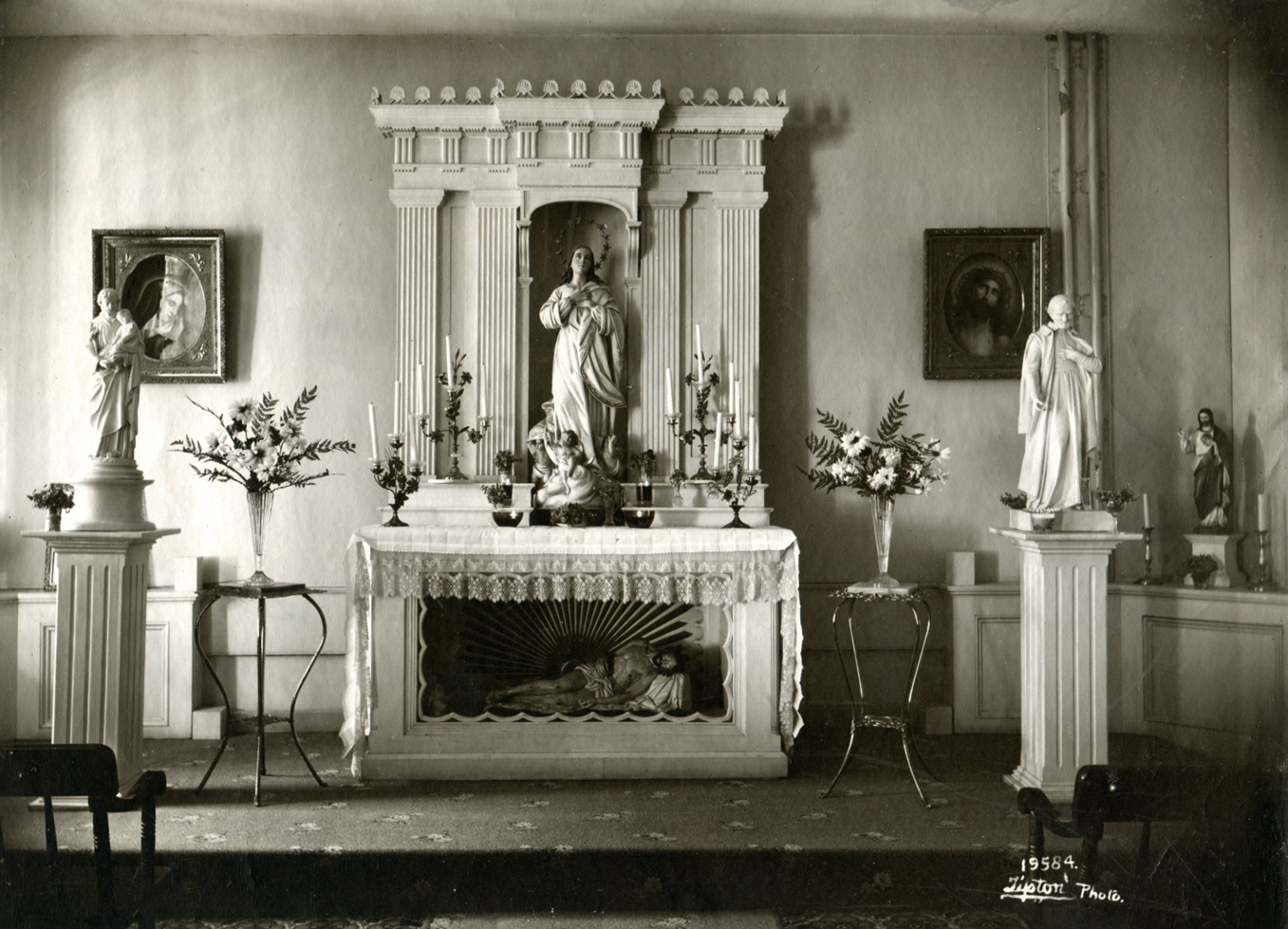
Oratory at St. Joseph's Academy, Emmitsburg, MD (Photo by William H. Tipton)

Oratory at St. Joseph’s Academy, Emmitsburg, MD (Photo by William H. Tipton)

Music room at St. Joseph's Academy, Emmitsburg, MD (Photo by William H. Tipton)

Music room at St. Joseph’s Academy, Emmitsburg, MD (Photo by William H. Tipton)

Group of St. Joseph's Academy students, 1900 (Photo by William H. Tipton)

Group of students, St. Joseph’s Academy, Emmitsburg, MD, 1900 (Photo by William H. Tipton)

St. Joseph's Academy, Emmitsburg, MD, class of 1903 (Photo by William H. Tipton)

St. Joseph’s Academy, Emmitsburg, MD, class of 1903 (Photo by William H. Tipton)

St. Joseph's Academy, Emmitsburg, MD, class of 1894 (Photo by William H. Tipton)

St. Joseph’s Academy, Emmitsburg, MD, class of 1894 (Photo by William H. Tipton)

Leave a comment

Filed under Emmitsburg, Gettysburg, St. Joseph's Academy

William H. Tipton photos in the Provincial Archives

(Images used with permission of the Daughters of Charity Provincial Archives. Text is based on an article which appeared online in PACivilWar150.com)

St. Joseph's Academy class of 1894 (photo by William H. Tipton)

St. Joseph’s Academy class of 1894 (photo by William H. Tipton)

Art classroom at St. Joseph's Academy (photo by William H. Tipton)

Art classroom at St. Joseph’s Academy (photo by William H. Tipton)


Seen here are two images from the early 1890s at St. Joseph’s Academy in Emmitsburg. One is the group image of the Class of 1894; the other is an art classroom. They are, of course, a window into the lives of the young women who were educated in Emmitsburg over 100 years ago; however, they have a second interesting feature. They, along with other images in our St. Joseph’s Academy collection, are the work of a well-known Civil War photographer, William H. Tipton.

At the time of the Battle of Gettysburg in 1863, the only local commercial studio in the town was operated by Charles J. (1838-1906) and Isaac G. Tyson (1833-1913). The studio was founded in 1859. Tipton (1850-1929) was a native of Gettysburg who began working there as an apprentice at the age of twelve. Following the battle, the studio distributed images documenting the battlefield area and Gettysburg itself taken before and after the battle.

In 1866 Tipton and one of his employees, Robert A. Myers, purchased the studio from the Tysons and renamed it Tipton and Myers Excelsior Gallery. In 1880 Tipton became sole owner and the firm became known as W. H. Tipton and Company. Tipton’s business flourished, and he continued to photograph Civil War battlefields, including Antietam, Fredericksburg, Petersburg, Spotsylvania, and Chancellorsville. He served on the Gettysburg Town Council and was elected to the state legislature, and worked on President Theodore Roosevelt’s campaign.

tipton-identification02


An indication of the scope of Tipton’s business can be seen on the back of the 1894 class picture, which contains this note:

… I have many thousands of plates taken from battle to present time, from which I can furnish photographs or lantern slides.
Headquarters for souvenir albums, guide book, and tourists novelties.
W.H. Tipton
3 Main Street
Gettysburg, PA”

Today, Tipton’s Civil War photography resides at the National Archives, as part of the records of the National Park Service.
Included in that collection are people and scenes used by Paul Philippoteaux as the basis for his Gettysburg Cyclorama. The cyclorama, now restored, can be seen today in the Visitor Center at Gettysburg National Military Park. It is not clear how much of Tipton’s non-Civil-War photography has survived. The Provincial Archives has none of Tipton’s business records, nor do we have images of Tipton’s connected with Gettysburg or the Civil War. The images of his that we have are from work he did for the Daughters of Charity at St. Joseph’s Academy. However, we were pleased to find that our collections can add, in a small way, to the record of this important local photographer.

1 Comment

Filed under Civil War, Emmitsburg, Gettysburg, St. Joseph's Academy