Category Archives: Baltimore

Long Overdue Gratitude to the Oblate Sisters of Providence

The cholera epidemic of 1832 that swept through Baltimore killed 1% of the city’s population, which translated into 800 deaths.  The Sisters of Charity of St. Joseph’s, Mother Seton’s community, received recognition and gratitude for its work and service.  Another community of sisters did not receive their gratitude for a very, very long time, purely because they were Black.

The Oblate Sisters of Providence were the first community of African American women religious in the United States.  Founded by Venerable Mother Mary Lange and counting among its first band of members Sister Theresa Maxis Duchemin, a student of Mother Seton’s school, the Oblate Sisters primarily came from and ministered to the free African American community in the Baltimore area.

The only known photo of Mother Mary Lange, c. 1870s/80s

The Calverton Almshouse was one of the great horror sites of the epidemic.  The Sisters of Charity labored in one room providing comfort to the dying, while the Oblate Sisters labored in another; segregation prevented a more efficient and effective method of care.  Yet, despite this practice, when Archbishop James Whitefield contracted the disease, he called upon the Oblate Sisters rather than the Sisters of Charity, who held the official mandate for care granted by the Archdiocese. 

Calverton Almshouse (Courtesy Enoch Pratt Free Library / State Library Resource Center)

Despite facing the same horrors, and each community losing Sisters to cholera in the epidemic, the accounts in the Daughters’ Archives fail to mention the work of their Oblate companions.  Only in 2023 did the city of Baltimore extend an official recognition of gratitude to the Oblate Sisters. 

While better late than never is certainly true, it is our hope that all be recognized in their own times and to see the completeness of the work of God’s Church and every soul that forms it.

1 Comment

Filed under African American History, Baltimore, Epidemics, Oblate Sisters of Providence

St. Joseph’s School before St. Joseph’s Academy

The commitment to education of the American Daughters of Charity and Sisters of Charity dates to Saint Elizabeth Ann Seton’s initiative for female education, begun in Baltimore in July 1808.  It took two years, however, for female education to become a primary mission of the Sisters of Charity in the form of St. Joseph’s School in Emmitsburg, MD.   

Invited by Rev. Louis William DuBourg, P.S.S., President of St. Mary’s College, the Widow Seton began a small boarding school for Catholic girls on Paca Street with the support of the Sulpician priests at St. Mary’s Seminary.  There she met Samuel Sutherland Cooper, a seminarian who was divesting himself of accumulated wealth in order to pursue his vocation to the priesthood.  He encouraged the widow to agree to direct an educational program on a property that he would purchase.

Pace Street House, Baltimore, c. 1890s

Located beyond the town limits of Emmitsburg, Cooper and the Sulpicians believed the setting to be ideal for an institution to educate girls, with nearby Mount St. Mary’s College providing education for boys. 

On June 22, 1809, Mother Seton arrived at Mount St. Mary’s in Emmitsburg with one of her daughters and a few of her companions; the rest of her children, early community members, and two pupils arrived a little more than a month later when the Stone House was ready for occupancy.  On July 31, 1809, the Sisters of Charity of St. Joseph’s officially began, and St. Joseph’s School became one of the first free Catholic schools for girls staffed by sisters in the United States.

As it became increasingly clear that funding was required, the school began admitting boarding students who paid tuition in May 1810.  These students came from the surrounding Frederick County and became the first boarding students. 

The school curriculum included grammar, spelling, reading, writing, geography, parsing, arithmetic, French, music, and fine sewing, etc.   All pupils received religious education and faith formation, according to their grade level.  Mother Seton wrote to her friend, Julia Scott, how her daughter Annina “studies French, Spanish and Italian with [the day students] under a mistress who is sweetness and modesty itself”

After St. Joseph’s School became St. Joseph’s Academy in 1828, the school continued to teach “day scholars” from the surrounding area for free up until 1870.  When operating costs began to hinder this practice, the Sisters still offered discounts and worked to find ways for students to afford tuition when they needed it. 

St. Joseph’s School and, later, St. Joseph’s Academy, were not parochial schools but Catholic schools sponsored and funded by the Sisters of Charity.  Saint John Neumann, CSsR, 4th bishop of Philadelphia, initiated Catholic parochial education when he established the first diocesan parochial school system in the United States in 1852.

3 Comments

Filed under Baltimore, Elizabeth Ann Seton, Emmitsburg, Paca Street, St. Joseph's Academy

Newly Conserved Materials!: Financial Ledgers and Their Use

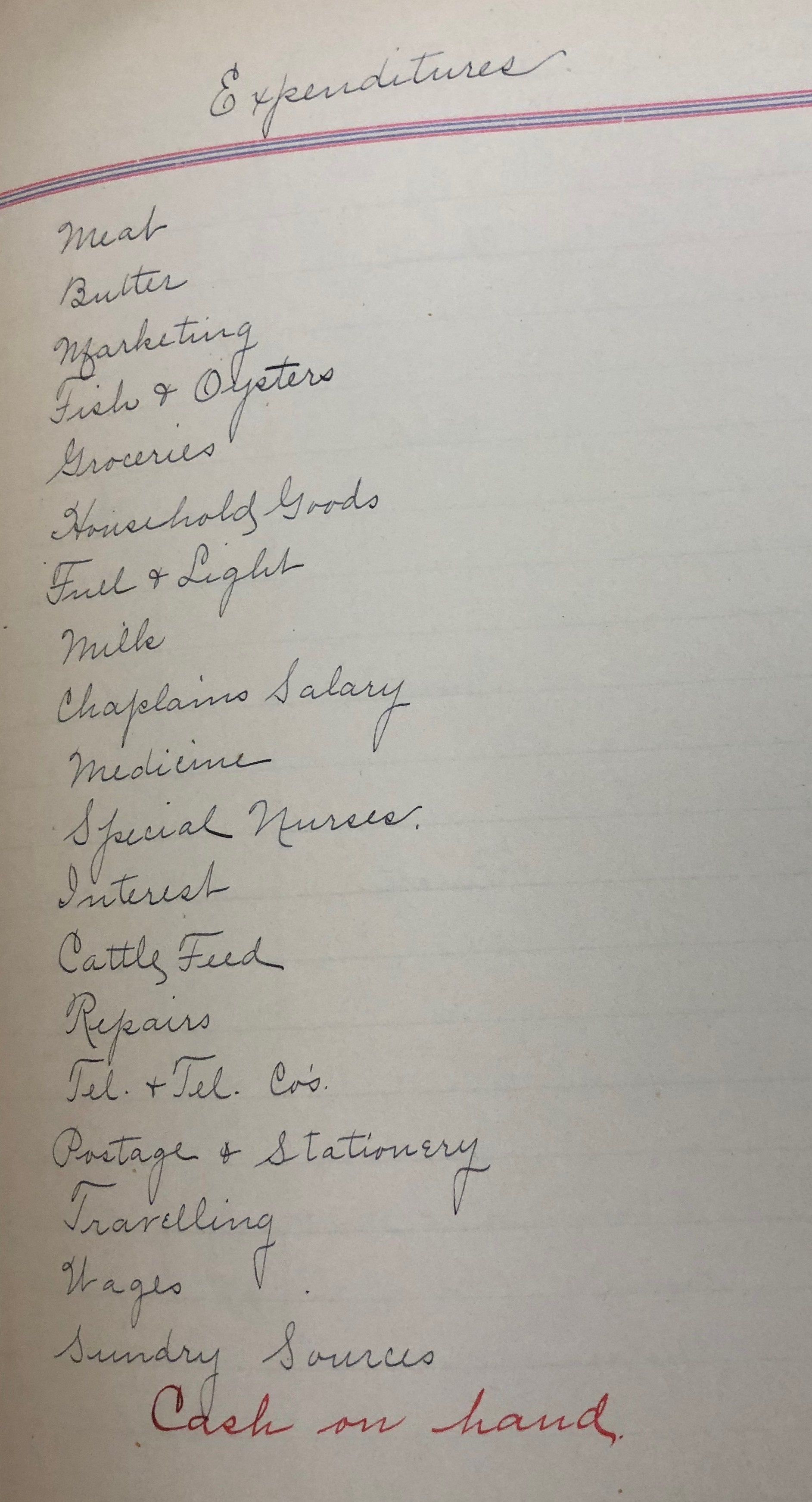
The Archives is happy to have seen work completed on some more pieces of the collection.  In the 18th, 19th, and early 20th century, it was not uncommon for businesses, nonprofits, or in this case religious communities to keep their financial records in large bound volumes.  These ledgers of St. Agnes Hospital and of the Central House in Emmitsburg are not only beautiful material pieces, but provide hints to the operations and life in the community.

Among the various budget lines to run a hospital are some expected things, such as “Special Nurses” and “Repairs”, but also notables such as a separate budget line exclusively for “Fish & Oysters” or, in what is today a developed area of Baltimore City, “Cattle Fund”

file6-2 (2)

The financial ledger for Emmitsburg shows other interesting expenditures, including, in 1918, dedicated line items for an “Auto Fund” and, a mere 20 years after Marie Curie’s pioneering work on radiation, a line item for “X Ray”

file3-8

The ledgers also keep statistics of the sisters activity in both the health and religious fronts.

file-101.jpeg

The ledgers are available to researchers at the archives by appointment.

Leave a comment

Filed under Announcements, St. Agnes Hospital