
Today, July 4, 2026, celebrates the 250th anniversary of the ratification of the Declaration of Independence. A big round-number anniversary that affords a time to re-examine our history and reflect a little more on the meaning, symbols, and values of our past national celebrations and histories.
The 250th commemoration encouraged us in the Archives to look back fifty years to our bicentennial celebration, which led to us finding this old calendar in the collections! The months spanned from September 1975 (the time of Mother Seton’s canonization) through August 1976 and was published by the USCC – the former name of the United States Bishops’ Conference – and National Catholic Educational Association. We encourage you to zoom in to see some of the celebrations and milestones that it lists, but we in the Archives wanted to point out a few things of note ourselves!
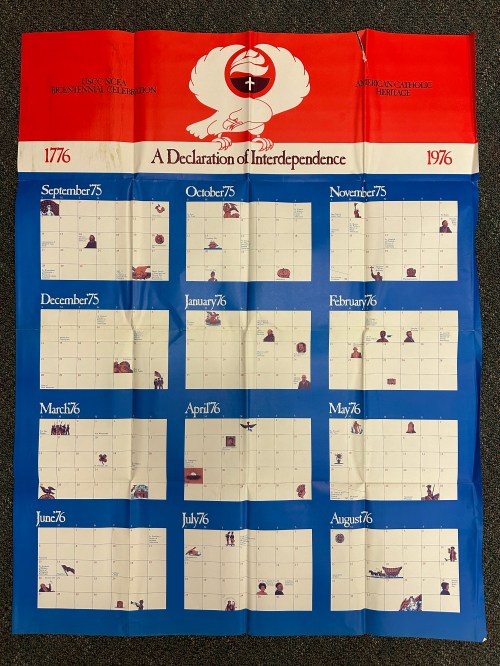
There is a pride in highlighting our faithful citizens, Catholic Americans and some Protestants as well. In January, the birthdays of three distinguished citizens were honored: Thomas Merton, American monk and theologian; John Carroll, the first American Catholic bishop who served in Baltimore; and Dr. Martin Luther King, Jr., who was born in 1929 and whose dream for the country was tragically cut short in April of 1968. A continuing admiration for the Kennedy family amongst American Catholics appears in the month of July, with matriarch Rose Fitzgerald Kennedy ‘s birthday on the 22nd.
The calendar gives nods to the two Catholics to sign the U.S. Constitution, Daniel Carroll of Maryland and Thomas Fitzsimons of Philadelphia. However, it does fails to include Marylander Charles Carroll of Carrollton, the sole Catholic to sign the Declaration of Independence.
In February’s second week, we find Black History Week, which was established by historian Carter G. Woodson in February of 1926 to coincide with the birthdays of Abraham Lincoln (February 12) and Frederick Douglass (February 14). In 1976, President Gerald Ford expanded the recognition to encompass the entire month of February. More recently, in June of 2021, President Joe Biden declared Juneteenth (19th) a National Independence Day Act a federal holiday.
Reflecting the ideals of the 1970s, we see numerous saints’ days marked for culturally diverse ethnic groups: St. Teresa of Avila for Spanish Americans in October, St. Martin de Porres for Black Americans and St. Josaphat of Polotsk for Ukrainian Americans in November, certainly St. Patrick for the Irish Americans in March, and Our Lady of Guadalupe for Mexican Americans and St. Francis Xavier for Asian Americans (although the term used on the calendar is… out of date). We hope that a Semiquincentennial edition of this calendar might build on 50 more years of knowledge and experience to expand these even further, showing that full scope of the Calendar of Saints is meant to serve every single person in a universal Church.
Independence Day blessings to you all!


