
Dwight D. Eisenhower, President, 1953-1961. Self portrait by Eisenhower, now in the collections of the Provincial Archives
(All images and passage from Provincial Annals of 1961 used with permission of the Daughters of Charity Provincial Archives)
The Daughters of Charity’s campus in Emmitsburg is located approximately 15 miles from Gettysburg, Pennsylvania, which has a long association with President Dwight David Eisenhower. Eisenhower’s association with the town and battlefield of Gettysburg began in 1915 when he visited the battlefield as a West Point Cadet. In the early 1950s, he bought and renovated a 189-acre farm adjoining the Gettysburg battlefield. During his presidency, Eisenhower used the farm as a weekend retreat and a place to meet world leaders.
In 1958, while on a visit to the United States, Mother Francine Lepicard, then the international superior of the Daughters of Charity, visited Eisenhower in the White House, accompanied by three Sisters from Emmitsburg. The Provincial Annals for July 1, 1958 record the details of Mother Lepicard’s visit. The Sisters who accompanied her were:
Sr. Isabel Touhey, Visitatrix (Provincial superior)
Sr. Eleanor McNabb, Head of Providence Hospital in Washington, DC
Sr. Margaret Flinton, a Sister fluent in French who served as translator for Mother Lepicard

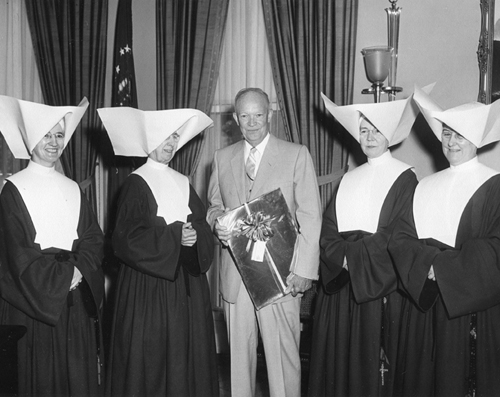
Sisters with President Eisenhower. Left to right: Sr. Margaret Flinton, Mother Francine Lepicard, President Eisenhower, Sr. Isabel Touhey, Sr. Eleanor McNabb. Eisenhower is holding a gift from Mother Lepicard.
VISIT OF MOST HONORED MOTHER WITH PRESIDENT EISENHOWER
WHITE HOUSE – – – July 1, 1958
The meeting with the President was scheduled for 11:30 a.m. Most Honored Mother [M.H.M] arrived around 11:15, accompanied by Sister Visitatrix, Sr. Eleanor from Providence Hospital, and Sister Margaret from Emmitsburg.
A cordial good-morning greeting was extended by the various secretaries of the president. Mr. Jim Haggerty, Secretary of the Press, introduced himself and shook hands with each of the Sisters. Another secretary came in and told the Sisters to make themselves at home in the Conference Room and asked if there was any special message Most Honored Mother had for the President. She told of the gratitude of the French people and the wonderful remembrance kept of him in France since the Second World War. The woman secretary said to be sure to tell President Eisenhower as that would please him greatly. She also mentioned the fact that it was the President’s 42nd Wedding Anniversary.
Within a few minutes the Sisters were ushered into the President’s office. One secretary or press agent remained with the Sisters during the half-hour interview. The President in a most gracious and friendly manner shook hands with each Sister introduced by name and position. When Sister Visitatrix said Emmitsburg, he smiled and expressed his delight at seeing one of his neighbors. President Eisenhower then asked the Sisters to be seated around his desk.
Most Honored Mother then told the President it was a happiness, an honor, and a privilege for her to have been granted this personal meeting with the President of the United States. Sister Margaret then asked the President if he understood Most Honored Mother or should she translate. Mr. Eisenhower smiled and said he had followed her fairly well but then he sat back in the chair and exclaimed: “Let me tell you the problem with my French. I followed fairly well what was being said until the word United States. At that point, a word stumped me and from then on I tried to figure out what that word was”.
M.H.M. expressed the feeling of the French for him and told him how grateful she was for the magnificent and enthusiastic welcome shown her everywhere since her arrival in San Francisco and this marvelous privilege of being greeted by him.
President Eisenhower asked if he might, at this point, ask the Sisters a few questions. His words were about the following: “I have always admired the life that you lead but it has always been a mystery to me. It is a life of real sacrifice and it reminds me of the days when I was a little boy. I would go out to work on the farm at dawn and would keep right on going until darkness set in and I couldn’t do any more. I have always wanted to know more about you, how you live, how you work without union cards or limiting yourselves to a certain number of hours per week. …
The President then added: “I know you have schools. Do you have hospitals? Other Social works? Do you live together or do you just come together each day for work? Sister Visitatrix enumerated the various works of the community; mentioned by name the various houses in Washington. He asked in particular about St. Joseph College. It was explained to him that it was a Liberal Arts College offering specialization in various fields. “What about the school across the way? Is that a parochial school?” Sister Visitatrix explained that it was somewhat of a campus school which provided the opportunity of training the young Sisters.
M. H. M. told the President that the Community is greatly aware of the needs of the time. The days of service of the sick or of the poor by an untrained Sister showing good will were long since passed. To meet the challenge of the twentieth century the Sisters were forced to train themselves professionally in the latest methods and to make use of the technical inventions of the times. For that reason, the Sisters had to pursue higher studies and to obtain the highest degrees in order to give the nurses in the hospitals, the students in the various schools, and the poor the very best service possible so that all those under the direction and guidance of the Sisters might be well prepared to take their place in the present-day world.
President Eisenhower smiled when M.H.M. said she was the Mother of 43,000 Daughters throughout the world and had no difficulties with them. In spite of the difference of language and customs, peace and union reigns in the big family.
M.H.M. then presented a gift to President Eisenhower, (A beautiful painting of the Head of Christ provided by our dear Sister Visitatrix) and told him she knew it was a very special day in his life, his 42nd Wedding Anniversary. The President’s face lit up and his blue eyes twinkled with delight as he took the beautifully-wrapped package. He admired it but said he would not open it until Mamie was with him. Had he known, he explained, that we were the particular group (community in his language!) coming to visit him, he would have arranged to have had Mamie there, for of the various groups she has seen, she thinks very highly of yours.
At this moment, a secretary entered and asked the President if he would be kind enough to be photographed with his guests as the Press was most anxious to have the picture. He asked M.H.M. if she would be willing and she in turn asked if he would. As if a whistle had been blown, about 12 or 15 photographers were lined up across the room. Television cameras, lights, cameras kept clicking as the Sisters stood talking with the President. Suddenly, a signal was given for everyone to face the cameras. M.H.M.’s exclamation that it reminded her of “an army in battle array” brought laughter … The cameras kept clicking as the President said he had never forgotten the wonderful impression made upon him and Mamie three years previously when Sisters and students of St. Joseph College lined up along the highway to greet him as he returned from the hospital on his way to the Gettysburg farm. … M.H.M. then promised that the Sisters would pray for the President and Mamie and that she would tell M.H. Father Slattery the privilege that had been granted her in meeting the President of the U.S.A.
Eisenhower sent to the Sisters in Emmitsburg a thank-you note for Mother Lepicard’s gift. The note, on White House stationery and with an original signature, is now in our collection.
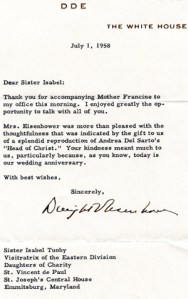
Letter from Eisenhower to Daughters of Charity, July 1, 1958 (Daughters of Charity Provincial Archives)
Eisenhower’s relationship with the Daughters continued after Mother Lepicard’s visit. Following his presidency Eisenhower retired to Gettysburg, and he and his wife, Mamie lived there for the rest of their lives. On January 20, 1961, John F. Kennedy succeeded Eisenhower as President. The Provincial Annals of that day record that Eisenhower returned to Gettysburg following the inauguration and that Sisters and students from St. Joseph College once again lined up to greet him as his car passed by the campus. In 1961, Mamie Eisenhower received an honorary degree from St. Joseph’s College, and President Eisenhower later presented a gift of his own to the Daughters of Charity: a self-portrait (seen at the top of this post) that is now preserved in the collections of the Provincial Archives.
The Eisenhowers donated their Gettysburg farm to the National Park Service. Today it is the Eisenhower National Historic Site
Learn more about Dwight D. Eisenhower














 docarchivesblog.org