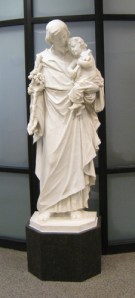
Statue of St. Joseph, in the Province of St. Louise offices in St. Louis (used with permission of Daughters of Charity Provincial Archives)
Excerpt from the Provincial Annals, March 20, 1885 (used with permission of the Provincial Archives)
The Fire at St. Joseph’s
The morning of Friday, March twentieth broke. A sharp north west wind had been blowing through the night, and from moment to moment it grew colder and colder. The fires were well kept up, for it seemed that the deepest cold of winter was again upon us. Through the morning Sr. Mariana [Flynn] had been haunted by the fear of fire, always so vigilant, and preventing on this point, this morning she felt the necessity of being doubly so. Her thoughts flew, however, in other directions, not to the kitchen.
It is hard to tell when or how the fire originated. The whole interior space between the ceiling and roof was probably one volume of seething flame before and human eye marked its presence. John Classen, one of the men, was coming home across the fields from town when he saw the flames or smoke and hastened to give the alarm. At the same instant came a message by telephone from town: “Did we know the house was on fire?” This met Sr. Mariana as she came heading the ranks from Da Pacem. By the time she reached the kitchen, the men, our men, were already there with the hose. It was at dinner time and the whole force of men were at hand.
Sr. Mary David [Solomon], the procuratrix who has been sleeping in the upper apartment of the kitchen building, since we have been so straighten for room in consequence of the pulling down of the old infirmary, was sick in bed at the time. A little coal stove helped to heat this apartment, and the cold being excessive this day, it was kept red and rosy. Some lay the blame of the fire to the little stove. However, if it caused the trouble, it made no sign in the apartment. Beyond a crackling sound Sr. M. David had no intimation of the presence of fire. Sr. [Gertrude] Kruse had just brought in her dinner, was about quarter past twelve. Drawing her curtains she saw the flames coming from above. The men came running up. She made her escape in undress, nothing was saved, but what she had on her, not even a bonnet or pair of stockings. In the meantime Sr. Adele knowing she was sick in bed & anxious about her safety ran upstairs, & across the room. The bed was empty, but as she turned to come back, for the bed was far over across the room, burning wood fell from above and obstructed her path. She seized a comfort from one of the beds, and threw it over her head, making for the direction of the door which she could not see on account of the blinding smoke. At the moment she considered her situation desperate ‘Gustini’s strong arm reached in and drew her out, but she jumped over burning wood to get clear.
The fire company of Emmitsburg was quickly on the spot and at work. When it was sought to attach the hose to the Mountain Water plug, it was found frozen up. Hot water had to be procured to thaw it out. This caused some delay. All Emmitsburg, all the neighborhood, all the priests and students of Mt. St. Mary’s came running to our assistance. Still the bells of St. Joseph’s clamored for help. The wind blew fiercly from the N.W., perhaps it was our salvation. It was bitter cold; everywhere the water fell, save in the living flames it was at once converted into ice. The men who fought the flames were literally incased in ice. Still the fire advanced. The refectory caught. The Gothic building was the next, upon it rested all hopes for St. Joseph’s. That attained every building must go. Recognizing this the firemen turned the stream of water steadily on the point of connection. The old dry shingled roof, shingled twenty years ago, seemed to invite the flames. The projecting, dormant window on the N. East corner seemed to kiss the burning building. As Sr. Mariana saw the two first buildings abandoned, she was almost in despair. “I beg you try to save them.” No, Sister, they must go; we must try to save the Gothic building.” Later she recognized the necessity and wisdom of the act. Meanwhile, a hundred eyes were necessary in every direction. The little new bakery was covered with blankets kept constantly drenched. The barnyard caught, the ice house caught, the pile of straw etc. by the cow stable caught. The stock was all turned loose. Mr. Rowe taking a force with him, mounted the roof over the children’s infirmary and with water from the tanks there situated, kept the building wet. The large force on the grounds rescued much from the flames, nearly everything was saved from the cellars of the two burning buildings, and from the first floors; even from the third floor of the refectory building, used as a dormitory. The capacity of this dormitory was forty eight beds, but only thirty six were used. Some four or five Sisters were sick in bed there, there being no room in the infirmary. The sound of men’s feet and men’s voices roused them from their beds. A few minutes later their beds were flung from the windows. When the fire had been first discovered smoking from the kitchen roof, it burnt as tho’ confined in an oven, but soon from each separate shingle darted forth a tongue of fire, and in a little if whole roof was a blaze, the volume of fire was whirled and swept by the blasts of wind. It travelled against the wind up to the refectory cornices, licked and curled itself along to the Gothic building, and now it seemed that must go. Mother telegraphed to Baltimore and to Frederick for assistance. Baltimore was too far, but Frederick responded. The fight against the fire in the corner of the refectory building was frightful. Young James Elder mounted on the pinnacle of the Gothic roof with a rope tied about him kept watch & worked. Icicles hung from his cap, his hair a mat of ice, his coat frozen upon him, sheeted ice. Some time during the past eighteen months a little stairway of about twelve steps has been made connecting the dormitory of the refectory building with the cells porch. The flames rushed through this door as though they sought to lick in to the very cells. The water poured steadily on the connection. In the meantime, the roof of the burning kitchen fell in. The crash was greeted by a yell of defiance from hundreds of throats. The volume of flame was now lessened and the danger for surroundings momentarily not so great. Between three & four the Frederick Fire Companies, and engine arrived. Every train had been side tracked that the special one might speed on its errand of mercy. Col. Victor Baughman, saw Mother a few minutes in her room. “You are not out of danger yet; you little systems of water works up here has worked admirably, but the danger exists. However, as soon as we bring our “Steamer” to play upon the flames they will soon yield. We are wanting now for a banal, but in a few minutes we will be at work.” While he spoke, Col. Baughman held in his hand the beaver which caused so much railing amongst his comrades and associates.
The danger was not over, the angry fire still raging, the most “obstinate fire,” an old fireman said, that he had ever seen, and the probabilities are that without the assistance from Frederick, the whole place would have laid in ashes.
Soon after the steamer began to play upon the flames, they manifestedly declined. Yet ever and anon they belched up again from some part or corner, and until near midnight the hose was directing its quieting streams where most needed. Every appearance of fiery tongues was hailed with a shout of defiance. The night was bitterly cold. There was scarcely any means for providing for the comfort of our guests and defenders. Mother ordered supper for one hundred and twenty five guests at the hotel in Emmitsburg, but many did not care to go and preferred to take pot luck at St. Joseph’s. The kitchen Sisters took possession of the children’s kitchen and prepared tea and what they could for refreshments. Sr. Olivia Coyne, Assistant in the Children’s Infirmary, did what she could on her little range toward providing for the Sisters, many a little cup of tea did she make for them that night. The children got their supper, warm tea, bread & [p23] butter cut it in their hands. About the Sisters infirmary their was a strange confounding of comfort and discomfort. The cells had been emptied about two o’clock of invalids and furniture. About six o’clock when the danger had subsided a good deal, it was thought the best thing that could be done was to move all back again. The two northeastern windows were great shattered, the cold intense, ice on the floor, yet it seemed the best that could be done. Those nearest the broken windows were moved farther down and all made as comfortable as could be under the circumstances. The sick had their little suppers, and Col. Baughman and Co., by exalting some kind of a promise, hoped the Sisters would get some rest and sleep after the time of terror. Not many, however, went to bed, perhaps one half. The kitchen Sisters staid up, and nearly every office was represented. The corridors were all a lit, and Sister patrolling all around the house. One of our men, Johnnie Peters, with young James Elder, passed around inside the house too, every half hour. At midnight the danger was over, and the Frederick Company withdrew from the grounds, and returned to Frederick on a special train. To Mr. Wilson Brown, Sup. Frederick Division of Penna Rail Road, are we indebted for facilities allowed the Fire Company to come to our relief. After the departure of the Frederick “boys” as they call themselves, the Emmitsburg “boys” with our own men watched the fire. It flamed up at intervals until morning, and when daylight came was still smoldering sullenly in corners while every cool part of the standing walls were sheeted in ice, and the massive walnut stairway leading down from the dormitory, still a good part of it standing was heavily draped in solid ice. It looked like a picture of Niagara in winter time. Looking north from the Community windows an antic scene met the eye, ice, in an smoke begrimed objects everywhere. The porch floor was solid blackened ice. The room itself looked woe begone. It was emptied of everything except one or two empty cupboards standing hither and yon. The floor dirt and blood from some cut, mash or squeeze the ceiling towards the refectory drenched, the windows broken. All that part of the house looked like desolation, and the temperature freezing. When we rose at four we did not exactly know what our chances were for a breakfast, however a very good one was served us in the children’s refectory. All the ground coffee being burnt in the kitchen, we had only tea. That was about the only difference from other lenten breakfasts. Had we to submit to real discomfort and privation no one would have met the calamity with other than cheerfully resigned feelings. Everyone seemed so deeply penetrated with gratitude for our escape and deliverance, recognizing in the strange limit set to the fire a tender and at the same time strong Providence. No one could look up at the scorched and burnt ruins kissing the old dry shingled roof without uttering, “It is the work of God.”