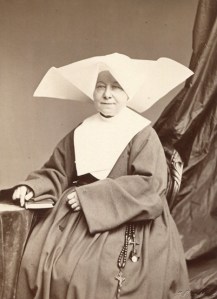
Sr. Mary Gonzaga Grace (used with permission of Daughters of Charity Provincial Archives)
(Letter of Sister Mary Gonzaga Grace to Mother Xavier Clark, May 9, 1844 used with permission of Daughters of Charity Provincial Archives)
Nativism was a movement that was anti-foreign and anti-Catholic in nature. The movement began with an increase of German and Irish immigrants to America in the 1820’s and 30’s, many of whom were Catholic. At this time the majority of Americans was Protestant and saw Catholicism as a major threat to their way of life. Protestants believed that Catholics pledged their allegiance primarily to the Pope and this type of loyalty was seen as suppressing free thought and a threat to democracy.
In May and July of 1844 Philadelphia was at the epicenter of religious and ethnic rioting and violence aimed at Catholic and Irish immigrants. A first-hand account of one such riot in Philadelphia survives in our collection, in the form of a letter written by Sister Mary Gonzaga Grace (then head of St. Joseph Orphan Asylum) to Mother Xavier Clark, community superior of the Sisters of Charity of St. Joseph’s, May 9, 1844.
Midnight
St. Joseph’s Asylum, Philada
My Beloved Mother,
Perhaps, before this letter shall have reached you, many of your poor children and their Orphans may be launched into eternity; called to appear in the presence of their God and their judge without a moment’s preparation. We are in the midst of frightful dangers, a great portion of our peaceful city is the scene of dreadful riot and bloodshed: two of our churches burned to the ground, St. Michael’s up in Vennington this afternoon and St. Augustine’s about half past nine to night – St. John’s has been guarded since Monday night and St. Mary’s is now surrounded by a strong detachment of the military besides a patrol. St. Joseph’s & Holy Trinity as well as St. Mary’s churches have removed all the sacred vessels, vestments xc into private houses, the clergymen have left their dwellings, the Bishop his house, the Priests and students have deserted the Seminary – every one seeking a night’s lodging in the family of some friends. Three police officers now guard our asylum, and we know not what moment our dear little ones must be roused from their peaceful slumber to fly for their lives. Threats have been made positively to destroy St. John’s church to night: and in consequence the poor Sisters and Orphans have been obliged to retire to some good families for a shelter because if the church were burned, the Asylum would certainly catch – several of our friends have kindly offered us, also, to bring the children to their houses, but we cannot hear the thoughts of scattering them unless we were sure of imminent danger – the managers think it can’t be possible that the mob could be so reckless as to attack helpless female orphans
Last night we did not close our eyes till two o’clock and now it is near that and we are watching still. S Albina and I. Eusebieg are here from St. John’s they were afraid the former might become excited in case there were danger and they concluded we, were safe, down here: God grant it may be so! I am fearful it will be worse tomorrow night: the military are out upon duty but it seems of no use. They have burned whole rows of houses and shot many as they passed along.
The commencement of the disturbance was chiefly this, many of the citizens had assembled to adapt some resolutions with regard to political affairs when some Irish Catholics insulted them and made such a noise that the spoken could not be heard, one word brought out an then until a battle ensued – the truth is, it is nothing but a party of Protestants leagued against the Catholics, under the names of native Americans and the Irish It is believed to be, actually, more religion than politics which is the cause of the riot.
Do pray for us very hard dear Mother, for what will become of us if the Asylum should be attacked how could we escape with ninety nine helpless children, seventy of whom would not be able to assist themselves even to get out of the mob and they have sworn vengeance against all the Sis and their institutions; we have every reason to expect the same fate.
Adieu dear Mother pray for your poor distressed children.
Ever yours affectionately
S. Mary Gonzaga
May 9/44
5 o’clock in the morning
we are safe yet, thank God.
9 o’clock – a little quiet, the Governor has issued a proclamation that the mob be fired upon this it seems will be likely to put a stop to the riot.
S. M. G.
Haste
Mother Xavier
St. Joseph’s Valley
near Emmitsburg, MD.
For more on the 1844 Nativist riots in Philadelphia, see Chaos in the Streets: The Philadelphia Riot of 1844, an online exhibit from Villanova University.