Father Burlando

In the United States, there was never a more influential Provincial Director than Father Francis Burlando.

The position of the Provincial Director is always held by a Vincentian priest.  He is meant to invoke the spirit of the community’s founders in the Daughters within a province, play a role in the formation of the Sisters, have a vote in Council decisions, and ensure that the Daughters of Charity live the spirit of their vows of poverty.  Father Burlando was born in Genoa, Italy in 1814.  He volunteered to go to America shortly before his ordination as a priest in 1837.  He taught in Perryville, Missouri, and was pastor at St. Vincent’s Parish in St. Louis, where important gatherings and Masses are still celebrated for the Daughters today.

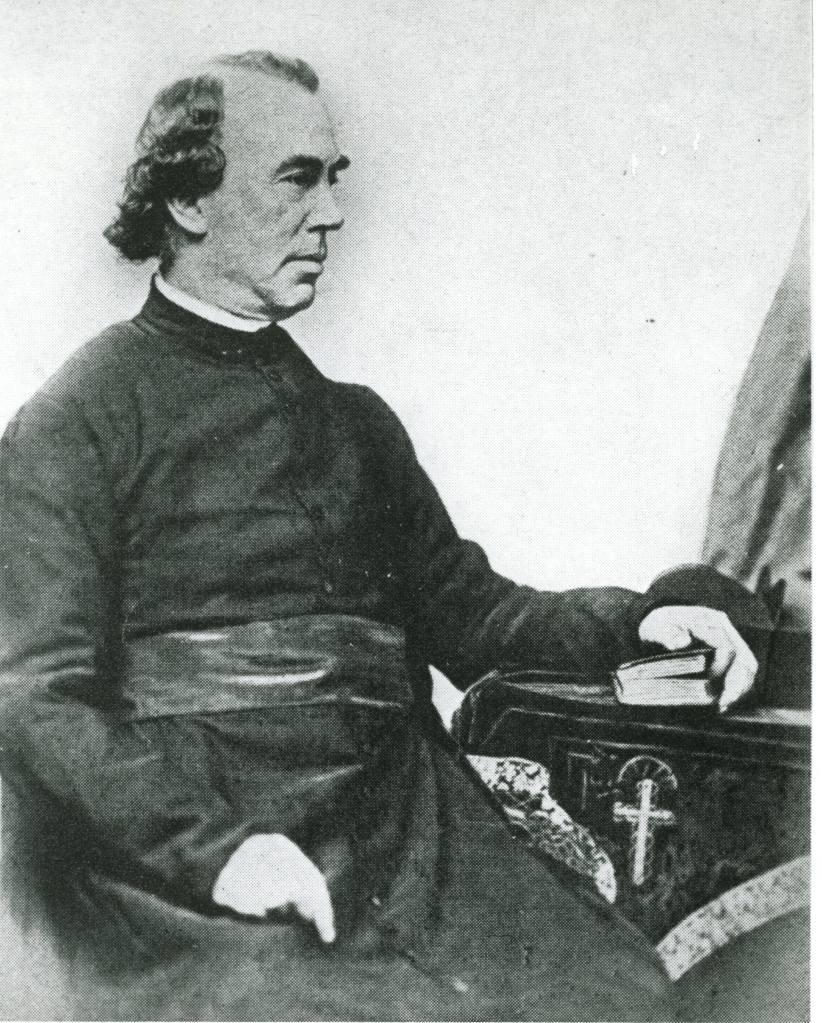
Father Burlando, circa 1870
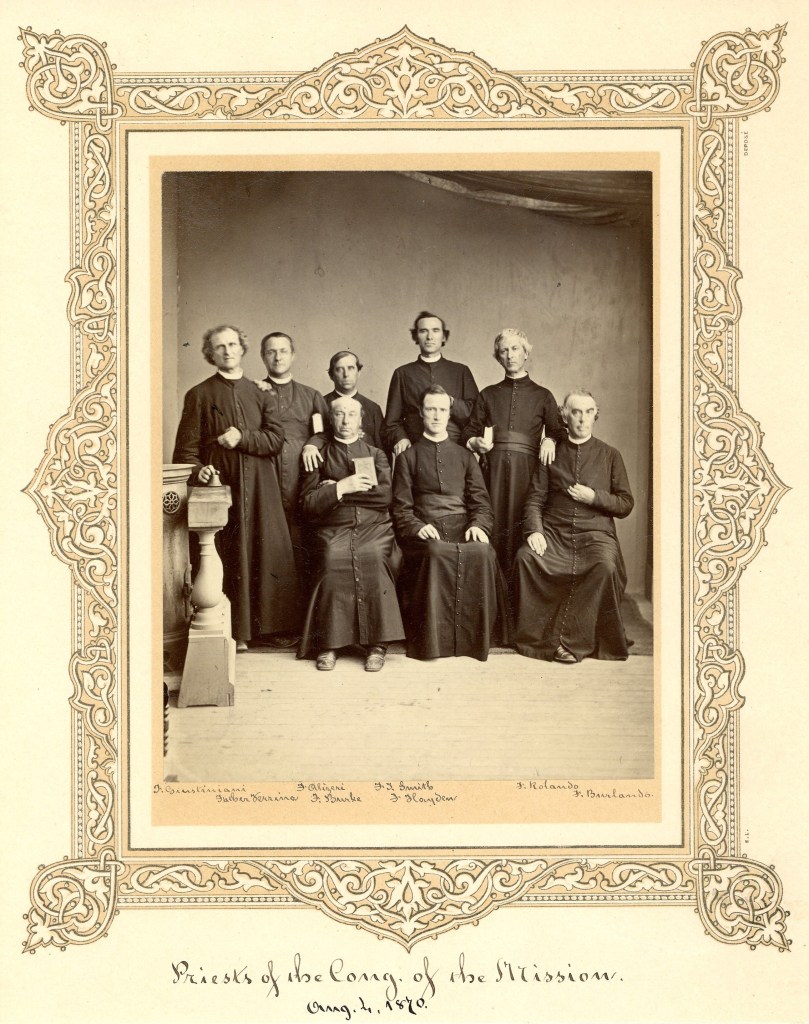
American Vincentians, 1870, Father Burlando at right

In 1849, he accompanied Father Mariano Maller to Emmitsburg.  Father Maller was set to take his position in 1850 as the first Provincial Director for the Daughters of Charity in the United States, after Mother Seton’s community formally merged with Daughters in 1850.  Father Burlando was to be the Sisters’ confessor but returned to St. Louis for health reasons.  In 1853, Father Maller was appointed as Director for the Daughters’ Province in Brazil, and Father Burlando was appointed as the Provincial Director in the United States.

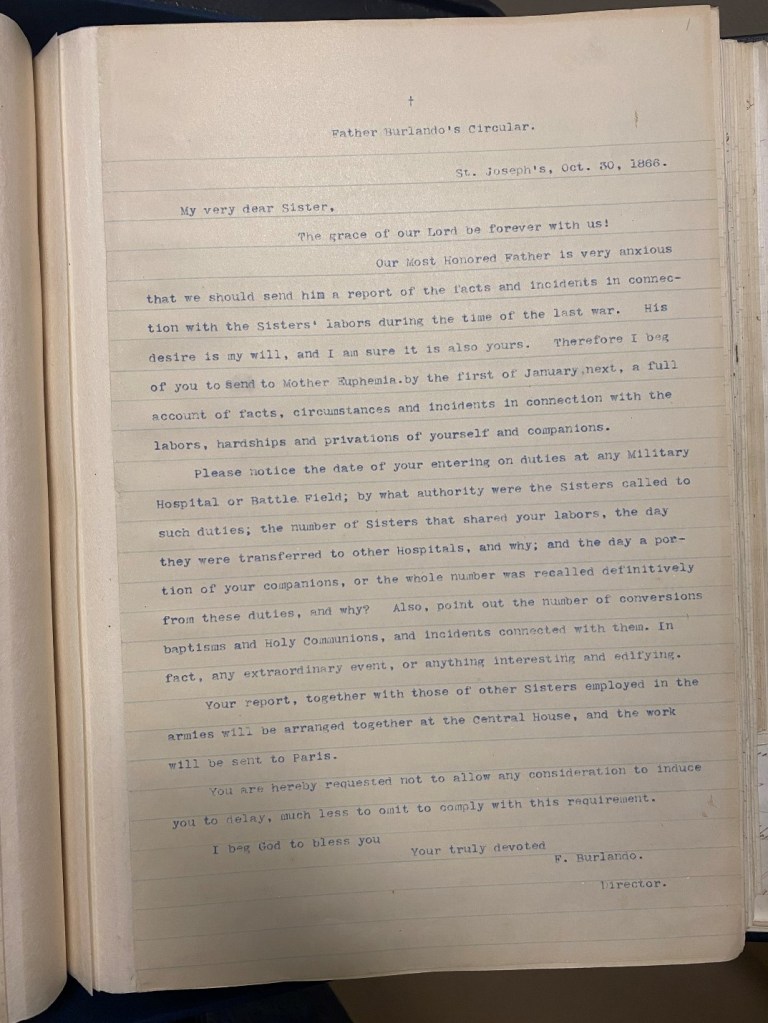
Father Burlando had the responsibility of completing the transition of the Sisters of Charity into Daughters of Charity.  Although the blue and white habit of the Daughters had begun to trickle into the United States, Father Burlando oversaw the completion of the change across the entire country through 1854. When the Civil War passed through Emmitsburg and the Sisters’ grounds became host to marching armies, Father Burlando worked to keep both Sisters and students safe, using their status as religious to make sure no accidental firing occurred.  When the Battle of Gettysburg subsided on July 3, 1863, Burlando personally led the Sisters to Gettysburg to begin their nursing duties there.  After the War, he helped shape the historical record by encouraging the Sisters to write their accounts of what they experienced.  Today, these accounts are some of the greatest treasures in the Archives.

With regard to St. Joseph’s Academy, Burlando oversaw an expansion of the school and the construction of his namesake building.  Having learned of architecture and building from his father in Italy, a plumber, he co-designed what would become his namesake building, which still stands as part of the FEMA Fire Academy.

Someone only identified as “An Old Pupil” described his relationship with the students at the Academy: 

Father Burlando took the most active interest in the studies of the pupils of St. Joseph’s and in everything pertaining to their comfort and welfare, always planning how to give them increased pleasure in their recreation, and in return the pupils loved him with a sincere affection, regarding him as a most tender Father. His practical mind was always suggesting something new for their future benefit, and as he fully realized the influence of [a] woman in her home, he labored to direct the education of those under his care to that end, introducing the study of domestic economy at St. Joseph’s, that the young ladies might be trained to fulfil properly the important duties of life. For this alone he is entitled to everlasting gratitude.

Burlando Building at St. Joseph’s Academy, Emmitsburg, circa 1871

Burlando also provided guidance on business matters, with his template for establishing ministries as incorporated institutions, which helped guide the community as it established some of its most long-lasting works.  Drafted in 1870, his guidelines provided uniform structure and procedure for the next 80-plus years, ensuring the longevity and independence of the Daughters’ ministries. 

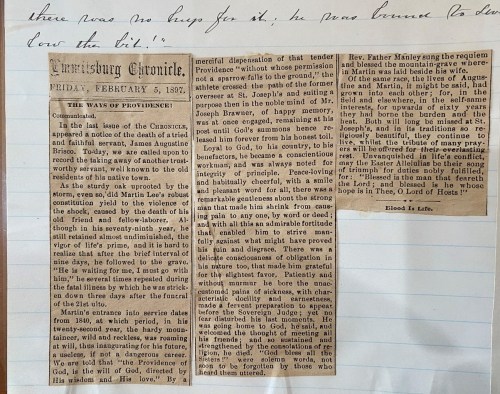
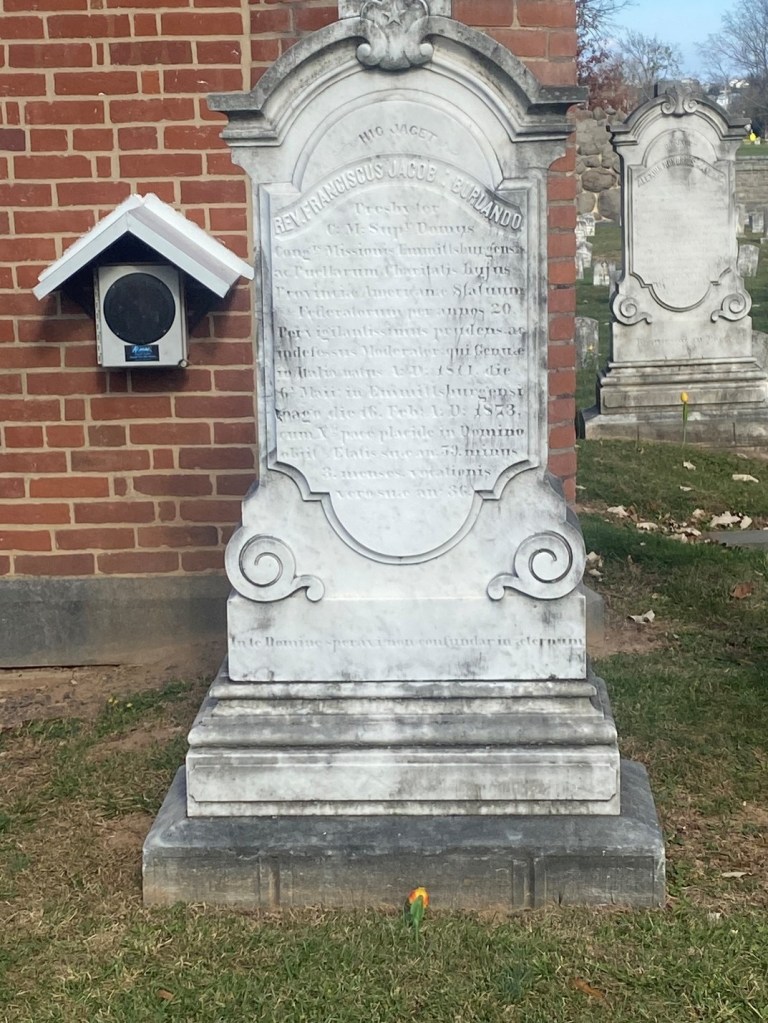
Father Burlando died suddenly in 1873 of a stroke.  Along with his importance, the suddenness of his death probably contributes to the voluminous accounts of his funeral.  Father Burlando is one of the priests, or even non-Sisters, to be buried in the Old Cemetery in Emmitsburg, in a place of honor directly around the mortuary chapel.

The Provincial Archives contains much of his personal and business correspondence, the notes that he used to compile the history of the community mergers in 1850; and his notes that were used to re-construct the Provincial Annals for the 1850s, 1860s, and early 1870s; and many of his retreats, which began in 1856.  Among the accounts of his death and funeral are poems written by Sisters and students alike:

1 Comment

Filed under Civil War, Gettysburg, Rev. Francis Burlando

The Setons at the National Archives

The National Archives and Records Administration is the repository of all official documents of the United States government.  With Mother Seton and her family’s long history in the United States, particularly in the United States Navy, the Seton family appears in many different places in our nation’s official government repository.

First, it is also worth noting that the ancestral Seton family have their own collection in the National Records of Scotland from Glorious Revolution through 1785.

The most obvious place that the family is represented is in the census records, with Elizabeth Ann and William Magee Seton appearing in the earliest censuses in New York City, and then Mother Seton appearing in Emmitsburg in 1810 and 1820.  The census records provide massive volumes of information related to demographics and are used most immediately for congressional apportionment and for funding for public services.

Listing for Mother Seton and the community in the 1810 census under “E. Seton”

William Seton III, one of Mother Seton’s surviving sons, is among the most represented due to his career in the Navy.  Military records, for both genealogists and veterans, are among the most used and requested materials in the National Archives.  Within the collection “Naval Records Collection of the Office of Naval Records and Library,” there is a series called “Letters Received from Commissioned Officers Below the Rank of Commander and from Warrant.”  This series contains various letters documenting official correspondence of enlisted sailors and their interaction with superior officers.  Among these are 19 letters including requests for leave, administrative documents, and reports from William Seton reporting to his commanding officers.  They span from his time on the Macedonian during its tour of the Pacific (and whose log is in the possession of the Daughters’ Archive).  Many others request shore leave or ask for extensions of leave.

William’s sister Catherine makes an appearance in one of his requests.  On October 9, 1828, William requested leave to travel in Europe due do “the continued ill health of my sister, to whom the Phisicians [sic] have recommended that course, as the only hope of renovating her constitution.”  This occurred during Catherine’s “World Traveler” era, when she was making extended stays in Europe, before eventually becoming a religious Sister of Mercy.  His letters stretch through his return to Norfolk in 1833 and return to civilian life.

William Seton to the Secretary of the Navy, October 9, 1828:  “Sir[,] I had the honor a few days past, to apply to you for permission to travel in Europe.  I beg leave to state that my reason for doing so was the continued ill health of my sister, to whom the Phisicians [sic] have recommended that course, as the only hope of renovating her constitution”

William Seton Maitland, nephew of Elizabeth and William Magee, also appears in the military records during the Seminole Wars in Florida. 

In the more modern day, and as a preview of things to come, the National Archives is also in possession of the official proclamations from the U.S. government about Mother Seton’s canonization.  Under Press Secretary William Baroody’s files, held at the Gerald Ford Presidential Library, is the official proclamation of Elizabeth Ann Seton Day, alongside a signed thank you letter from Sister Mary John Lindner for the community’s replica copy, signed by President Ford.  This replica will be on display next year (2025) for our exhibit “One of Us” at the Seton Shrine, celebrating the 50th anniversary of this event!

As a reminder of the vast scale of the National Archives, and the complexity of archival research, these records are among those that are digitized and available remotely to researchers.  This totals a mere 2% of the National Archives’ holdings, and there may well be other materials that one day are accessible without a trip to your nearest NARA branch.  William Seton IV, Mother Seton’s grandson, appears in Civil War veterans records, but his company, the New York 16th Artillery, have not been digitized yet. 

As an example of records which need to be visited in-person, these scans were lent to us by our friend and colleague Dr. Catherine O’Donnell and come from the National Archives branch in Kansas City, where Record Group 21 “Records of District Courts of the United States” reside.  Less than 0.5% of these records are scanned and online as of this time, but among them are early records of the United States bankruptcy court.  It is in these documents that the Setons’ life in New York City began to unravel, as the Seton-Maitland shipping company ran out of money, and the Setons were forced to sell their assets.

Front cover of 1800 bankruptcy filing
First page of Seton Family’s assets during bankruptcy case

Archivists at NARA are working hard to make more materials available, both in-person and remotely.  A way that you can help is to make more materials more searchable.  Their Citizen Archivist program allows anyone with an Internet connection to apply metadata and transcription to documents that have been scanned and made available.  These tags help make more materials searchable, so that that needle in haystack – that one stray name in a vast file – can turn up with a few strokes of a keyboard.

The records in the National Archives are the property of the American people.  Make use of your records, and help others make use of them too!

Leave a comment

Filed under Archives, Elizabeth Ann Seton

Father Dubois’s Last Visit

Father John Dubois was among the most influential people in the early days of Mother Seton’s community.  Although he was not the first priest-Superior, he worked the most closely with Mother Seton in establishing the rules and norms of the Sisters of Charity of St. Joseph’s.

Portrait of Dubois

Father Dubois was the Superior from 1811 to 1826, in addition to his role as the founder, in 1809, of Mount St. Mary’s University.  In 1826, he was appointed as Bishop of New York and left his role in Emmitsburg.  On May 16, 1842, Father Dubois made one final trip to Emmitsburg.  He stayed for a few weeks, departing in June.

The accounts of his visit show him quite frail, aged 78.  Sister Ann Aloysia Reed was tasked with assisting him during his visit, and he often needed guidance to navigate the terrain.  When he was invited to give Mass to the Sisters, Mother Mary Xavier Clark worried about his health, and asked Sisters to forgo Communion and attend a second Mass later for fear of overtaxing him.  Nonetheless, he would wake early every day at the first bell after sleeping in a bed set up in Mother Seton’s old room.   

Nonetheless, for the Sisters who had been around during his tenure, it was a joyous occasion, and for the younger Sisters to meet someone about whom they had heard so many stories.  Father Dubois had provided the Sisters their first home in Emmitsburg, in a cabin on the property of Mount St. Mary’s.  He had been the most influential figure in crafting the Rule of St. Vincent for the particular situation of an American Sisters’ community, and he had helped establish a long-lasting administration of St. Joseph’s Academy.  He had provided Mother Seton with her last rites.

Father Dubois did not live long after his visit, departing this world in December of 1842, a few meager months after his visit.  Shortly after his visit, he wrote one final letter to the Community, thanking them for their hospitality and congratulating Mother Mary Xavier on her re-election as Superioress. 

Leave a comment

Filed under Emmitsburg, John Dubois