Kate Hewitt and John Reynolds

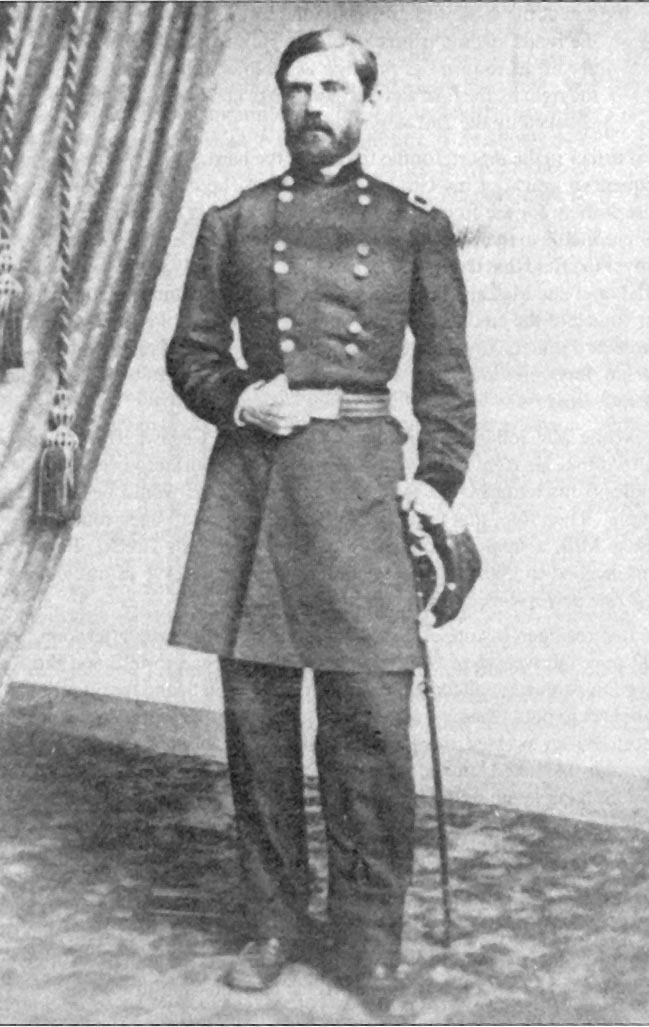
John F. Reynolds

John F. Reynolds

This article, originally published in 2014, has been updated in July 2020 to reflect more recent scholarship on the life of Catherine Mary “Kate” Hewitt.

One of the enduring human interest stories of the Battle of Gettysburg is the story of General John Reynolds, whom Meade entrusted with the entire left wing of the Union army at the start of the Battle of Gettysburg, and Kate Hewitt, the young woman to whom Reynolds had been secretly engaged. They had planned to marry after the war; Hewitt had promised Reynolds that she would join a convent if Reynolds did not survive the war. Reynolds lost his life on July 1, 1863, and within a year, Kate Hewitt joined the Daughters of Charity in Emmitsburg, Maryland. Little is known about Kate Hewitt’s life, and much mis-information has appeared about her time with the Daughters of Charity. Here is what we know about her from the entrance register of the Daughters of Charity in Emmitsburg.

Name: Catharine [sic] Mary Hewitt

Birth date: April 1, 1836. We do not have a copy of her birth certificate; this is the date written in the entrance register.

Birth place: Owego, New York.

Baptism date: March 18, 1861. We do not have a copy of her baptismal certificate. However, she would have had to produce evidence of being baptized before being accepted as a postulant, so the date is probably accurate.

She lived in Huntingdon, New York at the time she applied to join the Daughters of Charity.

She was a postulant at Mount Hope Retreat, a psychiatric hospital in Baltimore. This was the normal course for all Daughter of Charity postulants at that time. We do not know the exact dates for Kate Hewitt’s postulancy, but she probably completed her postulancy in or around March of 1864.

She entered the Seminary on March 17, 1864. In other religious communities, this stage of formation is called the novitiate and sisters in this stage are called novices. In the Daughters of Charity, this stage of formation is called the Seminary and sisters at this stage are called Seminary Sisters. Daughters of Charity did not make (and still do not make) temporary and final vows. The date that a Sister enters the Seminary is known as her vocation date, and on that date she becomes a full member of the Company of the Daughters of Charity. Approximately 5 years after her vocation date, a Daughters of Charity pronounces vows for the first time and renews them every year after that.

She finished her Seminary on October 2, 1864 and received the habit at that time. Also at that time she would have been given a community name. Kate Hewitt’s community name was Sister Hildegardis. Some accounts claim that girls in the Reynolds family helped Kate Hewitt select her community name. This is not true. Community names were assigned by community superiors, and the Sister had no say in what her community name would be.

After receiving the habit, Kate Hewitt, now known as Sr. Hildegardis, was sent on mission to St. Joseph’s School in Albany, NY. Some accounts (most notably, Gabor and Jake Borritt’s The Gettysburg Story audio tour of the Gettysburg battlefield) claim that Kate Hewitt spent the rest of her life as a Daughter of Charity. She did not. The last entry in the register notes, “Left from St. Vincent’s Home, Philadelphia, September 3, 1868”.

Our collection contains no photos or correspondence of Kate Hewitt. We have no records which shed light on her activities or whereabouts after leaving the Daughters of Charity.

More details on Kate Hewitt’s life can be found in Marian Latimer, “Is She Kate?”: The Woman Major General John Fulton Reynolds Left Behind and “Finding Kate:  Diligent Research Reveals the True identity of General John Reynolds’ Mysterious Fiancee” (Civil War Times Illustrated, August 2020) by Jeff Harding and Mary Stanford Pitkin.

Other resources are available through the National Civil War Museum here and here.

Further information on the Reynolds family is located in the Special Collections Department at Franklin and Marshall College, Lancaster, Pennsylvania.

2 Comments

Filed under Civil War, Exhibits, Gettysburg, Kate Hewitt

Civil War exhibit to open on June 29

Our buildings and very earth trembled
“On the 1st of July 1863, the two armies met near Gettysburg, a large town in Pennsylvania about ten miles north of Emmitsburg. They fought until the evening of the 3rd, advancing by their movements more and more towards our peaceful vale, so that our buildings and very earth trembled from their cannons. That night the rain fell heavily and continued to do so all the next day, Saturday.” – Daughters of Charity, Civil War Annals, 1863

The story of the fateful days of late June and early July 1863 will be the subject of our next exhibit, “Our Buildings and Very Earth Trembled”, opening on June 29 and running through July 6. Each day, we will present a reading and talk about the events of that day, 150 years ago, told through the voices of the Union generals (Custer, Reynolds, Schurz, and others) who camped on the grounds in Emmitsburg and Sisters’ written recollections. Changing exhibits will highlight photos, manuscripts, and artifacts from the collections of the Provincial Archives.

The exhibit is open from 1:00 PM to 5:00 PM daily. Gallery talks begin at 1 PM and occur every half hour until 4:00. Exhibit tours begin at 1:30 and take place every half hour until 4:30. Contact us at 301-447-6041 or by email at archives@doc.org to sign up for a time, or use the contact form found on the “Exhibits” page.

2 Comments

Filed under Announcements, Civil War, Exhibits

Daughters of Charity Cornette – Conclusion

(Image used with permission of the Daughters of Charity Province of St. Louise Archives)

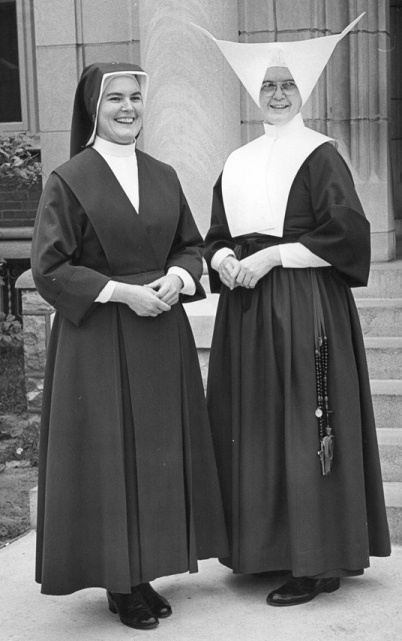
Old and new habits, 1964

Sister Mary Rose McPhee wears the cornette habit; Sister Regina Priller wears the habit which replaced the cornette in September 1964

The reforms of Vatican II in the 1960s brought dramatic changes to every aspect of the community life of the Daughters of Charity. Constitutions were re-written, common rules and customs, some of which had been in effect for centuries, were adapted and modernized. But for the general public, no change was as visible or as dramatic was the change in habit. To conclude our series on the history of the Daughters of Charity habit, we turn to September 20, 1964, when Daughters of Charity all over the world wore a new habit for the first time since the 17th century. While the entire worldwide community (then 45,000 Sisters) changed habits on the same day, the change was many years in the making. In the words of a Daughter of Charity publication from 1964: “we have been preparing for this event a long time, because the Church had spoken and our Superiors had ordained it.” [note 1].

Talk of changing the traditional attire of women religious began in 1951, when Pope Pius XII, addressing the Congress of the Italian Federation, declared:

“As for the religious habit, choose it in such a way that it may be the expression of the interior nature of simplicity and religious modesty; then it will be an object of edification for all, even for modern youth … Changes will be made when it is opportune: 1. Whenever it is question of clothing of purely local or accidental origin, no longer in accord with our times. 2. Whenever it is question of an excessive quantity of material. 3. Whenever the style or form may be notably injurious to health or in any way contrary to the laws or demands of public health. 4. Finally when it is question of a style that provokes attention or astonishment of others”. [note 2]

In December of 1959, Mother Francine Lepicard, Superioress General of the Daughters of Charity, said in a circular addressed to the community’s provincial leadership:

“A large number of religious communities have already followed the directives of the Holy See in changing their [habits], in order to simplify it, diminish its size, and to make it more adapted to the needs of the present time. The time has now come, dear Sisters, for us, too, to take into consideration these requests.”

In a circular to the Sisters of the St. Louis Province from February of 1960, Sister Catherine Sullivan, St. Louise Province Visitatrix, explained that changing the habit would involve a lengthy process, and offered some additional thoughts for the Sisters as they prepared for the change of attire:

[Mother Lepicard’s] circular invites the Visitatrices to present their ideas of what the adaptation should be, together with the description of the adapted habit, send several pictures or a model of it. In a Community so widespread as ours, the gathering of suggestions from many nations, their study and evaluation is, in itself, a lengthy process. When that has been done, all must be submitted to Rome. Therefore, dear Sisters, I can neither tell you when the change will take place, nor what it will be …

… Believe me, dear Sisters, if I write of this almost matter-of-factly, it is because the sacrifice asked is too great and too obvious to need dwelling on. Every article of our holy habit is endeared to us personally, and by tradition. But Obedience is dearer still … In this instance, may we not apply almost literally those words of our Blessed Lord: “Is not the life a greater thing than the food, and the body greater than the clothing” (Matt. 6, 25) The spiritual life of hundreds of thousands of Sisters of all nationalities has, for three and a quarter centuries, preserved its distinctive Vincentian character by the “food” of the doctrine of our holy founders, coming to us from their direct successors. And, to keep intact the body of the Community–second only to the body of the Church in our love and reverence–would any Daughter of Charity hesitate, or even find it difficult, to make a change of clothing?

… After personal consultation with Sister Isabel, Visitatrix of the Emmitsburg Province, concerning the adaptation of the holy habit, we decided to submit our suggestions in a joint letter to Most Honored Mother. We prefaced the letter with this statement:
‘Most Honored Mother, we both assure you, with all possible sincerity and earnestness, that, whatever the final decision may be, you can count on us and on every Sister in our Provinces to accept the decision whole-heartedly, unreservedly, and promptly. The decision will be the will of God, and we desire nothing else.’

It took five years of study and consultation to arrive at the final design for the new habit. When we consider that in 1964 the worldwide community of the Daughters of Charity numbered 45,000 Sisters in sixty provinces spread out over 5 continents, it is not difficult to see why. An article in a Daughter of Charity publication, Echo of the Mother House, from 1964 gives some perspective on the complexity of the problem.

“The Company of the Daughters of Charity … finds itself concerned in situations that are very diverse, where the question of the Habit is approached in very different ways. At Paris, in the suburbs and in the working-class districts, the cornette is very popular and creates and immediate tie between the people and the Sister. In certain industrial regions the cornette, almost unknown, creates a barrier which prevents a true dialogue with the workers. In Mexico, our Habit is the only one authorized; its change will create some difficult problems … Prudence demanded consultations, interchange of opinions and a long time for ideas to mature and for minds to prepare.” [note 3]

In addition to local and cultural issues, the work of the Sisters had to be considered. The works included hospitals, schools from kindergarten through college, social work, day camps, youth centers, and many more. Much of the Sisters work was (and is today) done outside of an institution, in urban and rural settings. Because of this the new habit had to be, in the words of a 1964 press release, “trim, simple, and suitable for all weather service. This necessitated a radical change.” [note 4]. The new habit did retain one aspect of the old: the colors, blue and white, a symbol of the community’s devotion to Mary Immaculate.

The Sisters’ attire has changed several times since 1964 and continues to do so, in response to the present day needs of the Sisters and of the people they serve.

Notes
Note 1. “Our New Habit”. Echo of the Mother House, November 1964, p.525.
Note 2. Ibid., p.526.
Note 3. Ibid.
Note 4. “World Wide Community Will Change Religious Garb”. Press release, August 14, 1964

1 Comment

Filed under Habit, Vatican 2