Category Archives: Sisters of Charity Federation

The Sisters of Charity and Venerable Pierre Toussaint

There are currently six African Americans on the pathway to sainthood.  One of them, Ven. Pierre Toussaint (1766-1853), shares a connection with the early Sisters of Charity of St. Joseph’s.

Toussaint arrived in New York City from Haiti with his enslavers in 1787.  He was permitted to work and earn money for himself as a hairdresser, becoming renowned for his skill and able to command high prices from the upper classes for his work.  When his Mistress died in 1807, he was freed through her last will and testament.  His renown grew through his connections with different members of society – the upper native classes through his work, the immigrants from the Francophone world through his mother tongue, and the Black community – both free and enslaved – through his race and life experience.  Upon his freedom, he took the last name Toussaint in honor of Toussaint L’Ouverture, hero of the Haitian Revolution. 

Toussaint’s financial success and Catholic faith inspired him to give back.  Among other charities, he was a major visitor and contributor to the Roman Catholic Orphan Asylum on Prince Street, an orphan asylum that had been run by the Sisters of Charity of St. Joseph’s since 1817.  His special concern for this cause likely came from the death of his sister, after which he took in his niece to raise her.  At one time, his donations totaled one-third of all the yearly donations of the Asylum.  This is in spite of the Orphan Asylum being, at the time, for white children only.

Among the other causes that he championed, Toussaint showed particular concern for refugees, particularly those who spoke French.  He also founded the first Catholic school for Black children in New York City, located at the Parish of St. Vincent de Paul, the city’s Francophone parish at the time. 

Toussaint was known for attending daily Mass at St. Peter’s, which was Mother Seton’s parish during her New York years! 

In 1846, the Sisters in New York City and Brooklyn withdrew from Mother Seton’s community to form the Sisters of Charity of New York, who inherited the community’s history in the Metro area up until that time.  In 1850, members of the Sisters of Charity of St. Joseph’s joined with the French Daughters of Charity, and a separate group of Sisters formed the Sisters of Charity of Cincinnati.  The New York Orphan’s Asylum forms part of the core history of the Sisters of Charity of New York and therefore, of the shared history of Mother Seton’s Daughters.
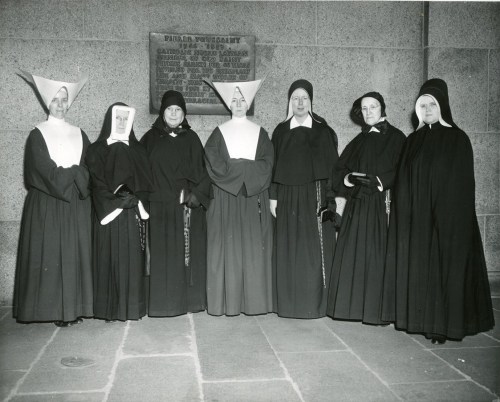
A meeting of the Sisters of Charity Federation, sometime after 1953, in front of the plaque to Pierre at Old St. Patrick’s Cathedral. 

In 1990, for his role in helping the Catholic Charities of the city survive in their early days, Toussaint was re-interred to the crypt of St. Patrick’s Cathedral.  He is the only layperson so honored.  He was declared venerable in 1996.  The Pierre Toussaint Guild and Office of Black Ministry of the New York Archdiocese actively engages in charity and sponsorship projects that they believe Toussaint would support today.

Leave a comment

Filed under African American History, Sisters of Charity Federation, Sisters of Charity of New York, Sisters of Charity of St. Joseph's

Saints, Blesseds, and Founders in Emmitsburg

This is part of a yearlong series about the early days of the Sisters of Charity of St. Joseph’s commemorating the 200th anniversary of the death of Saint Elizabeth Ann Seton, foundress of the community.  In 1850, the Emmitsburg-based Sisters united with the international community of the French Daughters of Charity.

Saint Elizabeth Ann Seton is the first North American-born saint recognized by the global Catholic church.  The Daughters of Charity Provincial Archives in Emmitsburg is the largest holder of writings and artifacts of Mother Seton in the world.

Brick and wrapper from Seton home on State Street, New York City

However, Mother Seton is not the only one represented in the collection recognized as a holy person by Rome, nor is she the only foundress of a community in the collections.  We can provide resources and information about a number of other individuals of this caliber!

Father Simon Bruté was Mother Seton’s spiritual director, a Sulpician priest who later became the first Bishop of Vincennes (now the Archdiocese of Indianapolis).  His cause for canonization was opened in 2005, and he was accepted as a Servant of God.  Materials of his in the archives include correspondence with Mother Seton and her family, spiritual writings, the bands he wore for his consecration as a Bishop, and his many drawings and sketches.

“Eternity, Jesus,” Father Simon Bruté, January 11, 1821

Saint Father John Neumann, CSsR,was Archbishop of Philadelphia from 1852 until his death in 1860.  He was canonized in 1977 and was instrumental in bringing the Daughters of Charity to St. Vincent’s Orphan Asylum.

Father John Neumann to Rev. Mariano Maller, C.M., Provincial Director, July 29, 1852

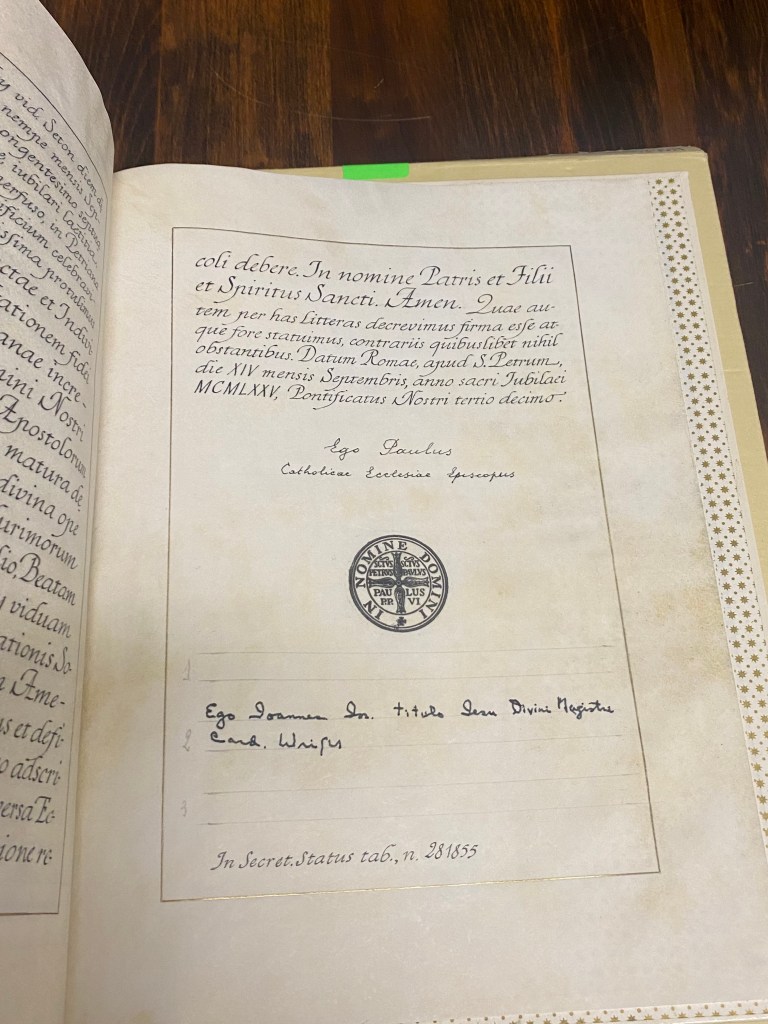
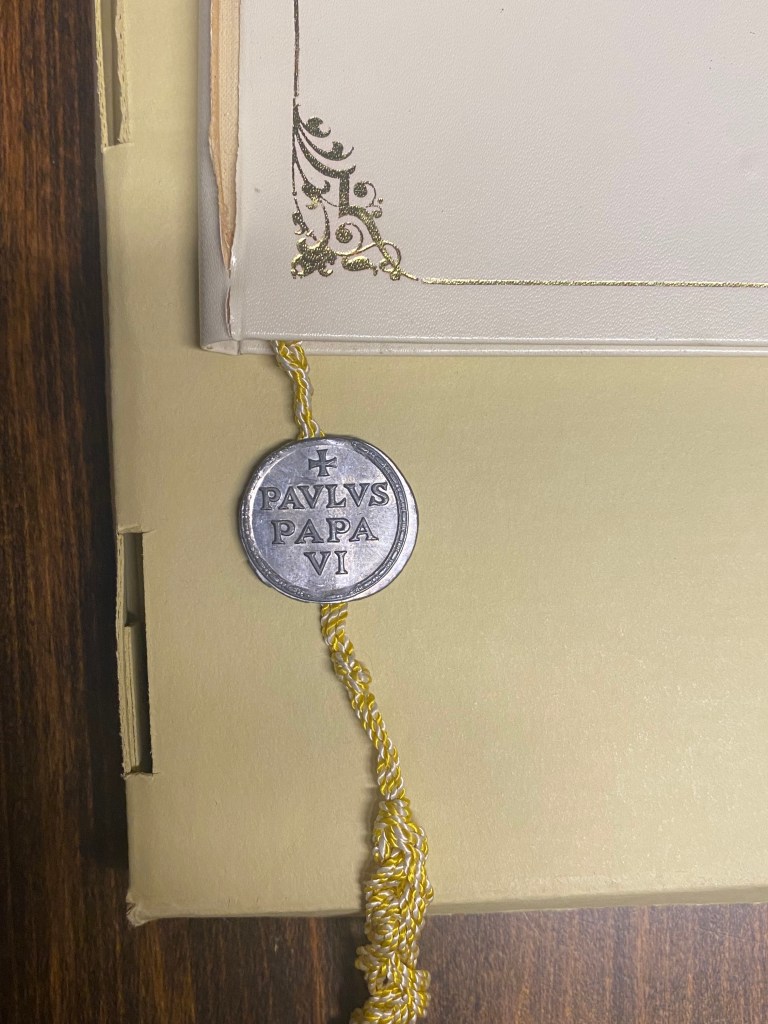
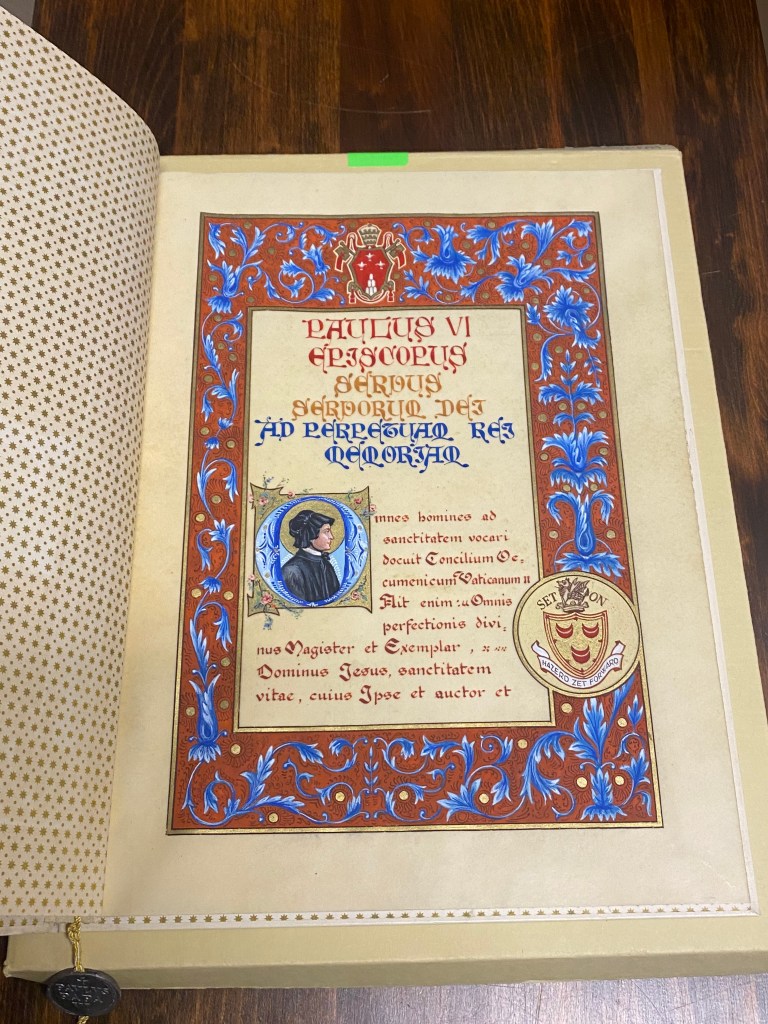
Canonized Popes Many Daughters have been lucky enough to meet the Successors to St. Peter, sometimes as part of a crowd, and sometimes in more serious business.  The most notable occasion relating to the community’s history was Saint Pope Paul VI, who canonized Mother Seton in 1975, thus making Mother Seton’s canonization bull itself a relic of a saint.

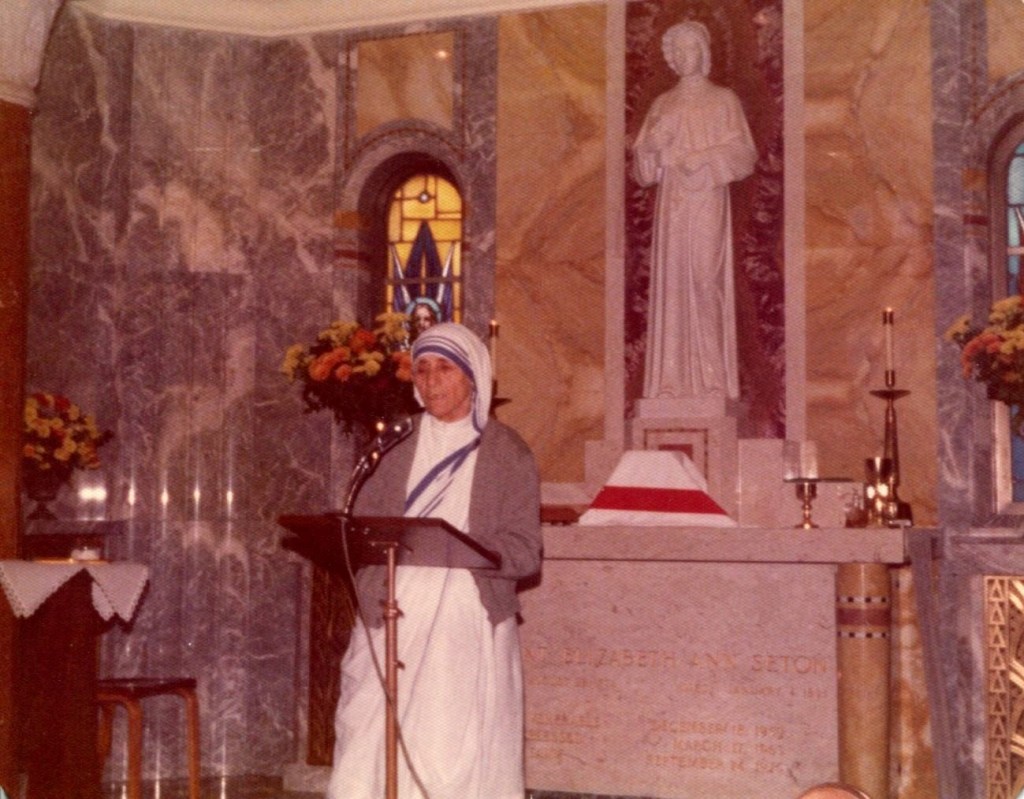
Saint Teresa of Calcutta – often still known as Mother Teresa – made a three-day tour of the United States in 1975.  During her visit, she visited the Shrine of the just recently canonized Saint Elizabeth Ann Seton alongside her more formal trips to the United Nations and Washington, D.C.  The archives contains photos of her visit.

Almeide Maxis Duchemin – later known as Mother Theresa Duchemin – was a student of St. Joseph’s Academy from 1819-1823 from around ages 9-13.  She became a founding member of the Oblate Sisters of Providence in Baltimore and became the first African American Superior General of a white religious majority community when she co-founded the Sisters, Servants of the Immaculate Heart of Mary.  The archives contains records of her schooling at the Academy.

Mothers Elizabeth Boyle and Margaret George were companions of Mother Seton and members of the Sisters of Charity of St. Joseph’s who founded their own communities; the Sisters of Charity of New York in 1846 and the Sisters of Charity of Cincinnati in 1852, respectively. 

3 Comments

Filed under Canonization, Emmitsburg, Mother Theresa Duchemin, Paul VI, Simon Brute, Sisters of Charity of Cincinnati, Sisters of Charity of New York, Teresa of Calcutta

Tracing the Rule: A Look at Charity Federation Treasures

Dee Gallo
Provincial Archivist

September 13 was a special day at the National Shrine of St. Elizabeth Ann Seton. As part of their celebration of the 40th anniversary of the canonization of Mother Seton, Seton Heritage Ministries hosted a gathering of sisters from the congregations of the Charity Federation. There were tours of the Shrine, its museum, and the historic houses in which Mother Seton and her Sisters of Charity of St. Joseph’s lived in the early 1800s. In addition, the Provincial Archives, along with our fellow Federation archives, arranged a special display of copies of the Federation congregations’ Rules, nineteenth-century documents that defined the religious characteristics and activities of their early sisters.

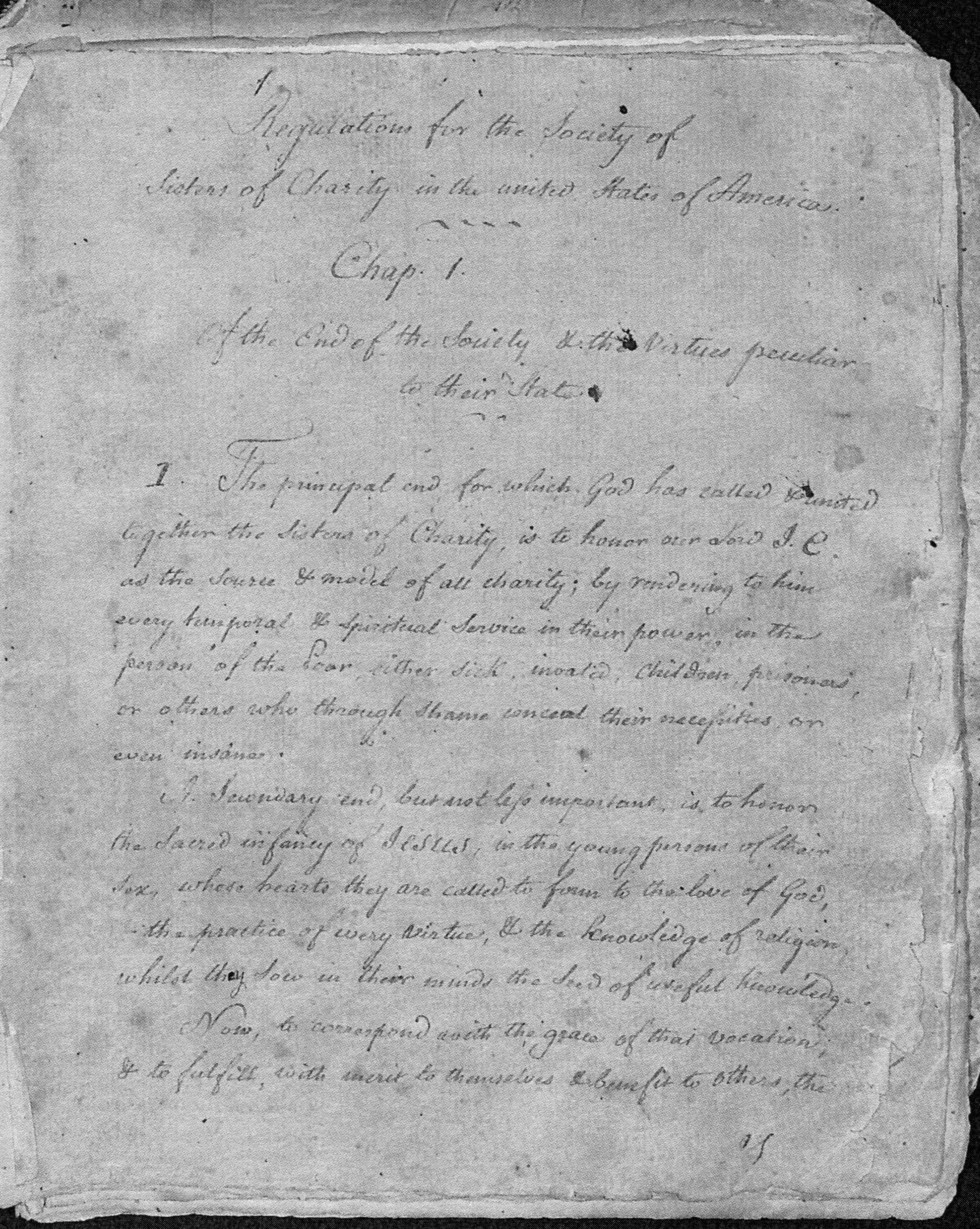
Some of these Rules clearly trace back to a single source: a manuscript copy of St. Vincent de Paul’s Regulations for the Daughters of Charity, the community he began in Paris in 1633. In August of 1811, Bishop Benedict Flaget brought the volume to Emmitsburg where it was adapted by Rev. John Dubois, founder of Mount St. Mary’s Seminary. Then, with the approval of Archbishop John Carroll of Baltimore and Rev. John Tessier, the new “American Rule” (Image 1) was presented to and accepted by Elizabeth Ann Seton and her community on 17 January 1812. In brief, this new Rule was clearly crafted for women religious working in the New World.

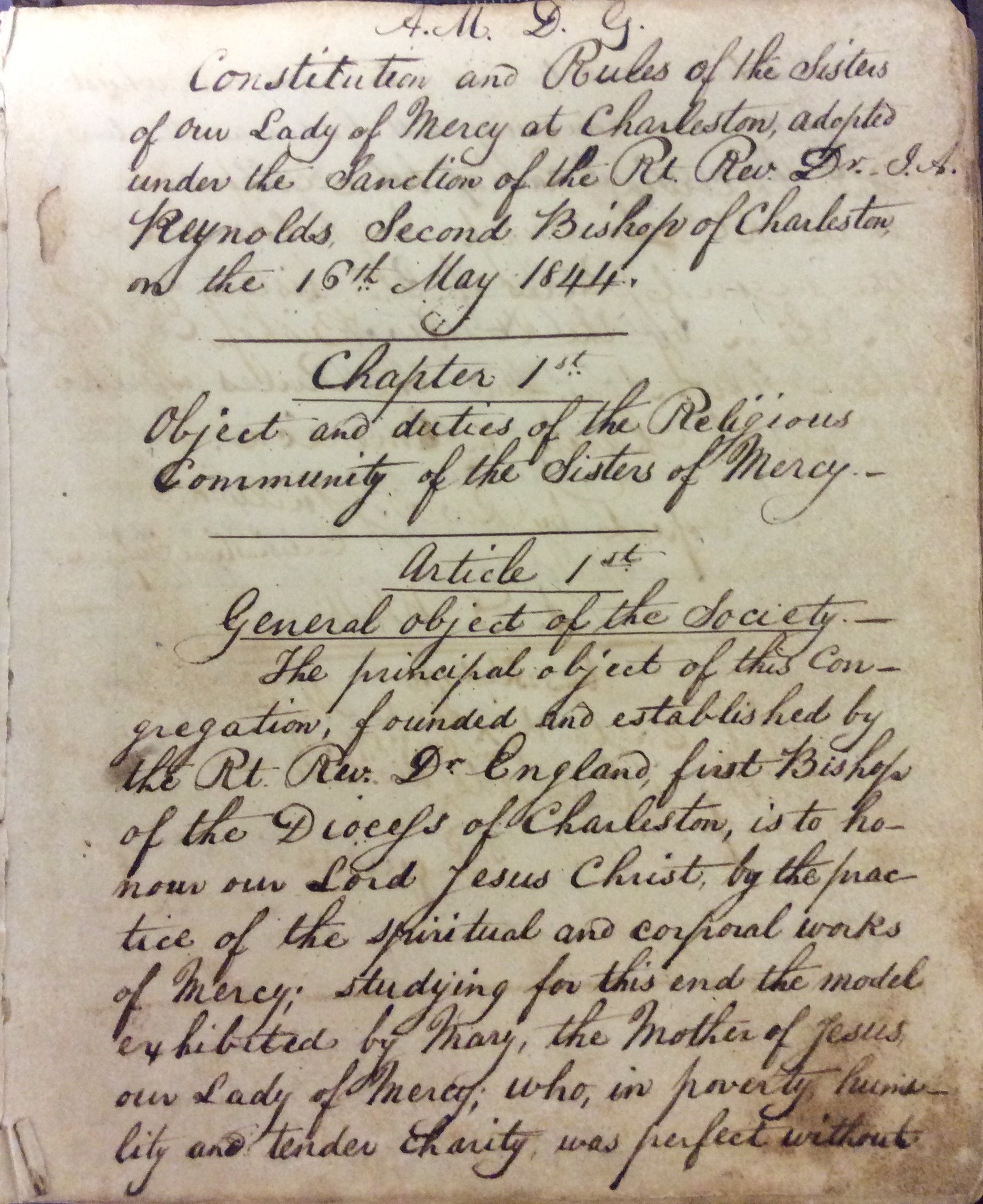
The Provincial Archives is privileged to have among its Rare Books the copy of the Vincentian Rule brought over by Bishop Flaget as well as the original American Rule accepted by Mother Seton. We shared those precious links to Setonian and Vincentian heritage with other Federation archivists who graciously brought their own copies of their Rules for the display. In addition to Emmitsburg’s , on exhibit were original copies of the Rules of the Sisters of Charity of New York (Image 2); the Sisters of Charity of Convent Station, New Jersey (Image 3); and a scan of the first page of the Rules for the Sisters of Charity of Nazareth, KY (Image 4). In this blog, we share those images along with others from the Sisters of Charity of Cincinnati (Image 5) and the Sisters of Charity of Our Lady of Mercy, Charleston, S.C. (Image 6).

By comparing and contrasting the various Rules, one finds that the links among the Charity congregations are as rich as threads in a tapestry. For example, Bishop Flaget, then prelate of neighboring Bardstown, KY, brought to Catherine Spaulding’s congregation in Nazareth a copy of the same Rule accepted by Elizabeth Ann Seton’s community; Mother Spaulding, however, chose to adapt theirs slightly differently– and in definitely more “American” English. Showing yet another link is a page from the manuscript of the Sisters of Charity of Cincinnati’s Rule which bears the language of the approvals of both Archbishop Carroll and Rev. Tessier given to the Seton document in 1812. Finally, the Rule for the South Carolina Sisters shows a link to Emmitsburg via Bishop John England of Charleston, who had procured a copy and proposed it for the congregation of Sisters which he started in 1829.

Our thanks to the archivists of the Sisters of Charity of New York, Sisters of Charity of Convent Station, Sisters of Charity of Cincinnati, Sisters of Charity of Our Lady of Mercy, and Sisters of Charity of Nazareth for granting permission to share images from their Rules. Thanks to Sr. Noreen Neary, archivist of the Sisters of Charity of Convent Station, for assisting with the Rules display at the National Shrine.

Image 1: Daughters of Charity, Emmitsburg (image courtesy of Daughters of Charity Province of St. Louise Archives, Emmitsburg, MD)

Image 1: Daughters of Charity, Emmitsburg, MD

Image 2: Sisters of Charity of New York (courtesy Sisters of Charity of New York)

Image 2: Sisters of Charity of New York

Image 3: Sisters of Charity of Convent Station, NJ (image courtesy of Sisters of Charity of Convent Station, NJ)

Image 3: Sisters of Charity of Convent Station, NJ

Image 4: Sisters of Charity of Nazareth (image courtesy of the Sisters of Charity of Nazareth)

Image 4: Sisters of Charity of Nazareth, KY

Image 5: Sisters of Charity of Cincinnati (image courtesy of Sisters of Charity of Cincinnati)

Image 5: Sisters of Charity of Cincinnati, OH

Image 6: Sisters of Charity of Our Lady of Mercy, Charleston, S.C. (image courtesy of Sisters of Charity of Our Lady of Mercy)

Image 6: Sisters of Charity of Our Lady of Mercy, Charleston, S.C.

Leave a comment

Filed under Sisters of Charity Federation, Sisters of Charity of Cincinnati, Sisters of Charity of Convent Station, Sisters of Charity of Leavenworth, Sisters of Charity of Nazareth, Sisters of Charity of New York, Sisters of Charity of Our Lady of Mercy, Sisters of Charity of St. Joseph's