Pope Francis isn’t the first pope to interact with the Daughters of Charity who run Casa Santa Marta in Rome. The account below comes from the diary of the Sisters who traveled to Rome for Catherine Laboure’s canonization in 1947.
(Account of the Canonization of Catherine Laboure, 1947, used with permission of the Provincial Archives)
VISITS TO ROME AND ENVIRONS IN PRE-CANONIZATION DAYS!
THERE’S GOLD IN THEM THAR HILLS: This slogan of the early Californian prospectors has descended to the level of a jest, yet how much truth and tragedy it holds! Worn with fatigue, ravished by fever, fainting with hunger, consumed with loneliness, those hardy men held on and went on because of the gold which they knew was hidden in the western hills. Their slogan, with a modern re-phrasing is ours, as Rome’s Seven Hills, the Pincian, the Capitoline, the Palatine, the Esquiline, the Coelian, the Janiculum, the Vaticana, – lie before us. They are gold of historical evidence for the archaeologist, gold of marble and bronze and silver for the antiquarian; gold of classical beauty in column and arch and fountain and villa for the architect; but more abundantly than all else, these hills hold for the Christian heart the gold of indisputable proof of the Church’s earthly beginning. Here one touches a pillar to which Paul was fastened, and venerates the spot on which Peter was crucified; one follows the winding ways of the catacombs in the bowels of the earth, and then walks awestruck through the grandeurs of temples converted into Churches. Rome has preserved in stone the history of the growth of the Church. Were it possible in the order of nature to drop an acorn into plaster of Paris which would retain every change end development as that acorn became a giant oak, one would have a parallel of what has happened historically to the Church in Rome. Yes, there is gold in the hills about us, and we ask Our Lady , House of Gold, to direct us to those veins which will enrich most our spiritual lives. We have a decade of days – July 17 to 26 – in which to do our “prospecting” and then comes the Great day of Blessed Catherine’s canonization.
SAINT MARTHA’S HOSPICE: Happily, we are domiciled at Saint Martha’s within the shadow of the Dome – literally within its shadow – Saint Peter’s. We share this privilege with one hundred and fifty other Sisters. Many many more than that will come to Rome for the great occasion, but as many of the pilgrims are also housed here, the other Sisters must seek hospitality at the other houses. We have fifteen in Rome which forms a Province in itself; a Province without a Seminary however , Sisters who enter for the Province of Rome receive their training in the Seminaries of Sienna, Turin, or Naples. Saint Martha’s is not included in the Province of Rome, but depends directly upon Paris.
It is difficult to find out much about Saint Martha’s because we are here at such a furiously busy time. We are told that it still retains something of its wartime status, inasmuch as some two floors are given over to persons who were invited here during the war and who cannot now, for political reasons, return to their country. The French ambassador whom Petain assigned to the Vatican is one of those persons; so also is the Bishop of Budapest, a most holy man who must live in the chapel. We frequently assist at his Mass and he is to be seen kneeling, wrapt (sic) in prayer in the back of the chapel every time we go for Community exercises. There is a Cardinal Granito de Bolmonte who has a suite of rooms here, but I rather think that is in the order of things and not the result of the war. Quite a host of Monsignori who act as Secretaries to various Vatican officials live here.
AN ANCIENT COMPANION GIVES HISTORICAL TIDBITS: One day at recreation the floor was happily given to a dear ancient who has been more more than fifty years and we listened avidly as she talked mentioning the various Holy Fathers she has known with the same affectionate familiarity with which one speaks of successive Sister Servants. The Sisters have been here since 1864, though the present Saint Martha’s , a modern looking building, was erected only thirty years ago. It was amusing to hear Sister tell how, in the evil days of the [1870s] when Rome was divided between those who flew the white flag of the House of Savoy and the black flag of the Papacy, one of the Sisters flung her black shawl to the breeze to denote the loyalty of the House. It was good too, to hear her tell, though one sighed for the change in the times, of how great industrialists of Italy, France and other countries used to come with hundreds of their employees at one time, to make the holy pilgrimage, The charge then was two francs a day and Sister delighted in telling us what was given for that amount.
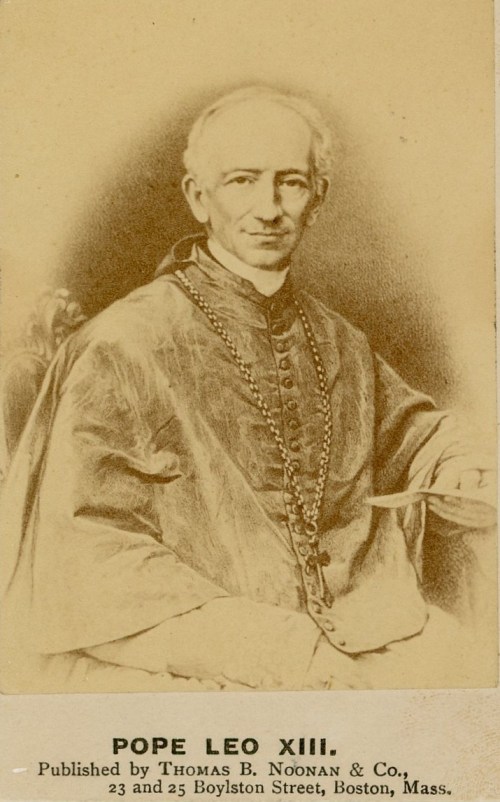
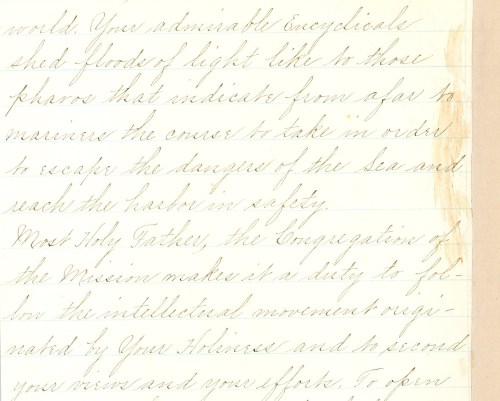
It was easy to see that Leo XIII was her favorite “Saint Pere”. She said he would frequently have ripe fruit gathered from the garden, taste one or two himself and then send them over to Saint Martha’s with the message: “Tell the Sisters the Holy Father has eaten a few”. In 1900, the great year of the Jubilee, he said to the Sisters: “This year because of the thousands of pilgrims, you will be over-burdened with work. Of course, you have obligations of your Vows as usual, but as for rules which prescribe penance and mortification- no, no, not this year, I have written to your Most Honored Father Fiat. You will be working for the Holy Father this year. He needs you to keep your health and strength.” At the end of his Jubilee, His Holiness thanked them for their services. At the close he not only gave “them his blessing, but I quote: “He caressed our cheeks with paternal tenderness,”
Benedict XV came to see the Sisters seven times and was most interested in them and in their work. The present Holy Father [Pope Pius XII] has not visited them, but he grants them many privileges, for they are a part of his household. When we asked this Sister how many canonizations she had seen, she dismissed the matter with a shrug and said: “Oh, so many I could not count them” No man is a hero to his own valet and even canonizations, the crowning pageantry of the Church, can become commonplace.



 docarchivesblog.org