Category Archives: Habit

Creating the Habit Exhibit

For about a month now, the Daughters of Charity Provincial Archives’ exhibit on the history, symbolism, and eventual change of the Daughters habit has been open. We wanted to use this opportunity to discuss some of the background that led us to the finished product of the exhibit.

The origin of the exhibit came, of course, with the planning of the renovation of the Seton Shrine Museum, when the Daughters Archive secured their own exhibit gallery, open to the public alongside the Shrine. As we thought about what would be our first opening to a large crowd, we turned to our own statistics and the number of questions we receive about the Daughters traditional habit. With the number of requests we receive on this subject, we saw an opening to appeal and educate on a popular subject. With the number of habits, rosaries, and chaplets in the artefactual collections, we saw a chance for a very material heavy exhibit.

From here, we saw five key things to focus on: the origins in the times of St. Louise, the habits and chaplets and their symbolism, making a cornette, and the change of the habit.

When it came to creating the mannequins, the showpiece and centerpieces of the exhibit, we did have to acquire a few more mannequins, but also now faced the challenge of how to prepare them for a museum-going audience. Thankfully, we were able to draw upon our colleagues at Heritage Frederick, the Historical Society of Frederick County, to teach us how to dress them properly. Their curator, Amy Hunt, had just finished leading the creation of their “Women’s Work from Farm to Fashion” exhibit, and taught us what she knew about displaying textiles and clothing.

We realized early on that we wanted something of a ‘workshop closet’ feel, both as an aesthetic and as a way to establish some separation between the visitor and the habits – hence the platform and barrier. We realized the chaplets and rosaries could easily be displayed in exhibit cases that we already had, and we already had a pulled cornette on display in our old exhibit space in a perfectly sized case. The cornette-making equipment also provided a nice show piece, and we had already digitized an instructional video of a Daughter explaining how to make a cornette into its iconic shape and image.

We also realized that something in the artifact collections, which we had in abundance but which got very little actual use could give the exhibit a much-needed feeling of fun and spontaneity – the dolls. These not only illustrated the different habits over time, even when we did not have room for more mannequins, but also provided a resonance point for guests and particularly something relatable for children.

With the big showpieces and themes covered, we could then take steps to fill the rest of the space. One staff member realized that artwork depicting the habits could entice visitors. Another realized that guests could have a personal connection with a Daughter if they were allowed to touch and handle her chaplet. All of these things helped create our first exhibit truly open to the public without restriction. We invite you in to explore the truly iconic apparel of the Daughters of Charity!

Getting in the Habit: Iconic Apparel of the Daughters of Charity is open at the Seton Shrine in Emmitsburg, Maryland. Monday through Saturday 10AM-5PM, except Wednesday when it is open until 7:30PM. Private tours can be arranged by contacting archives@doc.org or calling 301-447-6067. The exhibit will be open through the end of 2024.

Leave a comment

Filed under Archives, Exhibits, Habit

Do the Daughters of Charity still wear a habit?

The Provincial Archives receives many questions concerning the Daughters of Charity’s traditional habit. Our new exhibit, “Swan Song”, opening today, will look back at the 1964 change from the 17th century “cornette” habit.

We recently received this question concerning the habit, and thought it would be a good one to address here. The question was:

“if not wearing the habit what else can you wear as daughter of charity?”

The short answer is, the Daughters of Charity DO still wear a habit. Since 1964, when the habit was first changed, it has been modified numerous times, and continues to be modified in order to adapt to the circumstances of the Sisters’ ministry of service to the poor.

One thing about the Sisters’ attire which has not changed is the color scheme, blue and white, which is a symbol of the Community’s devotion to the Virgin Mary. However, today’s attire allows for much more variation than was the case in the years of the cornette habit. This story from the Province of St. Louise’s website, about the Sisters’ recently-completed Provincial Assembly, includes a picture of the Sisters who attended the Assembly. You will see in the picture the many different ways the current habit can be worn.

4 Comments

Filed under Exhibits, Habit

Why Did the Daughters of Charity Change Their Habit?

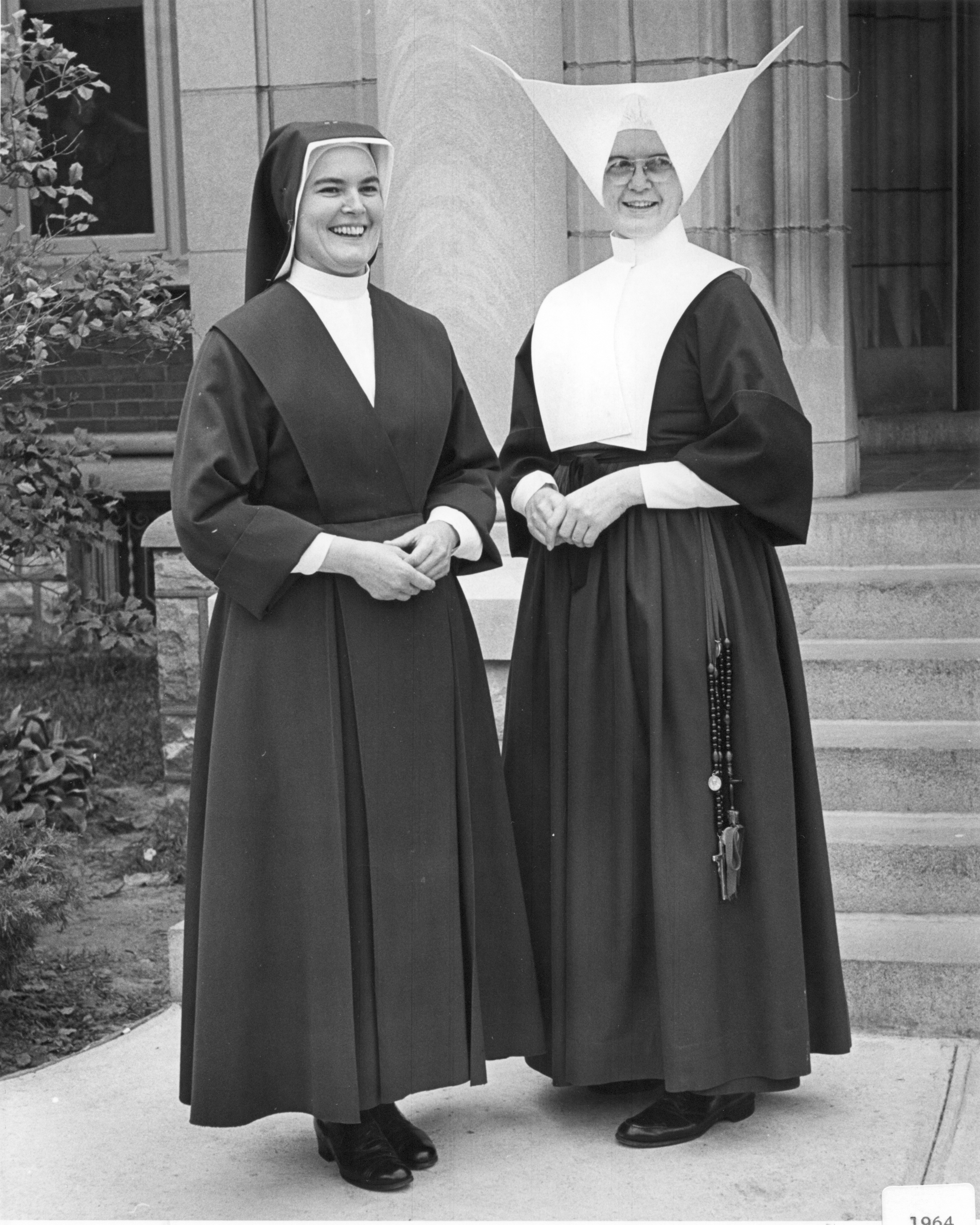
Old and new habits of the Daughters of Charity

Sr. Regina Priller models the 1964 habit; Sr. Mary Rose McPhee models the cornette habit (used with permission of Daughters of Charity Provincial Archives)

Our upcoming exhibit, Swan Song, opening next week, looks back at the change in the Daughters of Charity’s traditional habit, which occurred 50 years ago this September and the experiences of the Sisters who experienced it. As we look back on the change, an important question to ponder is: why? Why did the habit change at all and why did it change at this particular time?

The change of habit was one of many major changes to religious life that happened in response to the Church’s call to change that began with Pope Pius XII and continued through John XXIII and Paul VI and the work of the Second Vatican Council. As Sr. Kieran Kneaves, D.C. has written, “in June 1962 Sr. Suzanne Guillemin was elected our Superioress General and in October, Pope John XXIII opened the Vatican Council. And so, we were called to begin the journey to renewal. And our lives have never been the same.”

Our library collection holds many editions of the documents from the Second Vatican Council. From these we can see the strong focus on re-examination and renewal which characterized the Council’s work. It wasn’t just the habit that changed. A whole way of life changed, as religious communities, both women and men, were directed to take a fresh look at the spirit and charism of their founders, to cast off practices and traditions which had become outmoded, to rewrite constitutions and common rules, and to simplify their attire. At the same time dramatic changes took place in the liturgy and lay people’s participation in it. Decrees on Ecumenism and on the Church’s Missionary Activity drew religious communities into new ministries and gave a new focus on issues of social justice.

In keeping with these directives, the Daughters of Charity’s Constitutions, Common Rules, and Book of Customs were extensively re-written and updated. And it was in the 1960s that Louise de Marillac’s contributions as a co-founder of the Daughters of Charity first received greater attention and recognition.

A few representative quotations from Vatican II documents are below. The documents of Vatican II are available online; print copies are also available for study in the Provincial Archives.

“[The Church] is preparing to welcome the Fathers of the Second Vatican Ecumenical Council … This is a solemn hour for the history of the Church. It involves, therefore, increasing the fervor of its efforts for spiritual renewal, which are always at work, in order to give new impetus to the works and institutions of its millennial life …”
Pope John XXII, Letter to Women Religious
July 2, 1962


The most important work of the General Chapters is the studied accommodation of the rules of their Institute to the changed conditions of the times … Religious Institutes will flourish and prosper so long as the integral spirit of their Founder continues to inspire their rule of life and
apostolic works.”
Pope Paul VI, To All Religious, May 23, 1964


“The religious habit, being a sign of consecration to God, should be simple and modest, poor and at the same time becoming. In addition it should meet the requirements of health and be suited to the circumstances of time and place and to the needs of the ministry. The habit of both men and women Religious which does not conform to these norms is to be changed.”
Pope Paul VI, On the Adaptation and Renewal of the Religious Life (Perfectae Caritatis), October 28, 1965


“You hear rising up, more pressing than ever from their personal distress and collective misery, ‘the cry of the poor’ … It calls for the conversion of hearts, for liberation from all temporal encumbrances. It is a call to love.”
Pope Paul VI, On the Renewal of the Religious Life According to the Teachings of the Second Vatican Council (Evangelica Testificatio), June 29, 1971


“We believe that the day has come when the life of women Religious has to be given greater honor and be made more effective, and that this can be done by perfecting the bonds that unite it to the life of the whole Church … We have given orders that some devout qualified ladies are to attend as auditors several of the solemn ceremonies and several of the General Congregations of the coming third session of the Second Vatican Council; what we have in mind are those Congregations that will discuss matters of particular importance to the lives of women.”
Pope Paul VI, New Horizons for the Women Religious, September 8, 1964

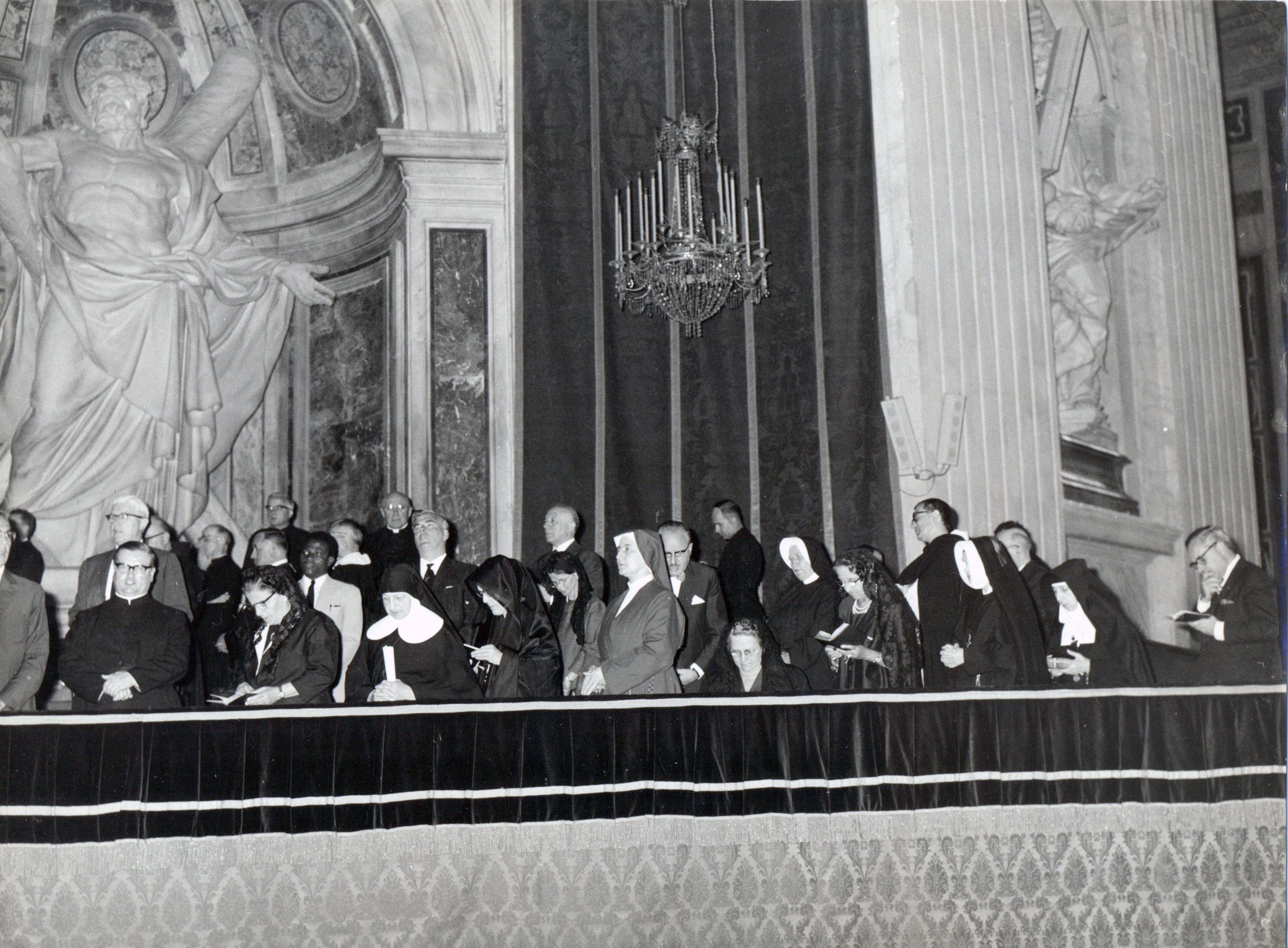
Vatican 2 auditors

Mother Suzanne Guillemin, D.C., then-Superioress General of the Daughters of Charity, was one of the women chosen to be an auditor at Vatican II. Seen here are Mother Guillemin and the other auditors (Photo credit: Fotografia Pontificia Giordani, Rome)

For more information, see Sr. Doris Gottemoeller, RSM “Vatican II: The Call to Religious Change”, an informative post found on the blog of the US Conference of Catholic Bishops.

3 Comments

Filed under Exhibits, Habit, John XXIII, Vatican 2