Category Archives: Elizabeth Ann Seton

The Death of Saint Elizabeth Ann Seton

This day, January 4, 2021, is a special and significant one for the American Daughters of Charity and the global Vincentian family – the 200th anniversary of the day that the American foundress of the community left this world and entered eternity. 

Elizabeth Bayley Seton was first addressed as Mother Seton by Archbishop John Carroll at the St. Mary’s Seminary on Paca Street in Baltimore on March 25, 1809.  Eleven-and-a-half years after she founded the Sisters of Charity of St. Joseph’s, which brought the Rule of St. Vincent to the Western Hemisphere for the first time, and 18 years after the dread tuberculosis took the life of her husband, changing the course of her life forever, Mother Seton succumbed to the disease herself.  She was 46 years old.

The most valuable records of that moment, after midnight on the morning of January 4, come from her Sisters in community; her last living daughter, Catherine; her Sulpician superior, Father John DuBois; and her spiritual director, Father Simon Bruté.  In her bedroom in the Emmitsburg White House, the Sisters of St. Joseph’s gathered for her last moments on this Earth.  The scene, heartbreaking to witness:
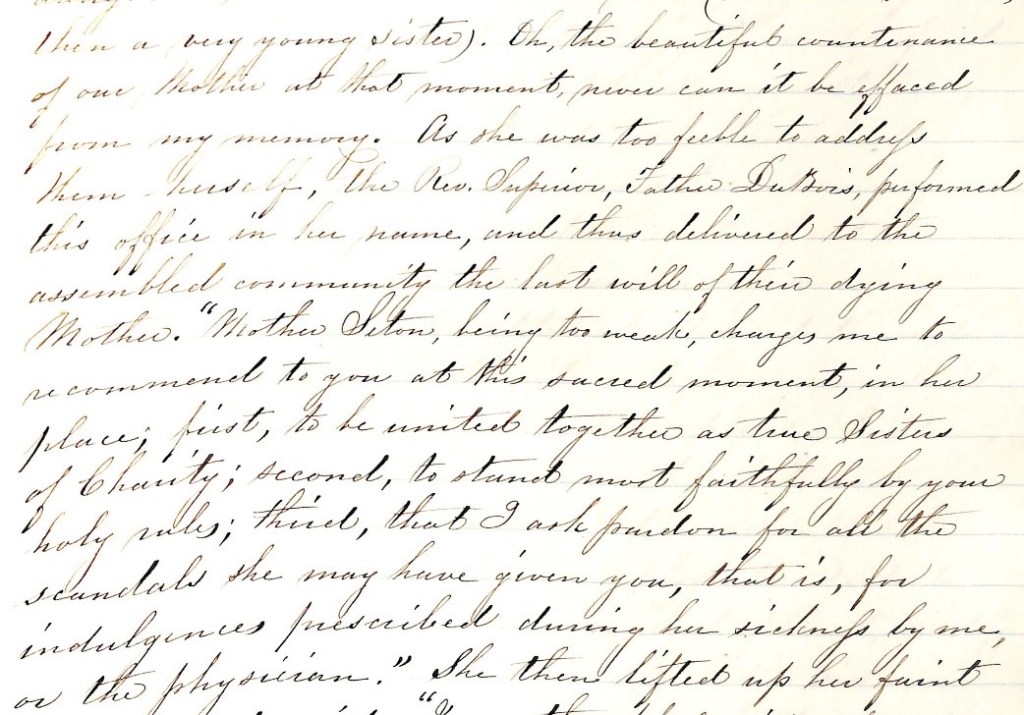
“Oh, the beautiful countenance of our Mother at that moment, never can it be effaced from my memory.  As she was too feeble to address them herself, the Rev. Superior, Father Dubois, performed this office in her name, and thus delivered to the assembled community the last will of their dying Mother.”

Father DuBois went on to address the Sisters:  “Mother Seton, being too weak, charges me to recommend to you at this sacred moment, in her place; first, to be united together as true Sisters of Charity; second, to stand most faithfully by your holy rules; third, that I ask pardon for all the scandals she may have given you, that is, for indulgences prescribed during her sickness by me, or the physician.” (V. 2 Annals, 412)

To all assembled, she gave her last pronouncement as Superioress of the community:

“I am thankful sisters, for your kindness, to be present at this trial.  Be children of the Church; be children of the Church” (V. 2 Annals, 412)

Father DuBois gave her the last rites of the Church.

Her last words were the names of the Holy Family.

Father Bruté created emotive, beautiful, haunting images of those last moments.

Today, five religious communities in North America recognize Mother Seton as their foundress:  The Sisters of Charity of Cincinnati, Sisters of Charity of New York, Sisters of Charity of St. Elizabeth, Sisters of Charity of Halifax, and the Sisters of Charity of Seton Hill.  The American Daughters of Charity have a special devotion to Mother Seton because of the joining of her Sisters of Charity of St. Joseph’s with the French Daughters of Charity in 1850.  She was canonized in 1975.

In this year 2021, expect us to look at many aspects of Mother Seton’s life and legacy.

Saint Elizabeth Ann Seton, pray for us!

Leave a comment

Filed under Elizabeth Ann Seton

Unlocking the archival legalities of donating the Seton key

Image courtesy of Seton Heritage Ministries

Image courtesy of Seton Heritage Ministries

By Dee Gallo, Provincial Archivist

It seems impossible that anyone who followed Pope Francis’ visit to the United States did not hear that one of two gifts President Barack Obama gave to His Holiness was a key to the original door of the Stone House, St. Elizabeth Ann Seton’s first residence here in Emmitsburg, Maryland, on the property on which she founded her religious community, the Sisters of Charity of St. Joseph’s. Dating from 1809, this key appears to be like so many others of its time. Yet its symbolism sets it apart – it literally and figuratively opened the door to let in new students who would experience Catholic education and to send out women religious to care for the poor and voiceless by opening service ministries that continue on into our own century.

Up until recently, the key given to the Pope and a second one like it were under the curative care of Provincial Archives of the Daughters of Charity, just across the lawn from where the Stone House now sits. Some people have wondered how President Obama ever came in possession of the key and whether it was really his to give. Well, this key’s path from its archival home to the United States Department of State is an excellent example of the legalities which all archives and archivists must observe when transferring items from their collections.

About two months ago, my colleague, Rob Judge, Executive Director of The National Shrine of St. Elizabeth Ann Seton, told me he wanted to discuss something “confidential” with me. Now, we collaborate with the Shrine frequently to assist in loaning our artifacts for their exhibits; the “gift key,” in fact, was until recently on exhibit in the Shrine’s museum. However, the committee Rob had convened – and sworn to secrecy – was to face another challenge. He had been contacted by the State Department who wondered whether some artifact representing the life of Mother Seton might be obtained and transformed into a gift from the President to the Pope. The Shrine folks were elated – what a wonderful way to let the world know about Mother Seton and the National Shrine! For my part, I was elated as well – an artifact from our Archives would become a part of national history! But “loose lips would sink Papal gifts”; if any news leaked out, we were out of the running.

And so began weeks of closed-door meetings. I enlisted the help of one of my staff, Bonnie Weatherly, who has been working in the Emmitsburg archives for 35 years and has been assisting the Shrine museum with their displays for almost as long. We went through Archives’ collection of Seton artifacts, making lists of objects that might meet the criteria. Our little committee, however, kept coming back to the key for it had the best “narrative.” As Rob suggested, as a gift, it would be “a fitting tribute for a woman who opened the doors for so many women to serve the poor,” and for Pope Francis, “a man who has been a strong advocate for those who are poor and marginalized.”

Then came the legal transfer of the object from our Archives to the State Department.

Any item in an archives has to be “accessioned” or taken into a collection by making a record of its existence and location. This ensures that the repository has the legal “physical” right to it as property. In order to give the key to the State Department for the President to present it as a gift, however, we had to “deaccession” the key. As Provincial Archivist, I’m just the curator of the collections – the Daughters of Charity, Province of St. Louise, actually own everything in the archives. So the State Department presented us with a Donor Form, which I prepared and sent off for the Provincial Visitatrix, Sr. Louise Gallahue, to sign. In addition to acknowledging donation, the agreement also expressly stipulated that were there some change of plans and the key not be given to Pope Francis, it would be returned to the Archives. Only when that document had been completed and received was the key legally no longer part of our collections. The final step, then, was to change our records to show that one of the two keys labeled as items 1-3-#266 [“keys to the original doors of the Stone House”] was donated to the State Department. This will show to archivists (and researchers) in years to come that the Provincial Archives once possessed TWO keys to the original doors of the Stone House and what the disposition of one of those had been. The second key will go into the Shrine Museum to replace its predecessor.

The overall implications of the gift are more numerous than one can count. St. Elizabeth Ann Seton’s name has been mentioned in the national press and in almost every Mass and religious ceremony at which the Pope presided. The Daughters and Sisters of Charity who follow in her works have been highlighted as continuing her wonderful legacy. And the story of her roles as wife, mother, and widow now give refreshed meaning to Catholic family life. Ah, but to the archivist who was lucky enough to attend that first confidential meeting and to navigate the legal steps of this once-in-a-lifetime property transfer – wow! Just wow!

7 Comments

Filed under Elizabeth Ann Seton, Emmitsburg, Francis, Popes

Preservation Projects: Seton Canonization Banner

Elizabeth Ann Seton canonization banner, now on display in the Seton Shrine Museum (image used with permission of the Provincial Archives)

Elizabeth Ann Seton canonization banner, now on display in the Seton Shrine Museum (image used with permission of the Provincial Archives)

By Denise Gallo, Provincial Archivist

(The American Library Association has designated the week of April 27 as Preservation Week. This week, we will highlight preservation projects undertaken by the Provincial Archives over the last two years.)

Elizabeth Ann Seton will have been canonized for 40 years come September 14, 2015. That’s almost as long as the Daughters of Charity in Emmitsburg have had in their archives one of the most important artifacts of that momentous day in 1975 – the banner that hung from the balcony of the Vatican announcing her elevation to sainthood. This year, that very banner, now a part of the collections of the Provincial Archives, became the focus of a preservation project as large in scope as the banner is in actual size – 148” high and 106” wide.

As plans for the canonization commemoration took shape, Archives offered the banner for an exhibit in the museum of the National Basilica of St. Elizabeth Ann Seton. Since its arrival from Rome, the banner had been stored as it had been shipped — rolled up in plastic. As discussions with Seton Heritage Ministries progressed about the banner’s loan, it was moved into one of Archives’ exhibit halls where it was unrolled and examined by art conservator Nancy Pollak of Art Care Associates, who was engaged to clean the banner and prepare it for display. With her expert advice, the banner was rolled back up within large white sheets around a cardboard tube and moved to her studio for treatment.

The other critical participants in the banner’s preservation were members of the Daughters of Charity Maintenance Staff, led by George Brenton, Director of Campus Facilities. George and his staff transported the banner to Nancy’s studio, returning it just before the Shrine exhibit was to open on April 11, 2015. Phil Plank, one of Maintenance’s carpenters, built a special frame for it, following specific instructions about type of wood, metal clasps for stretching, and braces to hold the banner in place. Nancy worked painstakingly for an entire day stretching the newly-cleaned banner onto the frame. After it was hung on the museum wall, she completed the final phase by “in-painting” any obvious flaws that would show up under the museum’s lights.

Destined for a single day’s use, the banner was created to be viewed from far below by the multitude of pilgrims in Vatican Square, with artist Giuseppe Ciotti using what is known as “snail’s eye” perspective. Looking at the banner from a different angle, Shrine visitors can clearly see that Mother Seton has unusually large hands which she extends in protection over North America, its geographic details also having been exaggerated to clearly depict the Rockies and the Appalachians. In an attempt to diminish that effect, the banner has been hung as high as possible on the museum wall and is best viewed by standing back at a slight distance.

The canonization banner was the Provincial Archives’ most extensive preservation project to date. The overwhelmingly positive reactions from Shrine visitors as they see the same image of Mother Seton that hung in Vatican Square on Sept. 14, 1975, have made it well worth the time and effort.

Leave a comment

Filed under Elizabeth Ann Seton, Exhibits, Preservation, Sisters of Charity of St. Joseph's