Category Archives: Elizabeth Ann Seton

Mother Seton’s Guadalupe Painting

This is the final part of a yearlong series about the early days of the Sisters of Charity of St. Joseph’s commemorating the 200th anniversary of the death of Saint Elizabeth Ann Seton, foundress of the community.  In 1850, the Emmitsburg-based Sisters united with the international community of the French Daughters of Charity.

A treasure of the archives is a piece owned by Mother Seton that can seem out of place for her time period in the Northeast United States – an oil painting of Our Lady of Guadalupe.

Purchased by Matthias O’Conway – father of Sister Cecilia O’Conway, the first sister to join Mother Seton’s community in 1808 – from Emmitsburg native James Hughes, the image hung over the altar in the historic St. Joseph’s House (also called the Emmitsburg White House).  O’Conway had likely become familiar with the image and the devotion it inspired through his travels around the world, including time in Spanish New Orleans and Cuba.  The icon’s cost of $200 in 1811 evidently gave Mother Seton pause in accepting it, writing to Matthias, “I must go back a long way to tell you the mingled feelings of love and sorrow with which I received the dear picture which Mr. Heughs [sic] says he saw you pay down two hundred Dollars for – but it was to our Adored and that is enough for You.”

Saint Elizabeth Ann Seton to Matthias O’Conway, June 5, 1811; Courtesy Philadelphia Archdiocesan Historical Research Center

Indeed, as a Catholic and early supporter of Mother Seton’s community, while this was not the first painting that Matthias donated, he was known to experience money problems when he was not working as a translator and publisher.  However, the place of prominence that this painting received, which “[made] our humble chapel look really like a chapel,” points to the place that this work held in the hearts of the Sisters of Charity of St. Joseph’s.

The Feast Day of Our Lady of Guadalupe is December 12.

Leave a comment

Filed under Blessed Mother, Elizabeth Ann Seton

The Canonization Scrapbooks

This is part of a yearlong series about the early days of the Sisters of Charity of St. Joseph’s commemorating the 200th anniversary of the death of Saint Elizabeth Ann Seton, foundress of the community.  In 1850, the Emmitsburg-based Sisters united with the international community of the French Daughters of Charity.

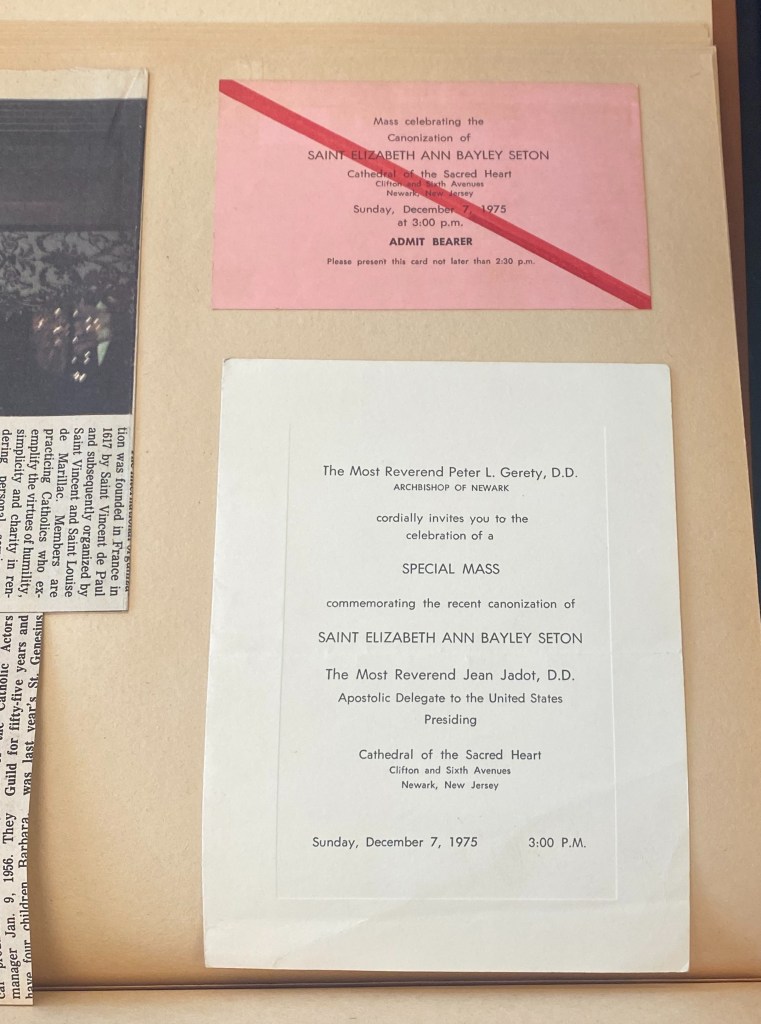
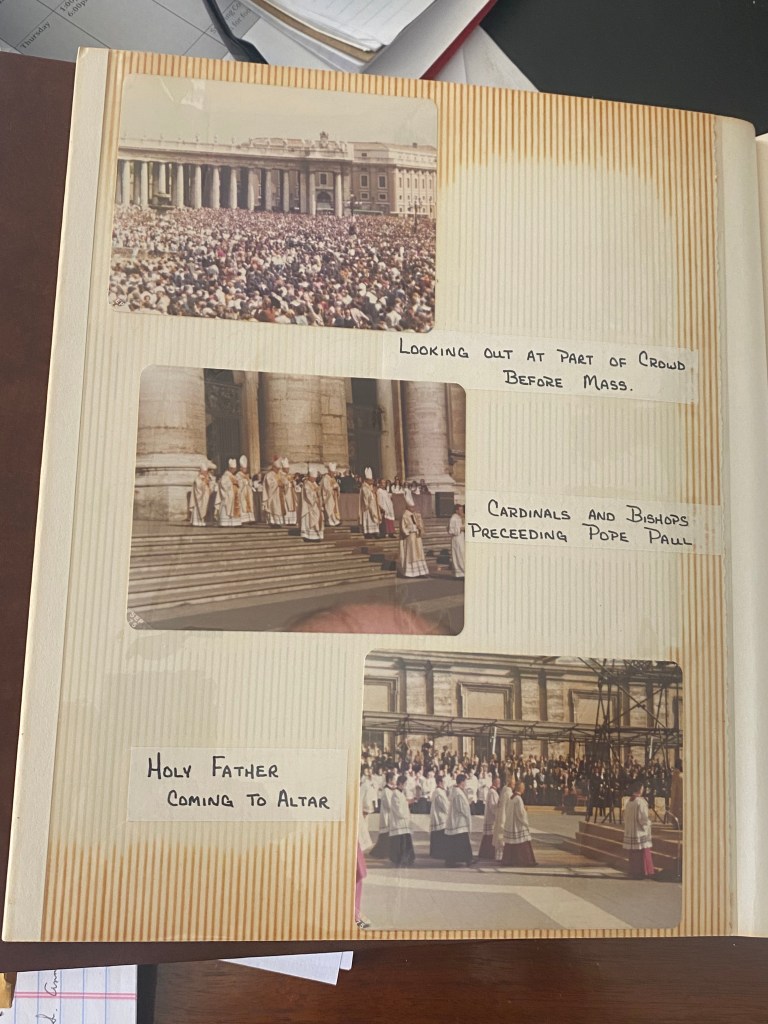
On September 14, 1975, Mother Seton was recognized by the global church for what many of her devotees already saw her as – the first American-born saint of the Roman Catholic Church!

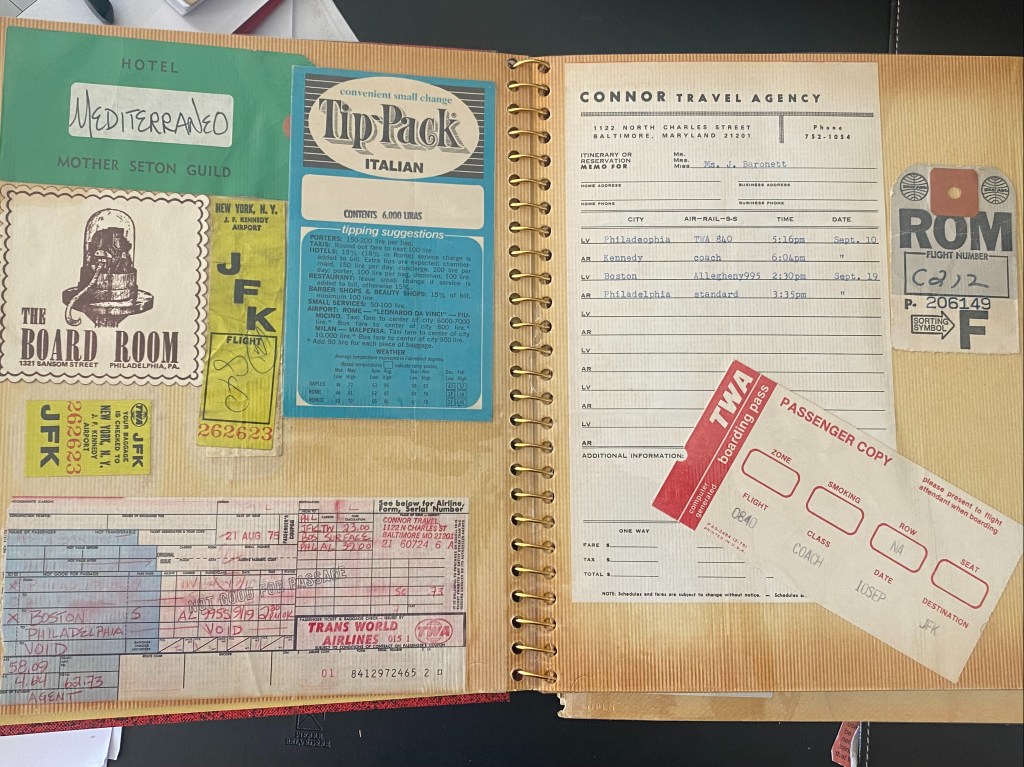
The Daughters of Charity Provincial Archive contains significant information about the process of Mother Seton’s canonization, including the introduction and advocacy of the cause, correspondence, and investigation into her virtues and miracles.  However, the 23 canonization scrapbooks in the archive reflect what individual people experienced while the event was taking place, both in Rome and in the United States.

Some scrapbooks do not have a name attached to them, but contain many newspaper clippings from around the country about the event, along with American and Vatican memorabilia. 

Other scrapbooks reflect group pilgrimages, such as that of the Emmitsburg Community Chorus, donated to the archives in 2000.

Still more gather photos of that magnificent day in the Eternal City. 

Donors include sisters, priests, supporters of the cause, and members of the Mother Seton Guild, one of the leading groups advocating for the cause.

Taken collectively, these scrapbooks show the effect that Mother Seton’s canonization had on the community and Catholics around the world at a very specific moment in 1975.

Travel information and ticket stubs from Ms. J. Baronett of the Mother Seton Guild

Leave a comment

Filed under Canonization, Elizabeth Ann Seton

The Hamilton Letter

This is part of a yearlong series about the early days of the Sisters of Charity of St. Joseph’s commemorating the 200th anniversary of the death of Saint Elizabeth Ann Seton, foundress of the community.  In 1850, the Emmitsburg-based Sisters united with the international community of the French Daughters of Charity.

Lin-Manuel Miranda did not include Mother Seton in his smash Broadway hit Hamilton, but be assured that the two of them ran in the same New York society in the early days of the American experiment at the southern tip of Manhattan.

Many of Mother Seton’s surviving letters from this period of her life discuss the social scene, business partners, her friends, and friends and business partners of her husband, William Magee Seton.  Among these is a draft of a letter to John Wilkes, a friend and cousin-through-marriage to her husband.  Although it is undated, its subject matter reveals that it was written a short time after July 14, the day of Alexander Hamilton’s funeral.

In the heyday of William’s business, the family had lived at 27 Wall Street, a block away from Hamilton’s home and across the street from the office of The Manhattan Company, the predecessor to JPMorgan Chase Bank founded by Hamilton’s dueling partner, Aaron Burr.

At the time of Hamilton’s death, however, John and Charles Wilkes, alongside another related family, were helping Elizabeth (now a widow) and her children through a New York situation that seems highly modern – paying too high a rent on a too-small apartment.  Located on N. Moore Street, today in Tribeca, Elizabeth for the first time had to rely on her relatives’ assistance to make it by, and even pushed back on the suggestion to begin taking in boarders.

Hamilton’s funeral was at Trinity Church, at the end of the Seton’s former neighborhood on Wall Street.  Fresh from the funeral, Charles stopped by Elizabeth’s Moore Street House:

“He was quite pleased with my little House and my darlings whom he found eating their bread and milk with a very good appetite but I observed that he was really so affected at the tolling of the Bells for the death of poor Hamilton that he could scarcely command himself…how much you will be distressed at this melancholy event – the circumstances of which are really too bad to think of”

Although their paths divided significantly, Hamilton going into government and meeting an untimely demise; Burr to a treason trial, a westward land scheme, and undignified obscurity; and Seton to Catholicism and a small town in Maryland, what we refer to as the “Hamilton letter” helps show how closely Mother Seton’s world was intertwined with the world of the early U.S. government and high society.

4 Comments

Filed under Alexander Hamilton, Elizabeth Ann Seton