Tag Archives: scrapbooks

The Common Autograph Poems of St. Joseph’s Academy Students

This is a guest post by Addison Pickett, our intern for the summer and a member of the Mount St. Mary’s University Class of 2028!

Keeping autograph books was a common practice for students in the 19th century to remember their classmates and friends from their school years. Autograph books were eventually replaced by the autograph pages in yearbooks and are now a relic of their time.

While the go-to for 21st century students are writing things like ‘HAGS,’ ‘Stay Cool!,’ or their phone numbers, students of the 19th century often recited small poems with themes of friendship and remembrance alongside their signatures. The autograph books of Emma Moore and Mame from St. Joseph’s Academy in Emmitsburg, Maryland are no exception. These autograph books date from 1885 and 1886, respectively, and hold signatures from as late as 1892. These books shed light on the thoughts and feelings of high school girls in the 1880s.

Portion of Emma Moore's scrapbook, page 25
From Emma Moore Scrapbook, page 25: “When rocks and hills divide us, / And you no more I see, / Remember it was Tiphine, / Who wrote these lines to thee. Yours Sincerely, Tiphine Burnbach”
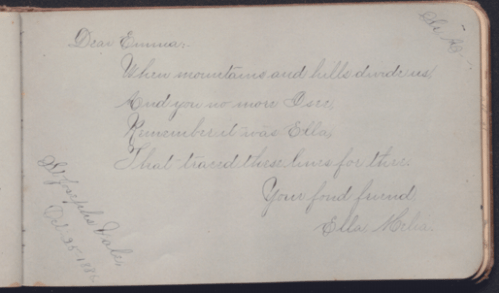
Portion of Emma Moore's Scrapbook, page 55
From Emma Moore Scrapbook, page 55: “When mountains and hills divide us, / And you no more I see, / Remember it was Ella, / That traced these lines for thee. Your fond friend, Ellen [Ella] Melia”

This poem was a very common recitation in autograph books of the 19th century, and even provides a space to write one’s name within the poem. There are many different variations of the poem, and these two entries showcase that. While Tiphine writes “rocks and hills,” Ella writes “mountains and hills,” perhaps feeling it was more apt for their home on St. Joseph’s Vale. At the end of the poem, as well, Tiphine writes “who wrote these lines to thee,” whereas Ella says “who traced these lines for thee.”

From the Autograph Book of Mame, page 15: “Drop one pearl in memory’s casket for your loving friend M. A. May”

From the Emma Moore Scrapbook, page 42: “In memory’s casket drop one pearl for your schoolmate and friend Annie Farrell”

Another common “Forget-Me-Not” poem from the 19th century, this poem uses the imagery of dropping pearls into a casket as symbolism for remembering old friends. A variation of these lines are even featured in the 1881 book “New Choice Selections for Autograph Books: Comprising Original and Selected Friendly, Affectionate, Humorous and Dedicatory Verses, Suitable for inscription in Autograph Albums, on all occasions.”

From the Autograph Book of Mame, page 51: “Memory consecrates these lines, / Friendship holds them dear, / May they often call to mind / The friend that placed them here. Sincerely your friend Louisa McSherry”

Portion of Emma Moore's scrapbook, page 61
From the Emma Moore Scrapbook, page 61: “Memory consecrates these lines, / Friendship holds them dear, / May they often call to mind / The friend that placed them here. Marie Duperier”

While this poem holds no variation between Louisa and Marie’s entries, there is no record of the verse online. Perhaps lack of variation and availability online shows that this was a more unique or contained “Forget-Me-Not” poem. It is a simple poem that simply calls for remembrance of friendship.

From the Autograph Book of Mame, page 17: “Gather ye rosebuds while ye may, / Old time is still a-flying, / And that same flower that blooms today, / Tomorrow may be dying.”

From the Emma Moore Scrapbook, page 6: “Gather your rosebuds while you may, / Old time is still a-flying, / And the same flower that smiles today, / Tomorrow may be dying.”

This poem is titled ‘To The Virgins, Make Much of Time,’ and was written by Robert Herrick in 1648. Departing from themes of remembrance and friendship, Herrick’s poem is often described as a “Carpe Diem” poem about making the most of your life. Besides “Forget-Me-Not” poems, themes of living well were also very common in these two autograph books. Interestingly, Julia O’Keefe errs from the original poem when she writes “that same flower that blooms,” instead of “that same flower that smiles.” Julia likely misremembered the line or learned the poem from someone who misremembered.

These poems display the traditions and culture of 19th century schoolgirls, revealing their interests and desires as well as love for their friends. The 19th century can seem so foreign to the modern age, but small traditions like these autograph books show that humans are always united by their love and care for one another.

References:

https://queensu.scholaris.ca/server/api/core/bitstreams/c710c6f7-b9d6-4d6d-9fd2-751b5f8a645a/content

https://ameshistory.org/content/autograph-book-verses

Leave a comment

Filed under Archives, St. Joseph's Academy

The Canonization Scrapbooks

This is part of a yearlong series about the early days of the Sisters of Charity of St. Joseph’s commemorating the 200th anniversary of the death of Saint Elizabeth Ann Seton, foundress of the community.  In 1850, the Emmitsburg-based Sisters united with the international community of the French Daughters of Charity.

On September 14, 1975, Mother Seton was recognized by the global church for what many of her devotees already saw her as – the first American-born saint of the Roman Catholic Church!

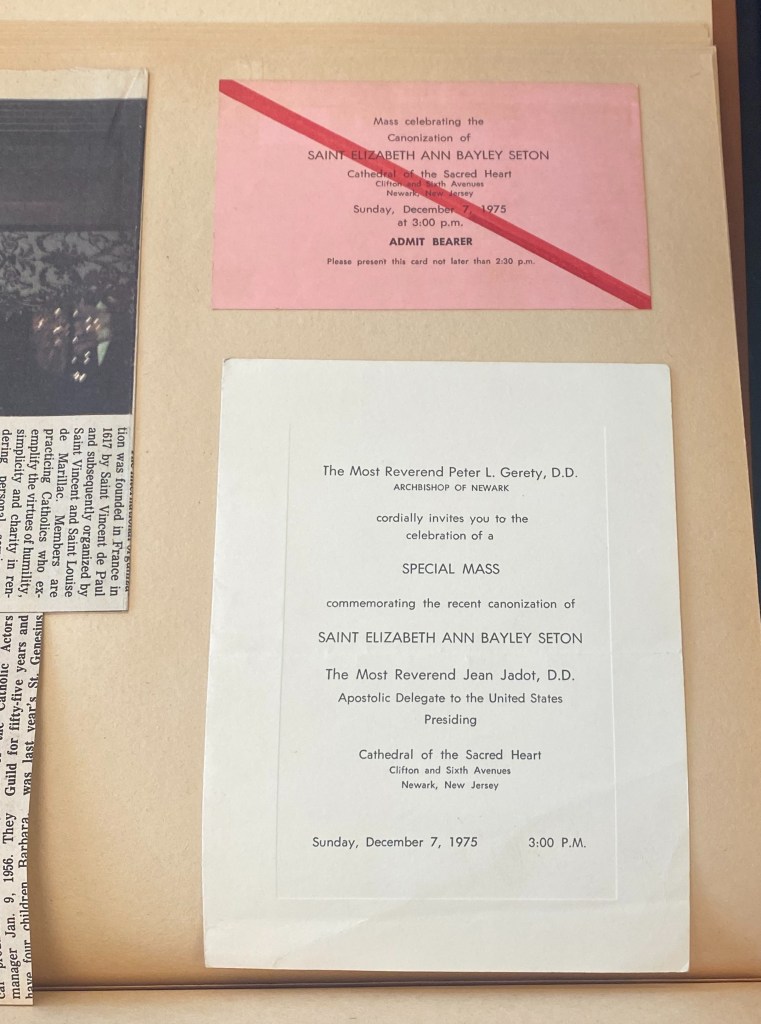
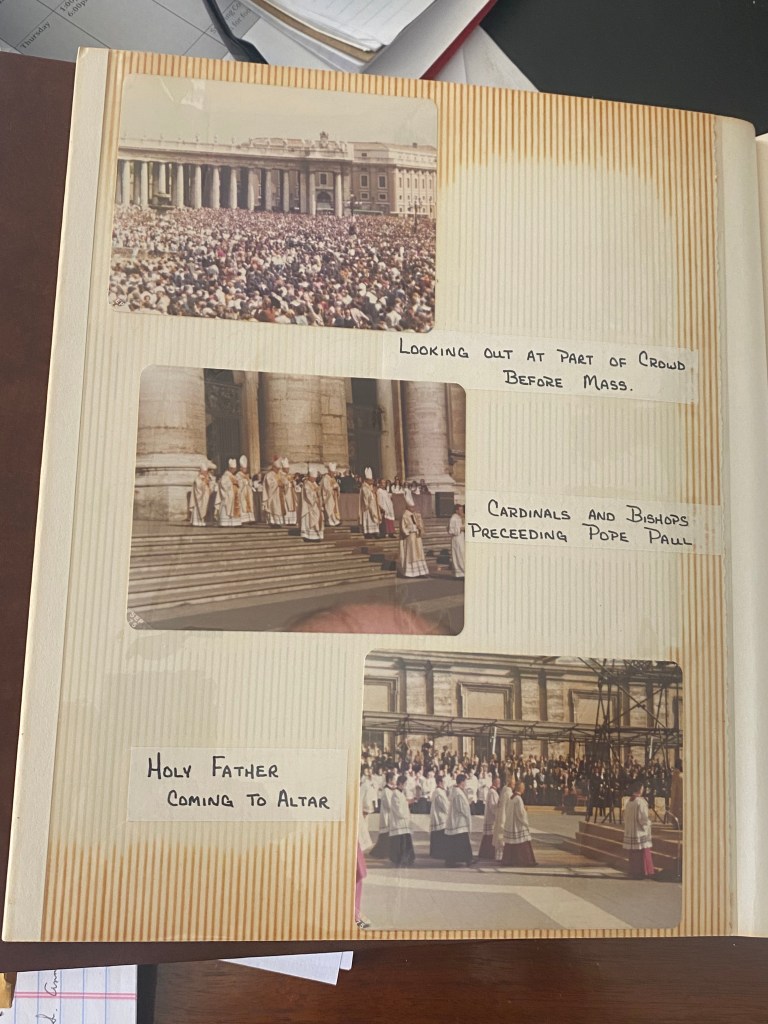
The Daughters of Charity Provincial Archive contains significant information about the process of Mother Seton’s canonization, including the introduction and advocacy of the cause, correspondence, and investigation into her virtues and miracles.  However, the 23 canonization scrapbooks in the archive reflect what individual people experienced while the event was taking place, both in Rome and in the United States.

Some scrapbooks do not have a name attached to them, but contain many newspaper clippings from around the country about the event, along with American and Vatican memorabilia. 

Other scrapbooks reflect group pilgrimages, such as that of the Emmitsburg Community Chorus, donated to the archives in 2000.

Still more gather photos of that magnificent day in the Eternal City. 

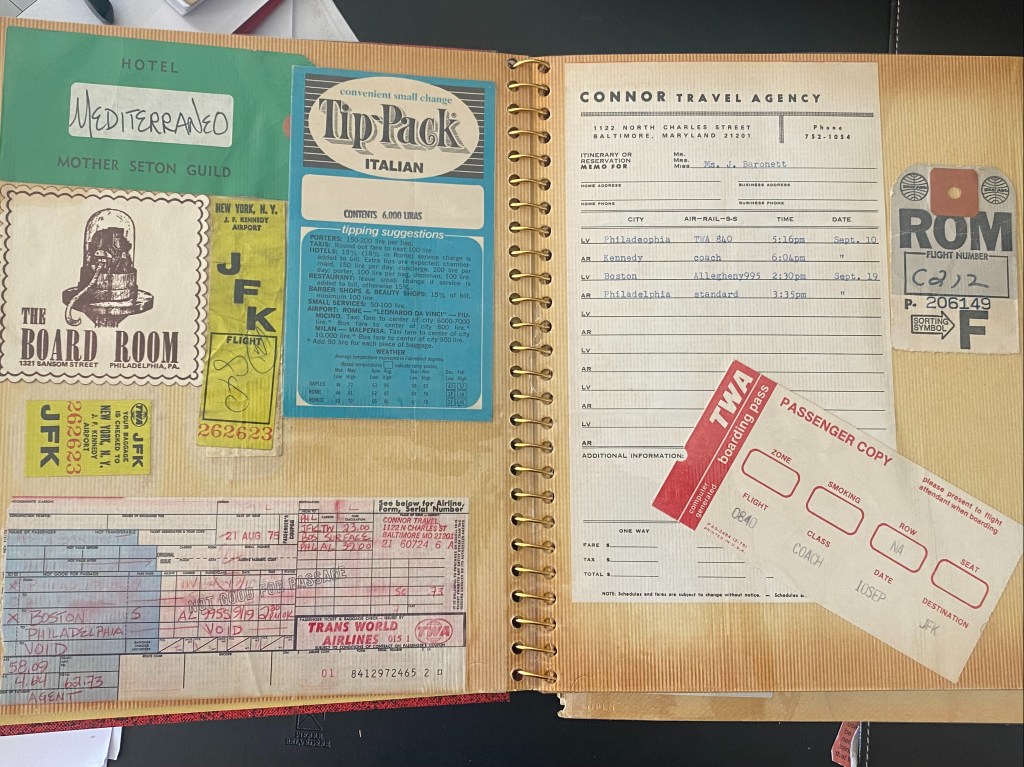
Donors include sisters, priests, supporters of the cause, and members of the Mother Seton Guild, one of the leading groups advocating for the cause.

Taken collectively, these scrapbooks show the effect that Mother Seton’s canonization had on the community and Catholics around the world at a very specific moment in 1975.

Travel information and ticket stubs from Ms. J. Baronett of the Mother Seton Guild

Leave a comment

Filed under Canonization, Elizabeth Ann Seton