Category Archives: Elizabeth Ann Seton

Mother Seton and the Augustinians

One of the communities of priests that influenced the development of the Catholic Church in the colonial United States was the Order of St. Augustine, or Augustinians.  Working and living in the same time period and parts of the country as Mother Seton, it was natural that their paths should cross.  Although the Daughters archive does not explicitly talk about Augustinian business, figures and events from their early history in the United States are peppered throughout the records within the collection.

The Augustinians were founded in the 1200s in Italy with a charism based upon the rule of St. Augustine of Hippo.  The order arrived in the United States in 1796 with the Irish Fathers John Carr and Matthew Rosseter.  Matthew Hurley, also an Irishman by birth, was the first to join the American community, and after the deaths of Rosseter and Carr in 1812 and 1820, he was the only Augustinian in the country.

Father Matthew Hurley, O.S.A., as painted by Thomas Sully in 1813

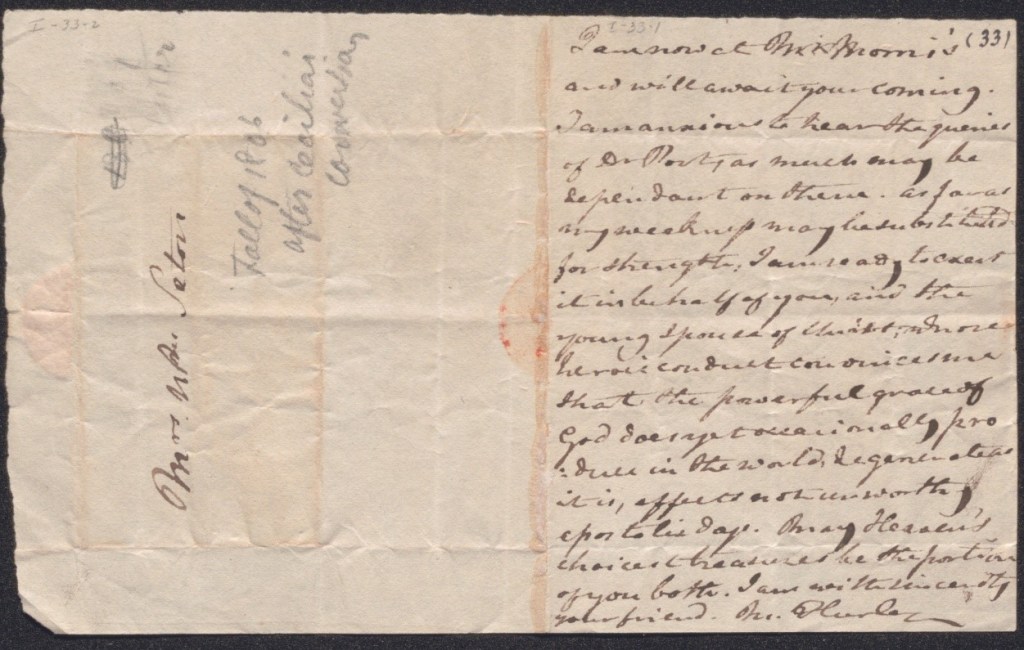
Elizabeth met Father Hurley in 1805 during her years in New York City, after she had converted to Catholicism but before she founded her community, when Hurley was at St. Peter’s Church.  Although there are only three surviving drafts of letters from Mother Seton to Hurley and two from Hurley to Mother Seton, mentions of him in her correspondence are numerous, as Hurley very much fulfilled the role of spiritual advisor early in her time as a Catholic.  It was Hurley who gave Elizabeth the confirmation name Mary and performed the honor of receiving her sister-in-law Cecilia and daughter Anna Maria into the Church.

Seton to Hurley, draft, n.d.
Hurley to Mother Seton, 1806, after the conversion of Cecilia Seton

In 1807, Father Hurley was recalled in ill health to Philadelphia by Father Carr, where he went on to become pastor at St. Augustine Church. There, he formed part of a Catholic circle that remained in contact with Mother Seton, including Mathew Carey, who published the first American English-language Catholic Bible; Matthias O’Conway, a translator and early donor to the community; his daughter Cecilia, who was the first to join Mother Seton’s community; and Rachel Montgomery.  Montgomery formed the lay board of St. Joseph’s orphan asylum, who, along with Hurley, urged Mother Seton to send Sisters for the first time out from their spiritual home in Emmitsburg, Maryland.  Sister Rose White led the band of Sisters to St. Joseph’s in 1814 and would later become Mother Seton’s successor as leader of the community. 

Despite his influence, no letters received by Hurley from Mother Seton survive.  Indirectly, the community records provide the reason for this in the accounts of Sister Mary Gonzaga Grace and the Philadelphia Know-Nothing riots of 1844.  Here, anti-Catholic and anti-immigrant mobs sacked churches, burning most of the Augustinian library, including Mother Seton’s letters.

Among the other Augustinian effects on Mother Seton and the community include some of the Augustinian spiritual tradition.  Likely at the recommendation of Father Hurley, the Archives is still in possession of Elizabeth’s copy of The Sufferings of Our Lord Jesus Christ, a spiritual work of Father Thomas of Jesus, member of the Order of the Hermits of St. Augustine.

Even with the loss of Mother Seton’s letters to the early Augustinians, tragic as it may be, the materials in the collection document the spiritual growth and development of Mother Seton.  Even if she ultimately based her community on the tradition of Saints Vincent de Paul and Louise de Marillac, she built upon the traditions that surrounded her and the inherited tradition of (at that time) 1,800 years of spiritual growth and development.  The Augustinians today operate three provinces in the United States, as well as one university, Villanova, in Philadelphia.

1 Comment

Filed under Elizabeth Ann Seton

The Opportunity for a Richer Understanding of Canonization

This is a guest post by our archival intern for the semester, Jenna Brady, Mount St. Mary’s University class of 2023.

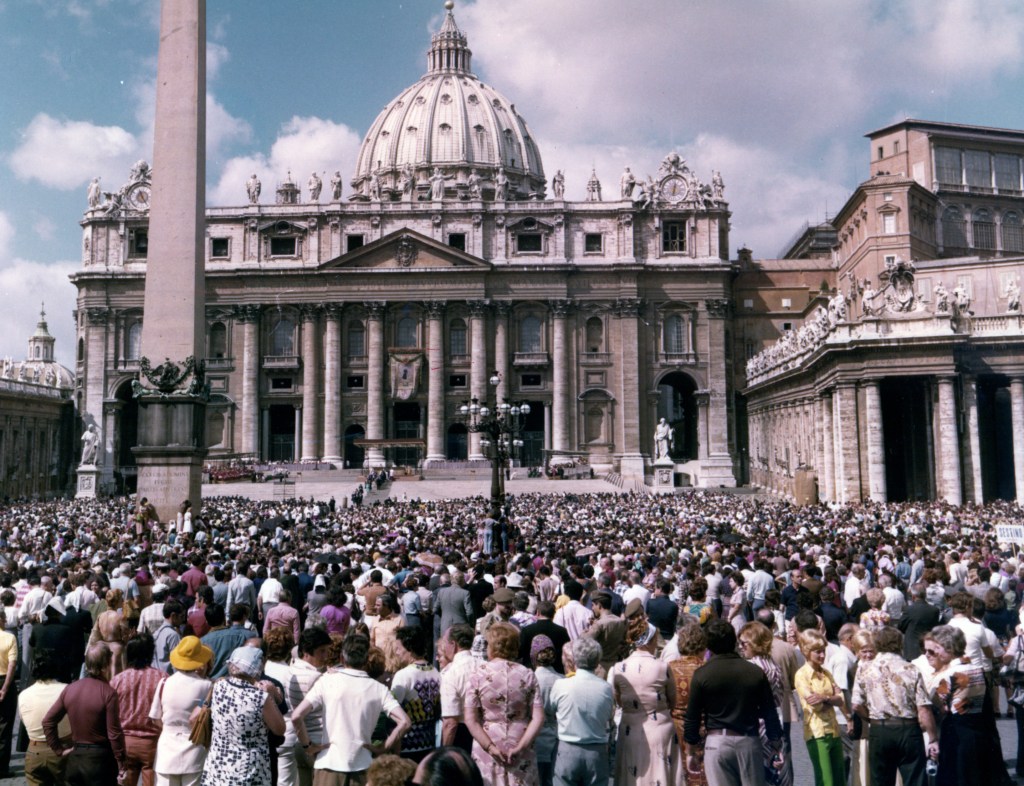
Throughout my internship with the Daughters of Charity Archives, I have had the unique opportunity to go through the past newsletters of sisters from the West Central Province in the 1970s. The West Central Province was established in 1969 by the Daughters of Charity in St. Louis as one of five provinces located in the US. While there are several interesting topics and vast stores of history that I have read and learned about, one of the most exciting events was the Canonization of St. Elizabeth Ann Seton. This momentous event took place on September 14, 1975 and was an event that many Daughters of Charity petitioned and prayed hard to achieve.

Elizabeth Ann Seton

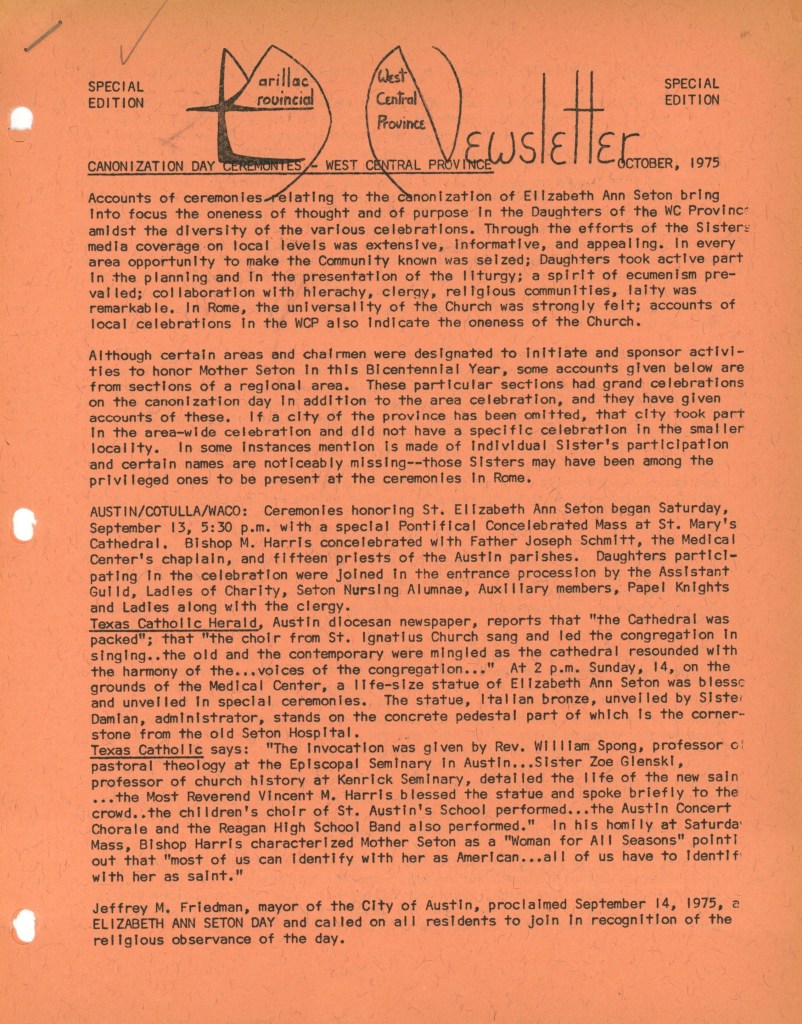
The newsletters that I have had the opportunity to read and index recount the journey toward canonization and the great anticipation throughout the early ‘70s. The letters make constant reference to the different preparations that were being made by the provinces in anticipation of the canonization of their namesake. The newsletter from October 1975 is completely devoted to the events throughout the province; such as different Masses and talks that were held during the months preceding the canonization.  This description not only shows how important and monumental the canonization was to all involved but as the newsletter states, “brings into focus the oneness of thought and of purpose in the Daughters of WC Province…” (West Central Province Newsletter, October, 1975, 1).  It then goes on to include an excerpt from a sister in each province discussing the steps that were taken in their own province to prepare and celebrate. Many of these sisters are those who had been featured throughout the course of the newsletters regarding different matters of the province.

View of the crowd at the canonization in Vatican City

While the details of St. Elizabeth Ann Seton’s canonization are easily accessible today, being able to read firsthand accounts of the celebrations and the profound impact this had on her order gives a deeper meaning to the event. Through reading these newsletters, I have been given the opportunity to come to view the canonization not just as a celebration of a new Saint but rather as the canonization of the woman many sisters considered their mentor in faith and mother in life.

Special Edition of the Marillac Provincial Newsletter, October 1975

Leave a comment

Filed under Elizabeth Ann Seton

St. Joseph’s School before St. Joseph’s Academy

The commitment to education of the American Daughters of Charity and Sisters of Charity dates to Saint Elizabeth Ann Seton’s initiative for female education, begun in Baltimore in July 1808.  It took two years, however, for female education to become a primary mission of the Sisters of Charity in the form of St. Joseph’s School in Emmitsburg, MD.   

Invited by Rev. Louis William DuBourg, P.S.S., President of St. Mary’s College, the Widow Seton began a small boarding school for Catholic girls on Paca Street with the support of the Sulpician priests at St. Mary’s Seminary.  There she met Samuel Sutherland Cooper, a seminarian who was divesting himself of accumulated wealth in order to pursue his vocation to the priesthood.  He encouraged the widow to agree to direct an educational program on a property that he would purchase.

Pace Street House, Baltimore, c. 1890s

Located beyond the town limits of Emmitsburg, Cooper and the Sulpicians believed the setting to be ideal for an institution to educate girls, with nearby Mount St. Mary’s College providing education for boys. 

On June 22, 1809, Mother Seton arrived at Mount St. Mary’s in Emmitsburg with one of her daughters and a few of her companions; the rest of her children, early community members, and two pupils arrived a little more than a month later when the Stone House was ready for occupancy.  On July 31, 1809, the Sisters of Charity of St. Joseph’s officially began, and St. Joseph’s School became one of the first free Catholic schools for girls staffed by sisters in the United States.

As it became increasingly clear that funding was required, the school began admitting boarding students who paid tuition in May 1810.  These students came from the surrounding Frederick County and became the first boarding students. 

The school curriculum included grammar, spelling, reading, writing, geography, parsing, arithmetic, French, music, and fine sewing, etc.   All pupils received religious education and faith formation, according to their grade level.  Mother Seton wrote to her friend, Julia Scott, how her daughter Annina “studies French, Spanish and Italian with [the day students] under a mistress who is sweetness and modesty itself”

After St. Joseph’s School became St. Joseph’s Academy in 1828, the school continued to teach “day scholars” from the surrounding area for free up until 1870.  When operating costs began to hinder this practice, the Sisters still offered discounts and worked to find ways for students to afford tuition when they needed it. 

St. Joseph’s School and, later, St. Joseph’s Academy, were not parochial schools but Catholic schools sponsored and funded by the Sisters of Charity.  Saint John Neumann, CSsR, 4th bishop of Philadelphia, initiated Catholic parochial education when he established the first diocesan parochial school system in the United States in 1852.

3 Comments

Filed under Baltimore, Elizabeth Ann Seton, Emmitsburg, Paca Street, St. Joseph's Academy