Category Archives: Elizabeth Ann Seton

The Daughters of Charity Cornette – Part 4

(Images used with permission of the Daughters of Charity Provincial Archives)

St. Elizabeth Ann Seton
St. Elizabeth Ann Seton

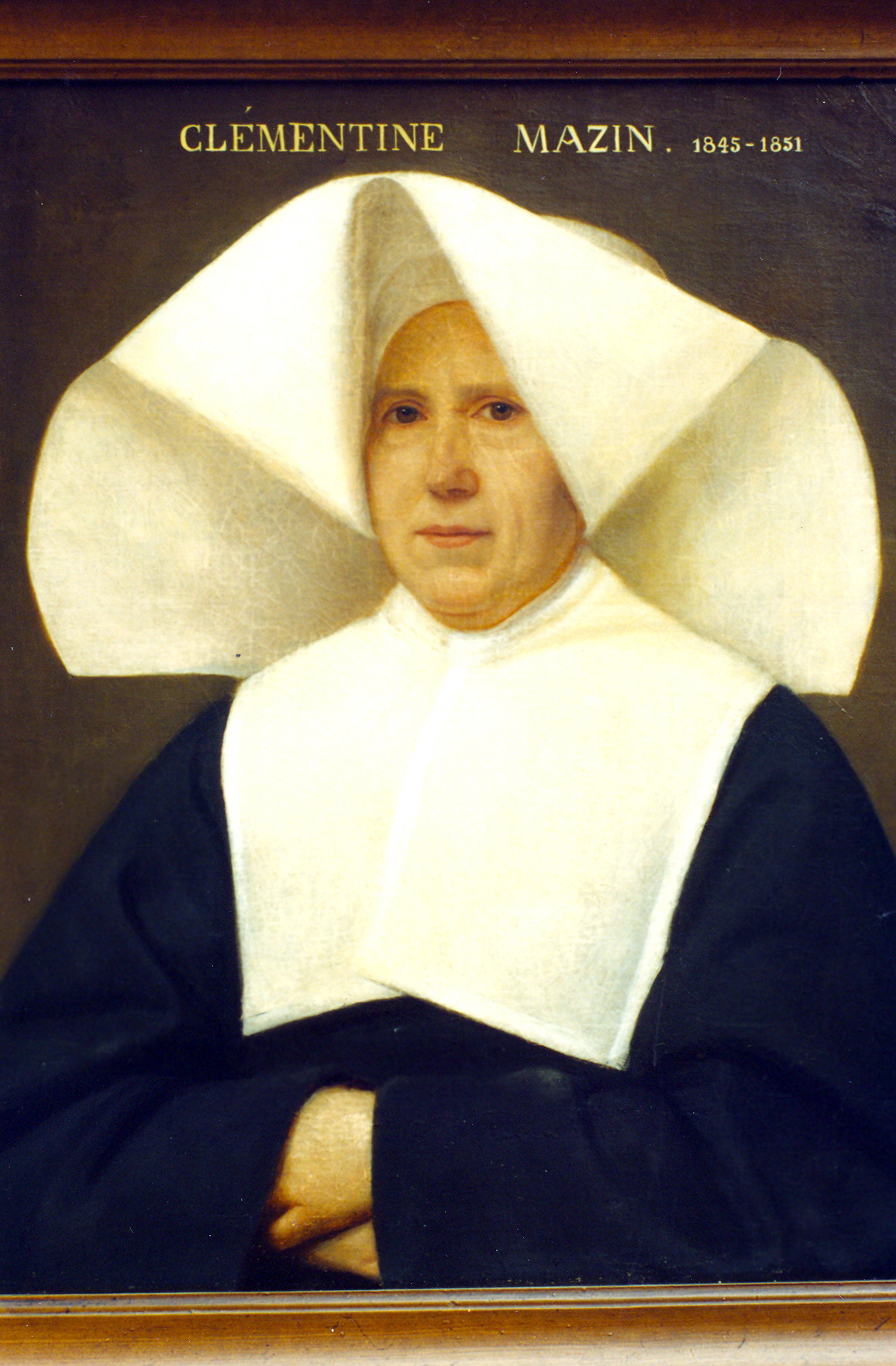
Mother Clementine Mazin

Mother Clementine Mazin, Superioress of the Daughters of Charity at the time of the American union with France.

The top photo shows St. Elizabeth Ann Seton, wearing the attire of the community she founded, the Sisters of Charity of St. Joseph’s. Mother Seton’s attire is commonly known as the “black cap”. Mother Seton died in 1821; the community in Emmitsburg joined with the French Daughters of Charity in 1850. The bottom photo shows Mother Clementine Mazin, the Superioress General of the Daughters of Charity at the time of the American union with France.

On March 25, 1850, Sisters in Emmitsburg renewed their vows according to the vow formula of the Daughters of Charity for the first time. The formal union came in November of 1850. During the year 1850 four sisters were sent from Emmitsburg to France to become imbued with the spirit and practices of the Daughters of Charity: Sisters Vincentia Repplier, Valentine Latouraudais, Ann de Sales Farren, and Marie Louise CaulfIeld. Sister Marie Louise spoke French fluently and was chosen to be trained as the fIrst secretary of the American province, an office she held for almost half a century. In 1851 Sisters Etienne Hall and Ann Simeon Norris traveled to France. Both Sisters later served as Visitatrix of the American Province. [note 1]

During a retreat for sister servants held at Emmitsburg in October 1850, Sister Vincentia and her three companions, recently returned from France, modeled for all the blue habit and white cornette. On December 7, 1851, all the Sisters in Emmmitsburg wore the cornette for the first time. [note 2]

It took until September of 1855 for the entire American province to change from the black cap to the cornette. There were several reasons for this. One was the geographic reach of the province. By 1850 the American province had spread far beyond Emmitsburg, with Sisters as far north as upstate New York, as far south as New Orleans and Mobile, and as far west as St. Louis and Detroit. Another was the difficulty of obtaining the needed material. Since the time of Vincent and Louise it had been the custom of the Daughters of Charity for all Sisters to have their attire provided by the Mother House in Paris. In 1850, the Mother House did not make each Sister’s habit, but the material, a heavy, navy-blue wool, was imported from France. Difficulties in acquiring material, along with the time required to make habits for all the American Sisters, meant that the change from the black cap to the cornette was a gradual one. The issue of importing material from France came up again during the Civil War; this incident will be the subject of Part 5.

Notes:
note 1. Sr. Daniel Hannefin, Daughters of the Church: A Popular History of the
Daughters of Charity in the United States, 1809-1987 (New City Press, 1989), p.92.

note 2. Provincial Annals, RG 7-8-3, 1851; Ellin Kelly, Numerous Choirs, p.186.

10 Comments

Filed under Elizabeth Ann Seton, Habit

Exhibit ‘Our Town’ opens today; beginnings of DC presence in Emmitsburg

Today is opening day for our new exhibit, ‘Our Town’: A Pictorial History of Emmitsburg and the Daughters of Charity Through the Years. The exhibit will run until June 12 in Exhibit Gallery 2 of the Provincial Archives. Public hours for the exhibit are Wednesdays, 1:00 PM to 4:30 PM.

The Daughters of Charity owe their presence in Emmitsburg to Rev.Samuel Sutherland Cooper (1769-1843), a wealthy sea captain from Philadelphia who converted to Catholicism in 1807. Cooper studied at St. Mary’s Seminary at Baltimore under the Sulpicians and was ordained a priest in Maryland in 1818. As a seminarian he became a significant benefactor of Elizabeth Seton and the Sisters of Charity through his donation of money to purchase property in Emmitsburg. The Sisters of Charity of St. Joseph’s, followed by the Daughters of Charity, have occupied the ground Cooper donated continuously since 1809. Today, a memorial to Cooper can be seen on the Emmitsburg Campus.

Below is the text of a letter from Elizabeth Seton to Julia Scott, March 2, 1809, in which Mother Seton talks about Cooper’s impending purchase of land and her thoughts about moving to Emmitsburg. The text is from: Elizabeth Bayley Seton: Collected Writings, ed. Regina Behtle, S.C. and Judith Metz, S.C. Volume 2, pp. 58-59.

“… As you have so long shared all my pains my dearest how much pleasure it will give you to know that providence has disposed for me a plan after my own heart-a Benevolent gentleman of this place [Samuel Cooper] has formed a scheme of establishing a manufactory for the use of the poor, and includes in his intention the Education of children rich and poor. he is about purchasing a place at Emmetsburg’ some distance from Baltimore, not very considerable, and has offered me the department of taking care of the children who may be presented or rather of being the Mother of the family. this pleases me for many reasons – in the first place I shall live in the mountains, in the next I shall see no more of the WorId than if I was out of it and have every object centered in my own family both of provision employment etc …

I am quite at my ease on the subject caring very little how I am disposed of the remainder of my life if only I may persevere in acting the Mothers part with fidelity. the care of teaching will be off my hands tho ‘ not the superintendence and I do not hesitate to embrace the offer of going to the country as no doubt it will be a means of prolonging my days for my dear ones … ”

Leave a comment

Filed under Elizabeth Ann Seton, Emmitsburg, Exhibits

Exhibits: St. Louise and Her Legacy

Louise de Marillac exhibit

Louise de Marillac exhibit

If you are in the Emmitsburg area you are invited to the Provincial Archives to view our inaugural exibit: St. Louise de Marillac: Her Legacy in the Daughters of Charity History, on display now through April 19. The exhibit is free and open to the public on Wednesdays from 1:00 to 4:30 PM. Among the items on display is Elizabeth Ann Seton’s handwitten translation of the life of Louise de Marillac, seen here in the center of the front row.

Leave a comment

Filed under Elizabeth Ann Seton, Exhibits, Louise de Marillac