Category Archives: Elizabeth Ann Seton

Feast of St. Joseph, 1885 fire in Emmitsburg

(Excerpt from Provincial Annals of March 20, 1885 used with permission of the Daughters of Charity Provincal Archives)

Today is the feast of St. Joseph, to whom St. Elizabeth Ann Seton had a great devotion. On her arrival in Emmitsburg in 1810 Mother Seton named the area St. Joseph’s Valley, and it is known by that name to this day. On the feast of St. Joseph in 1885 a fire broke out on the Sisters’ grounds which destroyed one building and damaged several others. Below is an excerpt from a first-hand account of the fire, found in the Provincial Annals of March 20, 1885.

Provincial Annals (20 March 1885)
The Fire at St. Joseph’s

The morning of Friday, March twentieth broke. A sharp north west wind had been blowing through the night, and from moment to moment it grew colder and colder. The fires were well kept up, for it seemed that the deepest cold of winter was again upon us. Through the morning Sr. Mariana [Flynn] had been haunted by the fear of fire, always so vigilant and preventing on this point, this morning she felt the necessity of being doubly so. Her thoughts flew, however, in other directions, not to the kitchen.

It is hard to tell when or how the fire originated. The whole interior space between the ceiling and roof was probably one volume of seething flame before and human eye marked its presence. John Classen, one of the men, was coming home across the fields from town when he saw the flames or smoke and hastened to give the alarm. At the same instant came a message by telephone from town: “Did we know the house was on fire?” This met Sr. Mariana as she came heading the ranks from Da Pacem. By the time she reached the kitchen, the men, our men, were already there with the hose. It was at dinner time and the whole force of men were at hand.

The fire company of Emmitsburg was quickly on the spot and at work. When it was sought to attach the hose to the Mountain Water plug, it was found frozen up. Hot water had to be procured to thaw it out. This caused some delay. All Emmitsburg, all the neighborhood, all the priests and students of Mt. St. Mary’s came running to our assistance. Still the bells of St. Joseph’s clamored for help. The wind blew fiercly from the N.W., perhaps it was our salvation. It was bitter cold; everywhere the water fell, save in the living flames it was at once converted into ice. The men who fought the flames were literally incased in ice. Still the fire advanced. The refectory caught. The Gothic building was the next, upon it rested all hopes for St. Joseph’s. That attained every building must go. Recognizing this the firemen turned the stream of water steadily on the point of connection. The old dry shingled roof, shingled twenty years ago, seemed to invite the flames. The projecting, dormant window on the N. East corner seemed to kiss the burning building. As Sr. Mariana saw the two first buildings abandoned, she was almost in despair. “I beg you try to save them.” No, Sister, they must go; we must try to save the Gothic building.” Later she recognized the necessity and wisdom of the act …

Mother telegraphed to Baltimore and to Frederick for assistance. Baltimore was too far, but Frederick responded … Between three & four the Frederick Fire Companies, and engine arrived. Every train had been side tracked that the special one might speed on its errand of mercy … At midnight the danger was over, and the Frederick Company withdrew from the grounds, and returned to Frederick on a special train …

During the night telegrams were coming and going, there was no end. Parents inquiring for their children. Benefactors, friends, Sisters sending messages of sympathy and condolence. As soon as the report wildly exaggerated spread in Balt. of Saint Joseph’s burning down, several of the parents hastened to catch the four o’clock train and came up not knowing in what condition their poor children would be found, even bringing clothes for them. As St. Joseph’s came in sight with its appearance of calm, untroubled, quiet for all the fire was in the rear, no one could imagine, they said, the feeling of serenity and peace which descended on the hearts.

Leave a comment

Filed under Elizabeth Ann Seton, Feast Days, Provincial Annals, St. Joseph's Academy

FAQ: Sisters of Charity and Daughters of Charity

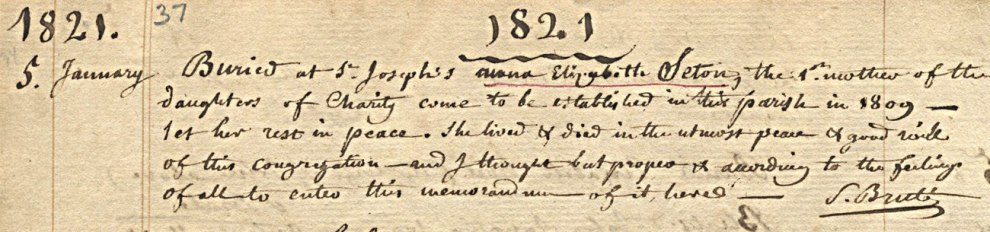
Our January 4, 2013 posting of Fr. Simon Bruté’s record of Elizabeth Ann Seton’s death prompted a question we often receive concerning the distinction between Sisters of Charity and Daughters of Charity.

In short, Mother Seton’s community was called the SISTERS of Charity of St. Joseph. Their spirit and charism was based on the charism of serving the poor established by Vincent de Paul and Louise de Marillac, who founded the DAUGHTERS of Charity in France in 1633.

Spiritually, the Sisters of Charity of St. Joseph’s were in the tradition of the Daughters of Charity. Canonically, they were not. The actual union between Mother Seton’s community in Emmitsburg and the French Daughters of Charity didn’t happen until 1850. While the community in Emmitsburg did unite with the French Daughters, other Sisters of Charity communties did not. “Sisters of Charity” and “Daughters of Charity” are often used interchangeably but they are in fact different communities.

The model community on which John Carroll and the French Sulpicians had in mind for Mother Seton’s community was the Daughters of Charity. The common rules brought to America from France in 1810 refers to that group as the “Filles de la Charité” – Daughters of Charity.  In 1812 the rules of the Daughters of Charity were translated by Bishop Flaget – this translation is known as the American Rule. In the American Rule the name was changed to the “Society of Sisters of Charity.” St. Vincent de Paul and St. Louise de Marillac intentionally tried to disguise their group as the French government wanted women religious to stay in a cloister; so they did NOT call them Sisters. John Carroll and the Sulpicians, on the other hand, wished to identify this new group as women religious so they felt free to use that term. How did Mother Seton’s group refer to themselves, though? In “Numerous Choirs,” Ellin Kelly’s two-volume history of the Charities, Appendix A of Volume I has a transcription of the American Rule of 1812. Chapter II demonstrates how flexible the nomenclature was. Mother Seton’s group was called the Sisters of Charity of St. Joseph but on p. 244, we see that they are referred to “Sisters of St. Joseph” as well as “Sisters of Charity.” Those names are used interchangeably throughout. And while it would seem that the real distinction was made after some of the sisters merged with France in 1850, it’s interesting to note that up until the creation of today’s Province of St. Louise in 2011, official documents of the Emmitsburg Province still referred the these Daughters as the “Sisters of Charity of St. Joseph” — SCSJ.

 Vincent and Louise’s desire to have the Daughters of Charity serving in the community rather than remaining in the cloister shows up in many ways. The Daughters of Charity, then and now, do not make lifetime vows. They make annual vows. The Daughters of Charity have a seminary, other communities have a novitiate. Women who enter the seminary are considered full members of the Company of the Daughters of Charity – there are no “temporary” and  “final” professions in the Daughters of Charity. The date that a Daughter of Charity enters the seminary is called her vocation date. Roughly five years after her vocation date she pronounces vows for the first time and renews those vows every year after that. Daughters of Charity all over the world renew their vows every year on or about March 25. The desire to not be cloistered also influenced the design of the Daughters of Charity habit. In Vincent and Louise’s time the habit was a French peasant dress with a very simple sunbonnet – the habit didn’t take on the look we associate with the Daughters of Charity (including the “winged” cornette worn until 1964) until the 19th century. Vincent and Louise wanted the first Daughters to blend in with the people they were serving, and so they dressed like them.  The charism of serving the poor started by Vincent and Louise, along with many aspects of the DC community rules, were the basis for Mother Seton’s community. The DC habit was not, because Mother Seton’s community was not united with France during her lifetime. So Mother Seton’s community wore the “black cap” habit, not the cornette.

14 Comments

Filed under Elizabeth Ann Seton, FAQs, Habit, Sisters of Charity Federation, Sisters of Charity of St. Joseph's, Sulpicians

January 4: Feast of Elizabeth Ann Seton

January 4: Feast of Elizabeth Ann Seton

Photograph of Simon Bruté’s entry by Sr. Betty Ann McNeil, used with permission of Daughters of Charity Provincial Archives)

Fr. Simon Bruté, spiritual director of St. Elizabeth Ann Seton, wrote this entry in an early Sacramental Register at St. Joseph House, Emmitsburg, marking her death on January 4, 1821. The text reads:
“1821
5 January
Buried at St. Joseph’s Anna Elizabeth Seton, the first mother of the daughters of Charity come to be established in this parish in 1809 — let her rest in peace. She lived & died in the utmost peace & good will of this congregation, and I thought but proper
and according to the feelings of all to enter this
memorandum of it here.
S. Bruté”
This register, is now housed in the Archdiocesan Archives in Baltimore.

Leave a comment

Filed under Elizabeth Ann Seton, Feast Days, Simon Brute