(Images used with permission of the Daughters of Charity Provincial Archives)

St. Elizabeth Ann Seton
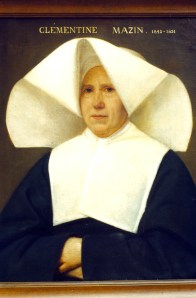
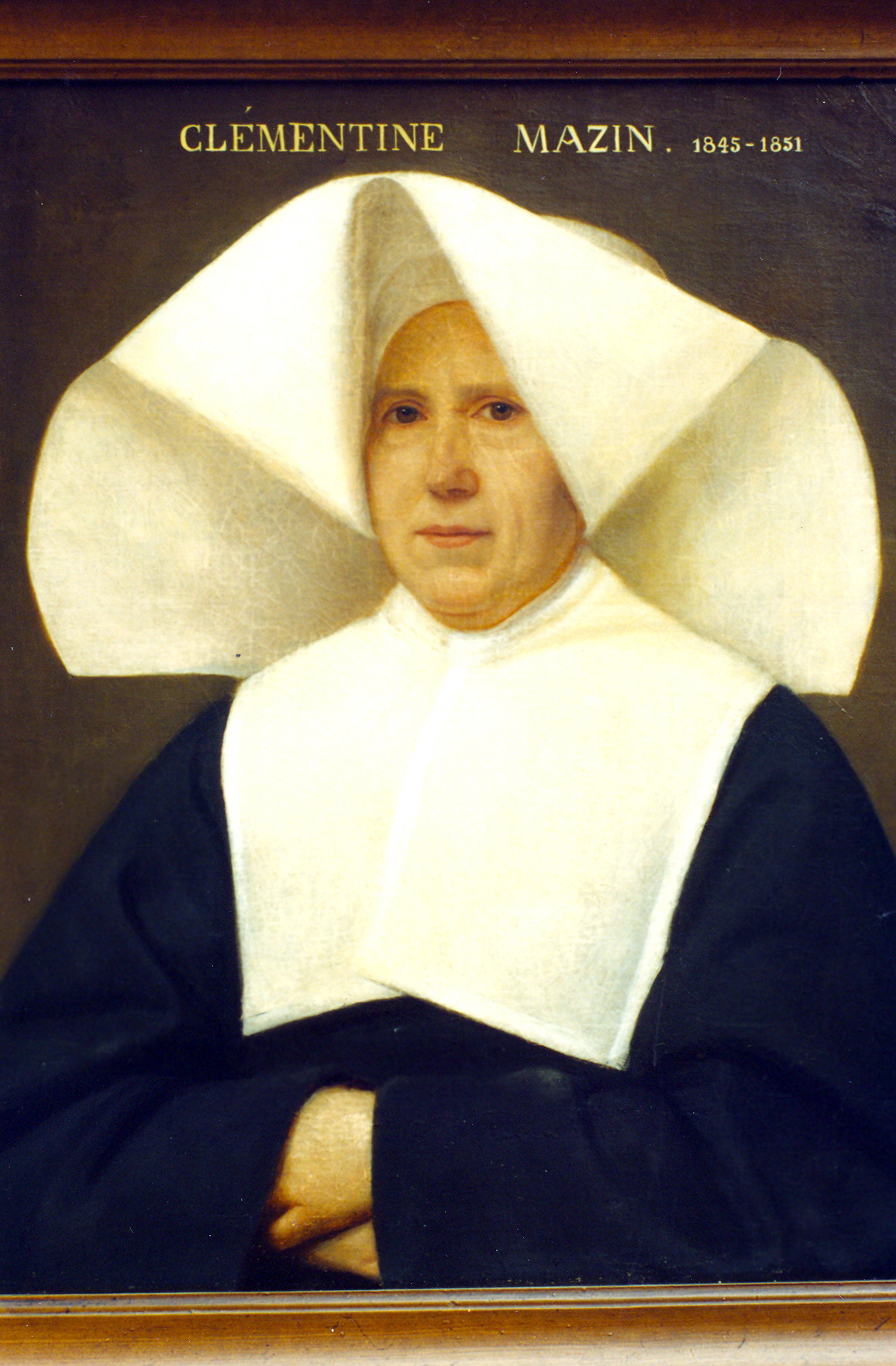
Mother Clementine Mazin, Superioress of the Daughters of Charity at the time of the American union with France.
The top photo shows St. Elizabeth Ann Seton, wearing the attire of the community she founded, the Sisters of Charity of St. Joseph’s. Mother Seton’s attire is commonly known as the “black cap”. Mother Seton died in 1821; the community in Emmitsburg joined with the French Daughters of Charity in 1850. The bottom photo shows Mother Clementine Mazin, the Superioress General of the Daughters of Charity at the time of the American union with France.
On March 25, 1850, Sisters in Emmitsburg renewed their vows according to the vow formula of the Daughters of Charity for the first time. The formal union came in November of 1850. During the year 1850 four sisters were sent from Emmitsburg to France to become imbued with the spirit and practices of the Daughters of Charity: Sisters Vincentia Repplier, Valentine Latouraudais, Ann de Sales Farren, and Marie Louise CaulfIeld. Sister Marie Louise spoke French fluently and was chosen to be trained as the fIrst secretary of the American province, an office she held for almost half a century. In 1851 Sisters Etienne Hall and Ann Simeon Norris traveled to France. Both Sisters later served as Visitatrix of the American Province. [note 1]
During a retreat for sister servants held at Emmitsburg in October 1850, Sister Vincentia and her three companions, recently returned from France, modeled for all the blue habit and white cornette. On December 7, 1851, all the Sisters in Emmmitsburg wore the cornette for the first time. [note 2]
It took until September of 1855 for the entire American province to change from the black cap to the cornette. There were several reasons for this. One was the geographic reach of the province. By 1850 the American province had spread far beyond Emmitsburg, with Sisters as far north as upstate New York, as far south as New Orleans and Mobile, and as far west as St. Louis and Detroit. Another was the difficulty of obtaining the needed material. Since the time of Vincent and Louise it had been the custom of the Daughters of Charity for all Sisters to have their attire provided by the Mother House in Paris. In 1850, the Mother House did not make each Sister’s habit, but the material, a heavy, navy-blue wool, was imported from France. Difficulties in acquiring material, along with the time required to make habits for all the American Sisters, meant that the change from the black cap to the cornette was a gradual one. The issue of importing material from France came up again during the Civil War; this incident will be the subject of Part 5.
Notes:
note 1. Sr. Daniel Hannefin, Daughters of the Church: A Popular History of the
Daughters of Charity in the United States, 1809-1987 (New City Press, 1989), p.92.
note 2. Provincial Annals, RG 7-8-3, 1851; Ellin Kelly, Numerous Choirs, p.186.






 docarchivesblog.org