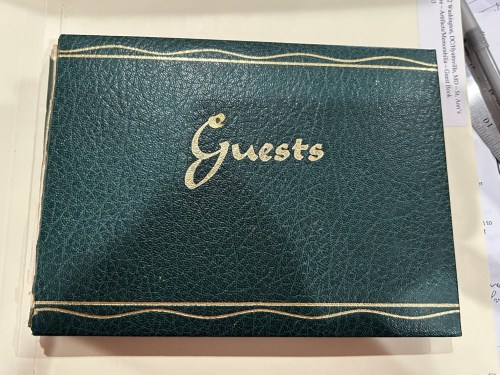
Guestbooks for major life events are keepsakes of the most important events. A day to day guestbook might not quite have the same value, but over time it can reveal some important things.
St. Ann’s Infant Home, founded in Washington, D.C. in 1860 and which later moved out to Hyattsville, Maryland in 1962 was one of the most prominent institutions of the Daughters of Charity in the capital area. It’s role of caring for orphaned children evolved into a modern day care and family service center (now fittingly called St. Ann’s Center for Children, Youth and Families).
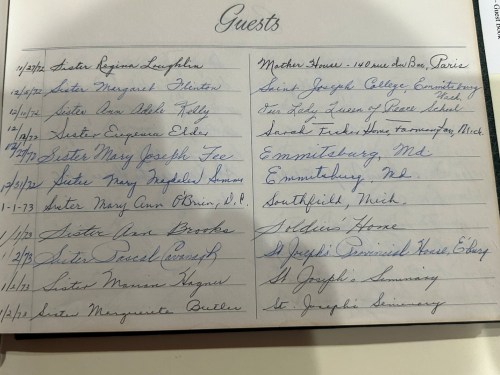
And its guestbook shows just how prominent of an institution it was.
Many of the names are Daughters of Charity from around the U.S., illuminating the full range of ministries that they were engaged from the earliest date in the book, 1972, to its latest, 1983.
Amongst those visitors, though, are also Sisters from around the world, reflecting the global missionary spirit of the Daughters of Charity. There are a number of Daughters from Bolivia, Ecuador, Venezuela, Japan, the Philippines, Vietnam, Madagascar, the U.K., and France.
Several members of the local media appear, including journalists from local station WJLA, led by the trailblazer and future Emmy-winning journalist Renee Poussaint.
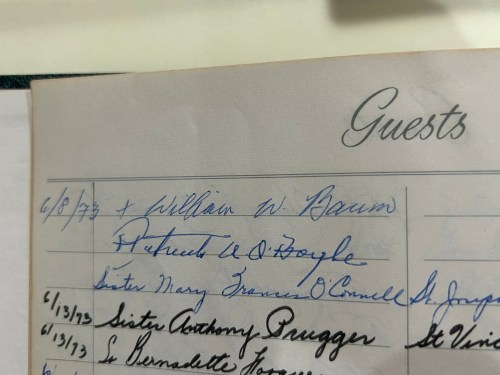
A delegation of the Bishop and Archbishops of Washington visited on June 8, 1973, consisting of Archbishop William Baum and former Archbishop Patrick Cardinal O’Boyle.
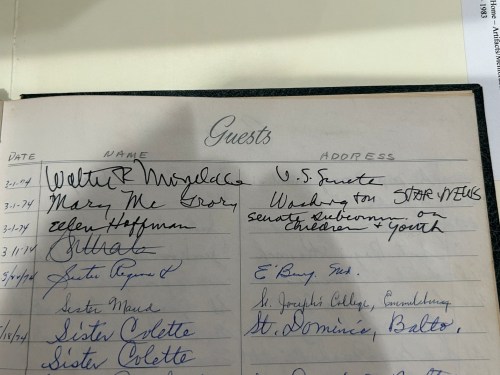
Most eye catching however, are the names of national level politicians. Just glancing through the entries we see Representative George Miller of California, Senator Pat Leahy of Vermont, and future Vice President Walter Mondale, who arrived with a cadre of reporters.
Mary 18, 1981 saw perhaps the Center’s most frequent high-profile visitor, First Lady Nancy Reagan, barely six weeks into her new role. The St. Ann’s collection highlights many high profiles visits, and this First Lady has the most folders amongst any Washington political figures.
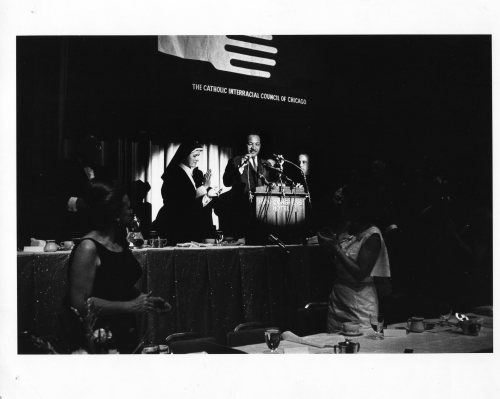
Five years ago, the Daughters of Charity Archives began to thoroughly investigate the relationship between the Sisters and the Black community. There were known stories certainly, such as Sister Mary William Sullivan and Martin Luther King for example, or the long relationship between the Sisters and the Briscoe family in Emmitsburg.
Sister Mary William Sullivan with Dr. Martin Luther King, Jr., 1964
The collections also contained materials that showed a relationship between the Daughters of Charity and the institution of slavery prior to the Civil War, such as the Mary Dorsey document, which created a bond of an enslaved woman in exchange for tuition in 1856, or the Community’s acceptance of sixteen enslaved persons to work at Charity Hospital in New Orleans.
Over the last five years, we have tried to systematically examine the collections to document the relationship of the Daughters to slavery and the relationship with the Black community – the good and the bad.
We have tackled and examined the types of records that most easily come to mind for us and that can be moved through with relative ease – tangible items like diaries, Council records, and first-hand accounts from ministries below the Mason-Dixon line. We are facing one of our last biggest hurdles in the process, which is the systematic examination of the financial ledgers. This process is made more difficult by the relative lack of attention paid to these ledgers until now with regards to any topic. Many of the books had been simply labelled “Financial,” but we had not really learned how to use them.
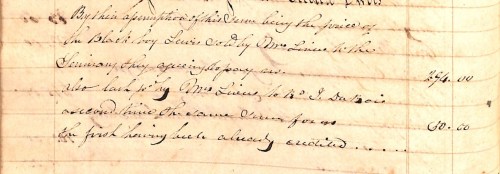
The process is also made difficult in communication. The early Community, founded by Mother Seton, was the Sisters of Charity of St. Joseph’s. In 1850, they merged with the French Community to become Daughters of Charity. This is a distinction in the nitty-gritty terminology of the Catholic Church, but which requires explanation to all but the most-versed in the history of the Sisters. Through these processes, we have discovered significant and valuable information, some heartening and some disheartening. Working with our colleagues at Mount St. Mary’s University Archive, we received access to some of their early records, which verified an agreement to accept labor from an enslaved man named Lewis of the Livers family.
From Ledger 57: “By their assumption of this sum being the price of the Black boy Lewis sold by Mr. Livers to the Seminary they agreeing to pay us 296.00”
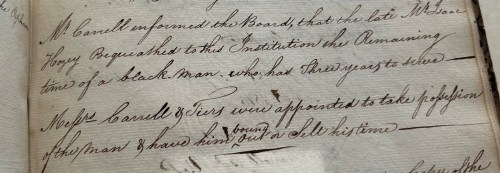
We discovered the acceptance and sale of an indentured servant in Philadelphia St. Joseph’s Home, the first ministry of the Daughters in the United States outside of Maryland, although the Sisters themselves did not have input on this decision.
From Board of Director Minutes, February 13, 1815: “Mr. Carrell informed the Board, that the late Mr. Isaac Hozey bequeathed to the Institution the Remaining time of a black man, who has three years to serve.”
We discovered that the Sisters did have input on some decisions of the enslaved at Charity Hospital in New Orleans, that the enslaved were tasked with removal of bodies during the epidemics of the late 1830s, and that all were sold and replaced with hired white labor. Working with a researcher in Louisiana, fluent in French, we discovered the names of each and every person through the surviving sacramental records.
We discovered that the Sisters made a political statement in the opposite direction in 1830, when the Council decided “to help Simon in getting his wife free by some arrangement with her owner, & Simon.” We are still searching for some further clue or mention of Simon or his wife.
From Council Minutes, November 9, 1830: “Agreed to help Simon in getting his wife free by some arrangement with her owner, & Simon-“
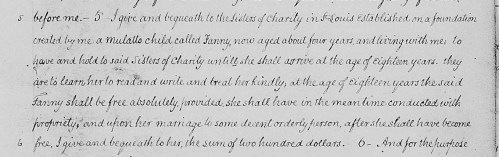
Thanks to a researcher-intern, we discovered further evidence of just how reliant the Sisters were upon Catholic benefactors who were also enslavers in slaveholding states like Missouri in the early days.
From the will of John Mullanphy, St. Louis, 1827: “I give and bequeath to the Sisters of Charity in St. Louis established on a Foundation created by me a mulatto child called Fanny, now aged about four years…to have and hold to said Sisters of Charity until she shall arrive at the age of eighteen years. they are to learn her to read and write and treat her kindly….” (courtesy St. Louis City Recorder of Deeds)
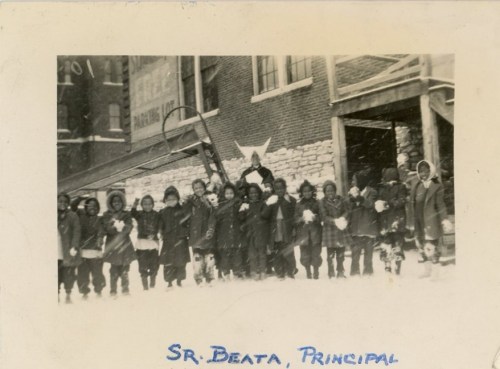
We also rediscovered entire collections pointing to elements of the Community’s history and our local and national histories. The St. Malachy School in St. Louis was a Black Catholic school before integration, which documents the experience of St. Louis’s Mill Creek neighborhood. Other historically Black Catholic parishes have collections too, including the Cathedral School in Natchez, Miss.; St. Stephen’s School in New Orleans; and St. Theresa’s Parish in Gulfport, Miss. The Daughters were also involved in teaching both during eras of segregation and eras of desegregation in Emmitsburg; Norfolk, VA; and Greensboro, NC.
Sister Beata Goetta and her students at St. Malachy School, St. Louis, 1940s
Most importantly, we discovered the trove of local history that the financial ledgers provide in regards to the surroundings of Emmitsburg in Northern Frederick County, Maryland. At the far fringes of the county, much of its local history, white and Black, gets overlooked in favor of Frederick City. The financial ledgers reveal the finances of a small rural town, the comings and goings of people and merchants, and the complex interlocking web both free and enslaved families in the area.
Take, for example, Ann Coates/Coales, whom we discovered in the “Talks of the Ancient Sisters” speaking for herself:
Ann Coales, colored – “I used to work down here at the washhouse in Mother Rose’s time, bought my own freedom – ten dollars a month and allowed me nothing for my clothes.”
Ann makes further appearances receiving pay from the Community in Financial ledger 58 in September 1823, alongside a Henry Coates, Betsy Coats, and Mary Ann Coats. In 1845, Ledger 70, we suddenly see a new name: Kelly Koats (Thomas), that forced us to draw some connections and gave us new pathways for research.
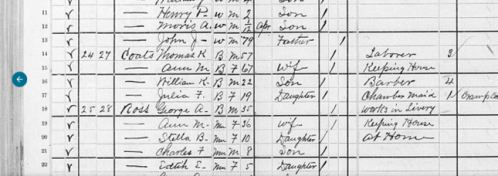
We began to search for Thomas Kelly Koates and all associated spellings. In the Baltimore Archdiocesan marriage records, we found a match, and found his marriage to a member of the Butler family. Sure enough, we see them as husband and wife in the federal census records.
1880 United States Census
With this information, we can now connect the two families and find Ann even further back in the records under the name Ann Butler, who appears throughout the records as well! Using these names, we can help compute the family trees of the local African American families, their lives, professions, and to a certain extent, their moves in and out of the area!
This work is certainly slow-going at times – we must also complete all our other work as well after all – but we are updating our research and subject guides on Slavery and African American History when we make it through a new ledger. Their current iterations can be found here and here.
Check back from time to time and join us on this journey! The Daughters of Charity Archives is excited to be a partner in the processes of research, accountability, and reconciliation.
We must also thank our interns, volunteers, hired researchers, and colleagues at the Seton Shrine for their hard work and dedication in this process. The value of your contributions cannot be overstated.
Published with the approval and assistance of Nicky Dilts
Occasionally in these posts, we like to highlight projects our researchers are working on. This post is not about an academic project, but about a family history exploration with some deep personal meaning.
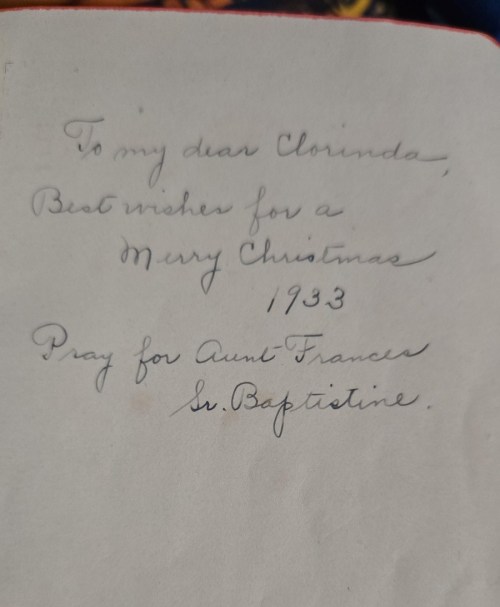
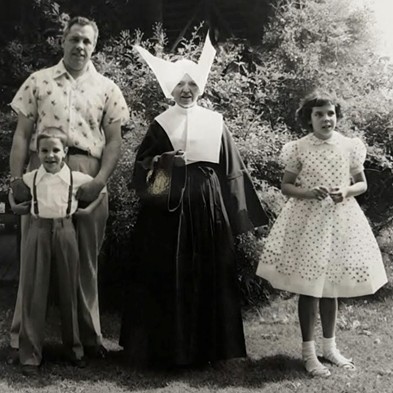
Nicky Dilts is her family’s historian, and there was a branch that she was missing on her family tree. Her grandmother, Clorinda Pasquinucci, had spoken of an aunt that became a Catholic Sister of some order or another. In Nicky’s possession were two memorials of her great-great-aunt. The first was a photograph, and the second was a prayer book gifted to her grandmother from this mysterious Sister-aunt. The prayer book is signed “To my dear Clorinda[,] Best wishes for a Merry Christmas 1933[,] Pray for Aunt Frances Sr. Baptistine.”
Courtesy Nicky Dilts
With this artifact, Nicky had a community name, a baptismal name, and a time period. From her extended research, she knew her likely last name – Massa – and that she had emigrated from Italy. The one thing she didn’t know for certain was what Community Sister Baptistine was in. Thankfully, the distinctive habit – with the notable cornette head covering, worn before 1964 –meant that Sister Baptistine could only be a Daughter of Charity.
Courtesy Nicky Dilts
Nicky called us with her information, and we were able to match it instantly. We are able to provide the information found in the Community ledgers and confirm what she knew already, including Sister Baptistine’s birthplace in Levanti, Italy and her parents, Emanuel Massa and Christine Luceti. Moreover, we could share Sister’s date of birth, date of death, date she entered the Community, and where she had served on ministry.
For some genealogists, especially looking further back, this is the limit to what we are able to provide to people, before the explosion of recordkeeping. Sister Baptistine’s file, however, contained a goldmine of information. Some things were vital documents, where, although we disappointed Nicky in not having Sister Baptistine’s birth certificate, we did have her naturalization certificate when she became a U.S. citizen.
And, after Sister’s death, her file had correspondence between the Community and some of those same family members whom Nicky’s genealogical work had documented, showing the family’s support for the Community and the Community’s concern for a grieving family. It gave an account of her final days and her devotion to the Brady Maternity Home in Albany, where she lived, ministered, and eventually died after 49 years there.
Some of these documents even went into further detail about Sister’s family:
Although we use this blog to highlight some projects of academic researchers, our most common category of users is genealogists, and our most common question is “My aunt/great-aunt was a Daughter of Charity; do you have any pictures of her?” It is a question we are always happy to provide an answer to.








![Typewritten text reading: "June 28, 1966[.] Dear Mrs. Stevens and Miss Massa, I am addressing this letter to both of you so that together you will learn all about the last days of your dear Sister and our beloved companion. Sisters is a great loss to all of us as we all loved her and admired her for her kindness and her holiness. Sister was on active duty all day Saturday, June 25. She served our chaplain's breakfast and did all the other little things that she did all day, the last of which was to go around the home and bless the little children with Holy Water. This gave Sister the opportunity to meet all the personnel and to keep in touch with the children she loved so much."](https://docarchivesblog.org/wp-content/uploads/2025/12/picture3.png?w=500)
![Portion of a letter from Mrs. C. Lagario reading: "These are the names of Sisters relatives. Mr. Frank Montegane[,] Mr. & Mrs. I. Montegane[,] Mr. & Mrs. H. Bawers[,] Mr. & Mrs. M. Schenone[,] Mr. & Mrs. . Lamerdin[,] Mr & Mrs. H. Gaerndt[,] Mr. & Mrs. J. Labario[,] Mrs. Caroline Labario Our prayer are with you. Mrs. C. Lagario"](https://docarchivesblog.org/wp-content/uploads/2025/12/picture4.png?w=500)

 docarchivesblog.org