
The National Archives and Records Administration is the repository of all official documents of the United States government. With Mother Seton and her family’s long history in the United States, particularly in the United States Navy, the Seton family appears in many different places in our nation’s official government repository.
First, it is also worth noting that the ancestral Seton family have their own collection in the National Records of Scotland from Glorious Revolution through 1785.
The most obvious place that the family is represented is in the census records, with Elizabeth Ann and William Magee Seton appearing in the earliest censuses in New York City, and then Mother Seton appearing in Emmitsburg in 1810 and 1820. The census records provide massive volumes of information related to demographics and are used most immediately for congressional apportionment and for funding for public services.

William Seton III, one of Mother Seton’s surviving sons, is among the most represented due to his career in the Navy. Military records, for both genealogists and veterans, are among the most used and requested materials in the National Archives. Within the collection “Naval Records Collection of the Office of Naval Records and Library,” there is a series called “Letters Received from Commissioned Officers Below the Rank of Commander and from Warrant.” This series contains various letters documenting official correspondence of enlisted sailors and their interaction with superior officers. Among these are 19 letters including requests for leave, administrative documents, and reports from William Seton reporting to his commanding officers. They span from his time on the Macedonian during its tour of the Pacific (and whose log is in the possession of the Daughters’ Archive). Many others request shore leave or ask for extensions of leave.
William’s sister Catherine makes an appearance in one of his requests. On October 9, 1828, William requested leave to travel in Europe due do “the continued ill health of my sister, to whom the Phisicians [sic] have recommended that course, as the only hope of renovating her constitution.” This occurred during Catherine’s “World Traveler” era, when she was making extended stays in Europe, before eventually becoming a religious Sister of Mercy. His letters stretch through his return to Norfolk in 1833 and return to civilian life.

William Seton Maitland, nephew of Elizabeth and William Magee, also appears in the military records during the Seminole Wars in Florida.
In the more modern day, and as a preview of things to come, the National Archives is also in possession of the official proclamations from the U.S. government about Mother Seton’s canonization. Under Press Secretary William Baroody’s files, held at the Gerald Ford Presidential Library, is the official proclamation of Elizabeth Ann Seton Day, alongside a signed thank you letter from Sister Mary John Lindner for the community’s replica copy, signed by President Ford. This replica will be on display next year (2025) for our exhibit “One of Us” at the Seton Shrine, celebrating the 50th anniversary of this event!

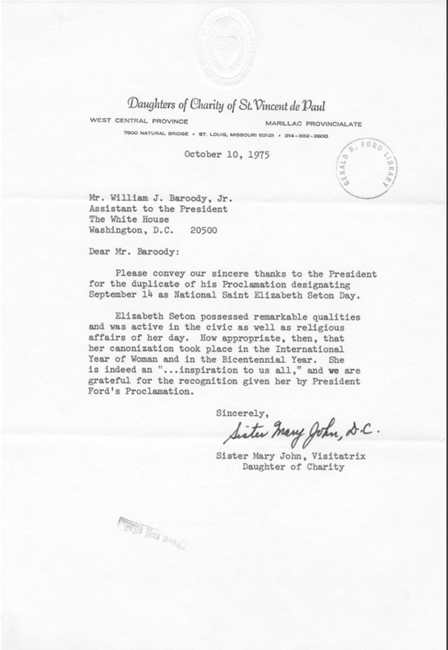
As a reminder of the vast scale of the National Archives, and the complexity of archival research, these records are among those that are digitized and available remotely to researchers. This totals a mere 2% of the National Archives’ holdings, and there may well be other materials that one day are accessible without a trip to your nearest NARA branch. William Seton IV, Mother Seton’s grandson, appears in Civil War veterans records, but his company, the New York 16th Artillery, have not been digitized yet.
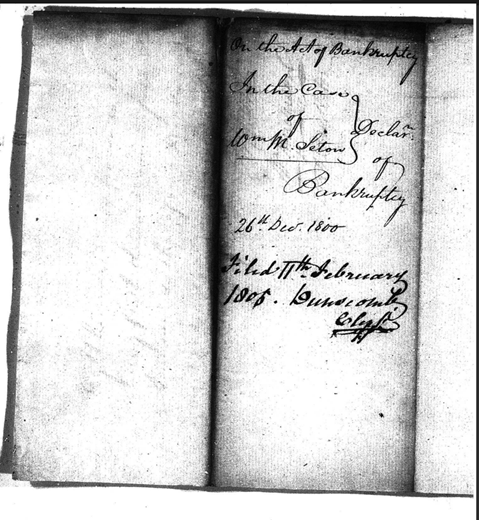
As an example of records which need to be visited in-person, these scans were lent to us by our friend and colleague Dr. Catherine O’Donnell and come from the National Archives branch in Kansas City, where Record Group 21 “Records of District Courts of the United States” reside. Less than 0.5% of these records are scanned and online as of this time, but among them are early records of the United States bankruptcy court. It is in these documents that the Setons’ life in New York City began to unravel, as the Seton-Maitland shipping company ran out of money, and the Setons were forced to sell their assets.

Archivists at NARA are working hard to make more materials available, both in-person and remotely. A way that you can help is to make more materials more searchable. Their Citizen Archivist program allows anyone with an Internet connection to apply metadata and transcription to documents that have been scanned and made available. These tags help make more materials searchable, so that that needle in haystack – that one stray name in a vast file – can turn up with a few strokes of a keyboard.
The records in the National Archives are the property of the American people. Make use of your records, and help others make use of them too!





 docarchivesblog.org