Tag Archives: Nurses

Sister Francine’s Family Collection

Dating back from the founding of the Province, the Archive contains at least basic information about all the Sisters of the province.  In the 20th and 21st centuries, we usually have a little more information, such as a formal obituary, a few accounts, or newspaper clippings.  Sometimes we even have a few pieces of personal memorabilia about a Sister.  But sometimes, we are fortunate enough that a Sister will donate pieces of her own family history, which illustrates both her pathway to the Sisterhood and brings to life a subject in its own right.

Recently, Sister Francine Brown was kind enough to donate a collection of her family materials to the Archives.  Sister Francine is a second-generation American who has spent most of her ministry with and for persons with intellectual and physical disabilities and their families or as an interpreter.  Her health care background, along with her knowledge and fluency in French stem from her mother and grandmother before her.

Julia Durupt Guérin, Sister’s grandmother, married Alfred Eugène Georges Guérin in 1919, after World War I, in eastern France.  She began her nursing service in 1938 in Paris, on the eve of World War II, after receiving her State nursing certification.  She rose to the rank of supervisor and later Director of the OB Department at La Maternité in Paris.  For her hospital service during the War and the Occupation, she was awarded the Departmental and Municipal Medal of Honor in 1949 for her service at the Lariboisiére.
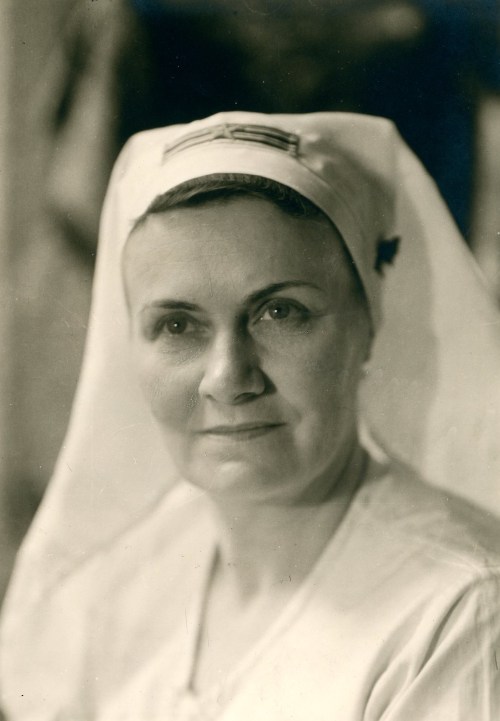
Julia Durupt Guérin portrait photo, 1946
Her Departmental and Municipal Medal of Honor

As an aside, Sister Francine donated many of her grandfather’s service records, including a diary with artillery sketches, to the World War I Museum in Meaux, France.  The Daughters of Charity Archives does have copies, along with a bullet that he sculpted for his fiancée.  The bullet is not live or active; we checked.

Madeleine Julia Guérin Brown, Sister Francine’s mother, was born in 1923 and followed in her own mother’s footsteps, receiving her State nursing diploma in 1948.  In the same year, she married an American former soldier, Howard Nelson Brown and left France for the United States.  She received her naturalized citizenship in 1952. 

Growing up in the chaos and uncertainty of the War, Madeleine had changed schools several times.  She did not have proof of completing or graduating from high school, and her nursing diploma was not considered reciprocal for receiving her nursing registration in the United States.  This meant that she had to go through the arduous process of receiving letters of practice and good conduct (from oversees to boot) and obtaining a high school equivalence certificate.  All of this in spite of her working in good conduct and standing, to the level that her supervisor called “of superior quality” (this letter is also in the collection).  She at last received her certification as a registered nurse in 1971 for the District of Columbia.

Madeleine’s 1947 nursing school class.  Madeleine is in the top row, 3rd from the right.
Madeleine’s naturalization certificate

In addition to the family history it entails, the collection is a valuable tool for looking at the professionalization of the nursing profession.  The Daughters of Charity, as a French community, have their own parallel history with this subject as they confronted the increased regimen of examinations and certifications, both with the scientific subject of nursing and the waves of secularization in France in the centuries since the Revolution.  They even share a history of having distinctive head coverings!  Yet it also shows the human level that a person will go to fulfill their duty.

This collection, for the time, is available with the permission of Sister Francine (you may contact the Archives about access).  It presents a full background of a Daughter of Charity and her family, the origins of her vocation, and her particular vocation within a religious community with a strong Franco-American history.

Navy blue and white veils with red and blue cockades worn by Madeleine during her nurse’s training (1945-47).  The blue veil was worn over the white veil only when doing public health nursing visits.  The cockades symbolize La Ville de Paris.  Stripe on the cap signifies being a registered (diploma) nurse of France.

Leave a comment

Filed under Health Care, Hospitals

Pioneers: Estelle Howard at Providence Hospital, Washington

Today we would like to highlight a pioneer at one of the Daughters largest and longest-lived institutions, Providence Hospital in Washington, D.C.  When Estelle Howard arrived at Providence to begin her career as a nurse, she became one of the first two Black nurses to work at the hospital.  She would spend the next 43 years at Providence, garnering a number of other pioneering firsts during her time there.

It was 1947 when Sister Rita Voss called the Freedman’s Hospital Nursing School and asked for the best two students in the graduating nursing class.  No white hospital had ever made such a request of Freedman’s before.

Expecting an interview, the two nurses were hired on the spot and asked if they were ready to work.  In 1951, Ms. Howard became head of a segregated ward, but as units desegregated, she became the first Black head nurse of an integrated unit.  She later rose to the ranks of Assistant Director of Nursing and Control Coordinator of the Emergency Unit.

Among her other accomplishments, roles, and titles at the job were those of a reporter for the employee newsletter and leadership positions in the District of Columbia’s Nurses Association.

Estelle Howard in 1963

In 1982, for her pioneering role and years of dedicated service, Ms. Howard was the inaugural winner of the Sr. Anne Robb Award, given to those who have shown dedication to Providence Hospital, above average performance and achievements, and perseverance in the face of difficulties.  Even after this lifetime achievement award, she served for another eight years at the hospital.  In her presentation of the award, Sister Irene Kraus called her “a model of a person who focuses on the good in life and people and refuses to be embittered or to respond in kind when she meets unkindness … Miss Howard has the unique ability over the years to be loyal and supportive of those she has worked with at every level.”

Estelle Howard and Sister Irene Kraus in 1982, when Ms. Howard received the Sister Anne Robb Award

Estelle Howard retired after exactly 43 years at Providence on April 23, 1990.  The hospital proclaimed it Estelle Louise Howard Day.  Her work made it possible for many others to pursue their career as they desired and to make nursing and the Hospital better for its administrators, doctors, nurses, and patients.  Even after her retirement, she continued to volunteer at the hospital.

Estelle Howard in 1990, near her retirement

Estelle Howard’s story is documented in the Archives through the various employee newsletters, photo collections, and a profile written about her in 1990, but we are also fortunate enough to have a copy of a life story that she wrote “And Now My Time at Bat Remembering” in 1999.  Although it is but a few brief pages, it allows her to tell her story in her own words and as she wished to, with deep reverence for her immediate and extended family and for the elder family members who can preserve and pass on Black family history.  It documents her ancestors’ leaving Alabama during the Great Migration and the forces growing up that shaped her life, including the town library, the Great Depression, and stories of family history in Louisiana.

Leave a comment

Filed under African American History