Tag Archives: Daughters of Charity

The Hurricane Katrina Collection

Hurricane Katrina redefined natural disasters and their effects on humanity.  New Orleans has never totally recovered from the effects of the storm and the failure of the levies, which put 80% of the city under water.  It has since invested in new inland protections from flooding and has created a current plan that accepts a “living with water” philosophy.  August 29, 2005, changed the Gulf Coast on a fundamental level.

The Hurricane Katrina Collection in the Daughters of Charity Archives contains information about the Daughters who were displaced during the storm: messages of goodwill from friends, colleagues, and Sisters around the world; students’ memories of those days in August and September; news articles about the destruction on the Gulf Coast; and scrapbooks and DVDs about the recovery projects that the Daughters of Charity, along with Catholic Charities, undertook to rebuild in Louisiana and Mississippi.

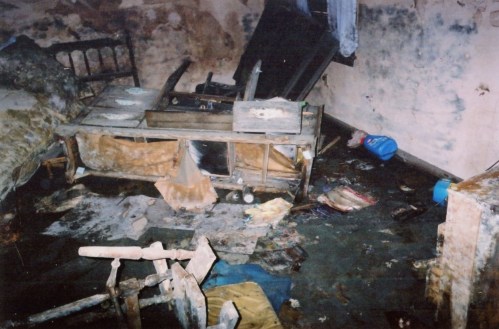
A challenge for many of the Daughters primed to assist in recovery efforts was the fact that several of them were among the displaced.  Alongside nearly 400,000 others in the New Orleans area alone, 38 Sisters relocated to other community homes in Texas, Missouri, and inland Louisiana.  Four of their homes were among the 60,000 that were total losses beyond repair. 

Damage to the Daughters’ residence on Claiborne Street

The collection also documents just a fragment of the recovery in the first two years after the storm.  Seven Daughters of Charity returned to areas affected within six weeks to assist in the recovery in whatever capacity they could best be used. 

Sisters Mary Satala and Doris Clippard worked with the Society of Vincent de Paul in the Mobile, AL area to perform some of the most immediate work for those affected by the disaster:  collecting testimonies, ensuring distribution of food and supplies, and assisting with the preparation of paperwork for FEMA and disaster relief.  The collection contains accounts of some of their most impactful experiences.  Daughters of Charity served with the community of Sisters, who traveled there to work in short-term ministries during the crisis.

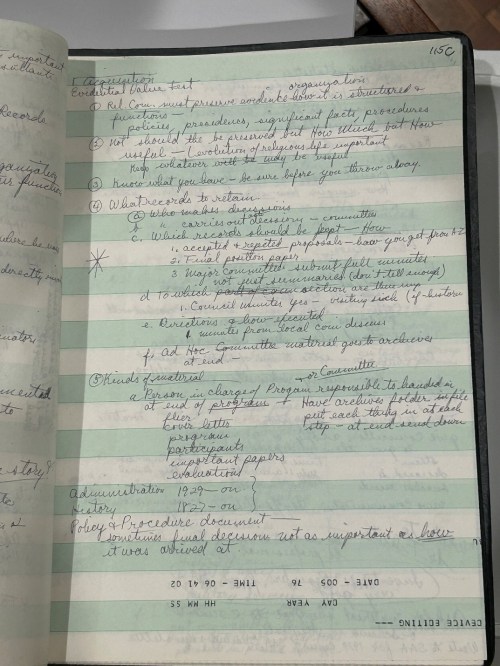
Sr. Doris and Sr. Mary Excerpt
Conclusion of a letter signed jointly by Sister Doris Clippard and Sister Mary Satala to Sister Honora Remes
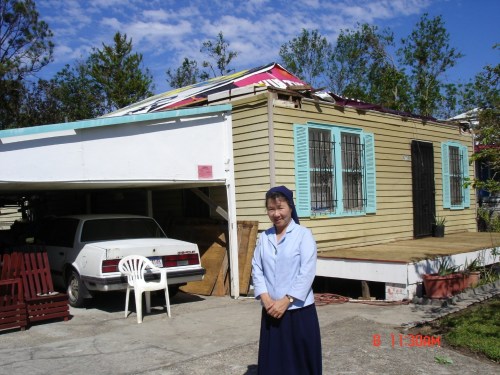
Sister Catarina Chu (Province of St. Elizabeth Ann Seton) outside a home in Bayou La Batre, AL
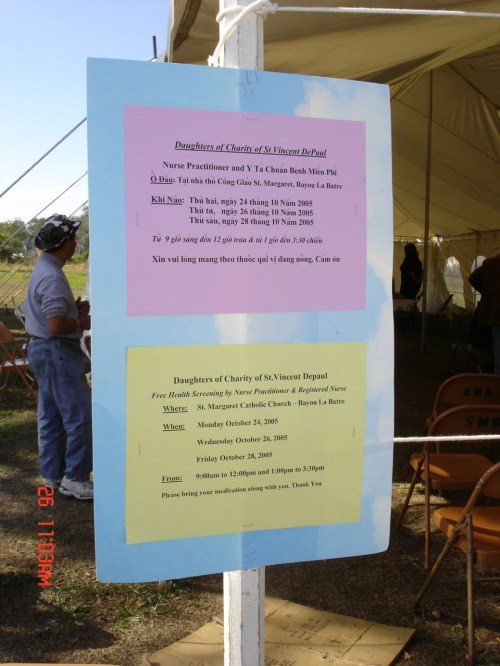
Nursing Clinic for Vietnamese Residents of New Orleans

Some Sisters assisted refugees outside the city.  Sisters Juanita Chenevert and Mary Ellen Seo took positions at St. Aloysius School in Baton Rouge, whose numbers had swelled with those unable to return to New Orleans.  At the same time, Sister Juanita, who was principal of St. Stephen Catholic School in the Crescent City, looked for ways to cover expenses to reopen the school for her own students, many of whom would otherwise be unable to afford recovery and tuition.  She and Sister Mary Ellen served with Sister Carmela Molini to deliver books to six schools and a branch of the public library system, working with K-12 and community college students.

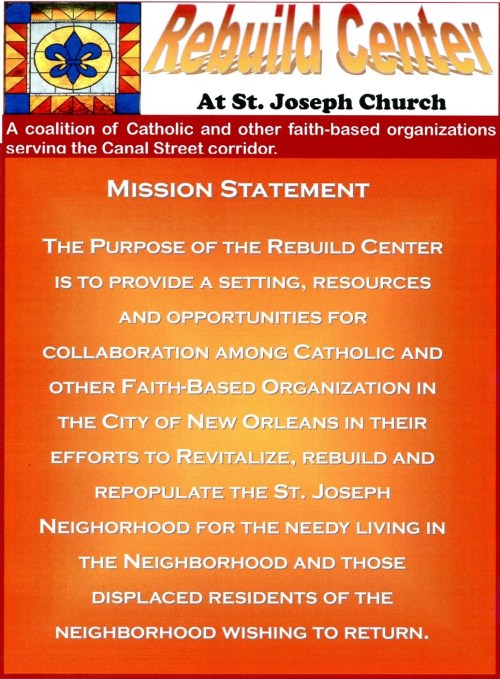
From a top-down level, the Daughters collaborated with their brothers, the Vincentian priests, on a project rebuilding the parish neighborhood around St. Joseph’s Church, not far from the Superdome.  The goal of this project was a long-term one, to ensure that those still residing there could stay and that those residents who left had the opportunity to return.  This service continues today, and “It is now a place where the homeless and those in need are treated with respect and dignity, where they can rest by day as they get the services and food they require.”  More information about their continuing work can be found at https://stjosephchurch-no.org/st-joseph-rebuild-center/.   

'Rebuild' Mission Statement

'Rebuild' Plans

Among other Daughters’ works in the region, DePaul Hospital was forced to close completely and permanently due to the damage it sustained.  DePaul Community Health Centers also suffered damage.  In addition, the Long Beach, MS – St. Vincent de Paul School and the New Orleans, LA – St. Joseph’s School collections contain information related to Hurricane Katrina and its aftermath. There is one final aspect of Hurricane Katrina that the collection shows and does not shy away from, and that is the disparities.  When Sister Marie Therese Sedgwick, the Visitatrix of the Province, reported to her fellow Sisters in May of 2006, she addressed what the Daughters did and had to do for the Sisters under her purview.  But she also placed an emphasis on the greater impacts of a natural disaster like this – on the marginalized communities and those living in poverty who bear a far greater brunt of nature’s fury. 

Sr. Marie Therese Notes

Humanity does not have the power to stop hurricanes, but we have the power to rebuild communities afterward and a duty to have concern for those who are in its pathway.

The MAX School Letter
Letter from  Sister Eileen Sullivan, SBS to the Daughters of Charity of the West Central Province for their help rebuilding the temporarily merged MAX School in New Orleans

Leave a comment

Filed under Daughters of Charity, New Orleans

Curiosities and Government Forms: Prohibition

In this post, we’d like to highlight two small oddities in the Archives, relatively simple records of the Sisters and an awkward accommodation with the government.

The first comes from a small, now defunct government office called the Bureau of Industrial Alcohol.

The document itself is located within a folder named “Various Corporate Certificates,” containing letters, approvals, and resolutions that, while necessary to conduct the business of the Sisters, are relatively mundane.  The association with a government office such as the Bureau of Industrial Alcohol is the first thing that is peculiar. 

This is explained when you look at the date, April 8, 1933.  Through December of 1933, Prohibition in the United States was still in effect, placing Sisters, priests, and many Catholics in a theological bind – How were Catholics to partake in Communion when wine was illegal?

The Volstead Act of 1920 had carved out exemptions for alcohol used for medicinal purposes and specifically for wine “for sacramental purposes or like religious rites,” but this required a permit from a commissioner to do so.  Thus, a letter in the official documents governing the province from a minor government office in Baltimore.

It is also worth noting that the letter addresses the Sisters as “Gentlemen” in its greeting, as the assumption of the time was that only men would be serving on a corporate board. 

The letter, however, brings up a problem.  The government office had received their permit application, but the Treasurer of the community was not a recognized agent to work with the Bureau.  Prohibition was in its thirteenth and final year of enactment in the United States; this was not a new rule the Sisters were complying with at this point.

A hint for this comes when looking at the Treasurers of the Community.  Sister Bernard Orndorff had served as Treasurer for the Eastern Province for over 30 years, from 1901 to 1933, but had to abruptly resign for health reasons in February.  Indeed, just the year before, the corporate minutes of the Province show that the Sisters had petitioned for the very same form (although the alcohol was not for liturgical purposes, but “for their laboratories and infirmaries,” presumably at St. Joseph College in Emmitsburg).

Succeeding Sister Bernard as Treasurer was Sister Mary Loretta McGinness.  The helpful permitting agent pointed out, though, that Sister Bernard was still the authorized agent to work with the Bureau.  Thus, he advised the Sisters to pass a resolution authorizing their new Treasurer to be named as the official person to work with the Bureau, which the Sisters then did.

This process would soon be rendered moot when the 21st Amendment was ratified in December of 1933, essentially abolishing the government departments meant to enforce Prohibition and leading to the consolidation of the remaining ones into the Bureau of Alcohol, Tobacco, Firearms and Explosives.  A month before this letter was sent, President Franklin Roosevelt had signed the Cullen-Harrison Act, which defined drinks with alcohol content up to 3.2% as not legally alcoholic for the purposes of the Volstead Act.  The agent seems very lenient with the requirements for the permit from the Sisters – it is a mere act of their board and a piece of paperwork that is missing, and the permit would be granted. 

Prohibition is a curiosity of an era in American history, possibly from its coinciding with the Roaring 1920s, possibly from its constitutional oddity and the shortness of its enaction.  Nonetheless, it had a wide effect on American life during its 13-year national lifespan, with a few bureaucratic records showing that the lives of the Sisters were no exception.

Leave a comment

Filed under Daughters of Charity, Prohibition, Sister Bernard Orndorff, Sister Mary Loretta McGinness

Sister Francine’s Family Collection

Dating back from the founding of the Province, the Archive contains at least basic information about all the Sisters of the province.  In the 20th and 21st centuries, we usually have a little more information, such as a formal obituary, a few accounts, or newspaper clippings.  Sometimes we even have a few pieces of personal memorabilia about a Sister.  But sometimes, we are fortunate enough that a Sister will donate pieces of her own family history, which illustrates both her pathway to the Sisterhood and brings to life a subject in its own right.

Recently, Sister Francine Brown was kind enough to donate a collection of her family materials to the Archives.  Sister Francine is a second-generation American who has spent most of her ministry with and for persons with intellectual and physical disabilities and their families or as an interpreter.  Her health care background, along with her knowledge and fluency in French stem from her mother and grandmother before her.

Julia Durupt Guérin, Sister’s grandmother, married Alfred Eugène Georges Guérin in 1919, after World War I, in eastern France.  She began her nursing service in 1938 in Paris, on the eve of World War II, after receiving her State nursing certification.  She rose to the rank of supervisor and later Director of the OB Department at La Maternité in Paris.  For her hospital service during the War and the Occupation, she was awarded the Departmental and Municipal Medal of Honor in 1949 for her service at the Lariboisiére.

Julia Durupt Guérin portrait photo, 1946
Her Departmental and Municipal Medal of Honor

As an aside, Sister Francine donated many of her grandfather’s service records, including a diary with artillery sketches, to the World War I Museum in Meaux, France.  The Daughters of Charity Archives does have copies, along with a bullet that he sculpted for his fiancée.  The bullet is not live or active; we checked.

Madeleine Julia Guérin Brown, Sister Francine’s mother, was born in 1923 and followed in her own mother’s footsteps, receiving her State nursing diploma in 1948.  In the same year, she married an American former soldier, Howard Nelson Brown and left France for the United States.  She received her naturalized citizenship in 1952. 

Growing up in the chaos and uncertainty of the War, Madeleine had changed schools several times.  She did not have proof of completing or graduating from high school, and her nursing diploma was not considered reciprocal for receiving her nursing registration in the United States.  This meant that she had to go through the arduous process of receiving letters of practice and good conduct (from oversees to boot) and obtaining a high school equivalence certificate.  All of this in spite of her working in good conduct and standing, to the level that her supervisor called “of superior quality” (this letter is also in the collection).  She at last received her certification as a registered nurse in 1971 for the District of Columbia.

Madeleine’s 1947 nursing school class.  Madeleine is in the top row, 3rd from the right.
Madeleine’s naturalization certificate

In addition to the family history it entails, the collection is a valuable tool for looking at the professionalization of the nursing profession.  The Daughters of Charity, as a French community, have their own parallel history with this subject as they confronted the increased regimen of examinations and certifications, both with the scientific subject of nursing and the waves of secularization in France in the centuries since the Revolution.  They even share a history of having distinctive head coverings!  Yet it also shows the human level that a person will go to fulfill their duty.

This collection, for the time, is available with the permission of Sister Francine (you may contact the Archives about access).  It presents a full background of a Daughter of Charity and her family, the origins of her vocation, and her particular vocation within a religious community with a strong Franco-American history.

Navy blue and white veils with red and blue cockades worn by Madeleine during her nurse’s training (1945-47).  The blue veil was worn over the white veil only when doing public health nursing visits.  The cockades symbolize La Ville de Paris.  Stripe on the cap signifies being a registered (diploma) nurse of France.

Leave a comment

Filed under Health Care, Hospitals