
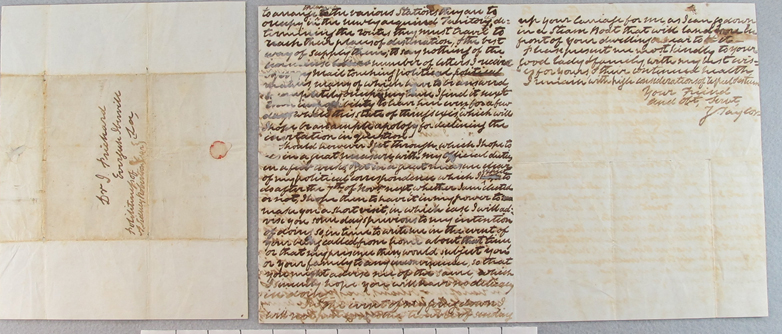
One side of the restored Zachary Taylor letter (image courtesy of Nancy Purinton, Purinton Preservation, Frederick, MD)
By Denise Gallo, Provincial Archivist
Recently, we proudly announced the return of an autograph letter of Zachary Taylor, twelfth president of the United States, which came into the Daughters of Charity Provincial Archives as part of the inheritance of one of the sisters.
Of the interesting features of our letter is its date: just one month before the presidential election, Tuesday, Nov. 7, 1848 – the first day in which the vote was held on the same date throughout the nation. What is intriguing is that in excusing himself from not being able to accept its recipient’s invitation to visit, Taylor suggests that he will have more time for such pleasantries after the election, whether he won or not! Known as “Old Rough and Ready,” Taylor only served from March 1849 to July 1850, dying from a stomach ailment the diagnosis of which is still disputed.
But to our letter….. We’ve been able to transcribe most of it, although some sections remain illegible and to trace some historical detail. We’re eager for any scholars to step forward to put this in the context of Taylor’s life.
The envelope, simply a paper folded to house the letter, reads:
Dr J. Prichard
Evergreen Iberville
LA.
Politeness of A. Sidney Robertson, Esqr.
From this we can tell that the letter to Prichard was delivered to him by Robertson; indeed, according to the 1850 U.S. Federal Census, an A.S. Robertson, planter, aged 42, lived in Iberville Parish with his wife and their four children. The Louisiana Sugar Census Index of 1850-1860 records a James Pritchard (note spelling) in Iberville Parish who owned a sugar plantation on the Mississippi River L(eft) side; he is noted in the 1850 Federal Census as Doctor J. Pritchard, aged 59, resident of Iberville with his wife, three children, and an overseer named Murphy. Since Pritchard’s name is spelled consistently with the “t” in all of the census documents, we can suggest that Taylor was not on intimate terms with him and perhaps knew of him only through Robertson or through the Mr. Thorp who delivered the doctor’s letter to Taylor. By the way, Pritchard’s Evergreen plantation is not the one that survives to this day. It was another which, according to sources we asked, no longer stands. Taylor would have been interested in Pritchard’s farming since he himself owned two plantations, one near Baton Rouge where he served in Army headquarters and the other in Mississippi.
Baton Rouge October 7th, 1848
Doctor J. Prichard
My Dear Sir,
Your kind & acceptable letter of the 27th inst[ant] was handed me a few days since by Mr. Thorp inviting me to make you a visit & spend a data or two at your desant [sic] & hospitable mansion, which invitation is highly apreciated [sic] [illegible] the same eminates [sic] from the purest motives & I hardly need say the pleasure it would have afforded me could I have accepted & complied with it as it would have been truly gratifying could I have spent the time referred to with you, your excellent & accomplished lady & interesting family; besides the opportunity it would have afforded me in company with Mrs. P[richard] & yourself to have gone over your fine and handsomely arranged plantation, where I would have expected to have acquired much information on the subject of the culture of cane, as well as the next mode of manufacturing sugar, both of which I take the [illegible] interest in; and all of which I regret to say I must abandon for the present as any public duties now, & will for some time keep me constantly employed. Soon after returning home from the Lakes in War of New Orleans, I was placed in command of the Western division of the Army, since then [the] norganizing [sic] the Regiments to arrange them at the various stations they are to occupy in the newly acquired Territories, determining the routes they must travel to reach their places of destination, & the best way of supplying them; to say nothing of the [illegible] letters number of letters I receive of [illegible] mail touching upon political political matters, many of which have to be answered [illegible] completely occupies my time I find it next [illegible] to leave here even for a few days while this state of things exists, which will I hope be all ample apology for declining the invitation in question.
Should however I get through, which I hope to [illegible] in a great measure, with my official duties in a few weeks, get in a great measure clear of my political correspondence which I expect to do after the 7th of Nov. next, whether I am elected or not, I hope then to have it in my power to make you a short visit, in which case I will advise you some days previous to my intention of doing so, in time to write me in the event of your being called from home about that time, or that my presence then would subject you or your family to an inconvenience, so that you might advise me of the same, which I sincerely hope you will have no delicacy in doing.
In the event of my going down I will not put you to the trouble of sending up your carriage for me as I can go down in a steam boat that will land me in front of your dwelling or near to it – please present me most kindly to your good lady & family, with my best wishes for yours & their continued health.
I remain with high considerations of respect and esteem
Your Friend
And Ob[edien]t. Serv[an]t.
Z.Taylor




 docarchivesblog.org