Sister Francine’s Family Collection

Dating back from the founding of the Province, the Archive contains at least basic information about all the Sisters of the province.  In the 20th and 21st centuries, we usually have a little more information, such as a formal obituary, a few accounts, or newspaper clippings.  Sometimes we even have a few pieces of personal memorabilia about a Sister.  But sometimes, we are fortunate enough that a Sister will donate pieces of her own family history, which illustrates both her pathway to the Sisterhood and brings to life a subject in its own right.

Recently, Sister Francine Brown was kind enough to donate a collection of her family materials to the Archives.  Sister Francine is a second-generation American who has spent most of her ministry with and for persons with intellectual and physical disabilities and their families or as an interpreter.  Her health care background, along with her knowledge and fluency in French stem from her mother and grandmother before her.

Julia Durupt Guérin, Sister’s grandmother, married Alfred Eugène Georges Guérin in 1919, after World War I, in eastern France.  She began her nursing service in 1938 in Paris, on the eve of World War II, after receiving her State nursing certification.  She rose to the rank of supervisor and later Director of the OB Department at La Maternité in Paris.  For her hospital service during the War and the Occupation, she was awarded the Departmental and Municipal Medal of Honor in 1949 for her service at the Lariboisiére.

Julia Durupt Guérin portrait photo, 1946
Her Departmental and Municipal Medal of Honor

As an aside, Sister Francine donated many of her grandfather’s service records, including a diary with artillery sketches, to the World War I Museum in Meaux, France.  The Daughters of Charity Archives does have copies, along with a bullet that he sculpted for his fiancée.  The bullet is not live or active; we checked.

Madeleine Julia Guérin Brown, Sister Francine’s mother, was born in 1923 and followed in her own mother’s footsteps, receiving her State nursing diploma in 1948.  In the same year, she married an American former soldier, Howard Nelson Brown and left France for the United States.  She received her naturalized citizenship in 1952. 

Growing up in the chaos and uncertainty of the War, Madeleine had changed schools several times.  She did not have proof of completing or graduating from high school, and her nursing diploma was not considered reciprocal for receiving her nursing registration in the United States.  This meant that she had to go through the arduous process of receiving letters of practice and good conduct (from oversees to boot) and obtaining a high school equivalence certificate.  All of this in spite of her working in good conduct and standing, to the level that her supervisor called “of superior quality” (this letter is also in the collection).  She at last received her certification as a registered nurse in 1971 for the District of Columbia.

Madeleine’s 1947 nursing school class.  Madeleine is in the top row, 3rd from the right.
Madeleine’s naturalization certificate

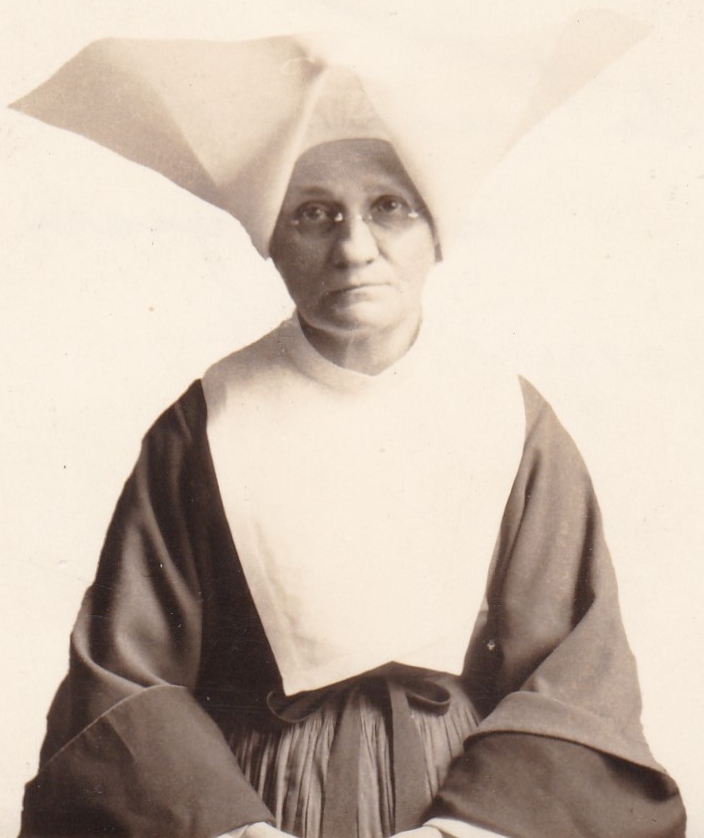
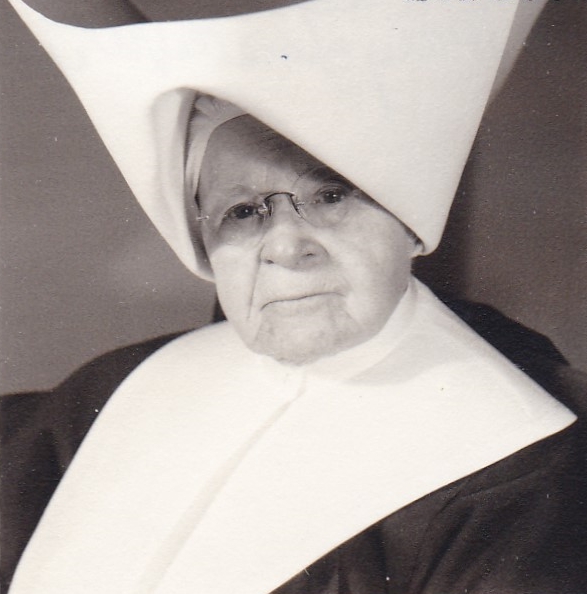
In addition to the family history it entails, the collection is a valuable tool for looking at the professionalization of the nursing profession.  The Daughters of Charity, as a French community, have their own parallel history with this subject as they confronted the increased regimen of examinations and certifications, both with the scientific subject of nursing and the waves of secularization in France in the centuries since the Revolution.  They even share a history of having distinctive head coverings!  Yet it also shows the human level that a person will go to fulfill their duty.

This collection, for the time, is available with the permission of Sister Francine (you may contact the Archives about access).  It presents a full background of a Daughter of Charity and her family, the origins of her vocation, and her particular vocation within a religious community with a strong Franco-American history.

Navy blue and white veils with red and blue cockades worn by Madeleine during her nurse’s training (1945-47).  The blue veil was worn over the white veil only when doing public health nursing visits.  The cockades symbolize La Ville de Paris.  Stripe on the cap signifies being a registered (diploma) nurse of France.

Leave a comment

Filed under Health Care, Hospitals

Dinosaurs in Emmitsburg

Dinosaurs began to be recognized by paleontologists as the creatures that they were in the early 1800s.  In 1895, the Provincial Annals included a note about the local community and the scientific field of paleontology: 

“These few days past the men have been removing two large slabs from Avenue side walk.  One is destined for the Johns Hopkins’s University, the other for our own cabinet.  Prof. Mitchell of the Mountain [Mount St. Mary’s University] is the one who is securing these singular geological specimens.  They have long been objects of the Sisters’ curiosity & comment as they promenade up and down the Avenue in summer evening recreation.  They bear the impression of many feet of different kinds & sizes, pre-historic creatures that lived O many & many age ago!  The Professor’s interest in our quarry from where these slabs were taken led him.  His opinion is that all this land round about ages & ages ago formed an estuary, the mountains were its shores.”

The slabs documented by Dr. James A. Mitchell were the first dinosaur prints from Maryland to be announced in a scientific publication.

In the spirit of this time period, the cabinet referred to was a “cabinet of curiosities,” sort of a predecessor to a modern-day museum exhibit.  It was housed in the Burlando Building of St. Joseph’s Academy, the school thatthe Daughters operated.  Later, it was on display, in a deep historical anachronism, in the Stone House on campus where the community had begun in 1809. 

Dr. Mitchell made sketches of the slabs.  Then the slabs went missing.

In 1990, a group of maintenance workers discovered a slab in a crate with fossilized footprints in an old barn on campus.  The search was sparked by Dr. Peter Kranz, who was tracking Mitchell’s work from 100 years before.  In 1998, the slab was put on permanent display in the Maryland Science Center.  Before it was moved from Emmitsburg to Baltimore, the Sisters and employees in Emmitsburg could see it for themselves, privately and up close. 

The Maryland Science Center performed their own analysis on the footprints, identifying them as coming from:

“several dinosaurs who walked across it during the Triassic period, 210 million years ago.  Scientists are not certain exactly which type of dinosaur made the tracks….They were small, plant-eating dinosaurs, about the size of a turkey.  They were ornithischian dinosaurs, and had hip skeletons somewhat like that of birds [This time period in the 1990s is when the theory of dinosaur to bird evolution started to receive wide acceptance].  They usually walked on two legs (‘bi-pedal’), but occasionally dropped down to walk on four legs part of the time.”

Theorized sketches of the dinosaurs created by the Maryland Science Center

With the level of excitement of such a find, it was natural to assume that the same tracks that Mitchell and the Sisters set eyes on in the 1890s had been rediscovered.  However, based on his sketches, this is not the same slab, but an entirely different set of fossilized dinosaur tracks.  It appears the slab once sent to Johns Hopkins has been lost as well.

The discovery and transfer of the fossils were widely covered in the local media, and they went on display at the Maryland Science Center in the aftermath of the first two Jurassic Park films. They remain on display now in the “Dinosaur Mysteries” exhibit.

Sister Betty Ann McNeil overseeing the shipment of the slab out of Emmitsburg
Fossilized footprints on display at Maryland Science Center (Courtesy MD Science Center)

Leave a comment

Filed under Emmitsburg, Exhibits, James Mitchell, Ph.D., Mount St. Mary's University

New Project: The Saint Elizabeth Ann Bayley Seton Family Papers

We are happy to announce the launch of one of our America 250 Projects, celebrating the many, many legacies of the United States in the years surrounding the 250th anniversary of America’s independence in 2026.

Mother Seton, Saint Elizabeth Ann Seton, adopted and modified the Vincentian rule for the United States. Her community laid the foundation for six separate communities of apostolic religious women to commence world-changing service to those in need, among them being the Daughters of Charity of St. Vincent de Paul, with whom the Sisters of Charity of St. Joseph’s joined in 1850. Her virtuous life and her groundbreaking work led to her becoming the first native-born canonized American citizen in 1975.

The legacy of charity and groundbreaking work in education continues through the Sisters of Charity Federation.

Along with our partners at DePaul University, we have begun to digitize the entirety of Mother Seton and her entire family’s writings, so that they may be searchable and usable to researchers, discerners, and the general public in the most timely way possible. For the writings in the English language, full transcription is provided. (If you would like to volunteer to help provide translation for French, Italian, and Latin writings, please reach out via email at archives@doc.org).

This will not be an easy project. The materials from Box 1 of the collection are now available – for the record, there are 34 more boxes. While the work will extend past the Semiquincentennial year of 2026, accessibility of these materials will as well, and we hope this can be a lasting impact of the Seton Legacy.

We welcome all visitors to the site!: https://via.library.depaul.edu/seton_family_papers/

Sincerely, the Staff at the Daughters of Charity Provincial Archives, Emmitsburg, Maryland.

Leave a comment

Filed under Announcements, Archives, DePaul University, Digitized Collections, Elizabeth Ann Seton