Category Archives: Provincial Annals

Beatification of Louise de Marillac – DC pilgrimmage to Rome, May 1920 (part 1)

Louise de Marillac

Louise de Marillac, 1591-1660 (Image courtesy of Vincent de Paul Image Archive, DePaul University)

(Account of Sister Margaret O’Keefe taken from the Provincial Annals. Used with permission of Daughters of Charity Provincial Archives)

On May 9, 1920, Louise de Marillac, co-founder of the Daughters of Charity, was declared Blessed by Pope Benedict XV . Today’s is the first of three posts with accounts of Sister Margaret O’Keefe, then Visitatrix of the Emmitsburg Province, who traveled to Rome for the beatification ceremony.

May 6. Thursday. Went to St. Paul’s without the Walls. It is quite a long ride and we saw some of the old walls of Rome and other interesting things. The Church is magnificent and beautiful beyond expression. The Chapel of the Crucifix where St. Ignatius and his first companions made their first Vows, and where our Lord from His Cross spoke to St. Bridget of Sweden as she prayed before the crucifix. The magnificent Confessio where the relics of St. Paul and his disciples, Timothy are kept. The porphyry pillars in the Church were the gift of Mehemet Ali Viceroy of Egypt.

May 7. Friday. St. Mary Major. Our Lady of the Snow. Majestic and most beautiful 36 white marble pillars taken from a temple of Juno the beautiful paneled ceiling is richly decorated with the first gold brought from South America. The relics of Saint Matthew. The Borghese Chapel has precious marbles and is one of the richest in Rome. Above the beautiful altar is the Madonna painted by St. Luke. Sistine Chapel – in the center beneath the altar is the Chapel of the Manger in which are preserved some boards taken from the Manger in which our Lord was laid.

San Pietro in Vincoli. The chains which bound St. Peter in Jerusalem were brought from the Holy Land by the Empress Eudoxia and presented to Leo I. they are kept in a beautiful shrine under the high altar. It is enclosed by railings and marble steps lead down. A priest happened to come out of the confessional, and seeing us came and explained the different parts. Before opening the Shrine he put on a surplice and lighted two candles on the altar – turned a crank, and the doors of bronze and gold opened in the centre and slid back, revealing a beautiful gold shrine in which were the heavy iron chains so arranged that you could see them plainly, we knelt before them deeply impressed. We procured from the sacristy small chains blessed, that had touched this most precious relic. It was well worth climbing the three long flights of stone steps leading up to this hill.

Leave a comment

Filed under Benedict XV, Church History, Louise de Marillac, Popes, Provincial Annals

Bread and “miracles”

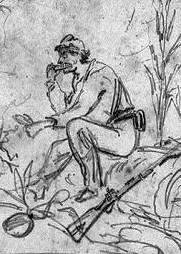
Sketch of soldier eating

Sketch of a soldier eating. Image courtesy of Library of Congress Prints and Photographs Division

(Text (c) The Provincial Archives of the Daughters of Charity and the author, Denise Gallo)

The Sisters’ accounts of events before Gettysburg often echo each other but clearly the most retold incident involved Sr. Mary Jane Stokes and the Community’s bread. On a visit back to Emmitsburg in 1886, she was asked to retell what she had witnessed during the Union encampment in 1863. “Nearly in these words,” the Annals narrator notes, she told the story: “The soldiers made their appearance here, as well as I can remember about three in the afternoon. We were going down to the barn, Sr. Camilla, the Treasurer, and I, to see about them there, when we turned around, and here was a whole pack of them at the house behind us. The poor fellows looked half-starved, lank as herrings, and barefoot. They were on their way to the Gettysburg battle. Well, the Sisters were cutting bread, and giving them to eat as fast as they came for it, all the evening, and I was afraid there would be no bread left for the Sister’s supper. However, they had supper, and plenty. After supper, I belonged to the kitchen Sisters, I went to Mother Ann Simeon, and told her I didn’t know what the Sisters would do for breakfast next morning, for they would have no bread. Then I went to see, and the baking of the day was there. I did not see it multiplied, but I saw it there.”

Two other Sisters also offered accounts of this episode. “And now occurred a singular fact,” recounted Sr. Marie Louise Caulfield, “worthy of record since it gives another instance of the sweet Providence of God even watching over, and supplying the wants of our Community when those wants grow out of the necessities of our Masters. This fact is related by Sister Stokes, the Sister then in charge of the farm. As squad after squad succeeded each other and all going away liberally supplied, she knew that the ordinary quantity of bread baked for the Community could not suffice for such a disbursement and went to the bake house to see if anything was there for the Sisters’ breakfast. To her surprise ‘the baking of the day was yet untouched.’ The Sisters had been feeding this vast concourse out of the ordinary portion prepared for themselves!”

Sr. Camilla O’Keefe noted: “An offering of refreshments to the men was very acceptable. Then the supper or a good lunch for the men was got ready by the Sisters, some set to cutting the bread, others making the coffee. Whilst the Sister in charge of the bread in serving out so much said to the others, I fear we will run short for the supper & breakfast for the house. So she ran over to the bake house to see what bread might be there and to her great surprise found they had all the baking of that day on hand. She could hardly believe her eyes and thought the bread must have multiplied.” Both Sisters were present when Sr. Mary Jane first reported the event in 1863 and also would have been in Emmitsburg when she retold it in 1886.

Examining the event today, the temptation is obvious – this unexpected appearance of bread surely must be a reiteration of the multiplication of loaves. In fact, the story is often interpreted that way. Yet Sr. Marie Louise only proposes that the bread is “another instance of the sweet Providence of God . . . supplying the wants of our Community.” Sr. Camilla merely states that Sr. Mary Jane thought the bread must have multiplied. The most cautious is Sr. Mary Jane herself who finishes her version with a carefully strong (underlined) disclaimer: “the baking of the day was there. I did not see it multiplied, but I saw it there.” None of the Sisters ever comes close to implying that there was a “miracle” and neither should we. There are many mundane explanations for how the bread came to be there (and we’ll suggest one in the next Bread blog). Insisting on a “miraculous” spin diminishes what actually happened during those days at St. Joseph’s when Vincent’s Daughters created an enveloping charity that fed certain bodies and souls on their way to an uncertain future.

Leave a comment

Filed under Civil War, Emmitsburg, Gettysburg, Provincial Annals

Daughters of Charity helped to build the Washington Monument

Washington Monument under construction

Washington Monument under construction, 1860 (Photo by Matthew Brady, courtesy of the Library of Congress Prints and Photographs Division, Washington DC)

(Photograph [c 1860] from the Brady-Handy Collection in the Prints and Photographs Division of the Library of Congress; Annals text reproduced with permission of the Provincial Archives)

Sometimes when you’re scrolling through documents looking for one thing, you stumble upon the most wonderful gems. For instance, we had no idea that the Sisters of Charity of St. Joseph’s and the students of St. Joseph’s Academy helped to build the Washington Monument! On September 8, 1836, the entry in the Provincial Annals notes that “In the morning a gentleman called with a subscription book for the Washington Monument to be erected in Washington City. No individual permitted to subscribe more than one dollar. Father Hickey subscribed one dollar. The institution twelve and the young ladies twenty for which they gave up their pocket money.” We wondered whether this was some scheme like selling the Brooklyn Bridge, but after doing a little Internet research we discovered that this donation project was legitimate, having been started in 1832 by the Washington National Monument Society. The money raised helped to begin the monument’s design and the cornerstone was laid on July 4, 1848. After fits and starts in construction, the monument finally was opened on Feb. 21 (Washington’s Birthday) in 1885. Now, as the iconic obelisk undergoes repairs for damage caused in the 2011 earthquake, it only seems fitting to call attention to that original $33 donation (not an insignificant sum in its day) that helped to raise the monument in the first place.

Leave a comment

Filed under Education, Emmitsburg, Provincial Annals, St. Joseph's Academy, Washington Monument