
(Images used with permission of the Daughters of Charity Provincial Archives)
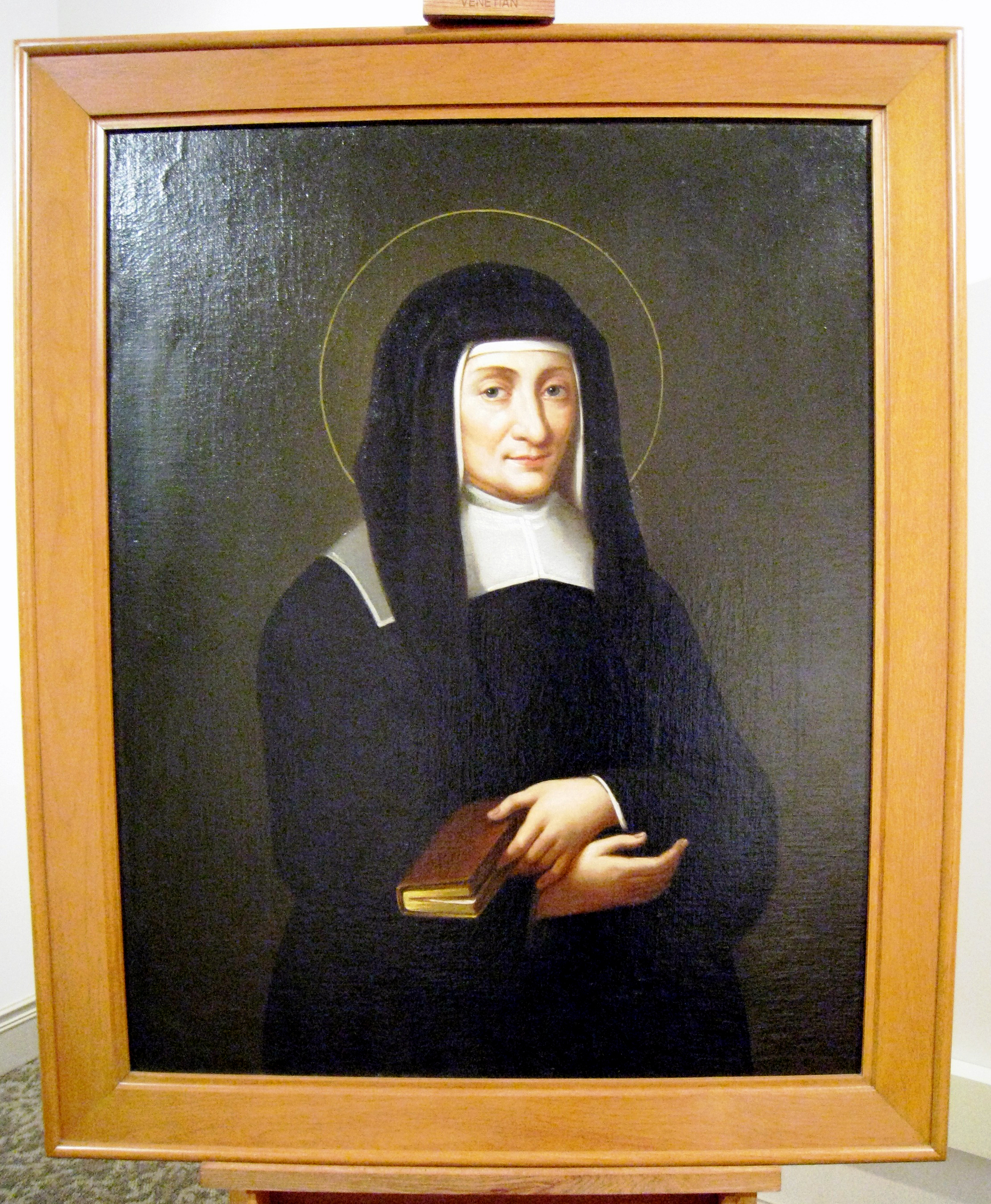
Louise de Marillac

Vincent de Paul
In the 1960s, one Pope was quoted as saying that the Daughters of Charity cornette was an “international symbol of Charity, even as the cross is the international symbol of Faith” (note 1). The Daughters of Charity stopped wearing the cornette habit in 1964 but to this day, no aspect of Daughter of Charity history garners more interest than their traditional attire with its distinctive wide-winged headpiece. Over the next few posts we will delve into the history of the cornette habit: how it originated, how it changed over time, and its relationship to the charism of the Daughters of Charity as envisioned by the founders, Vincent de Paul and Louise de Marillac. Special thanks go to Sister Marie Poole, D.C., for her comments and suggestions about this post.
The Daughters of Charity were founded in 1633. From the beginning the Daughters were a new kind of consecrated life for women. They were not confined to the cloister. Rather the Daughters would serve the poor by going into homes, into hospitals, into the streets, and into parishes. Wherever the poor were to be found, Daughters of Charity would go as well. Writing in 1658, Louise de Marillac said:
“The girls from Saint-Fargeau, who are asking to enter the Company of the Daughters of Charity, must be informed that it is not a religious house; nor is it a hospital from which they will never be moved. Rather they must continuously go to seek out the sick poor, in various places, in any kind of weather and at predetermined times.” [note 2]
Vincent de Paul, also writing in 1658, specified that young women wishing to become a Daughter, that Daughters of Charity needed to “understand very clearly the following things:
(1) that your Company is not a religious Order, nor your house a hospital from which they must not budge, but rather a Society of Sisters who come and go constantly to various places and at definite times for the assistance of the sick poor, regardless of the weather;
(2) that since the Daughters of Charity are servants of the poor, they too are poorly dressed and fed and may not change their white headdress or clothing;
(3) that they must have no other intention in coming to the Company than that of the service of God and the poor …” [note 3]
In addition to being an active form of consecrated life, many of the Daughters of Charity’s earliest members came from a different stratum of society – for the most part they were not from the upper class. Neither Vincent nor Louise describes in detail what the earliest attire looked like. However we know that the earliest attire of the Daughters of Charity was that of the village girls of the Ile de France. The first Daughters of Charity, almost all natives of the environs of Paris, wore the attire they were wearing when they presented themselves to Saint Louise to become members of the Community. Those who came from farther away dressed, for the sake of uniformity, like the village women of the area surrounding Paris.
In a letter to Louise from 1641, Vincent wrote, concerning one of the Sisters, “I don’t know what to tell you about little Jeanne, except that something must be said to her about the temptation of that kerchief. “ [note 4].
In 1646, Vincent wrote to a priest of the Congregation of the Mission,
“I do not approve, any more than you do, of their little ways of arranging their clothing, and it will be a good idea for you to have them moderate this, especially with regard to the veil they wear, unless that is the way it is ordinarily worn by women of the people. I will talk this over with Mademoiselle Le Gras.” [note 5]
The result of Vincent and Louise’s discussion is recorded in a letter from Louise written in August 1646. In the letter Louise wrote that she had suggested, and Vincent had approved, the wearing of a cornette, so that the face could be protected from extreme cold and heat. [note 6]. It took until 1685, 25 years after the deaths of Vincent and Louise, for the cornette to become a standard part of the Daughters of Charity attire and, as we’ll see in Part 3, the earliest cornette did not have wings.
Vincent de Paul insisted on complete uniformity in how the Sisters dressed. The reasons for this insistence on uniformity will be the subject of Part 2.
Notes
References to “CCD” refer to: Vincent de Paul, Correspondence, Conferences, and Documents, edited and translated by Sr. Marie Poole, D.C. and others. (New City Press, 1983-2009)
References to “Spiritual Writings” refer to: Spiritual Writings of Louise de Marillac, edited and translated from the French by Sr. Louise Sullivan, D.C. (New City Press, 1991)
note 1. Sr. Catherine Sullivan, “Swan Song”. Daughter of Charity Magazine, Fall 1964
note 2. Louise de Marillac to Brother Ducourneau. L.561, January 1658. Spiritual Writings, p.583
note 3. Vincent de Paul to the Sister Servant, in Saint-Fargeau. Letter # 2511 [January 1658] CCD, v.7, p.64-66
note 4. Vincent de Paul to Louise de Marillac. Letter # 534, [1641]. CCD: v.2, p.206.
note 5. Vincent de Paul to Antoine Portail. Letter #827, July 25, 1646. CCD v.2, p.675. “Mademoiselle LeGras” refers to Louise de Marillac
note 6. Louise de Marillac to Monsieur Portail. L.148, August 13, 1646. Spiritual Writings, p.162-163.


 docarchivesblog.org