Category Archives: Feast Days

Throwback Thursday: Elizabeth Ann Seton altar

Seton altar

Elizabeth Ann Seton altar prior to the transfer of Mother Seton’s relics in 1968 (Images used with permission of Daughters of Charity Provincial Archives)

For Throwback Thursday and the anniversary of Elizabeth Seton’s canonization coming up this weekend, here is a view of the Seton Altar in what is now the Basilica of the National Shrine of Saint Elizabeth Ann Seton before Mother Seton’s remains were formally transferred there in 1968. Look closely and you’ll see the words “Blessed Elizabeth Ann Seton” above the statue. Mother Seton was canonized on September 14, 1975 by Pope Paul VI.

Elizabeth Ann Seton’s remains have resided in a number of different locations on the Emmitsburg Campus since her death. When she died in 1821 she was buried in St. Joseph’s Cemetery, the original cemetery on our grounds. A headstone marking her original burial spot can still be seen today. In 1845 the Mortuary Chapel, located in St. Joseph’s Cemetery adjacent to Mother Seton’s first burial spot, was built to house her remains; her remains were transferred to the Mortuary Chapel in 1846. The Mortuary Chapel still stands as well. After her beatification in 1963 Mother Seton’s remains were placed in a copper casket and transferred to a niche above the main altar in the chapel at St. Joseph’s Central House. The chapel, located just south of our current campus, is now part of FEMA’s National Emergency Training Center. In 1968 her remains moved for the final time to the Sisters’ Chapel at St. Joseph’s Provincial House, now the Basilica of the National Shrine of Saint Elizabeth Ann Seton. The Basilica is open to the public and can be viewed from 10:00am – 4:30pm every day.

Leave a comment

Filed under Elizabeth Ann Seton, Emmitsburg, Feast Days

Feast of St. Joseph the Worker

White House

White House (used with permission of Daughers of Charity Provincial Archives)


May 1 is the feast day of St. Joseph the Worker. St. Elizabeth Ann Seton had a great devotion to St. Joseph, and this devotion is reflected in the name of the valley in which she settled and the dwellings in which she lived. In a letter to Antonio Filicchi, Mother Seton wrote:

” … You direct your letter to Baltimore, but we are fifty miles from it in the midst of woods and mountains … No wars or rumors of war here, but fields ripe with harvest; the mountain church St.Mary’s, the village church St. Joseph’s, and our spacious log-house, containing a private chapel (our Adored always there), is all our riches … ”
(Elizabeth Seton to Antonio Filicchi, June 24, 1811. Elizabeth Bayley Seton: Collected Writings, ed. Regina Bechtle, S.C. and Judith Metz, S.C. vol. 2, p.189, Letter #6.79)

The “spacious log house” refers to the structure known today as the White House, which Mother Seton named St. Joseph’s House. The Filicchi family helped finance its construction. Mother Seton and her community moved into the house on February 20, 1810, even though it was only partially completed. ON March 19, 1810, the first Mass was celebrated in the new chapel there. This building came to be called the White House after it was later faced with clapboard and painted white.

The White House was originally located east of the chapel which is now located at the United States National Fire Academy and Emergency Management Institute. The house was enlarged about 1826 and again about 1838. After the construction of other buildings, the decision was made to relocate it. In 1845 it was dismantled, board by board, and reassembled by John J. Shorb for $500. Mother Xavier Clark supervised the project and restored the house to the way it looked in Mother Seton’s lifetime. It was moved again in 1917 under the supervision of John T. Bramble of Baltimore because floor boards were rotting from being directly on the ground. A cellar was dug (as in Mother Seton’s time), and the house was again dismantled, reconstructed, and restored on a site about 50 ft. northwest where it now rests (Seton Collected Writings, v.2, p.92, footnote 4)

Leave a comment

Filed under Elizabeth Ann Seton, Emmitsburg, Feast Days, Sisters of Charity Federation, Sisters of Charity of St. Joseph's

Feast of Annunciation, Vow Day for Daughters of Charity

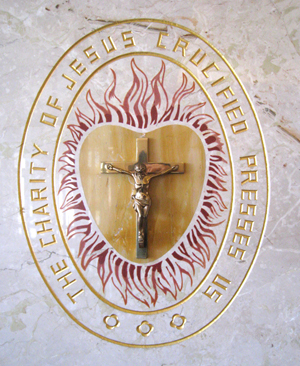
DC Community seal

Daughters of Charity Community Seal, seen in the entrance lobby of the Provincial Archives

(Text used with permission of Sister Mary Gilbart. Image used with permission of Daughters of Charity Provincial Archives)

On March 25th, feast of the Annunciation, over 17,000 Daughters of Charity in 91 countries all over the world will renew their vows.

This will not be simply a renewal of devotion,but, as their vows will have expired the night before, they will be free to choose to commit themselves to God by making them all over again.

Our vows differ from those of most religious in so far as they are annual, taken for one year at a time, and also we take a vow of service of persons who are poor as well as the usual vows of Chastity, Poverty and Obedience.

To understand these differences we must go back in history to the roots of our Company in 17th century France. At that time, there was great poverty, both in the cities and in the country areas which were ravaged by war and disease. St. Vincent de Paul felt urged to respond to the terrible needs he saw daily all around him. He had already organized some ladies into what became known as the Confraternities of Charity. In Paris many of the grand ladies were involved in ministering to the poor. This arrangement went well for a time, but then some ladies grew lax and sent their servants to replace them. This was not good enough for Vincent, and he and his collaborator, Louise de Marillac agonized seeking a solution. Divine Providence provided an answer. A good country girl, Marguerite Naseau, arrived in the capital and offered her services to help in caring for the sick.

Vincent was delighted, and soon other girls followed. At first they helped the Ladies in the parishes, and Louise kept in touch with them. The time came when she saw the need to gather them into a community for their protection and formation. After some initial reluctance Vincent agreed and in 1633 Louise took four girls into her house, and thus was born the Company of the Daughters of Charity.

Vincent and Louise wanted these girls to give their lives totally to God in order to serve Christ in the poor, but they avoided anything that would classify them as nuns. The reason for this was that, at that time religious women were cloistered, and this would prevent the girls being free to go into the hovels of the poor to care for the sick. For eight years there was no question of vows, though the girls lived a life of total dedication in imitation of Christ. Then Vincent tentatively mentioned the possibility to them, and a year later, on the feast of the Annunciation 1642, Louise and four others made perpetual vows of Chastity, Poverty and Service of the Poor. Vows were optional for many years. Louise, with her great devotion to Mary, chose this feast, and saw Mary as a model for her Daughters in her complete surrender to the call of God, and in dedicating her life completely to the person and mission of her Son. After 1660 it became standardized that all the Sisters made annual vows after five to seven years, and this practice has endured to the present day.

One might ask why continue this now, as many religious with perpetual vows are free to come and go. The answer is, I suppose that annual vows for the service of the poor has become part of our identity and is recognized by the Church. The Sisters look forward each year to the Feast of the Annunciation when they must choose to commit themselves all over again, and a great current of renewal sweeps through the entire Company, which is now established in 91 countries all over the world.

Leave a comment

Filed under Feast Days, Formation, Louise de Marillac, Vincent de Paul, Vows