Category Archives: Emmitsburg

New acquisition and two special visitors

Bryan and Anna Russell examine the architect's drawing of the Villa St. Michael Baltimore with Provincial Archivist Dee Gallo

Bryan and Anna Russell examine the architect’s drawing of the Villa St. Michael in Baltimore with Provincial Archivist Dee Gallo (used with permission of the Lynch and Russell families and the Daughers of Charity Provincial Archives)

The Provincial Archives had two very special visitors yesterday: Bryan and Anna Russell, the great grandchildren of William J. Lynch, Jr., a Construction Consultant for many of the building projects that housed the work of the Daughters of Charity across the United States. Bryan and Anna brought with them the architects’ drawing of the former Villa Saint Michael in Baltimore, a retirement facility for senior sisters until 1972 when that ministry was transferred to the current Villa Saint Michael here on the campus in Emmitsburg. Together with Provincial Archivist Dee Gallo, Bryan and Anna carefully studied the details of the drawing; of special interest were the cars and the trees! The Provincial Archives thanks the Lynch family for their generous donation of the rendering. Archives will put it to good use as we continue to document the legacy of the Daughters of Charity in the United States.

Another view of the architect's rendering of the Villa St. Michael in Baltimore (used with permission of Daughters of Charity Provincial Archives)

Another view of the architect’s rendering of the Villa St. Michael in Baltimore (used with permission of Daughters of Charity Provincial Archives)

Leave a comment

Filed under Baltimore, Emmitsburg, Health Care, Ministries

Battle of Gettysburg

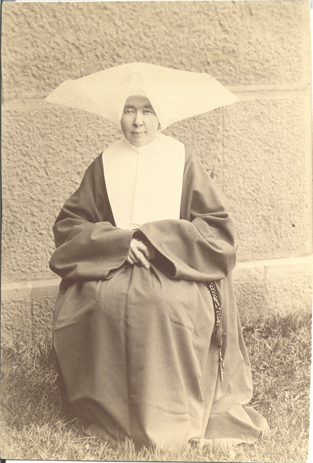
Sister Camilla O'Keefe

Sister Camilla O’Keefe (used with permission of Daughters of Charity Provincial Archives)

This week we mark the anniversary of the Battle of Gettysburg, fought a mere 11 miles from our campus in Emmitsburg, Maryland.

Shortly after midnight on July 2, 1863, the last two remaining brigades, both attached to the Union Army’s Third Corps, left their brief encampment on the grounds of St. Joseph’s Central House to march north to join in the Battle of Gettysburg. The men had been ordered to stay behind lest the fighting, which had commenced the day before, move to the south. It would be only four short days before Fr. Francis Burlando accompanied the first Daughters of Charity into the war-ravaged town. Pictured is Sr. Camilla O’Keefe, one of the sisters who traversed the body-strewn battlefield to begin the task of caring for the wounded and dying in Gettysburg’s makeshift hospitals.

Leave a comment

Filed under Civil War, Emmitsburg, Gettysburg

Feast of St. Joseph the Worker

White House

White House (used with permission of Daughers of Charity Provincial Archives)


May 1 is the feast day of St. Joseph the Worker. St. Elizabeth Ann Seton had a great devotion to St. Joseph, and this devotion is reflected in the name of the valley in which she settled and the dwellings in which she lived. In a letter to Antonio Filicchi, Mother Seton wrote:

” … You direct your letter to Baltimore, but we are fifty miles from it in the midst of woods and mountains … No wars or rumors of war here, but fields ripe with harvest; the mountain church St.Mary’s, the village church St. Joseph’s, and our spacious log-house, containing a private chapel (our Adored always there), is all our riches … ”
(Elizabeth Seton to Antonio Filicchi, June 24, 1811. Elizabeth Bayley Seton: Collected Writings, ed. Regina Bechtle, S.C. and Judith Metz, S.C. vol. 2, p.189, Letter #6.79)

The “spacious log house” refers to the structure known today as the White House, which Mother Seton named St. Joseph’s House. The Filicchi family helped finance its construction. Mother Seton and her community moved into the house on February 20, 1810, even though it was only partially completed. ON March 19, 1810, the first Mass was celebrated in the new chapel there. This building came to be called the White House after it was later faced with clapboard and painted white.

The White House was originally located east of the chapel which is now located at the United States National Fire Academy and Emergency Management Institute. The house was enlarged about 1826 and again about 1838. After the construction of other buildings, the decision was made to relocate it. In 1845 it was dismantled, board by board, and reassembled by John J. Shorb for $500. Mother Xavier Clark supervised the project and restored the house to the way it looked in Mother Seton’s lifetime. It was moved again in 1917 under the supervision of John T. Bramble of Baltimore because floor boards were rotting from being directly on the ground. A cellar was dug (as in Mother Seton’s time), and the house was again dismantled, reconstructed, and restored on a site about 50 ft. northwest where it now rests (Seton Collected Writings, v.2, p.92, footnote 4)

Leave a comment

Filed under Elizabeth Ann Seton, Emmitsburg, Feast Days, Sisters of Charity Federation, Sisters of Charity of St. Joseph's