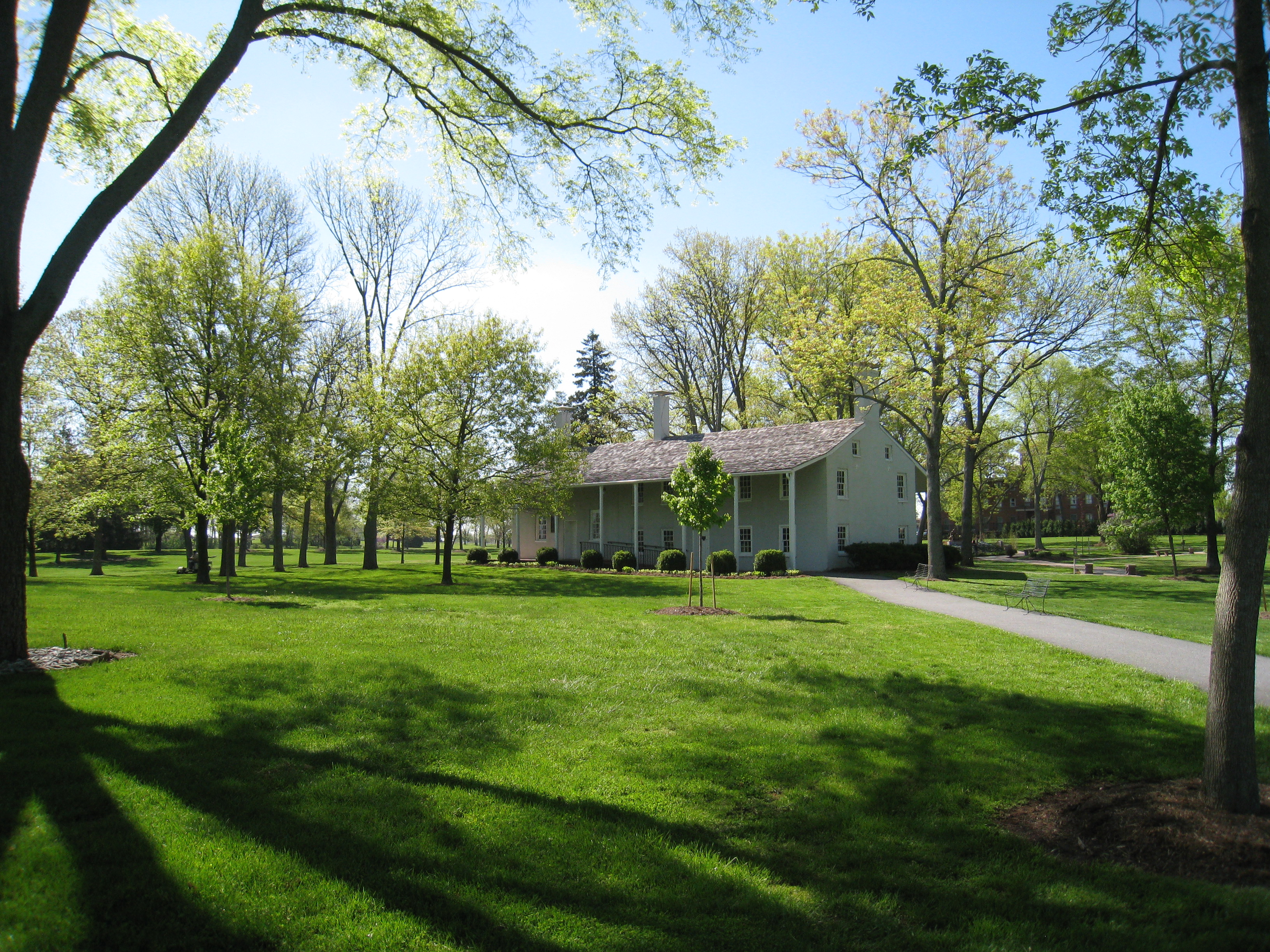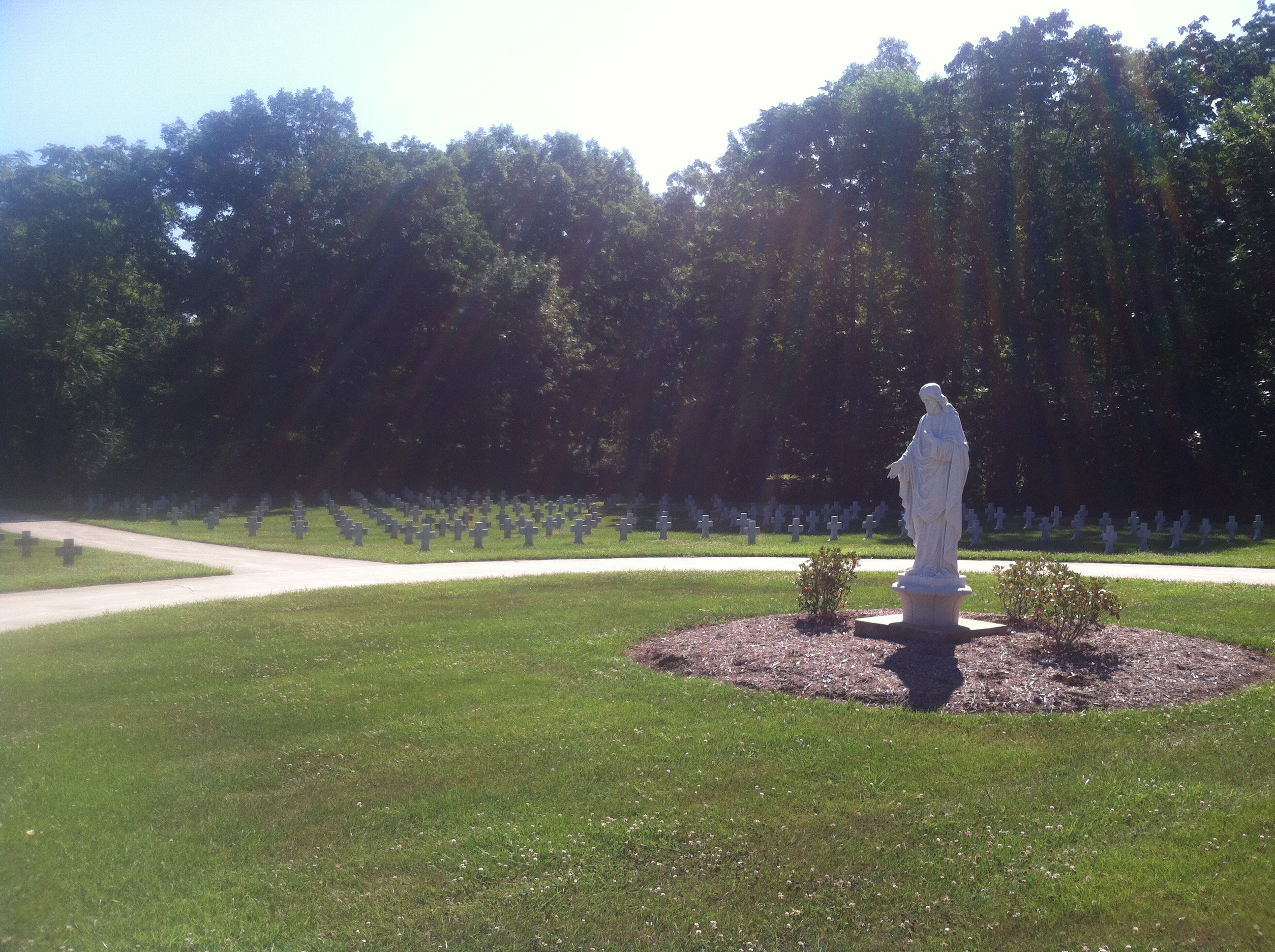
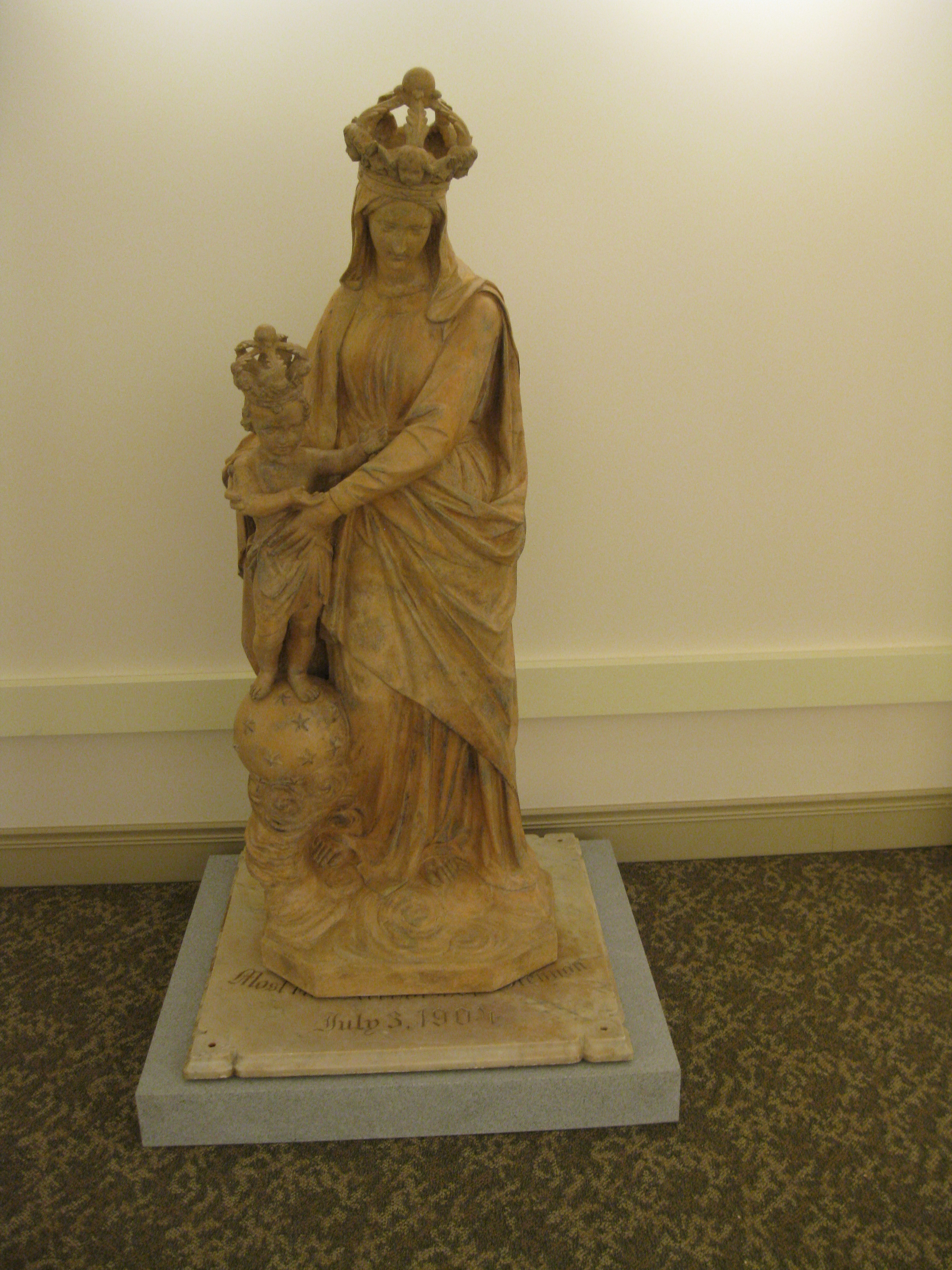
Our Lady of Victory, newly restored, on permanent display in the Provincial Archives
(All images and texts used with permission of the Daughters of Charity Provincial Archives)
“The Central House today possesses a reminder of those perilous days, when it was feared a crucial battle would occur in the immediate environs. According to tradition, Superiors promised that, should the danger be averted, a statue of Notre Dame des Victories would be erected in the Sisters’ grounds. For nine decades, this symbol of Our Protectress and Her Divine Son has been honored in St. Joseph’s Valley”
Sr. John Mary Crumlish, History of the Daughters of Charity (note 1)
Written in 1956, this account refers to what surely is our most famous statue, Our Lady of Victory, now housed in the Provincial Archives. The “crucial battle,” of course, was Gettysburg. Prior to marching north, soldiers from three Union Army Corps had camped on the Sisters’ property, the last two brigades leaving in the early hours of the battle’s second day. Despite the fearful noise, the fighting did not reach the Sisters’ property. According to Sr. John Mary, the vow was fulfilled when the statue of Our Lady of Victory was brought to St. Joseph’s Valley in 1866, “nine decades” earlier than her narrative.
Surely the fulfillment of such a solemn vow would have been heralded with celebration, but firsthand accounts and other primary sources examined in preparation for the 2013 Gettysburg sesquicentennial yielded no mention at all of the statue’s arrival or installation. Was the story factual or, as Sr. John Mary wrote, “tradition?”

Our Lady of Victory in her original location. The site is now part of the National Emergency Training Center.
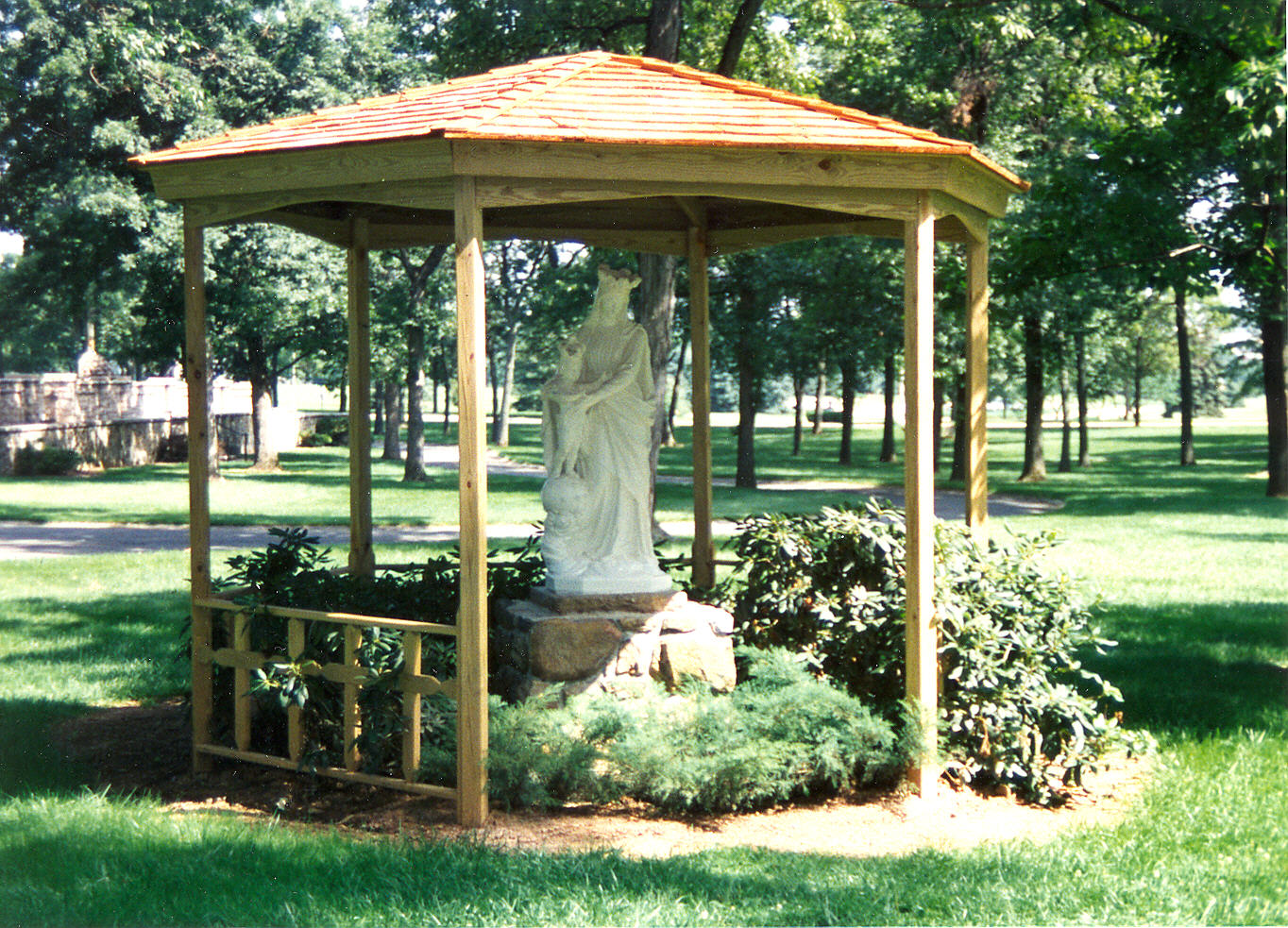
Our Lady of Victory, in her former location near Mother Seton’s White House
Our Lady of Victory
Pope Pius V was the first to give the Blessed Mother the title of “Our Lady of Victory,” instituting devotion to her after Christian forces defeated the Ottomans at the Battle of Lepanto in 1571. In 1629, France’s King Louis XIII honored Mary as “Our Lady of Victories,” dedicating a church in Paris in thanks for his own military successes. By 1837, the church, then a basilica, was the site for the Archconfraternity for the Conversion of Sinners. A special group of American visitors stopped there in 1851.
In 1850, the Sisters of Charity of St, Joseph’s merged with the French Daughters of Charity and to solidify the union, the following year a group of sisters traveled to the Mother House in Paris, led by Sr. Etienne Hall, the first American Superior (or Visitatrix). The Provincial Annals contain the following account from their journey: “We also visited ‘Notre Dame des Victoires,’ where the Arch-confraternity is established.” There they saw “a large handsome statue of our Lady of Victories, and around the statue these words, ‘Ave Maria gratia plena,’ all the letters being formed of gold hearts.” (note 2)
Perhaps while in Paris the American Sisters learned that Mother Mathurine Guerin, Superioress General of the Daughters of Charity in 1681, had special devotion to Mary as Our Lady of Victories and had placed all of the Daughters of Charity under her protection (note 3). Yet beyond this passage about their visit to the basilica, there are no further references to Our Lady of Victory (or Victories) until 1877 when the Provincial Annals records quite simply that the Daughters would process for Benediction to the statue, by then on their grounds (note 4). Without any references to Gettysburg and the sisters’ vow, we have no way of knowing how and when the statue arrived. We do know where it came from: Paris.
Standing five feet high and slightly less than two feet wide, Our Lady of Victory had been displayed on the grounds in various spots over the years. It last stood in a wooden pavilion until it was removed for conservation work in 2009. Molded from terra cotta (making it hollow inside), the statue had been painted white at least twice. Further treatments revealed small flecks of other colors, suggesting that the statue had been painted quite differently in its earlier life. When it was returned to Emmitsburg in 2012, it was installed in one of the galleries in the Provincial Archives where it will remain, protected from damage from the elements.
The statue bears a valuable clue about its provenance. On the back at the base is the name and address of its maker: Raffl, 59 rue Bonaparte, Paris. A manufacturer of statues and church furnishings with an international reputation, Josef-Ignace Raffl was active from 1857 until his firm changed hands in 1903. Raffl also was known for patenting methods of painting his statues; indeed some descriptions match what the statue’s conservator found after removing the white paint. The Daughters did business with Raffl’s studio on at least one other occasion; the Provincial Archives holds another much smaller Madonna which also bears his trademark on its base.
Raffl’s firm comes up frequently in Internet searches in the French legal registries of patent. In 1867, for example, he was given a 15-year legal patent for a process called “polychromie genre brocart,” a type of coloration that would give the effect of brocade on parts of statues that mimicked materials.
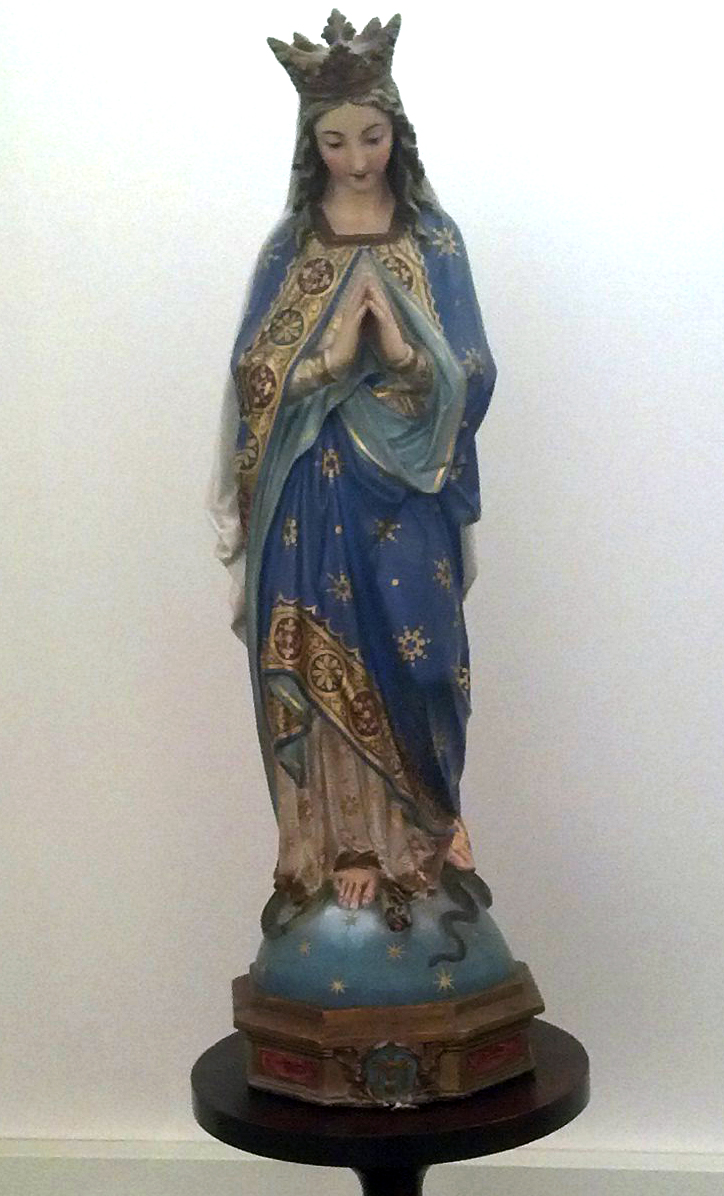
Madonna statue made by Raffl, now in the collections of the Provincial Archives
His work was soon known and valued internationally; in some cases, he was granted exclusive rights to duplicate statues as was the case with the statue of Our Lady of the Sacred Heart. In 1875, the Confraternity of Our Lady of the Sacred Heart in Rome, contracted with Raffl to create all of the statues based on the model of the Roman sculpter Gaspare Capparoni. Such commissions clearly helped develop a worldwide market for Raffl’s works. This could explain why his atelier or studio address seems to suggest an expansion, showing locations at both 59 and 64 rue Bonaparte and later at 39 rue du Four-Saint-Germain.
Without any firm facts, it is at present impossible to link Our Lady of Victory with the events at St. Joseph’s Central House in July of 1863. What we do know allows for a broader period of time in which the statue may have arrived. Our Lady of Victory could have come as early as 1857, Raffl’s first year in business, perhaps as a reminder of the Daughters’ trip to Paris or in honor of their recent merger with France. At the other end of the time span, the Provincial Annals confirm that the statue was definitely on the grounds in 1877.
Perhaps another oft-cited account has been conflated with the story of the Sisters praying for protection from the battle, one found in the memoirs of Maj. Gen. Régis de Trobriand, a French officer serving with the Union Army. Leader of one of the two brigades left behind on July 1, Trobriand (then a Colonel) asked to go up into the bell tower to survey the area. According to his narrative, he found several young Sisters there. “Ah! Sisters, I catch you in the very act of curiosity…. Permit me to make one request of you. Ask St. Joseph to keep the rebels away from here; for, if they come before I get away, I do not know what will become of your beautiful convent.” (note 5). As it was, the battle came no closer than 7 miles from the Sisters’ grounds, the southernmost fighting occurring near what is today the Eisenhower Inn on Business Rt. 15 (still referred to as the Emmitsburg Road).
Perhaps someday we’ll be able to verify Sr. John Mary Crumlish’s account – or perhaps we’ll discover that the statue arrived as a purchase or as a gift, with or without a special reason. Till then, the Provincial Archives’ search for the history of Our Lady of Victory continues.
The public is invited to see Our Lady of Victory each Wednesday from 1 to 4:30 p.m. or by special arrangement.
Although Our Lady of Victory was located on the grounds of St. Joseph’s Central House, its history is not part of the heritage of St. Elizabeth Ann Seton who preceded it by at least 36 years.
By Denise Gallo, Provincial Archivist
Notes
1. See APSL 1-7-2, 1809-1959 History of the Daughters of Charity, Emmitsburg, MD: 1959, p. 90.
2. APSL 1-7-2, Provincial Annals 1851, p. 371.
3. See Sister Elizabeth Charpy’s “Mathurine Guerin 1631 – 1704, continued,” Echoes of the Company, May 1986, p. 193.
4. APSL 7-8-5 Provincial Annals, 1877, p 18.
5. Four Years with the Army of the Potomac, translated by George K Dauchy. Boston: Ticknor and Co., 1889, p. 486.