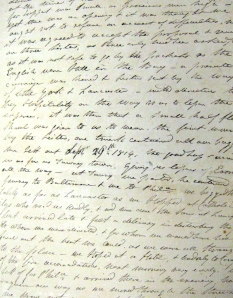
Page from journal of Mother Rose White, with her account of the journey to Philadelphia
(Image and excerpt from the diary of Mother Rose White used with permission of the Daughters of Charity Provincial Archives)
Preparations are well under way for our next exhibit, which will highlight the 200th anniversary of the start of the Sisters’ mission in Philadelphia, the first mission begun by Elizabeth Ann Seton outside of Emmitsburg. The first Sisters of Charity of St. Joseph’s to go to Philadephia were Mother Rose White, Sister Susan Clossy, and Sister Theresa Conroy. Mother Rose White’s journal provides an account of the journey of the first Sisters to Philadelphia. A passage from the diary is below.
Philadelphia application having been made by the trustees of the Orphan Asylum of St. Joseph’s, Philadelphia for Sisters to take charge of the Asylum, allowing $600 a year for the support of Sisters and orphans, the traveling expenses to be paid of the Sisters by the trustees. The call had been submitted to the Archbishop, who desired much that the Sisters should be sent, though it was at the time of the embargo, and the sum offered for the support was small as provisions were high. Yet, there was an opening and it was thought we ought not to refuse on account of difficulties, so it was agreed to accept the proposal and send on three Sisters, as three only had been asked for. As it was not safe to go by the packets, as the English were still in the Bay, a private carriage was hired, and Sisters sent by way of Little York and Lancaster with directions to beg hospitality on the way so as to lessen the expense. It was then that a small half flannel shawl was given us to wear, the first worn by the Sisters. One trunk contained all our baggage. We set out September 29, 1814. The good Superior accompanied us as far as Taneytown, giving us lessons of economy all the way.
At Taneytown we parted, he continued his journey to Baltimore and we to Philadelphia. We begged hospitality as far as Lancaster, as we stopped at Catholic families who received us kindly, and would have done the same at Lancaster, but arrived late and felt a delicacy in disturbing a family to whom we were directed, and whom we would have had to find out the best we could as we were all strangers to the place. We stopped at a hotel and had only to complain of the fine accommodations. Next morning very early we set off for Philadelphia and arrived there in the evening; had to inquire our way as we moved through the streets as we knew not even in what street we were. Frequently the driver, who was a friend of our neighbor Mr. Livers, would give us the reins to hold and would get down from his seat and ask at several houses if they could tell us where St. Joseph’s Asylum was. No one seemed to understand him. He became a little tried and one of the Sisters asking him if he had any information to guide him, “O, no,” said he, “you might as well ask a pig about a holy day as to ask those people where St. Joseph’s Asylum is.”
We drove on without knowing where we were going, but our good angel was with us, for wearied with going up one street and down another when the driver stopped and thought he would ask again, when behold! we were before the door of Trinity Church which was next to the Asylum. The carriage being closed. the housekeeper of the priest, a good French woman named Justine, approached the carriage thinking it was a corpse brought to be buried, when she lifted the curtain as if by inspiration, she said: “Are you not from St. Joseph’s?”
“Yes, who are you?”
“Rev. Mr. Hurley’s housekeeper.”
“Will you tell us where the Asylum is?”
“Yes, you are at its door. Will you get out of the carriage?”
“Yes, if you will tell us where the Rev. Mr. Hurley lives; we have a letter for him.”
“O, you are at a very great distance, but give me the letter; I will take it to him.”
So, off she went with the letter and we entered the Church. With gratitude and love we made our acts of adoration and remained an hour. By this time, Rev. Mr. Hurley arrived, took us to the asylum where the good old matron was making every preparation to leave the house, and we could not enter before she left the furniture being hers, we had to wait until things were provided. The children looked poor and miserable; were going to a free school and running the streets like so many little ragged beggars.



 docarchivesblog.org